Yutokuhinari Shrine
Yutokuhinari Shrine Movies


Basic Information
- Spot Name
- Yutokuhinari Shrine
- Location
- 〒849-1321 1855, Koeda Otsu, Kashima City, Saga Prefecture, Japan
- Access
- From Fukuoka city, take the JR Nagasaki Main Line from Hakata Station to Hizen-Kashima Station (approximately 60 minutes), then about 10 minutes by bus or taxi.
From the Nagasaki Expressway, it takes 30-40 minutes from Takeo IC or Ureshino IC. - Parking
- Approximately 3,000 vehicles.
- Business Hours
- Yutoku Museum: 9:00 AM - 4:30 PM
- Regular Holiday
- None
- Fees
- Yutoku Museum Admission Fee: Adults 300 yen, University and High School Students 200 yen, Junior High and Elementary School Students 100 yen.
- Contact Information
- Phone Number:0954-62-2151
- Official Website
Map
Detailed Information
Yutoku Inari Shrine is located in Furueda, Kashima City, Saga Prefecture. Along with Fushimi Inari Taisha in Kyoto Prefecture and Kasama Inari Shrine in Ibaraki Prefecture, it is often counted as one of the “Three Great Inari Shrines of Japan.” Affectionately known by locals as “Yutoku-san,” the shrine is said to attract approximately three million visitors each year. It is one of Saga Prefecture’s leading places of worship, as well as a popular tourist destination where visitors can enjoy its magnificent shrine buildings, flowers that bloom throughout the seasons, and panoramic views from the inner shrine.
Yutoku Inari Shrine was founded in 1687, during the early Edo period. Its origins date back to Lady Manuko of the Kazanin family, the wife of Nabeshima Naotomo, lord of the Kashima domain in Hizen. She invited a divided spirit of Inari Okami, whose sacred site had been designated by imperial prayer, to be enshrined here. Lady Manuko came from the Kyoto aristocratic Kazanin family and married into the Nabeshima family in 1662. It is said that she later brought here a divided spirit of Inari Okami, who had a deep connection with the Kazanin family, thereby laying the foundation for Yutoku Inari Shrine.
The three principal deities enshrined at Yutoku Inari Shrine are Ukanomitama no Okami, Omiyanome no Okami, and Sarutahiko no Okami. Ukanomitama no Okami is commonly known as Inari Okami and is worshipped as a deity who protects food, agriculture, clothing, food, housing, and everyday life in general. Omiyanome no Okami is known as a deity of artistic and technical skill, as well as good fortune and prosperity. Sarutahiko no Okami is said to have guided the heavenly grandchild during his descent to earth. Based on this tradition, Sarutahiko is worshipped as a deity who protects travelers, navigation, and traffic safety.
Seeking the divine blessings of these deities, people from throughout Japan visit Yutoku Inari Shrine to pray for prosperous business, the prosperity of their households, abundant harvests, plentiful catches of fish, and traffic safety. Many business owners and shopkeepers also come to worship, and the shrine is especially crowded during the New Year and around the first day of the Horse in February. Iwasaki Shrine, located within the grounds, is worshipped as a deity of matchmaking and is also popular among younger visitors praying for a good relationship.
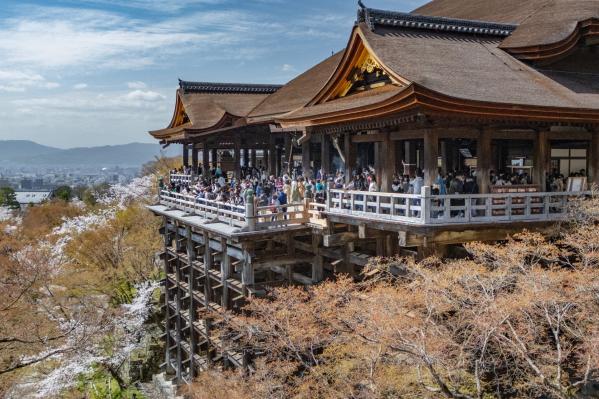
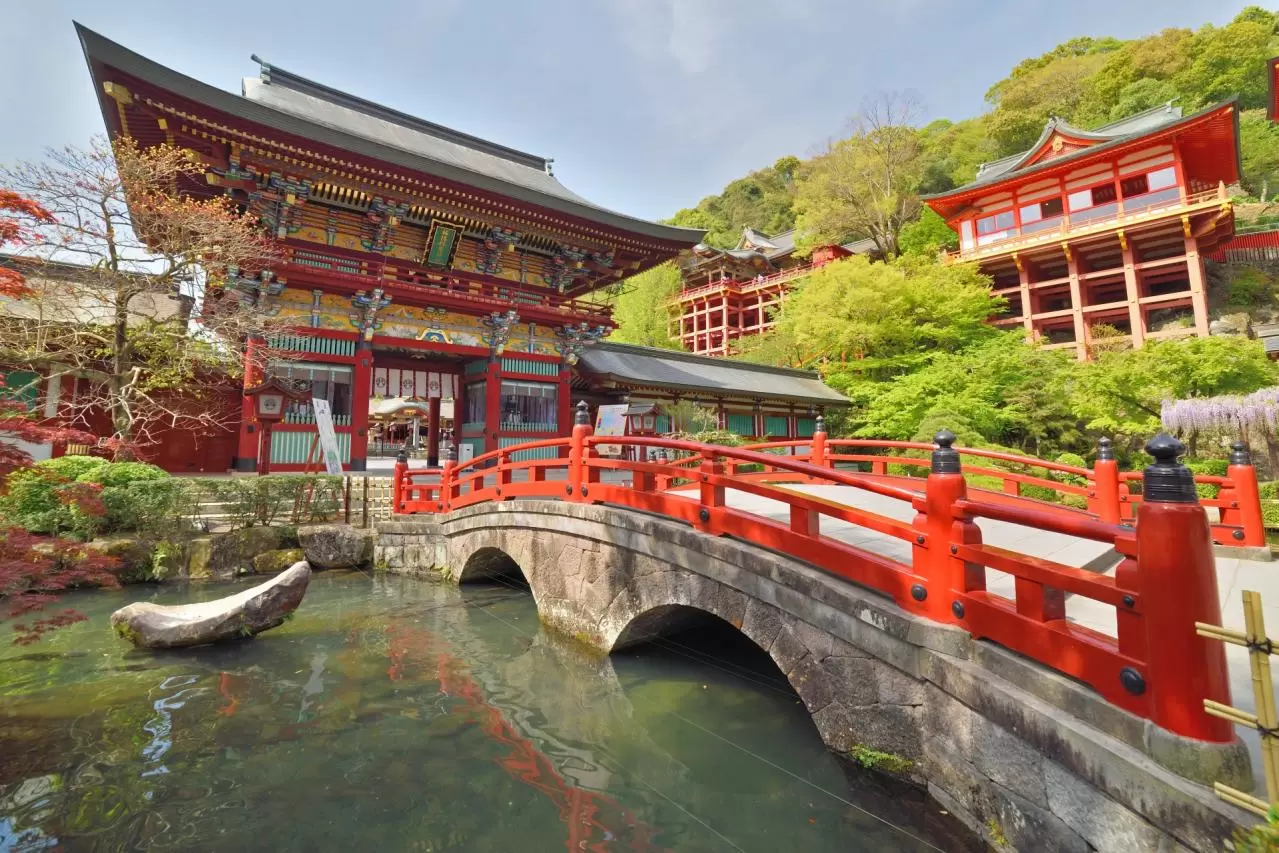
The symbol of Yutoku Inari Shrine is its vivid vermilion main hall, built on the slope of a mountain. Set against Mt. Sekiheki, the main hall features a stage-like structure supported by tall pillars. Its vermilion-painted columns and balustrades, together with brilliantly colored decorations accented with gold, create a spectacular sight. Viewed from below, the building appears to float dramatically on the mountainside. From the stage of the main hall, visitors can enjoy a magnificent view in which the tower gate, kagura hall, sacred pond, and other features of the grounds come together as one harmonious landscape.
The main hall, kagura hall, tower gate, and other principal buildings are finished in vivid colors with fully lacquered surfaces. Because of their grand and splendid appearance, Yutoku Inari Shrine is also known as the “Nikko of Western Japan.” “Chinsei” refers to the western regions of Japan, including Kyushu, and the shrine’s luxurious, vibrantly colored architecture is one of its greatest attractions.
However, the present main hall and other buildings have not survived unchanged from the time of the shrine’s founding. In May 1949, a fire destroyed the main hall, shrine office, and several other structures. Reconstruction then proceeded over approximately 20 years during the difficult postwar period, with the support of many worshippers and local residents. Much of the present main hall and its related facilities was rebuilt and restored while retaining traditional designs. At the same time, the former main hall from the Edo period was relocated to Meifu Shrine within the grounds, preserving an example of the shrine’s architecture from before the fire.
The tower gate that welcomes worshippers at the entrance to the grounds is another major highlight. This imposing gate, centered around the color vermilion, is adorned with elaborate decorations down to the smallest details. Inside the gate are statues of zuishin guardian figures made of Arita porcelain. The walls are decorated with chrysanthemums in the Kakiemon style, peonies in the Imaemon style, and large ceramic panels in the green Kinrande style, incorporating Saga Prefecture’s renowned ceramic culture into the architectural design. A sacred pond lies near the tower gate, creating a beautiful landscape where the vermilion buildings, waterside scenery, and surrounding greenery blend together.
Visitors reach the main hall by climbing a flight of stairs. Beneath the stage of the main hall stands Iwasaki Shrine, where Iwasaki Okami is enshrined. Known for blessings in matters of love and marriage, Iwasaki Shrine attracts many worshippers praying for a good match. Heart-shaped votive tablets are also popular, and countless wishes have been dedicated there. By visiting not only the main hall but also the various subsidiary and branch shrines scattered throughout the grounds, visitors can experience the diverse forms of faith that have been associated with Yutoku Inari Shrine.
Proceeding along the mountain path beyond the main hall, visitors enter the approach to the inner shrine, where vermilion torii gates continue one after another. The sight of the many gates creates the mystical atmosphere characteristic of Inari shrines and makes this a popular photography spot. Because the approach includes steep slopes and stone steps, those planning to visit the inner shrine are advised to wear comfortable, slip-resistant shoes. The stone steps and mountain paths can become slippery in rainy weather, so visitors should take particular care with their footing.
Meifu Shrine, located partway along the approach, enshrines Meifu Okami. Meifu Okami is believed to be the spirit of the white fox, the divine messenger of Inari Okami. The present building of Meifu Shrine was used as the main hall from 1804 to 1933 before being relocated to its current location. It is a historically significant structure.
The building of Meifu Shrine features intricate carvings that preserve the characteristics of Shinto architecture from the Edo period. Because of its historical and architectural value, it has been designated an Important Cultural Property by Saga Prefecture. Comparing the present main hall, splendidly rebuilt after the fire, with Meifu Shrine, the former main hall, allows visitors to sense the architectural changes and long history of Yutoku Inari Shrine.
Continuing farther up the mountain, visitors arrive at the inner shrine. The route from the main grounds to the inner shrine involves considerable distance and elevation gain, making it more like a short mountain hike than a casual stroll. From the area around the inner shrine, visitors can look out over central Kashima and the surrounding mountains. When weather and visibility are favorable, views toward the Ariake Sea can also be enjoyed. Walking up the mountain through successive vermilion torii gates and then taking in the expansive scenery after worshipping is a uniquely appealing experience at Yutoku Inari Shrine.
Yutoku Inari Shrine is also known as a place where visitors can enjoy flowers throughout the year. In winter, wintersweet, winter peonies, and plum blossoms bloom, while in spring, cherry blossoms color the shrine grounds and the area around the approach-side shopping street. The combination of vermilion shrine buildings and delicate cherry blossoms creates a brilliant scene filled with the atmosphere of spring. After the cherry blossoms, azaleas, wisteria, and peonies come into bloom, followed in early summer by Japanese irises and hydrangeas. In autumn, trees such as Japanese maples turn vivid colors, creating beautiful scenery as the autumn leaves contrast with the vermilion shrine buildings.
Higashiyama Tsutsuji Garden in the outer grounds is particularly famous as a spring destination. So many azaleas cover the slopes that the area is said to offer “50,000 azaleas at a glance,” with red, white, and pink flowers blooming all at once. From the high ground, visitors can look out over the azaleas, the buildings of Yutoku Inari Shrine, and the scenery of Kashima. A wisteria trellis stands at the foot of the azalea garden, while the flower gardens of Higashiyama Park also offer seasonal displays of cherry blossoms, rapeseed flowers, cosmos, and other plants. The Japanese garden within the shrine grounds likewise offers a variety of plants throughout the year, including winter peonies, plum blossoms, and hydrangeas.
A variety of festivals and Shinto ceremonies are held at Yutoku Inari Shrine throughout the year. Among the best known are the Hatsu-uma Festival, held on the first Day of the Horse in February, and the autumn grand festival known as Ohitaki, held on December 8. The Hatsu-uma Festival has a deep connection with Inari Okami, and many worshippers visit to pray for prosperous business, household prosperity, and other blessings.
Ohitaki is a festival expressing gratitude for the divine spirit that descended from the mountain to the rice fields during the spring festival, completed its work with the autumn harvest, and returns to the mountain. It also carries the meaning of a memorial and ritual of pacification. During the ceremony, the sacred fire before the deity is transferred to torches and used to ignite a structure called “the mountain,” made by stacking large and small pieces of wood and surrounding them with green bamboo. The sight of the great flames rising into the night sky is immensely powerful and has become one of the defining scenes of winter at Yutoku Inari Shrine.
It is believed that standing in the warmth of this sacred fire can cure illness and cleanse people of sins and impurities committed unknowingly. The ceremony also expresses gratitude for the harvest and includes prayers for good health, happiness in the coming year, and the arrival of spring. On the day of the festival, amazake made from newly harvested rice offered before the deity may be served to visitors, drawing large crowds.
The Yutoku Museum, adjacent to the shrine grounds, displays relics associated with Yutoku-in, sacred treasures passed down at Yutoku Inari Shrine, armor and helmets of successive lords of the former Kashima domain, art swords, ceramics, paintings, and more. Works of Kashima Nishiki, a traditional craft of Kashima, are also featured. Visiting the museum along with the shrine allows visitors to deepen their understanding not only of the shrine’s history but also of the Kashima domain and the region’s artistic and craft traditions. In addition to its permanent exhibits, the museum sometimes holds special exhibitions, such as displays of famous swords or Kashima Nishiki, depending on the season.
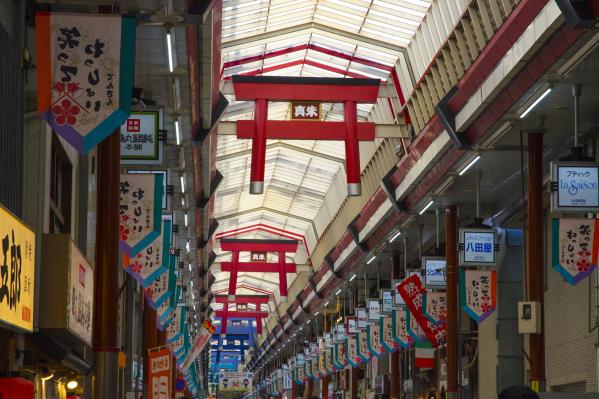
A roughly 300-meter-long approach-side shopping street stretches in front of the shrine. Restaurants and souvenir shops line the street, offering opportunities to enjoy a meal or shop after worshipping. Sweets such as the famous Inari yokan, along with local specialties, are sold here, allowing visitors to experience the traditional atmosphere of an old pilgrimage destination.
Yutoku Inari Shrine is far more than a place to simply admire splendid shrine buildings. Its many attractions come together in layers: the Inari faith passed down since the Edo period; the main hall, which tells the story of the shrine’s recovery from fire; Meifu Shrine, which preserves Edo-period architecture; the vermilion torii gates leading to the inner shrine; seasonal flowers; and the region’s ceramic and craft traditions. Whether visitors come to pray for prosperous business or traffic safety, or to enjoy history, architecture, nature, traditional culture, or photography, Yutoku Inari Shrine is one of Saga Prefecture’s foremost destinations.
Saga Tourist Attractions
View List
Rainbow Pine Grove
Niji no Matsubara is one of Japan's three great pine forests, stretching approximately 4.5 km along the coastline of Karatsu City in Saga Prefecture, and it has been...

Takeo City Library and Historical Museum
Takeo City Library and Historical Museum is a new-style facility operated by Culture Convenience Club (CCC), integrating a library, bookstore, and cafe. Since its re...

Yoshinogari Historical Park
Yoshinogari Historical Park is a national park where visitors can experience Japan's Yayoi period, located on about 54 hectares of beautiful hills straddling Kanzaki...

Hiyono Sato Okuwatayama
The secret kiln village of Okawauchi-yama is located in Imari City, Saga Prefecture, and was known during the Edo period as the official kiln of the Nabeshima family...


Nanatsugama
Nanatsugama is a scenic spot in the Kanmon Straits designated as a national natural monument. It features a magnificent natural formation created by the erosion of b...

Karatsu Castle
Karatsu Castle is a historic castle located in Karatsu City, Saga Prefecture, Japan. This castle was built by Terasawa Shimanokami Hirotaka, a retainer of Toyotomi H...

Mifuneyama Rakuen
Mifuneyama Rakuen is a magnificent garden located in Takeo City, Saga Prefecture, created by Lord Nabeshima Shige Yoshin 1845. Spanning a vast area of 150,000 tsubo,...