Nanatsugama
Nanatsugama Movies


Basic Information
- Spot Name
- Nanatsugama
- Location
- 〒847-0135 Yakataishi, Karatsu City, Saga Prefecture
- Access
- 30 minutes by taxi from JR Chikuhi Line Karatsu Station
60 minutes by car from Nagasaki Expressway Taku IC
Approximately 30 minutes by car from Karatsu city center - Parking
- Approximately 50 vehicles.
- Business Hours
- Free to visit; sightseeing boat operates from 9:30 AM to 4:30 PM.
- Fees
- Sightseeing Cruise Marine Pal Yanagikubo
TEL: 0955-82-3001
Departing from Yanagikubo Port every hour, you can enjoy a scenic tour of Nanatsukama lasting 40 minutes.
(Subject to cancellation in bad weather)
Fees / Nanatsukama sightseeing boat "Ikamaru": Adults (middle school students and above) 2,000 yen, Children (elementary school students) 1,000 yen. - Contact Information
- Phone Number:0955-74-3355
- Official Website
Map
Detailed Information
Nanatsugama is a scenic site along the Genkai Sea coast in Yakatateishi, Karatsu City, Saga Prefecture. Over many years, waves eroded the basalt cliffs jutting out into the sea, creating a unique landscape where seven sea caves line the coast. Its official designation as a cultural property is “Yakatateishi no Nanatsugama,” and it was designated a national natural monument on October 8, 1925. Combining magnificent coastal scenery with geological significance, it is one of Karatsu’s most representative natural attractions.
The name “Kama,” meaning “cauldron” or “kiln,” is said to come from the way the caves in the cliffs resemble a row of cooking stoves or cauldrons. The coast is covered with basalt featuring well-developed columnar and platy joints, and seven sea caves have formed along these fractures. The combination of basalt joints and multiple caves creates a rare landscape and is one of the reasons Nanatsugama is highly valued as a natural monument.
The basalt that makes up the cliffs of Nanatsugama is volcanic rock formed from magma that rose from underground. When high-temperature lava and similar materials cool and solidify, regular fractures develop as their volume decreases. When these fractures cause the rock mass to resemble a bundle of numerous columns, the formation is called “columnar jointing.”
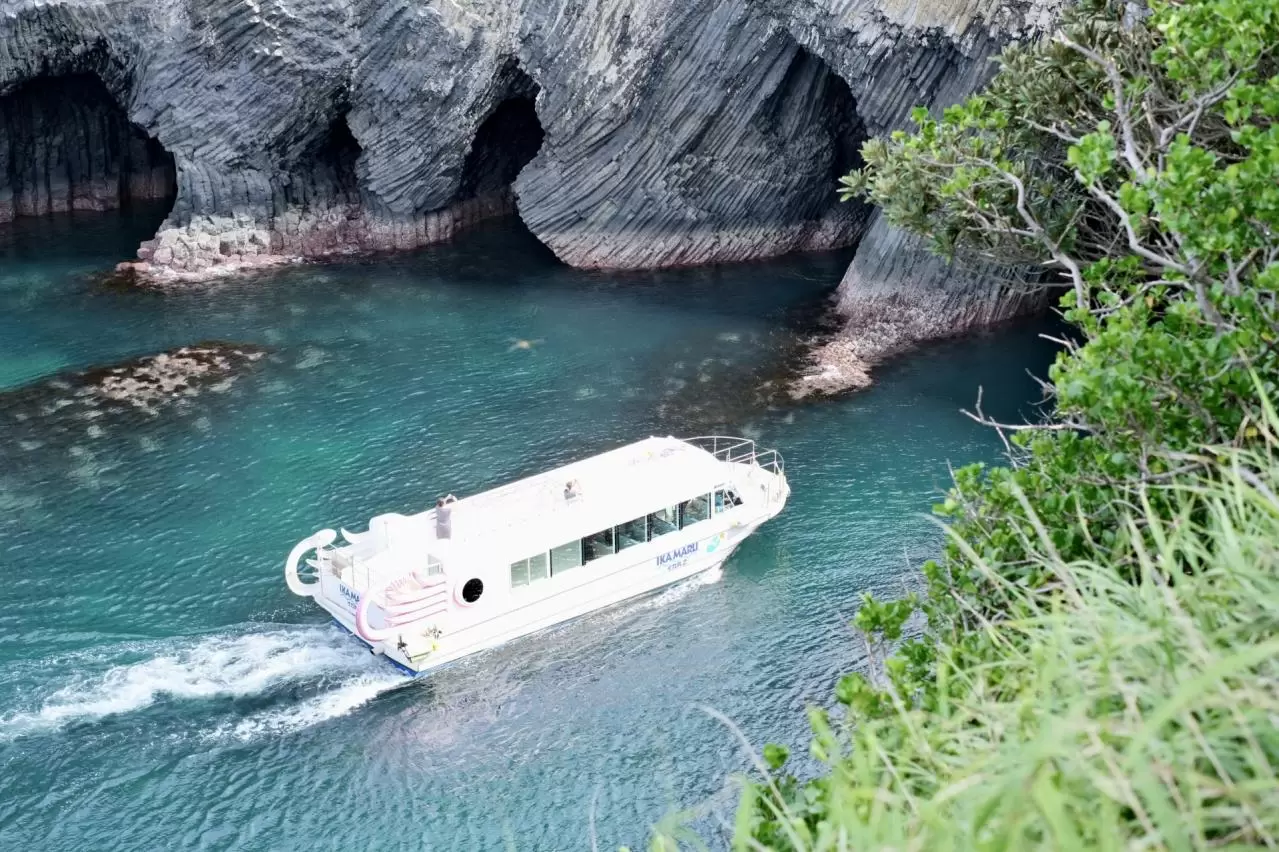
At Nanatsugama, visitors can observe countless basalt columns with polygonal cross-sections arranged across the cliffs. They may look like a wall built by stacking blocks of stone, but they were created by the natural cooling process. The lower parts of the cliffs feature relatively thick, vertically oriented columns, while in the upper sections, thinner columns extend diagonally or horizontally. The shape and direction of the rock surfaces vary from place to place.
Joints in rock are areas that are more easily eroded than their surroundings. Waves from the Genkai Sea repeatedly entered these cracks and gradually wore away the basalt over many years. As a result, sea caves formed, extending deep into the cliffs. Weathering and erosion caused by waves, tides, wind, and rain continue today, meaning that Nanatsugama remains a landform that is still being shaped by the forces of nature.
Of the seven caves, the one near the center is the largest. Its entrance is said to be approximately 3 meters wide and its depth about 110 meters. Seawater flows into the cave, and the sound of the waves echoes off the rock walls. Approaching it from the sea nearly head-on emphasizes the depth of the dark cave and the height of the cliffs, creating a powerful impression quite different from viewing it from land.
The southernmost cave passes all the way through to the opposite side of the rock wall, forming a natural stone gate. Each sea cave differs in size and shape, reflecting differences in the direction of the joints, the condition of the rock, and the way the waves struck the cliffs, all of which affected the progress of erosion.
One of the most popular ways to enjoy Nanatsugama is to view it from the sea aboard a sightseeing boat. The Nanatsugama sightseeing boat, “Ika-maru,” operates from Yobuko Port. Cruising across the Genkai Sea, passengers can observe the cliffs, columnar joints, and sea caves up close. With its friendly squid-inspired design, the boat is a popular tourist activity representative of Yobuko.
The sightseeing cruise usually takes about 40 minutes. Departing from Yobuko Port, the boat heads toward Nanatsugama while passengers enjoy views of the Genkai Sea and the coastline lined with columnar joints. One of the boat tour’s special attractions is the ability to view the cave entrances directly from the front, which is difficult from land. When wave, wind, and tidal conditions are favorable and safety is confirmed, the boat may even enter the largest sea cave.
If the boat is able to enter the cave, passengers can see basalt columns looming overhead and on both sides, as well as the blue sea and sunlight outside from within the dark cave. The sound of the waves and the boat’s engine echoes off the rock walls, allowing visitors to experience the power of nature not only visually but also through sound.
However, entry into the caves is determined based on the day’s waves, wind, tide levels, and other conditions. Even when the sightseeing boat is operating, it may not be able to enter the caves, and the cruise itself may be canceled in severe weather. Departure times, fares, and the number of services may also change, so it is advisable to check the official information provided by Marinepal Yobuko, the boat operator, before boarding.
Nanatsugama can also be viewed from land. The upper part of the cliffs is an open grassy area with walking trails and observation decks. The vivid green grassland, deep blue Genkai Sea, and dark basalt cliffs form a beautiful contrast, and on clear days visitors can enjoy a grand coastal panorama. It is also possible to look down on the sightseeing boats traveling across the sea and appreciate the immense scale of the ocean and cliffs.
As visitors walk along the trails, the appearance of the rocky shore and sea changes depending on the viewpoint. On calm days, the surface of the sea may appear blue or emerald green, while on rougher days, powerful white spray crashes against the cliffs. From spring through early summer, the grassland becomes especially lush, while autumn is a pleasant season for walking in the refreshing sea breeze.
At the same time, visitors must take care around the cliffs. Strong winds can blow in from the sea, and the walking trails may become slippery when it rains. It is extremely dangerous to cross fences or “Do Not Enter” signs and approach the edge of the cliffs. Visitors should not become so absorbed in taking photographs that they neglect their safety, and should view the site only from designated trails and observation decks. Comfortable, slip-resistant shoes are recommended, and visitors should avoid forcing themselves to continue in strong winds or bad weather.
The area around Nanatsugama is also known as a fishing spot because of its varied tidal currents and seafloor topography. However, rocky areas present dangers such as high waves, sudden changes in tide level, and falls. Visitors should not leave designated paths to descend beneath the cliffs or fish without adequate equipment. Those who fish should check local regulations and sea conditions and prepare safety equipment such as a life jacket.
At the northern tip of the cape stands Dokizaki Shrine, which enshrines Empress Jingu. According to a local tradition associated with Empress Jingu’s legendary “conquest of the Three Han states,” as described in ancient chronicles, the empress threw earthenware vessels at this location when she prayed for victory. Although the story has not been historically verified, it is one of the legends handed down in connection with maritime transportation and local religious beliefs. At Nanatsugama, visitors can experience not only the natural scenery but also the history and legends associated with the area.
Free parking and restrooms are available near Nanatsugama, and visitors can walk from the parking lot along a trail to the observation decks. Those using public transportation can take a local bus from central Karatsu or other areas to the Nanatsugama Iriguchi bus stop, then walk to the site. The walk from the bus stop to the viewing area is said to take approximately 30 minutes, and bus services are limited, so visitors should check the route and timetable in advance.
Nanatsugama is close to Yobuko and can be combined with visits to the Yobuko Morning Market and local squid restaurants. Since the sightseeing boats depart from Yobuko Port, popular itineraries include taking a cruise after exploring the morning market or enjoying Yobuko’s famous squid dishes after the boat tour. Visitors traveling by car from central Karatsu can also combine the trip with visits to Karatsu Castle and Nijinomatsubara Pine Grove.
The greatest appeal of Nanatsugama is that it allows visitors to observe two natural phenomena at once: basalt created by ancient volcanic activity and the erosion caused by the sea over countless years. As lava and similar materials cooled, columnar joints formed, and waves from the Genkai Sea eroded the cracks, creating the seven sea caves. The scenery, in which black basalt, blue sea, white waves, and green grassland come together, resembles a vast work of art created by nature.
Viewing the entire site from the land-based observation decks and approaching the cliffs and caves by sightseeing boat offer distinctly different experiences. Walking across the grassland provides expansive views of the Genkai Sea, while a boat ride allows visitors to experience up close the height of the cliffs, the depth of the sea caves, the power of the waves, and the intricate forms of the columnar joints. Offering geology, scenery, legends, and maritime sightseeing all in one place, Nanatsugama is a natural landmark well worth visiting as part of a Karatsu–Yobuko tour.
#Superb view/Scenic spot #Coast/Cape/Island #Sightseeing boat/vehicle
Saga Tourist Attractions
View List
Rainbow Pine Grove
Niji no Matsubara is one of Japan's three great pine forests, stretching approximately 4.5 km along the coastline of Karatsu City in Saga Prefecture, and it has been...


Mifuneyama Rakuen
Mifuneyama Rakuen is a magnificent garden located in Takeo City, Saga Prefecture, created by Lord Nabeshima Shige Yoshin 1845. Spanning a vast area of 150,000 tsubo,...

Karatsu Castle
Karatsu Castle is a historic castle located in Karatsu City, Saga Prefecture, Japan. This castle was built by Terasawa Shimanokami Hirotaka, a retainer of Toyotomi H...

Hiyono Sato Okuwatayama
The secret kiln village of Okawauchi-yama is located in Imari City, Saga Prefecture, and was known during the Edo period as the official kiln of the Nabeshima family...

Takeo City Library and Historical Museum
Takeo City Library and Historical Museum is a new-style facility operated by Culture Convenience Club (CCC), integrating a library, bookstore, and cafe. Since its re...

Yoshinogari Historical Park
Yoshinogari Historical Park is a national park where visitors can experience Japan's Yayoi period, located on about 54 hectares of beautiful hills straddling Kanzaki...

Yutokuhinari Shrine
Yutoku Inari Shrine is located in Kashima City, Saga Prefecture, and is counted among the three great Inari shrines of Japan, along with Fushimi Inari and Kasama Ina...