Rainbow Pine Grove
Rainbow Pine Grove Movies


Basic Information
- Spot Name
- Rainbow Pine Grove
- Location
- 〒847-0022 Higashitaratsu, Karatsu City, Saga Prefecture to Hamadama
- Access
- 5 minutes on foot from JR Chikuhi Line Nijinomatsubara Station.
40 minutes from Nagasaki Expressway Taku Interchange, and 10 minutes from West Kyushu Expressway Karatsu Interchange. - Parking
- 85 cars
- Business Hours
- Open for viewing自由
- Contact Information
- Phone Number:0955-72-4963
- Official Website
Map
Detailed Information
Niji-no-Matsubara is a vast pine grove stretching along the coastline of Karatsu Bay from Higashi-Karatsu to Hamatama in Karatsu, Saga Prefecture. It is known for its scenic combination of the blue waters of Karatsu Bay facing the Genkai Sea, a white sandy beach forming a gentle arc, and lush green pine trees—a landscape known in Japan as “white sand and green pines.” Along with Miho-no-Matsubara in Shizuoka City, Shizuoka Prefecture, and Kehi-no-Matsubara in Tsuruga City, Fukui Prefecture, it is counted as one of Japan’s Three Great Pine Groves and is one of Karatsu’s most representative scenic attractions.
Niji-no-Matsubara was designated a National Place of Scenic Beauty on August 22, 1926, and a Special Place of Scenic Beauty on March 24, 1955. Of Japan’s Three Great Pine Groves, it is the only one designated as a Special Place of Scenic Beauty. The surrounding area is also included within the Genkai Quasi-National Park, and the grove is highly valued not only for its beauty but also as a historic man-made forest and coastal forest.
The reported size of Niji-no-Matsubara varies slightly depending on the survey and the area covered. Karatsu City describes it as approximately 4.5 kilometers long and 500 meters wide. The Forestry Agency, meanwhile, gives figures of approximately 4 kilometers in length, 400 to 700 meters in width, and 210.47 hectares in area. Its total area is equivalent to roughly 45 Tokyo Dome baseball fields, making it the largest of Japan’s Three Great Pine Groves in terms of area. The grove is said to contain around one million pine trees, mainly Japanese black pines.
The history of Niji-no-Matsubara dates back approximately 400 years to the early Edo period. It is said to have begun when Terazawa Shima-no-kami Hirotaka, the first lord of the Karatsu domain, ordered Japanese black pines to be planted on the sand dunes along the coast. At the time, land reclamation and new rice-field development were underway in Karatsu, but strong winds carrying salt spray and blowing sand from the sea were causing serious damage to farmland and crops. The pine trees were therefore planted as a coastal forest to protect the area from wind, salt spray, and blowing sand.
Japanese black pines are relatively tolerant of salty winds and dry conditions, and can grow even in nutrient-poor sandy soil, making them well suited to coastal forests. Their branches and foliage reduce the force of winds blowing in from the sea and prevent sand from being carried inland. Their spreading roots also stabilize the sandy ground and help protect the fields and settlements behind the grove. Although Niji-no-Matsubara is now known as a beautiful tourist attraction, its origins lie in a man-made forest created to protect people’s livelihoods and agriculture.
During the feudal period, Niji-no-Matsubara was designated as an “oyama,” a forest under the direct control of the Karatsu domain, and the cutting of pine trees was strictly prohibited. At the same time, local residents were reportedly allowed to collect fallen pine needles and other materials for fuel in exchange for paying a fixed annual tax. The collected pine needles were used to fuel cooking stoves and baths, as well as kindling for firewood and charcoal.
The custom of regularly removing pine needles and dead branches also helped maintain the grove’s environment. Because fallen leaves did not accumulate thickly on the ground, the soil was prevented from becoming excessively fertile, preserving conditions favorable to Japanese black pines, which prefer nutrient-poor sandy soil. Niji-no-Matsubara is also a cultural landscape that demonstrates the coexistence of people and nature, having been maintained through people’s everyday use of the forest.
During the Edo period, the pine grove is believed to have extended farther west toward the Nishinohama area than it does today. Because of its length, it was called “Nirino Matsubara,” meaning “the Two-Ri Pine Grove,” and one theory holds that this name later changed into “Niji-no-Matsubara.” Another widely known explanation is that the name comes from the way the grove forms a rainbow-like arc along Karatsu Bay. There is no single confirmed theory about the origin of the name, but the beautiful curve formed by the present-day grove along the coastline certainly suits the name “Niji-no-Matsubara,” or “Rainbow Pine Grove.”
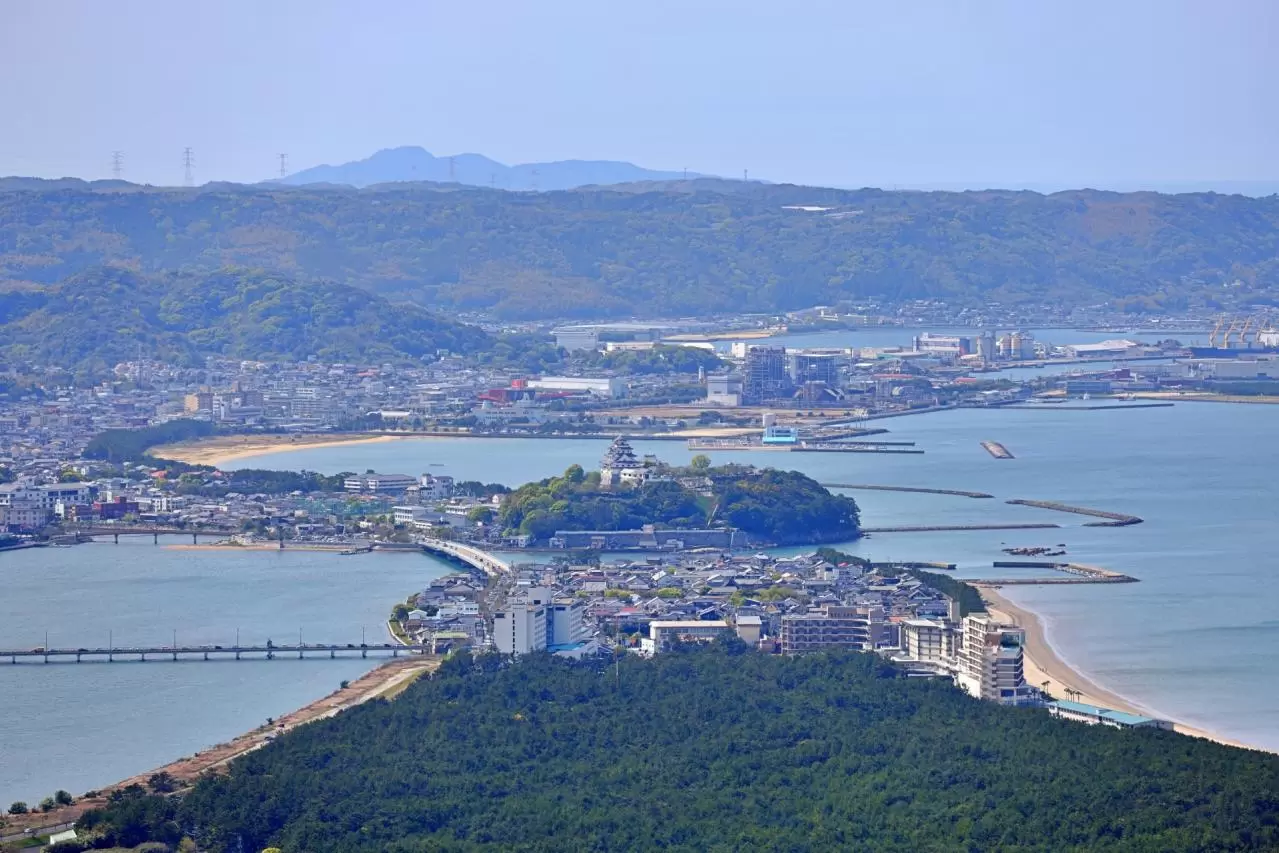
For a broad view of Niji-no-Matsubara, Mount Kagamiyama, which rises to an elevation of 284 meters south of the grove, is highly recommended. From the observation deck on Mount Kagamiyama, visitors can look down over the pine grove as it forms a gentle arc along Karatsu Bay. The view of the blue bay, white sandy beach, and deep green pine forest stretching out like bands is one of the most representative sights of Niji-no-Matsubara.
The observation deck also offers views of the islands scattered across Karatsu Bay and the city of Karatsu. On clear days, a magnificent panorama unfolds, and Karatsu Castle can sometimes be seen in the distance. Visitors can enjoy a uniquely Karatsu landscape in which the sea, pine grove, and castle town come together.
Walking through the grove offers a different kind of appeal from the view seen from Mount Kagamiyama. Walking trails run through the forest, allowing visitors to enjoy forest bathing while experiencing the fragrance of the pines and the sea breeze. The branches of the Japanese black pines form natural tunnels overhead, while sunlight filtering through the trees casts patterns on the sandy ground.
After being exposed for many years to strong winds and salt from the sea, many of the pine trees have distinctive trunks and branches twisted into unusual shapes. Visitors can enjoy observing the individual forms of the trees as they walk—not only pines that grow straight upward, but also those with branches spreading widely to the sides and those whose trunks curve close to the ground.
From the beach side, visitors can take in the white sand, blue sea, and pine forest up close—the quintessential scenery of white sand and green pines. Depending on the season, one can walk along the shore while listening to the sound of the waves or rest in the shade of the pine trees. However, prefectural and municipal roads run through the grove, so great care should be taken when crossing roads or walking alongside them.
Niji-no-Matsubara is home to animals such as moles and Japanese hares, as well as wild birds including Japanese pygmy woodpeckers, Oriental greenfinches, and long-tailed tits. Mushrooms characteristic of pine forests, such as matsutake-like Rhizopogon species and Suillus bovinus, can also sometimes be found. The Forestry Agency also lists the spring cicada, which appears from spring through early summer, among the organisms inhabiting the grove. When walking through the area, it is important to respect the natural environment by refraining from collecting or damaging animals, plants, mushrooms, or other living things.
Niji-no-Matsubara is also known as a place associated with numerous legends. The best known are the “Seven Mysteries of Niji-no-Matsubara.” Although they are generally referred to as seven mysteries, the stories are sometimes counted as eight. Their content, order, and wording vary somewhat depending on the region and source. They should be enjoyed as legends and folk tales passed down over many years rather than as established historical facts.
The first is “The Pine Grove Where Cicadas Do Not Sing.” According to legend, when Toyotomi Hideyoshi was traveling toward Nagoya Castle, which served as a base for his invasion of Korea, he scolded the cicadas singing loudly in the pine grove nearby, saying that they were noisy. It is said that the cicadas stopped singing from that time onward.
In reality, cicadas such as the spring cicada do inhabit Niji-no-Matsubara. The story is therefore a legend told as though Hideyoshi’s words possessed extraordinary power. Moreover, the pine grove is thought not to have reached its present size during the period when Hideyoshi passed through the area, before it was completed under Terazawa Hirotaka. This is another reason to regard the story as a later tradition rather than a historical fact.
The second is “The Glowering Pine.” According to the tale, when Hideyoshi passed through the grove, tall pine trees blocked his view of the surroundings, so he glared at them and ordered them to become shorter. Ever since then, it is said, some pines in the grove have grown outward rather than upward. In the grove, many pines have distinctive shapes with trunks and branches spreading sideways as a result of the strong winds and salt from the sea. The legend is thought to have developed by linking these natural features with the story of Hideyoshi.
The third is the legend of “The Spear-Hanging Pine,” said to be the tree against which Hideyoshi’s soldiers leaned their spears. The fourth is the supposed mystery that almost all of the approximately one million trees in the grove are Japanese black pines. The background to this story is likely the history of planting and maintaining Japanese black pines, which are well suited to the harsh coastal environment.
The fifth concerns a well near the coast that is said to produce fresh water without any salt despite its proximity to the sea. However, this is a story passed down as one of the seven mysteries and does not mean that the well water is still safe to drink today.
The sixth states that the center of the grove lies on the extension of a line connecting the eastern tip of Takashima Island in Karatsu Bay with the western tip of Kamishima Island. The seventh is the legend that there are no snakes in the grove because of a wish made by Suwahime, enshrined at Suwa Shrine in Hamazaki. Since it has not been confirmed that snakes are entirely absent from the area, visitors should take the same precautions as they would in any natural environment while walking through the grove.
As an eighth mystery, some versions include a story about a “Root-Rising Pine” that once stood, or can still be seen, on the Senninzuka sand dune near the mouth of the Matsuura River. A root-rising pine refers to a tree whose roots have become prominently exposed above the ground after the sand around its base has been shifted by wind or other forces. However, the present condition and exact locations of the Spear-Hanging Pine and the Root-Rising Pine associated with these legends may be difficult to determine.
These seven or eight mysteries arose from a combination of natural phenomena, landforms, unusual tree shapes, local beliefs, and the history of Toyotomi Hideyoshi and Nagoya Castle. By searching for legendary sites and strangely shaped pines while walking through the grove, visitors can enjoy a historical exploration that goes beyond simply admiring the scenery. Those wishing to visit the sites associated with the seven mysteries should check local information boards and the latest walking maps.
Niji-no-Matsubara has not remained unchanged for the past 400 years. As people’s lifestyles changed over time, household fuels shifted from firewood and charcoal to oil and gas beginning around the 1960s. As a result, residents had fewer opportunities to collect pine needles and dead branches. Fallen leaves began to accumulate in the forest, enriching the soil and allowing broad-leaved trees and undergrowth to flourish.
Japanese black pines are suited to bright, nutrient-poor sandy soil. When the condition of the soil changes because of accumulated leaves and other organic matter, the environment becomes less suitable for the pines, making it difficult to maintain the landscape of white sand and green pines. This has made clear the important role that the pine-needle gathering once carried out routinely by local residents played in maintaining the pine forest.
Other challenges include pine wilt disease, the spread of broad-leaved trees and undergrowth, and illegal dumping. To address these issues, the national government, Saga Prefecture, Karatsu City, local residents, businesses, schools, civic organizations, and others are working together on restoration and conservation activities, including gathering pine needles, removing weeds, collecting fallen branches, cleaning the forest, and protecting and cultivating pine trees. Since fiscal 2009, efforts to restore the landscape of white sand and green pines and pass Niji-no-Matsubara on to future generations have been carried out in earnest.
Niji-no-Matsubara is not simply a natural forest containing a large number of pine trees. It is a historic man-made forest created alongside the Karatsu domain’s development of new farmland and maintained as people made use of pine needles and other materials in their daily lives. While serving the disaster-prevention function of protecting farmland and settlements from salty winds and blowing sand, it now also plays important roles as a cultural heritage site, tourist resource, place for forest walks, and habitat for wildlife.
From the magnificent view overlooking the grove from Mount Kagamiyama and the forest bathing experience of walking through tunnels of pine trees to the landscape of white sand and green pines seen from the beach and the locally transmitted Seven Mysteries, Niji-no-Matsubara offers a wide range of attractions. Shaped by approximately 400 years of interaction between people and nature, this pine grove is a valuable scenic site symbolizing the history and character of Karatsu—one that deserves to be protected and passed down to future generations.
#Townscape/Bikan Historical Quarter #flowers/plants #Coast/Cape/Island
Saga Tourist Attractions
View List
Yutokuhinari Shrine
Yutoku Inari Shrine is located in Kashima City, Saga Prefecture, and is counted among the three great Inari shrines of Japan, along with Fushimi Inari and Kasama Ina...

Mifuneyama Rakuen
Mifuneyama Rakuen is a magnificent garden located in Takeo City, Saga Prefecture, created by Lord Nabeshima Shige Yoshin 1845. Spanning a vast area of 150,000 tsubo,...

Karatsu Castle
Karatsu Castle is a historic castle located in Karatsu City, Saga Prefecture, Japan. This castle was built by Terasawa Shimanokami Hirotaka, a retainer of Toyotomi H...

Nanatsugama
Nanatsugama is a scenic spot in the Kanmon Straits designated as a national natural monument. It features a magnificent natural formation created by the erosion of b...

Takeo City Library and Historical Museum
Takeo City Library and Historical Museum is a new-style facility operated by Culture Convenience Club (CCC), integrating a library, bookstore, and cafe. Since its re...

Hiyono Sato Okuwatayama
The secret kiln village of Okawauchi-yama is located in Imari City, Saga Prefecture, and was known during the Edo period as the official kiln of the Nabeshima family...


Yoshinogari Historical Park
Yoshinogari Historical Park is a national park where visitors can experience Japan's Yayoi period, located on about 54 hectares of beautiful hills straddling Kanzaki...