Yoshinogari Historical Park
Within the park, there are plentiful facilities where visitors can experience the culture and history of the Yayoi period. Restorations of watchtowers and pit dwellings, elevated granaries, and exhibition rooms showcase valuable artifacts, including bronze swords and glass beads excavated from the site, as well as other tools and decorative items from ancient times, allowing for a deep engagement with ancient Japanese life and culture.
The park is divided into four zones that recreate the atmosphere of the Yoshinogari ruins. Depending on the season, visitors can enjoy wildflowers such as Umanoashigata and Benibana, as well as ancient plants like Ooga Hasu. Additionally, experiential programs and special exhibitions are held throughout the year, providing new discoveries with each visit.
The Yoshinogari ruins are a precious archaeological site that illustrates the cultural development of Japan during the Yayoi period, and its significance has been recognized as a special historic site by the government. Moreover, Yoshinogari Historical Park offers various events, such as illumination events and hot air balloon competitions, giving visitors opportunities to enjoy ancient history.
This park plays a vital role in preserving the Yoshinogari ruins, a cultural heritage of Japan, and in disseminating information both domestically and internationally about the allure of the Yayoi period. Yoshinogari Historical Park is a must-visit place for those interested in Japan's history and culture.
Yoshinogari Historical Park Movies


Basic Information
- Spot Name
- Yoshinogari Historical Park
- Location
- 〒842-0035 1843 Tate, Yoshinogari-cho, Kanzaki-gun, Saga Prefecture
- Access
- 15 minutes walk from JR Nagasaki Main Line "Yoshinogari Park Station" and "Kanzaki Station". About 5 minutes from Nagasaki Expressway "Higashisefuri Interchange".
- Parking
- Large vehicles: 111 spaces (East entrance: 80 spaces, West entrance: 20 spaces, North entrance: 11 spaces) - 1050 yen
Regular vehicles: 1080 spaces (East entrance: 540 spaces, West entrance: 310 spaces, North entrance: 230 spaces) - 310 yen - Business Hours
- 9 AM to 5 PM (from June to August: 9 AM to 6 PM)
- Regular Holiday
- December 31st, the third Monday of January, and the following day.
- Fees
- Adults (15 years and older) 460 yen, Seniors (65 years and older) 200 yen, Free for middle school students and younger.
- Contact Information
- Phone Number:0952-55-9333
- Official Website
Map
Detailed Information
Yoshinogari Historical Park is one of Japan’s leading historical parks, extending across Kanzaki City and Yoshinogari Town in Kanzaki District, Saga Prefecture. The park was developed to preserve the Yoshinogari Site, known as the largest-scale moated settlement site from Japan’s Yayoi period, while conveying the lifestyle and social structure of the period in an accessible way through reconstructed buildings, exhibitions, and hands-on programs. The park’s central theme is “Hearing the Voices of the Yayoi People.” Rather than simply viewing the remains, visitors can actually walk through the settlement where people lived during the Yayoi period and experience their way of life and culture at close range.
The park is located on a tongue-shaped hill extending southward from the Sefuri Mountain Range. It is a historical park developed as an integrated complex consisting of a national government park with a planned area of approximately 54 hectares and a prefectural park established around it, with a total planned area of approximately 117 hectares. The first-phase area opened in April 2001, and development has continued in stages while incorporating the results of ongoing excavations and research. According to the official website, as of July 2024, approximately 106.9 hectares were open to the public, comprising about 52.8 hectares of national government park and 54.1 hectares of prefectural park. Because of its immense size, the park offers not only opportunities to explore historical remains but also nature observation and recreational activities.
Full-scale archaeological excavations at the Yoshinogari Site began in 1986 in connection with Saga Prefecture’s plans to develop an industrial park. As a result, numerous remains were discovered one after another, including pit dwellings, buildings constructed on raised-floor foundations, structures believed to have been watchtowers, and buildings thought to have been associated with rituals. In addition, approximately 3,100 jar-coffin burials and a tumulus believed to be the grave of an influential person from the middle Yayoi period were discovered.
The settlement was surrounded by an outer moat estimated to have extended for approximately 2.5 kilometers. Its highly defensive structure, equipped with moats and palisades, suggests that Yoshinogari was not merely a small village but served as the central settlement of a “kuni,” a regional polity that brought surrounding settlements together. The great academic value of the Yoshinogari Site lies in the way it allows visitors to trace the process by which rice-growing communities gradually expanded and developed into a society with social distinctions and political institutions.
Valuable burial goods, including bronze swords with hilts and glass tubular beads, were excavated from the tumulus. The pale-blue glass beads, in particular, are ornaments made using advanced technology. According to the official explanations, the raw materials used for the beads originated in China, but it has not been conclusively determined whether the beads themselves were made in Japan or China. These artifacts suggest that Yoshinogari was influenced by extensive networks of exchange connecting it with the Korean Peninsula and the Chinese mainland.
The “Artifacts Excavated from the Tumulus at the Yoshinogari Site in Saga Prefecture,” including bronze swords with hilts and glass tubular beads, have been designated Important Cultural Properties of Japan. The Yoshinogari Site itself has been designated a Special Historic Site of Japan and is protected as an extremely important archaeological site for understanding the formation and development of ancient Japanese society.
When the results of the excavations were widely reported in 1989 and the site was opened to the public, Yoshinogari attracted nationwide attention as a site reminiscent of Yamatai, the kingdom described in the Chinese historical text *Gishi Wajinden*—the “Account of the Wa People” in the *Records of Wei*. However, it has not been established that the Yoshinogari Site was Yamatai itself. Even so, its moats and palisades built to guard against external enemies, facilities for keeping watch, and districts where influential figures are thought to have conducted political and ritual activities provide fascinating clues for imagining the society of Wa described in the *Gishi Wajinden*.
The park is broadly divided into four zones: the Entrance Zone, Moated Settlement Zone, Ancient Forest Zone, and Ancient Field Zone. The Entrance Zone is the starting point for exploring the park. It contains information facilities, restaurants, shops, and other amenities where visitors can learn about the park’s highlights and plan their route. Since the grounds are extremely extensive, it is advisable to obtain a park map upon entering and decide on the destinations and viewing order in advance so that the park can be explored efficiently.
The Moated Settlement Zone, the central area of the park, contains reconstructed pit dwellings, raised-floor warehouses, watchtowers, palisades, gates, and other structures based on the results of archaeological excavations and research. Among the most important areas are the North Inner Enclosure and the South Inner Enclosure.
The North Inner Enclosure is believed to have been the place where important rituals, political ceremonies, discussions, and other activities for the “kuni” of Yoshinogari took place. Surrounded by two moats, it was a special district with a large Main Ritual Hall reconstructed at its center. Inside the hall, meetings and rituals conducted by influential figures are recreated using figures and other displays. It is a place where visitors can gain a concrete understanding of how closely politics and ritual were connected during the Yayoi period.
The South Inner Enclosure is believed to have been the area where successive kings and other powerful figures who ruled Yoshinogari lived. Because it was surrounded by moats and palisades and had restricted entrances, it is thought not to have been a place where ordinary people could come and go freely. Pit dwellings, watchtowers, and other structures have been reconstructed within the enclosure, allowing visitors to sense that different areas within the settlement were assigned according to social status and function.
The reconstructed watchtowers are believed to have been used to monitor approaching people from outside and the movements of enemies. From the elevated platform, visitors can look out over the surroundings and clearly see that the Yoshinogari Site was built on a hill with sweeping views of the broad Saga Plain. The watchtowers are thought to have been important facilities both for observing potential enemies and for keeping track of conditions in the surrounding area.
Pit dwellings were buildings constructed by excavating the ground, erecting pillars, and placing a roof over them. At the park, hearths and bed-like features have also been recreated, helping visitors imagine more concretely how Yayoi people lived. Many of the dwellings from the later Yayoi period identified at the Yoshinogari Site were rectangular, in contrast to the round dwellings that were common earlier—a difference that has attracted particular attention. Once inside a reconstructed building, the living space feels more spacious than one might expect from its exterior, making it easier to imagine the daily life of families at the time.
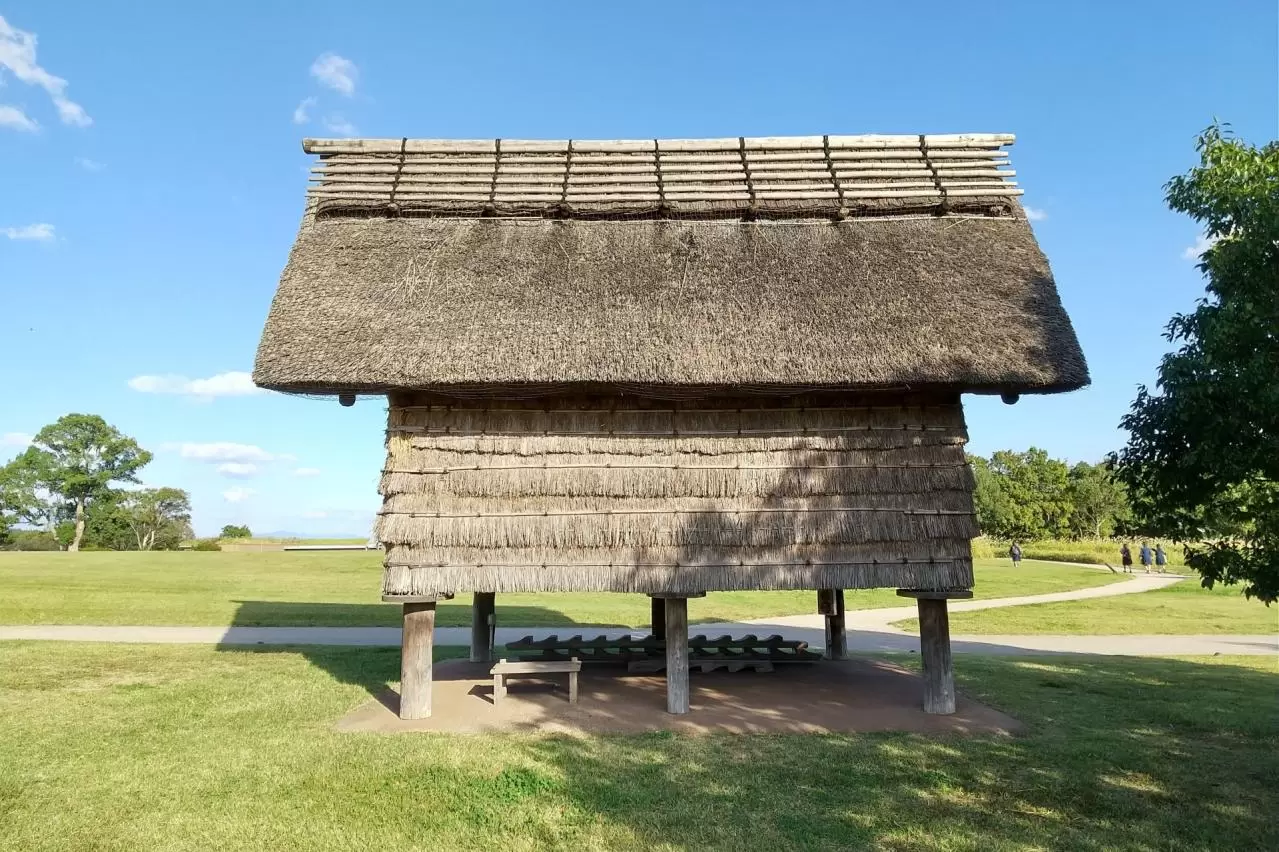
Raised-floor warehouses were buildings elevated above the ground. This structure was well suited to protecting grain and other goods from moisture and pests, and the remains of a large group of warehouses have been identified at Yoshinogari. These warehouses may have stored not only food for daily life but also seed rice, weapons, military provisions, and other supplies important to the settlement and its “kuni.” They are also thought to have functioned as a market where goods were collected and exchanged. At the park, this area has been reconstructed as “Warehouses and Market.”
The North Tumulus was built from the early to middle part of the middle Yayoi period and is believed to have been a special tomb for high-status individuals, such as successive kings and chiefs of the Yoshinogari settlement. Inside, jar coffins are displayed in a condition close to that at the time of excavation while the actual remains are carefully preserved. Fourteen jar coffins were discovered in the North Tumulus, and some contained bronze swords with hilts, glass tubular beads, and other objects.
The large scale of the tumulus, which differed from ordinary graves, together with the valuable burial goods, demonstrates that Yayoi society had social distinctions and powerful leaders. The rows of jar-coffin burials, in which numerous jar coffins are arranged in lines, are also valuable remains that convey a burial tradition characteristic of northern Kyushu, particularly Saga and Fukuoka prefectures.
The exhibition facilities display actual artifacts, replicas, models, and other materials, including bronze swords, molds for casting bronze objects, jar coffins, pottery, stone sickles, and stone arrowheads. Viewing these artifacts after walking through the reconstructed settlement allows visitors to understand more concretely what tools were used inside the buildings and what kinds of work people performed. The exhibits convey how Yayoi society was sustained by a wide range of activities, including farming, hunting, warfare, rituals, and trade.
In the Ancient Forest Zone, efforts are being made to recreate a forest landscape similar to the natural environment of the Yayoi period, using information about plants obtained through archaeological excavations and other sources. Visitors can learn how people in ancient times used a variety of forest resources, such as timber and nuts, in their daily lives. The park also features seasonal plants, including spring wildflowers, safflower, Oga lotus, and ancient rice varieties. One of the park’s attractions is that it encourages visitors to look not only at history but also at the natural environment that supported life at the time.
The Ancient Field Zone is a recreational area equipped with wide lawns and playground equipment. In the “Play Field,” children can enjoy a large playground inspired by a watchtower, a roller slide, combination play equipment, and other attractions. The area has been designed to make it easy for families with small children to spend an entire day there, as well as for adults interested in history.
The extensive range of hands-on programs is another major attraction of Yoshinogari Historical Park. Through activities such as making magatama comma-shaped beads, starting fires, crafting stone sickles, and braiding cords, visitors can experience Yayoi-period technologies and knowledge. Programs for making replicas of mirrors, bronze swords with hilts, bronze bells, and the “King of Wa, Friendly to Wei” seal are also sometimes offered, mainly on Saturdays, Sundays, and public holidays. Since the program content, fees, and registration times may change depending on the season, weather, and crowd levels, visitors who wish to participate should check the official website in advance.
In addition, the park hosts special exhibitions, history lectures, seasonal events, and a variety of other activities depending on the time of year, including illuminations and tethered hot-air-balloon rides. Restaurants and shops are also available for meals, breaks, and the purchase of local specialty products and souvenirs. Since the grounds are extremely large, comfortable walking shoes and plenty of time are recommended. Free shuttle buses are available for traveling around the park, but it is advisable to check their operating days, times, and routes in advance.
Yoshinogari Historical Park is more than a place where archaeological remains are simply preserved. By combining the protection of genuine excavated remains with reconstructed buildings, artifact exhibitions, hands-on learning, and the recreation of the natural environment, the park presents Yayoi-period society in a vivid and multidimensional way. Within this vast archaeological site, visitors can experience the process by which rice-growing culture spread throughout Japan, villages grew larger, and “kuni” polities eventually took shape. One of Saga Prefecture’s foremost tourist attractions, the park offers new discoveries and inspires an interest in history not only among those already familiar with the subject but also among children, families, and people encountering ancient culture for the first time.
Saga Tourist Attractions
View List
Mifuneyama Rakuen
Mifuneyama Rakuen is a magnificent garden located in Takeo City, Saga Prefecture, created by Lord Nabeshima Shige Yoshin 1845. Spanning a vast area of 150,000 tsubo,...

Karatsu Castle
Karatsu Castle is a historic castle located in Karatsu City, Saga Prefecture, Japan. This castle was built by Terasawa Shimanokami Hirotaka, a retainer of Toyotomi H...

Takeo City Library and Historical Museum
Takeo City Library and Historical Museum is a new-style facility operated by Culture Convenience Club (CCC), integrating a library, bookstore, and cafe. Since its re...

Nanatsugama
Nanatsugama is a scenic spot in the Kanmon Straits designated as a national natural monument. It features a magnificent natural formation created by the erosion of b...

Yutokuhinari Shrine
Yutoku Inari Shrine is located in Kashima City, Saga Prefecture, and is counted among the three great Inari shrines of Japan, along with Fushimi Inari and Kasama Ina...


Rainbow Pine Grove
Niji no Matsubara is one of Japan's three great pine forests, stretching approximately 4.5 km along the coastline of Karatsu City in Saga Prefecture, and it has been...

Hiyono Sato Okuwatayama
The secret kiln village of Okawauchi-yama is located in Imari City, Saga Prefecture, and was known during the Edo period as the official kiln of the Nabeshima family...