Mifuneyama Rakuen
Mifuneyama Rakuen Movies


Basic Information
- Spot Name
- Mifuneyama Rakuen
- Location
- 〒843-0022 4100 Takeo, Takeo Town, Takeo City, Saga Prefecture, Japan
- Access
- 12 minutes from Takeo Onsen Station on the JR Sasebo Line by JR Kyushu Bus heading to Ureshino Onsen or Kanekoshita, get off at Mifuneyama Rakuen. 10 minutes by car from Takeo-Kitako IC on the Nagasaki Expressway.
- Parking
- 150 cars
- Business Hours
- 8:00 AM to 5:00 PM (closing); during event periods, it may be open until 10:00 PM.
- Regular Holiday
- Open year-round.
- Fees
- Adults: 400 yen, Children: 200 yen (subject to seasonal variation)
- Contact Information
- Phone Number:0954-23-3131
- Official Website
Map
Detailed Information
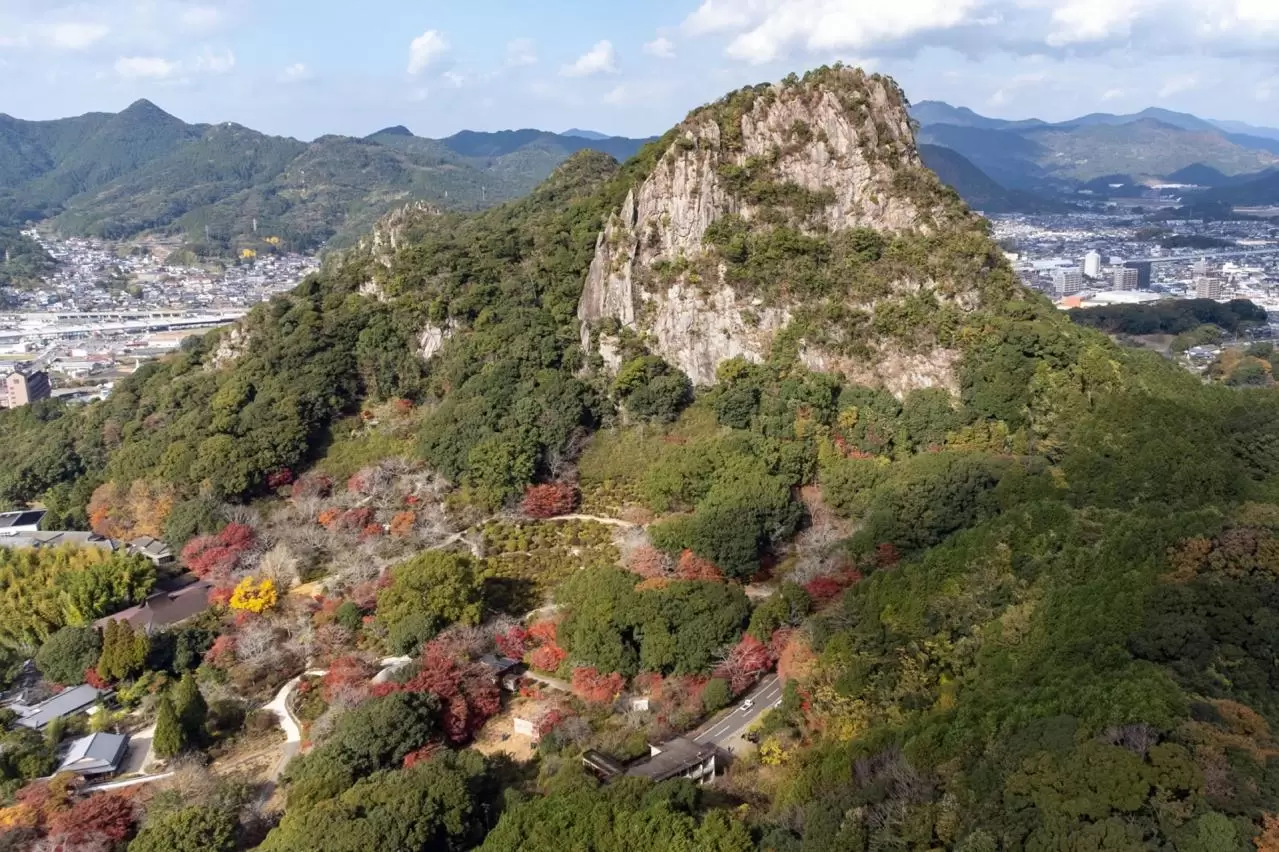
Mifuneyama Rakuen is a magnificent strolling pond garden spread across the southwestern foothills of Mount Mifune, the symbol of Takeo City in Saga Prefecture. Incorporating the sheer cliffs of Mount Mifune as a borrowed landscape, the garden offers harmonious views of ponds, teahouses, walking paths, and flowering trees and plants that change with the seasons. The grounds currently cover approximately 150,000 tsubo, or about 500,000 square meters—an immense area equivalent to roughly ten Tokyo Domes. With cherry blossoms and azaleas in spring, fresh greenery and hydrangeas in early summer, autumn foliage, and bare trees and snowy landscapes in winter, it is one of Kyushu’s finest gardens, displaying a different character in every season.
Mount Mifune is 210 meters high and has a distinctive shape. It is cherished as a symbol of Takeo City. The mountain’s name is said to originate from a legend that Empress Jingū moored her “imperial ship” to the mountain on her return journey from Silla. Its rugged, precipitous cliffs form a vivid contrast with the surrounding greenery and flowers, creating a magnificent landscape reminiscent of a Chinese shanshui painting.
The history of Mifuneyama Rakuen dates back to 1845, in the late Edo period. Nabeshima Shigeyoshi, the 28th lord of the Takeo domain of the Saga domain, spent approximately three years creating the garden as an accompaniment to his villa, completing it in 1845. At the time, it was called “Haginoo-en.” It is believed to have been designed as a garden where visitors could walk around a pond and admire the scenery, with the cliffs of Mount Mifune serving as a borrowed landscape.
Nabeshima Shigeyoshi was born in 1800 and is known as one of the leading figures of Takeo during the final years of the Edo period. He actively adopted Western learning, studied Western-style gunnery under Takashima Shūhan, and promoted the manufacture of Western-style cannons and steamships in the Takeo domain. These pioneering efforts greatly influenced Nabeshima Naomasa, the 10th lord of the Saga domain, who would later be regarded as one of the “Seven Wise Men of Saga.” They are also said to have helped lay the foundation for Saga’s advanced scientific technology and military capabilities at the end of the Edo period.
Shigeyoshi also had a deep interest in art. He studied paintings of the Kanō school and left works under the art name Kaishunsai. It is said that when creating the garden, he invited Kanō-school painters from Kyoto and commissioned them to produce a garden illustration comparable to a modern conceptual rendering. Shigeyoshi’s knowledge of painting and his aesthetic sensibility are believed to have influenced his vision for composing the cliffs of Mount Mifune, the pond, the waterside teahouse, trees, and other elements into a single landscape.
The Mifuneyama Rakuen seen today is not the original garden completed in 1845 preserved at its full size. It is based on the pond garden attached to the villa built during the Edo period, while the grounds were expanded and additional plantings of cherry trees, azaleas, and other varieties were carried out from the Meiji period onward. From the late Meiji period through the early Shōwa period, it developed into the magnificent garden seen today and became widely known as a scenic destination where visitors could enjoy flowers throughout the four seasons.
Mifuneyama Rakuen is highly regarded as an outstanding garden that skillfully incorporates the surrounding natural landscape. On February 22, 2010, it was registered as a Nationally Registered Monument related to places of scenic beauty under the name “Former Nabeshima Residence Garden of the Lord of Takeo, Mifuneyama Rakuen.” It was additionally designated as a Place of Scenic Beauty by Saga Prefecture on April 26, 2019. Its grand composition, featuring the cliffs of Mount Mifune as a borrowed landscape, and its history of expansion from the Edo period through the modern era were recognized as significant in the history of Japanese landscape gardening.
One of the great attractions of touring the garden is that the scenery changes dramatically depending on where you walk and from which angle you view it. There are places where the cliffs of Mount Mifune appear directly ahead, spots where trees can be admired across the pond, and slopes surrounded by flowers, each offering a distinct atmosphere. Visitors can take a leisurely stroll while enjoying the varied views characteristic of a strolling pond garden.
In spring, the cherry blossoms are the first major attraction at Mifuneyama Rakuen. Normally from late March to early April, approximately 2,000 cherry trees—including Somei Yoshino, Ōshima cherry, mountain cherry, and double-flowered cherry trees—come into bloom in succession. The sight of pale pink blossoms enveloping the garden against the rugged rock face of Mount Mifune is truly exceptional. Because the different varieties bloom at different times, visitors can enjoy a diverse succession of cherry blossoms over an extended period.
During the flowering season, flower festivals and nighttime illuminations may also be held. Cherry trees rising against the night sky under the lights and blossoms reflected on the surface of the water create a fantastical landscape unlike that seen during the day. Since the dates and opening hours may vary from year to year, visitors planning to see the nighttime blossoms are advised to check the details in advance.
Following the cherry blossoms, azaleas become the garden’s main attraction. Some 200,000 azaleas, including Kurume azaleas and Hirado azaleas, bloom in shades of red, white, pink, and purple. The most spectacular area is Tsutsuji Valley, a bowl-shaped valley spreading beneath the cliffs of Mount Mifune. The azaleas covering the slopes appear like a vibrant carpet of flowers.
In Tsutsuji Valley, the way the flower colors overlap and the composition with Mount Mifune change depending on the viewing position. From above, the rounded, carefully pruned azaleas form a landscape resembling a gigantic painting. As you walk along the paths and approach the flowers, you can also closely observe the color and form of each individual plant. The azaleas usually reach their peak from around mid-April to early May, although the blooming period varies depending on temperatures, weather conditions, and the varieties grown each year.
In spring, the great wisteria also attracts attention alongside the azaleas. Located near the Haginoo Teahouse, this ancient wisteria tree is estimated to be about 170 years old. Its long, drooping clusters of blossoms fill the surrounding area with a sweet fragrance. Visitors can also enjoy the “spring maples,” when the new leaves of the Japanese maples take on pale green and red hues. The beauty of translucent young leaves, as well as vivid flowers, is one of the special charms of Mifuneyama Rakuen in spring.
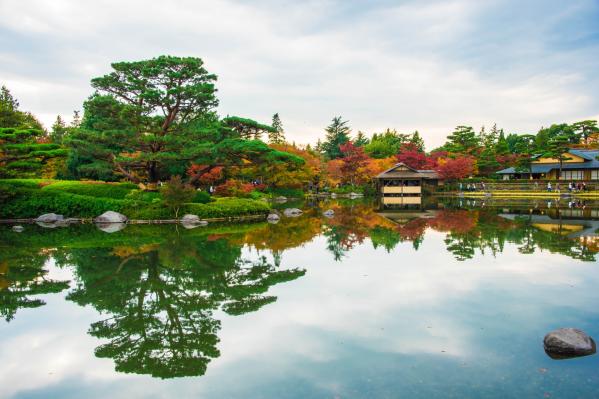
In early summer, satsuki azaleas and fresh greenery add color to the garden, while hydrangeas bloom during the rainy season. Trees and moss wet with rain take on deeper hues, creating a calm atmosphere quite different from that of a sunny day. On days with little wind, visitors may also be able to see “upside-down maples,” in which the surrounding maple trees and fresh greenery are reflected on the surface of Kagami Pond. The garden’s quiet beauty can be enjoyed not only during the peak flowering seasons but also amid the fresh greenery and rains of early summer.
In autumn, Mifuneyama Rakuen draws many visitors as one of Kyushu’s leading destinations for autumn foliage. The garden’s maple and other deciduous trees turn red, orange, and yellow, merging with the cliffs of Mount Mifune and the surface of the ponds to create a magnificent landscape. The autumn foliage viewed across the pond is particularly impressive. On calm, windless days, the colored trees are reflected in the water, producing a scene resembling a symmetrical painting.
The grounds contain numerous places where visitors can enjoy the autumn colors, including an ancient great maple tree estimated to be 170 years old, the vividly colored Tsutsuji Valley, Kaerimuki-zaka, a slope where the scenery changes as you walk and look back, and Kagami Pond. An autumn foliage festival is generally held from around early November to early December, and nighttime illuminations may also be offered. The foliage reflected on the pond under the lights creates a fantastical scene, allowing visitors to enjoy a beauty different from the grand, nature-rich garden seen during the day.
In winter, the grounds are enveloped in a quietness unlike that of the flowering and foliage seasons. The branches of leafless trees and the cliffs of Mount Mifune stand out, making it easier to observe the garden’s underlying terrain and composition. When snow falls, the cliffs, trees, and teahouse may be covered in white, creating a landscape reminiscent of an ink-wash painting. Takeo City is not an area that receives heavy snowfall, so snowy scenery cannot be seen at all times. Nevertheless, Mifuneyama Rakuen covered in snow offers a quiet beauty entirely different from that of the more colorful seasons.
Beside one of the ponds in the garden stands the Haginoo Teahouse, built in the sukiya style. The original garden is believed to have been created so that visitors could enjoy the scenery of Mount Mifune while resting at the teahouse or strolling around the pond. It conveys the atmosphere of the period when the garden was used as part of a private villa, and its harmonious relationship with the surrounding water and trees is particularly striking.
The Haginoo Teahouse may be open to the public for limited periods during events such as the flower festival and autumn foliage festival. When it is open, tea, dango dumplings, zenzai sweet red-bean soup, and other refreshments may be served, allowing visitors to relax while looking out over the garden. The opening dates, hours, and offerings vary depending on the season, so checking in advance is recommended.
In recent years, a new attraction at Mifuneyama Rakuen has drawn considerable attention: its collaboration with the art collective teamLab. In the limited-time exhibition “teamLab: Forest Where Gods Live,” artworks are presented using the forests, massive stones, ponds, waterfalls, and historic buildings in and around Mifuneyama Rakuen.
Rather than substantially altering the natural environment, the works use light, images, sound, and digital technology to reveal the forms and movements of life inherent in each location. The surface of the pond, rock faces, trees, and other elements become part of the artworks, and some pieces change their lights or images in response to visitors’ movements. The fusion of a garden that has continued since the Edo period with contemporary art offers an immersive experience entirely different from a daytime stroll.
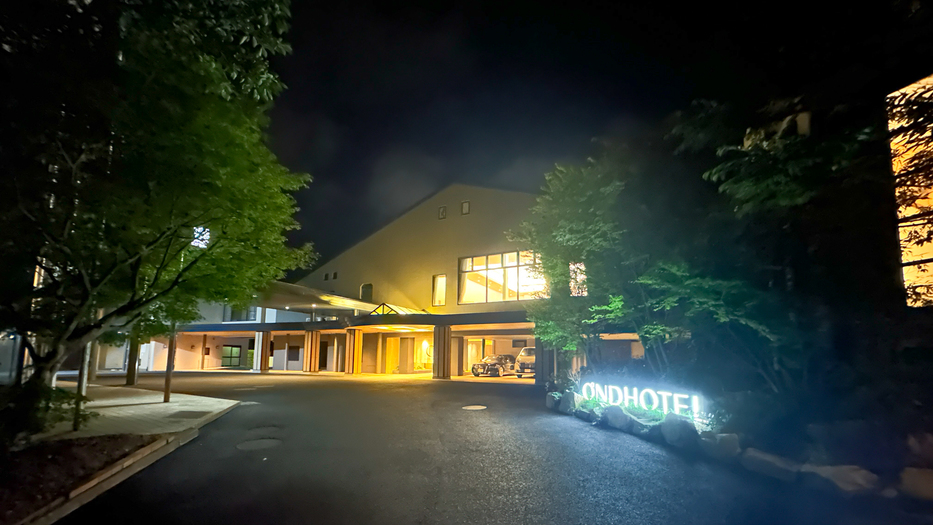
However, “teamLab: Forest Where Gods Live” is not a permanent exhibition; it is an exhibition held for a designated period. The dates, hours, featured works, and admission fees vary from year to year. Some related works may also be displayed inside the adjacent Mifuneyama Rakuen Hotel or other locations, but the conditions for access may differ from those for the exhibition within the garden. Before visiting, it is important to check the latest information on the official website of Mifuneyama Rakuen or teamLab.
The dates, opening hours, and admission fees for the spring flower festival and autumn foliage illuminations may also differ from those during regular periods. Since the peak flowering and foliage seasons vary with the climate each year, checking the blooming information on the official website before visiting will help you enjoy the scenery at its best.
The grounds have considerable changes in elevation, including steep slopes and areas where the footing can become slippery after rain. Comfortable, slip-resistant shoes are recommended, and visitors should allow plenty of time for their walk. Particular care should be taken with footing in rainy weather and at night.
Wheelchairs are available for loan, but the grounds include steep slopes and stairs. Visitors using wheelchairs should tour within reasonable limits accompanied by an attendant. Some routes to the Haginoo Teahouse also include stairs, so it is important to follow the local guidance and choose an accessible route.
In addition, hiking and rock climbing are prohibited in the Mount Mifune area in order to protect the natural environment and scenery and to ensure safety. When visiting Mifuneyama Rakuen, use the designated walking paths and take care not to enter restricted areas.
Mifuneyama Rakuen is more than simply a famous flower-viewing destination. It is a garden that carries on the aesthetic sensibility of Nabeshima Shigeyoshi, the lord of Takeo in the Edo period, where the nature of Mount Mifune, the design of a strolling pond garden, the cherry trees and azaleas added from the modern era onward, and contemporary art come together. Visitors can encounter different attractions throughout the year: brilliant flowers in spring, deep greenery in summer, vivid autumn foliage, and tranquil scenery in winter. It is an essential destination in Takeo, where history, nature, and art can all be experienced at once.
Saga Tourist Attractions
View List
Karatsu Castle
Karatsu Castle is a historic castle located in Karatsu City, Saga Prefecture, Japan. This castle was built by Terasawa Shimanokami Hirotaka, a retainer of Toyotomi H...

Yutokuhinari Shrine
Yutoku Inari Shrine is located in Kashima City, Saga Prefecture, and is counted among the three great Inari shrines of Japan, along with Fushimi Inari and Kasama Ina...

Takeo City Library and Historical Museum
Takeo City Library and Historical Museum is a new-style facility operated by Culture Convenience Club (CCC), integrating a library, bookstore, and cafe. Since its re...

Hiyono Sato Okuwatayama
The secret kiln village of Okawauchi-yama is located in Imari City, Saga Prefecture, and was known during the Edo period as the official kiln of the Nabeshima family...

Yoshinogari Historical Park
Yoshinogari Historical Park is a national park where visitors can experience Japan's Yayoi period, located on about 54 hectares of beautiful hills straddling Kanzaki...

Nanatsugama
Nanatsugama is a scenic spot in the Kanmon Straits designated as a national natural monument. It features a magnificent natural formation created by the erosion of b...


Rainbow Pine Grove
Niji no Matsubara is one of Japan's three great pine forests, stretching approximately 4.5 km along the coastline of Karatsu City in Saga Prefecture, and it has been...