Oze National Park
Basic Information
- Spot Name
- Oze National Park
- Location
- Katashina Village, Tone District
- Access
- From JR Numata Station on the Joetsu Line, take the bus for approximately 110 minutes (transfer at Hatomachi Toge Bus Terminal). It takes about 90 minutes from Numata IC on the Kanetsu Expressway.
- Parking
- Approximately 100 vehicles.
- Business Hours
- Mid-May to late October
Oze-numa Visitor Center: 7:30 AM - 4:00 PM
Oze-yamanohana Visitor Center: 7:00 AM - 6:00 PM - Fees
- Free
- Contact Information
- Phone Number:0278-58-3222
- Official Website
Map
Detailed Information
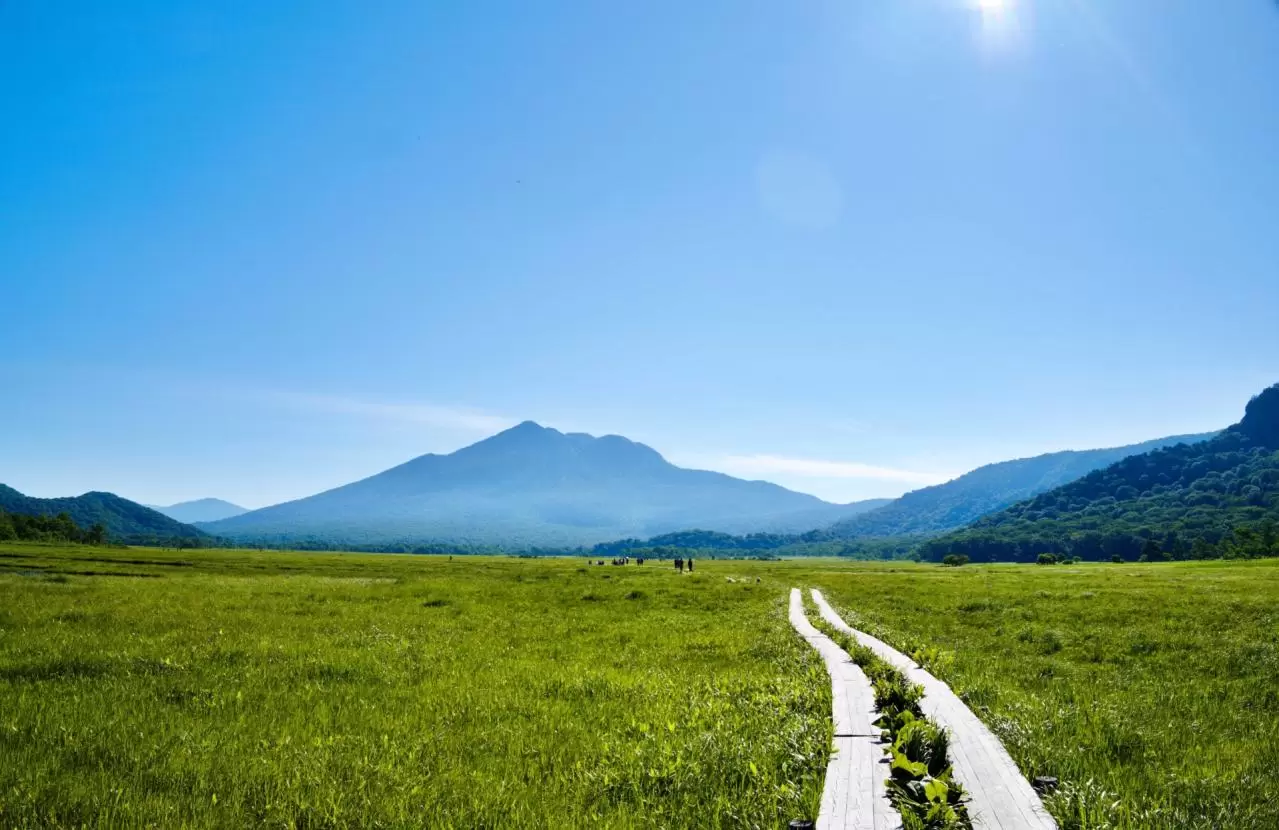
Oze National Park is a vast natural park that spans four prefectures—Gunma, Tochigi, Fukushima, and Niigata—and is home to the largest high-moor wetland on Japan’s main island of Honshu. Centered on the Oze Marsh at an elevation of about 1,400 meters (wetland area of approximately 760 hectares, with the designated Special Natural Monument area covering about 849 hectares) and Ozenuma Marsh at about 1,660 meters above sea level, the park is framed by famous peaks such as Mount Hiuchigatake (2,356 meters) and Mount Shibutsu (2,228 meters).
Oze is also known through the song “Haruka na Oze,” and offers visitors beautiful scenery in every season. In 2007, it became independent from Nikko National Park and was designated as Japan’s 29th national park.
History
Oze’s natural landscape has long been cherished by people. It was designated as part of Nikko National Park in 1934, and later became independent as “Oze National Park” in 2007. At that time, areas such as Mount Aizu-Komagatake, Tashiroyama, and Taishakusan were also incorporated into the park.
Oze has faced threats of development many times in the past, but its precious natural environment has been preserved through the conservation efforts of many people. For this reason, Oze is also called the “origin of nature conservation” in Japan.
Topography and Formation
The Oze area is a mountainous region formed by volcanic activity. As a result of depressions dammed by eruptions from the Oze volcanic group, wetlands and lakes such as the Oze Marsh and Ozenuma were created.
The Oze Marsh, formed about 10,000 years ago, is the largest high-moor wetland on Honshu. Because of the cool climate, plants do not fully decompose and accumulate as peat, creating its distinctive convex, dome-like terrain.
Mount Shibutsu also has widespread serpentine rock, and plants adapted to special soils containing heavy metals such as nickel and chromium can be seen there. Rare species such as Oze-so, Hosoba-hinauusuyukisou, and Kato-hakobe are representative examples.
Vegetation
The vegetation of Oze National Park is extremely diverse. From about 1,000 meters to 2,360 meters above sea level, the park includes a mountain zone dominated by beech, a subalpine zone where species such as Aomori fir and spruce grow, and an alpine zone covered with creeping pine.
In the marshes, wetland plants such as Horomuisge, cotton grass, and creeping cranberry can be seen, with colorful flowers blooming throughout the seasons.
Oze is also located at the intersection of northern and southern plant species, as well as Pacific-side and Japan Sea-side species, giving it an exceptionally rich flora. It is home to 938 species in 116 families—about one-tenth of all higher plant species confirmed in Japan. Of these, 42 are “native plants” first discovered in Oze, and 19 are “endemic species” found only in Oze. It is truly a treasure trove of plant life.
Fauna
Oze’s rich forests and wetland environments are also habitats for a wide variety of animals. Large mammals such as Asiatic black bears and Japanese serows are commonly seen, and the park is also rich in birds and insects. In particular, there are many species of dragonflies, and all 17 northern species found in Japan have been confirmed here.
In 2005, the Oze area was registered as a Ramsar wetland, earning international recognition as an important wetland.
In recent years, Japanese deer, previously thought not to inhabit the area, have been confirmed, and their browsing damage to rare plants has become a problem, making urgent countermeasures necessary.
Seasons and Highlights
The Oze season runs from mid-April, when roads open, until early November. As the snow melts, spring flowers bloom, and visitors can enjoy beautiful scenery that changes with each season.
• Spring (May): During snowmelt, the “akashibo” phenomenon can be seen, in which the snow surface turns reddish brown. Flowers such as skunk cabbage and Japanese globeflower bloom, marking the start of the Oze season.
• Early summer (June–July): This is the most splendid season in the marshland, when the white tufts of cotton grass and the yellow flowers of Nikko daylily color the wetlands.
• Summer (August): This is the peak mountaineering season, and many climbers visit Mount Shibutsu and Mount Hiuchigatake. Because the weather changes rapidly in the afternoon, early starts and early finishes are recommended.
• Autumn (September–October): The marsh grasses turn orange with autumn colors, and before long the beech forests also reach their peak foliage season. In late October, the first snow may fall, and Oze is enveloped in the quiet of winter.
Oze National Park is a paradise of marshlands that represents Japan, with its rich natural environment and diverse ecosystems. Its landforms and ecology, formed over approximately 10,000 years, are of great academic value, and it continues to be cherished by many as the “origin of nature conservation.”
Oze, which reveals a different face in every season, is a place that offers new inspiration each time you visit and stands as a symbol of Japan’s natural beauty.
#Superb view/Scenic spot #flowers/plants #mountain/plateau #Climbing/Hiking
Oze National Park Movies


Gunma Tourist Attractions
View List
Konnyaku Park
Konjac Park is a theme park where you can experience the charms of "konjac," a traditional Japanese ingredient. Here, you can enjoy free factory tours to learn about...

Haruna Shrine
Haruna Shrine, located on the slopes of Mount Haruna in Takasaki City, Gunma Prefecture, is an ancient shrine believed to have been established during the reign of E...

Hotokuji Temple
Hōtokuji is a historic temple founded during the Muromachi period. It is particularly famous for the "momiji on the floor" seen in the main hall, which is open to th...

Myogi Shrine
Myogi Shrine is located at the eastern foothills of Myogi Mountain and Hakubun Mountain, famous for its peculiar rocks and formations, surrounded by majestic scenery...

Ikaho Onsen
Ikaho Onsen is a historic hot spring area celebrated in classic Japanese poetry, including the Manyoshu and the Kokin Wakashu. With a history spanning over 600 years...

Gunma Safari Park
Gunma Safari Park is a vast safari park where about 100 species and 1,000 animals live in an environment close to nature. Visitors can observe lions, zebras, giraffe...

Kusatsu Onsen
Kusatsu Onsen is one of Japan's representative hot spring resorts located in Gunma Prefecture. A particular highlight is the "Yubatake," where blue-green hot spring ...

Usuidai Sankyoryo (Megane Bridge)
Usui Pass Third Bridge is one of Japan's largest brick arch bridges, located in Usui Pass, Annaka City, Gunma Prefecture. Its elegant form has earned it the nickname...