Impressive permanent exhibits
Full dinosaur skeletons and enormous dioramas make for a memorable visit.

AI Summary
This is an AI-generated summary. Please check the official information for opening hours, fees, and closed days.
A major museum where dinosaur fans and curious learners can explore and have fun.
Recognizable by its silver dome, this is one of Japan’s largest museums dedicated to dinosaurs. Its extensive displays of full dinosaur skeletons, fossils, and videos bring Earth’s history to life. At the Outdoor Dinosaur Museum, visitors can also see an excavation site and take part in activities, making it enjoyable for all ages.
Full dinosaur skeletons and enormous dioramas make for a memorable visit.
See an excavation site and try hands-on activities—ideal for an educational outing.
Explore regional discoveries, including exhibits featuring Fukuiraptor.
Explore the main museum first, then add the Outdoor Dinosaur Museum if you have time.
▶ Permanent Exhibition Hall
The Dinosaur Museum has a dome-shaped permanent exhibition hall divided into three zones: “The World of Dinosaurs,” “The Science of the Earth,” and “The History of Life.” In the vast pillarless space, full dinosaur skeletons, fossils, rocks, dioramas, and more are on display, allowing visitors to fully enjoy the world of geology and paleontology, including dinosaurs.
▸ The World of Dinosaurs
This zone features 50 full dinosaur skeletons, 10 of which are based on actual fossils. Visitors can experience the dinosaur era through a life-size diorama recreating the Mesozoic landscape of Sichuan Province, China, as well as the Dino Theater with facing screens.
▸ The Science of the Earth
This zone systematically presents the history of earth science, terrestrial and marine sediments, fossils buried in sediment, earth’s activity, and rocks and minerals formed through that activity.
▸ The History of Life
This zone traces the long history of the Earth over 4.6 billion years, from the birth of life through evolution and extinction amid environmental changes, up to the emergence of humankind. The newly added large mosasaur, Tylosaurus, is a must-see.
▶ Outdoor Dinosaur Museum
This field station offers a tour of the dinosaur fossil excavation site in Katsuyama City’s Kitadani area, along with fossil excavation experiences. It can be visited only on a dedicated bus tour departing from the Fukui Prefectural Dinosaur Museum. The Outdoor Dinosaur Museum has three zones: the Observation Plaza, the Exhibition Hall, and the Fossil Excavation Experience Plaza.
Gloves or work gloves are required to protect your hands during the excavation experience.
▸ What is the Kitadani dinosaur fossil excavation site?
This is Japan’s largest dinosaur fossil excavation site. The site contains strata known as the Kitadani Formation of the Tetori Group, dating to the Early Cretaceous, from which a wide variety of fossils have been recovered. The first test excavation survey began in 1988, and full-scale excavations started the following year, in 1989. Since then, the valuable fossils obtained through repeated excavations have become important holdings of the Fukui Prefectural Dinosaur Museum, which opened in 2000. The Outdoor Dinosaur Museum opened in 2014, and in 2017 part of the fossil excavation site was designated as a National Natural Monument.
▸ The Three Zones
Excavation site tour (Observation Plaza)
With a navigator, visitors tour the Kitadani dinosaur fossil excavation site. If you are lucky, you may be able to watch the researchers at work.
Excavation exhibit (Exhibition Hall)
The Kitadani dinosaur fossil excavation has a long history. Exhibits introduce what this area was like in the age of dinosaurs and what kinds of fossils have been found there.
Fossil excavation experience (Fossil Excavation Experience Plaza)
Participants become members of the museum’s excavation team. Important fossils they discover may contribute to future research at the museum.
▶ Purpose and Significance of the Fukui Prefectural Dinosaur Museum Plan
The Dinosaur Museum was built with the aim of utilizing Fukui Prefecture’s dinosaur resources for academic research, lifelong learning, regional revitalization, and enhancing the prefecture’s image, and to promote them both in Japan and abroad. More than 20 years have passed since its opening on July 14, 2000, and while it has become a national center for dinosaur research, it has also grown into a facility supported by people of all ages, from children to adults. During its first five years, annual visitors remained at around 250,000, but by fiscal 2010 this had increased to 500,000, and by fiscal 2015 it had reached 900,000. As a result, issues such as lines forming in front of the entrance and severe congestion inside and outside the entrance hall have emerged, making facility improvements to accommodate visitors an important challenge. The restaurant and shop are also consistently full during busy periods. With the opening of the Shinkansen in fiscal 2022 expected to bring even more visitors, expansion of exhibition space and entrance/common areas is needed in order to maintain and improve satisfaction.
In addition, monthly visitor numbers show significant seasonal variation, with about 25% of annual visitors concentrated in August during the summer vacation period, making it important to increase the number of visitors in winter. Along with the existing exhibitions, providing new year-round experiences and strengthening the museum’s functions are required as solutions to these issues. To make the Dinosaur Museum a museum that will continue into the future as a world-class center for dinosaur fossil research and information dissemination, the museum will be enhanced through expansion and renovation under the concept of “a complete makeover into a museum where visitors can enjoy experiences in all seasons.”
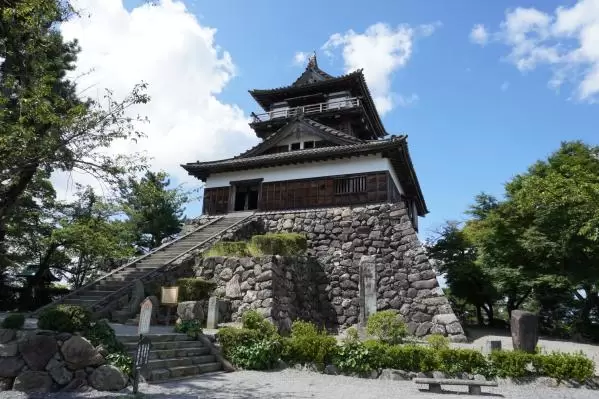
Maruoka Castle, also known as Kasumiga Castle, was built by Katsuie Shibata's nephew, Katsutoyo. The name "Kasumiga Castle" comes from a legend in which a giant serp...
Echizen Matsushima Aquarium is an interactive aquarium themed around "see, touch, and learn with fun." It features enjoyable attractions such as dolphin shows and pe...
The Ichijodani Asakura Clan Ruins is a valuable archaeological site where the remains of the castle town ruled by the Asakura clan during the Sengoku period have bee...
Mikata Five Lakes is the collective name for five lakes located in Mihama and Wakasa towns in Fukui Prefecture. They consist of Mikata Lake, Suigetsu Lake, Suga Lake...
Eiheiji, the head temple of the Soto Zen school, was founded by Zen Master Dogen in the second year of the Kan'gen era (1244). Located in Fukui Prefecture, its seren...
Shibamasa World is a large theme park covering an expansive area of 560,000 square meters facing the Sea of Japan. During the summer, it opens one of Japan's largest...