Takeo City Library and Historical Museum
Takeo City Library and Historical Museum Movies


Basic Information
- Spot Name
- Takeo City Library and Historical Museum
- Location
- 〒843-0022 5304-1 Takeo, Takeo-machi, Takeo City, Saga Prefecture
- Access
- About a 15-minute walk from JR Takeo Onsen Station. Approximately a 10-minute drive from Takeo-Kitagata Interchange.
- Parking
- 90 cars
- Business Hours
- From 9 AM to 9 PM.
- Regular Holiday
- None
- Contact Information
- Phone Number:0954-20-0222
- Official Website
Map
Detailed Information
Takeo City Library and History Museum is a cultural complex in Takeo-machi, Takeo City, Saga Prefecture, combining a public library with a history museum. Nicknamed “Epochal Takeo,” it not only supports reading and learning for local residents but also offers a wide range of functions, including exhibitions introducing Takeo’s history, lectures, workshops, a café, and a bookstore. Together with the adjacent Takeo City Children’s Library, it serves as one of Takeo’s leading cultural and community centers, welcoming people of all ages, from children to adults.
Takeo City Library and History Museum opened on October 1, 2000. Its nickname, “Epochal,” comes from the English word “epochal,” meaning “of a new era” or “groundbreaking.” It was created just before the beginning of the 21st century with the aim of combining a library and a history museum to provide a place for cultural and educational activities oriented toward the future. The year 2000 also marked the 400th anniversary of relations between Japan and the Netherlands, making it a symbolic year for Takeo, which has deep historical ties to Western learning and Dutch studies.
In 2013, the facility underwent extensive renovations and reopened in April of the same year. A designated administrator system was introduced for the library, and Culture Convenience Club Co., Ltd. began managing its operations. This new style of management, combining a public library with a bookstore and café, attracted nationwide attention. As a result, Takeo City Library became not only a public facility for local residents but also a destination visited by many sightseers and tourists.
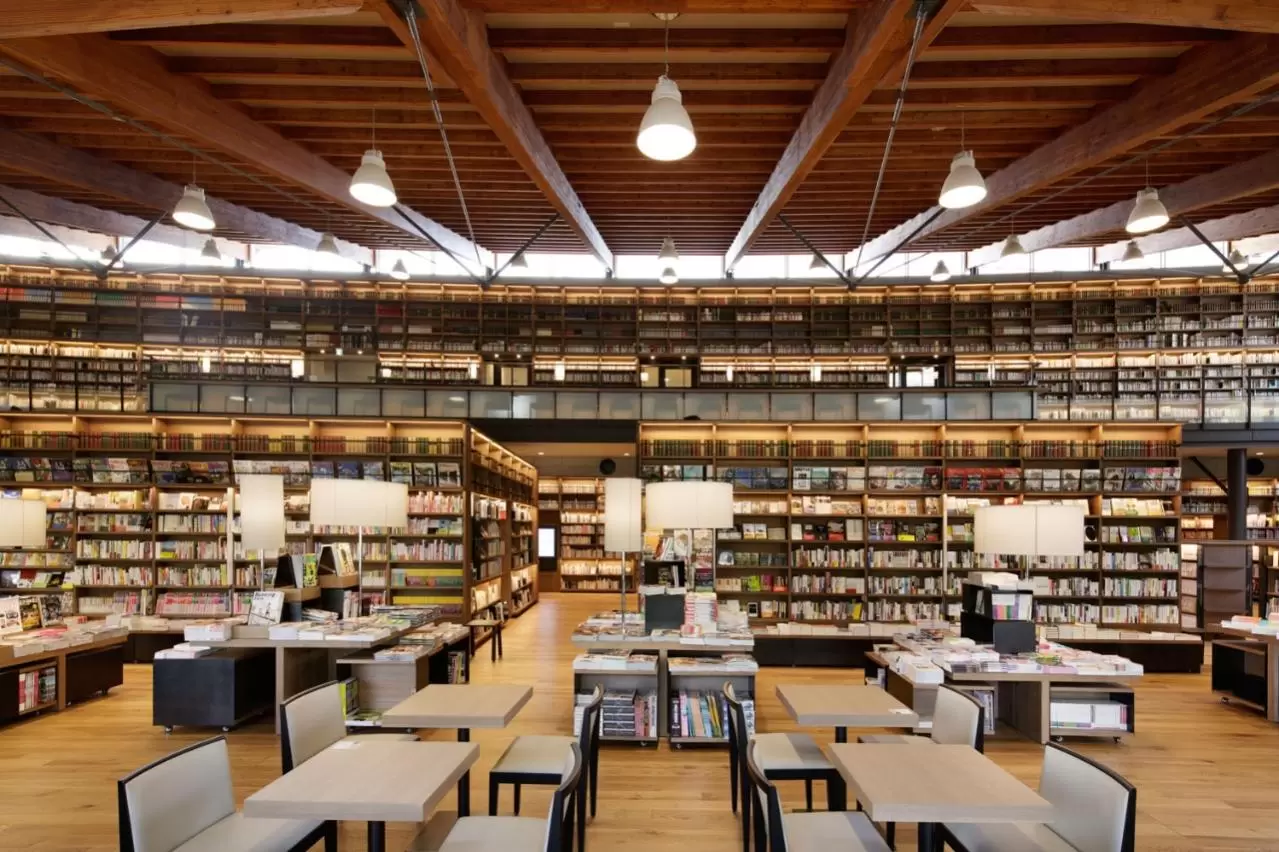
Upon entering the building, visitors encounter an open, welcoming space filled with the warmth of wood. Bookshelves line the high ceilings, and the continuous arrangement of shelving extending from the first floor to the second is one of the library’s most distinctive features. Surrounded by a large number of books, the interior gives a markedly different impression from that of a conventional public library. Materials from a wide variety of fields are arranged so that visitors can not only look for a specific book but also make unexpected discoveries of books and knowledge that spark their interest.
The library offers materials in a broad range of fields, including literature, history, travel, art, business, and practical books on everyday life. Newspapers and magazines are also available. The rare-books section contains valuable books and documents related to Saga Prefecture, Takeo City, and other areas. Visitors wishing to use these rare materials must make a request to a nearby staff member. Because the library allows visitors to research Takeo’s history, culture, nature, and tourist attractions in detail, it is useful not only to local residents but also to travelers collecting information about the area.
The library has a reference desk where visitors can consult staff members about research and finding materials. It can be used when visitors do not know which materials contain the information they need or when they wish to investigate the history of the local area in greater detail. Self-service checkout counters are also available, providing convenient library services that allow users to complete borrowing procedures on their own.
In addition to study rooms for research and self-study, the library provides shared rooms where users can work while charging devices such as computers, as well as counter seating on the second floor. These seats are generally available on a first-come, first-served basis whenever they are vacant. Public wireless LAN is also provided, making the facility useful not only for reading but also for individual study, research, and computer-based work.
A Braille and reading-aloud service room is available for people who have difficulty reading printed materials because of visual disabilities or physical limitations. Face-to-face reading services are provided for such users. The facility also includes children’s restrooms and a nursing room, ensuring that a wide variety of visitors can spend time there comfortably and with peace of mind.
One of the major features of Takeo City Library is that a public library, bookstore, and café coexist within the same space. Tsutaya Books operates inside the building, where visitors can purchase books, magazines, miscellaneous goods, and other items. In addition to borrowing library materials, visitors can buy books they like on the spot, expanding the ways they can enjoy reading. However, library holdings and bookstore merchandise are handled differently, so visitors should check the labels attached to the bookshelves and books when using the facility.
The building also houses Starbucks Coffee Tsutaya Books Takeo City Library. Drinks purchased at Starbucks with lids may be enjoyed inside most areas of the facility, except for certain designated sections. The ability to read while drinking coffee is one of the services that symbolizes Takeo City Library. Light meals may be enjoyed in designated locations, such as Starbucks’ dedicated seating area and the shared seating used by the library, bookstore, and café. Since the areas where food and beverages are permitted and the types of food and drinks that may be brought in are subject to rules, visitors should check the signs inside the building and the latest usage guidelines, and take care not to soil library materials.
The shared seating areas can be used for reading and relaxing, and courses and events are sometimes held there depending on the season. The media hall is used as a classroom and hosts lectures, training sessions, workshops, and other activities. A variety of other programs are also offered, including reading-related events, hands-on craft experiences, courses useful for everyday life, and markets. The library is characterized by its use as more than a quiet place to read; it functions as a place where people gather, learn, and interact.
Another central feature of this complex is the Takeo City History Museum. The museum houses numerous materials conveying the history and culture of Takeo City, including documents related to the Takeo Nabeshima family, which governed the Takeo region for many years. Until the beginning of the 17th century, the Takeo Nabeshima family was known as the Goto family and ruled the Takeo area from around the 12th century until the end of the Edo period. During the Edo period, the family was regarded as being of equivalent status to the relatives of the main Saga domain and played an important role in supporting domain administration as the family that supplied the chief senior retainer, known as the ukeyaku.
Among the history museum’s holdings, materials related to Western learning from the middle of the Edo period through the end of the shogunate are particularly noteworthy. At that time, Western countries were actively expanding into East Asia, and learning about Western science, technology, and military power became an important issue for the Saga domain, which was responsible for guarding Nagasaki. The Phaeton Incident of 1808, in which the British warship HMS Phaeton entered Nagasaki Harbor, was one of the events that prompted the Saga domain to recognize keenly the gap between Japan and Western countries in military strength and technological capability.
In this context, Nabeshima Shigeyoshi, the lord of the Takeo domain, actively introduced Dutch learning and Western-style gunnery. He collected and produced Western books, dictionaries, maps, technical drawings, and objects, and promoted research into science and technology, including Western-style artillery and cannon manufacturing. These efforts also influenced the Saga domain as a whole and are regarded as an important foundation for its development into an advanced domain in the fields of science, technology, and military engineering during the final years of the shogunate.
The “Western Learning Materials of the Takeo Nabeshima Family,” owned by Takeo City and preserved and utilized by the history museum, form a large collection comprising a total of 2,224 items. The collection consists of 1,304 documents and records, four specimens, 284 Japanese books and translated works, 133 Western books, 36 illustrated maps and maps, 159 technical drawings, seven photographs, and 297 objects.
These materials concretely demonstrate how Western science and technology were introduced into Japan, how people came to understand them, and how they acquired them as practical skills. Recognizing their high academic value, the collection was designated an Important Cultural Property of Japan on August 21, 2014.
The collection includes records concerning military technologies such as cannon manufacturing and Western-style gunnery, as well as Western books and dictionaries used for foundational research in various academic fields. The materials reveal not merely that foreign technologies were adopted, but also the process by which people of the time deciphered Western books and acquired knowledge and skills through repeated experimentation and trial and error. Another important aspect of the collection is that the materials collected and produced by the Takeo Nabeshima family have not been widely dispersed and remain together in Takeo, the very place where research into Western learning was conducted.
The Dutch Studies and Special Exhibition Room hosts several exhibitions each year introducing the history and culture of Takeo, primarily through materials from the museum’s collection. Not all of the holdings are displayed permanently; materials are changed according to the theme of each exhibition. As a result, visitors may encounter different objects and historical stories depending on when they visit. Independent exhibitions by local residents are also sometimes held, allowing the museum to serve as a facility that preserves, researches, and widely shares the history and culture of the local community.
Adjacent to Takeo City Library is the Takeo City Children’s Library, which opened on October 1, 2017. It provides an environment where children can freely become familiar with books, particularly picture books and children’s literature. At “Picture Book Mountain,” visitors can take off their shoes and read while relaxing. There is also a “Secret Room” filled with books on themes favored by children, where they can enjoy the feeling of entering the world of a story.
The children’s library features “Ookiku Sukusuku,” a colorful wall artwork created by the picture-book artist duo tupera tupera, modeled on Takeo’s giant camphor trees. The work stimulates children’s imaginations and is one of the children’s library’s signature attractions. The facility also includes a tatami-floored “Baby Rest Room,” where babies can relax when they become sleepy, as well as a nursing room and children’s restrooms. In the food court, there are seats where families can eat food they have brought with them, including baby food, making the facility particularly accommodating for families with infants and toddlers.
Outside the building is a lawn area where visitors can enjoy cherry-blossom viewing, picnics, and other activities on fine days. Storytelling sessions and events are sometimes held on the lawn. Inside the building, picture-book read-aloud sessions and programs for parents and children are also offered, providing children with opportunities to enjoy books, stories, and interaction with others in an environment different from home.
The children’s library also houses the Kyushu Pancake Café, which offers menus made with carefully selected ingredients from Kyushu, along with coffee and other items. Families can enjoy meals and take breaks there between reading activities, making it convenient for those who wish to spend a leisurely full day at the library. Since the store’s hours and menu may change, visitors are advised to check the latest information before visiting.
Takeo City Library and History Museum is much more than a facility for borrowing books. Modern library services, a bookstore and café, learning and community spaces, valuable historical materials from the Takeo Nabeshima family, and an environment where children can freely interact with books are all brought together in one place. The facility serves a wide range of purposes, whether visitors want to enjoy reading, learn about Takeo’s history, gather tourist information, or spend a relaxing time with their children.
Its great appeal lies in preserving the intellectual role of a public library while also offering the welcoming atmosphere of a place where people can casually stop by, all while passing Takeo’s history on to future generations. By expanding the traditional boundaries of a library, it has become a cultural attraction worth visiting in Takeo—an engaging place where local residents and tourists alike can enjoy new encounters with books, history, culture, and other people.
Saga Tourist Attractions
View List
Hiyono Sato Okuwatayama
The secret kiln village of Okawauchi-yama is located in Imari City, Saga Prefecture, and was known during the Edo period as the official kiln of the Nabeshima family...

Yutokuhinari Shrine
Yutoku Inari Shrine is located in Kashima City, Saga Prefecture, and is counted among the three great Inari shrines of Japan, along with Fushimi Inari and Kasama Ina...


Karatsu Castle
Karatsu Castle is a historic castle located in Karatsu City, Saga Prefecture, Japan. This castle was built by Terasawa Shimanokami Hirotaka, a retainer of Toyotomi H...

Nanatsugama
Nanatsugama is a scenic spot in the Kanmon Straits designated as a national natural monument. It features a magnificent natural formation created by the erosion of b...

Rainbow Pine Grove
Niji no Matsubara is one of Japan's three great pine forests, stretching approximately 4.5 km along the coastline of Karatsu City in Saga Prefecture, and it has been...

Yoshinogari Historical Park
Yoshinogari Historical Park is a national park where visitors can experience Japan's Yayoi period, located on about 54 hectares of beautiful hills straddling Kanzaki...

Mifuneyama Rakuen
Mifuneyama Rakuen is a magnificent garden located in Takeo City, Saga Prefecture, created by Lord Nabeshima Shige Yoshin 1845. Spanning a vast area of 150,000 tsubo,...