Karatsu Castle
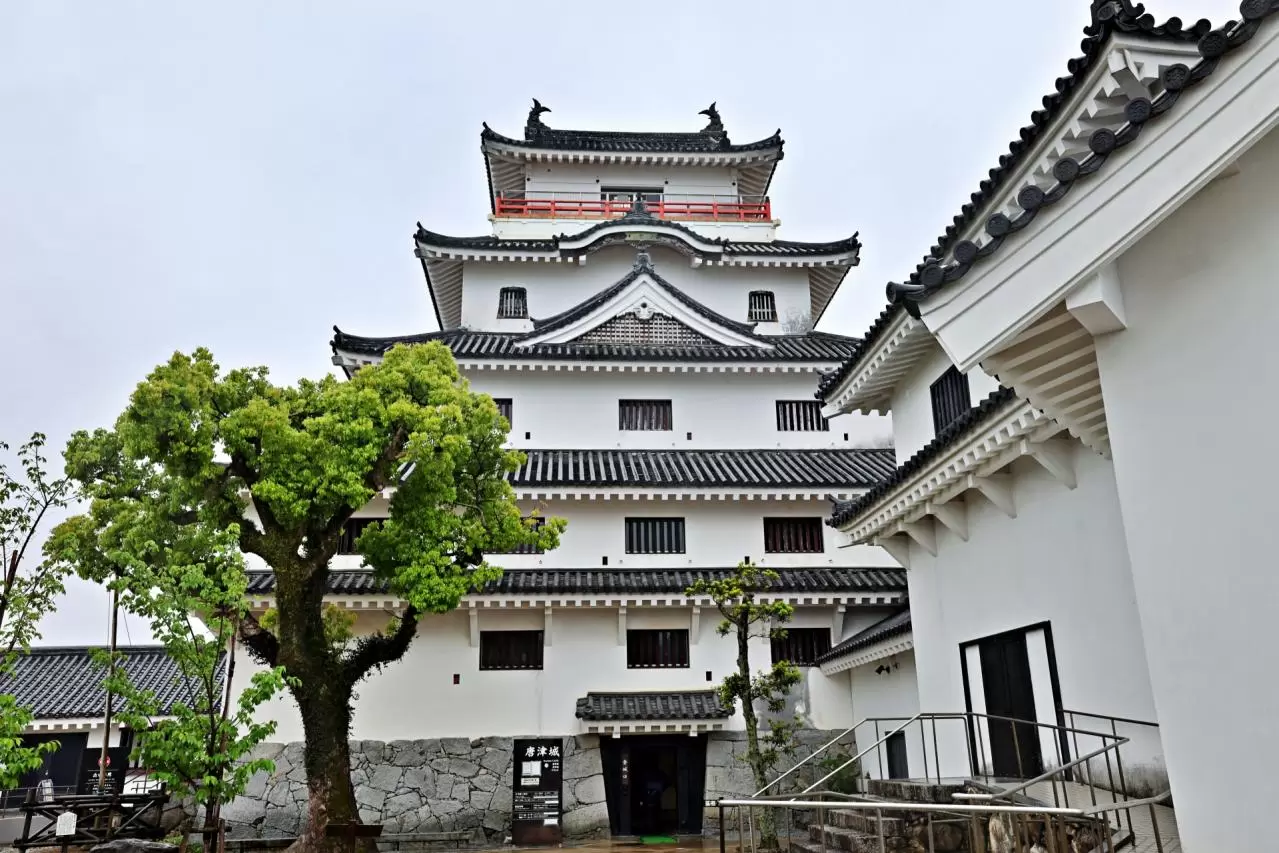
Karatsu Castle was constructed on a land-connected island called Mantouzan, making it a fortress surrounded on three sides by the sea and rivers. Within the castle, stone walls and moats were established, creating a strong defensive system. A magnificent donjon stands within the castle, and from its observation deck, visitors can enjoy beautiful views of the Genkai Sea and the picturesque Niji no Matsubara.
The current Karatsu Castle was built in 1966 as a cultural tourism facility and is now utilized as a local history museum. Inside the castle, visitors can view valuable materials and exhibits related to the history and culture of the Karatsu Domain, and gain insights into local culture, such as Karatsu pottery.
Surrounding Karatsu Castle is Maizuru Park, which is known for its beautiful cherry blossoms and wisteria flowers, making it a popular spot for hanami (flower viewing). Additionally, the castle is illuminated at night, providing a striking view.
Karatsu Castle combines historical value and beauty, and is cherished as a symbol of Karatsu City. It is worth visiting for its exhibits and scenic landscapes, as well as for experiencing the local history and culture.
Karatsu Castle Movies



Basic Information
- Spot Name
- Karatsu Castle
- Location
- 〒847-0016 8-1 Higashijōnai, Karatsu City, Saga Prefecture
- Access
- ■ By Car
7 minutes from JR Karatsu Station
■ On Foot
20 minutes from JR Karatsu Station - Parking
- Tojo Castle Parking Lot
- Regular vehicles: 190 spaces
1 hour or less: 100 yen
1 to 2 hours: 300 yen
More than 2 hours: 400 yen
(Nighttime rate is a flat 300 yen)
- Large vehicles: 5 spaces
1 hour or less: 400 yen
1 to 2 hours: 900 yen
More than 2 hours: 1300 yen
(Nighttime rate is a flat 1000 yen)
Motorcycle parking lot
Capacity: 25 spaces
Rate: Free - Business Hours
- 9:00 AM to 5:00 PM (Last admission at 4:40 PM)
*Opening hours may change depending on the season. - Regular Holiday
- December 29 to December 31
- Fees
- General admission: 500 yen
Elementary and junior high school students: 250 yen
Preschool children: Free
*Group discount: 20 or more persons, 20% off - Contact Information
- Phone Number: 0955-72-5697
- Official Website
Map
Detailed Information
Karatsu Castle, located in Higashijonai, Karatsu City, Saga Prefecture, is an iconic sightseeing landmark of Karatsu City, rising as if thrusting out into Karatsu Bay. The keep was built on a hill called Mount Mitsushima at the mouth of the Matsuura River, taking advantage of terrain surrounded by the sea and river. A hirayamajo, or castle built on a hill beside the sea, it also has the characteristics of a umijiro, or “sea castle,” incorporating the sea and river mouth into its defenses. The beautiful scenery created by the white castle tower, blue sea, and Nijinomatsubara Pine Grove is widely regarded as one of Saga Prefecture’s most representative castle landscapes.
Karatsu Castle was built by Terasawa Shimanokami Hirotaka, a retainer of Toyotomi Hideyoshi. Terasawa Hirotaka was involved in the construction of Nagoya Castle, which Toyotomi Hideyoshi built in 1592 as a base for his invasions of Korea, and carried out important duties such as transporting troops and supplying provisions. Highly trusted by Hideyoshi, he was granted in 1595 the former domain of Hata Chikashi, lord of Kishitake Castle, and came to govern the area around Karatsu.
At the Battle of Sekigahara in 1600, he joined the Eastern Army led by Tokugawa Ieyasu. After the battle, he was rewarded with an additional fief of 40,000 koku in Amakusa, making him a daimyo who governed a domain of more than 120,000 koku, including Karatsu. Hirotaka then began constructing Karatsu Castle as the center of administration for his new domain. Construction is said to have begun in 1602 and taken seven years, with the castle completed in 1608.
It is said that building materials from Nagoya Castle, which was abandoned after Toyotomi Hideyoshi’s death, were used in the construction. Daimyo from across Kyushu, including the Shimazu clan of Satsuma and the Kato clan of Higo, are also said to have cooperated with the project. The construction techniques of the Ano-shu, a group of stonemasons who had worked on the stone walls of Azuchi Castle and Nagoya Castle, were reportedly used as well.
Today, the castle and its surrounding areas still contain stone walls displaying construction methods and techniques from different periods, including nozura-zukuri, in which natural stones are stacked with little processing, as well as uchikomi-hagi and kirikomi-hagi. On the stone wall near the entrance to the castle tower platform, a carving of a cross within a circle—the crest associated with the Shimazu clan of Satsuma—can also be seen. This is notable as evidence that daimyo from across Kyushu cooperated in building the castle.
Karatsu Castle was laid out with Mount Mitsushima serving as the honmaru, or main bailey, surrounded by the ninomaru, sannomaru, and outer baileys. The outer bailey was protected by an outer moat, and Higashi Teramachi and Nishi Teramachi were established outside it. A carefully planned castle town was developed, including samurai residences, merchants’ quarters, and temple districts. The temple district, where temples were concentrated, is believed to have also helped reinforce the town’s defenses. Karatsu Castle and its castle town developed as the political, economic, and transportation center of the Karatsu domain.
Alongside construction of the castle, Hirotaka undertook large-scale improvements around the mouth of the Matsuura River and developed new rice fields. The river improvement projects are believed to have been intended both to improve water transportation and to protect the castle town and surrounding areas from flooding and other disasters. These extensive civil-engineering projects laid the foundations for the castle town and contributed to Karatsu’s development as a city.
Hirotaka also promoted the planting of black pine trees on the sand dunes along the coast of Karatsu Bay. The project was intended to protect newly developed farmland from sea winds and blowing sand, and is considered the foundation of what is now Nijinomatsubara, a nationally designated Special Place of Scenic Beauty. In the fishing industry, he is said to have invited fishermen from the Kishu region and introduced whaling techniques. In this way, Terasawa Hirotaka contributed to Karatsu’s development not only through the construction of the castle, but also through flood control, agriculture, forestry, and fishing.
The Terasawa family line ended after two generations, and the Karatsu domain temporarily became territory directly administered by the shogunate. It was subsequently ruled in succession by the fudai daimyo families of Okubo, Matsudaira, Doi, Mizuno, and Ogasawara. The frequent changes of ruling family are thought to have resulted from the shogunate’s view of Karatsu as strategically important for supervising Nagasaki administration and monitoring powerful tozama daimyo in Kyushu.
The successive domain lords introduced reforms in rural administration, education, industry, and finance during their respective periods. Under the Doi family, education became more widespread, an official kiln for Karatsu ware was established, and industries such as whaling and washi papermaking were promoted. Under the Mizuno family, repeated poor harvests caused by droughts and floods increased farmers’ dissatisfaction with the domain’s tax policies. In 1771, this led to the large-scale peasant uprising known as the Nijinomatsubara Ikki.
Mizuno Tadakuni is also known for carrying out the Tenpo Reforms as a senior councilor of the Edo shogunate after serving as lord of the Karatsu domain and moving to Hamamatsu Domain. It is said that one reason he sought a transfer from Karatsu to Hamamatsu, hoping to obtain a position closer to the center of shogunal power, was that the lord of Karatsu was responsible for the defense of Nagasaki and therefore had difficulty being appointed to important positions in the shogunate.
The Ogasawara family, the last to govern the Karatsu domain, promoted industries including coal mining, whaling, wax-tree cultivation, kozo paper production, and marine products, while working to rebuild the domain’s finances. Toward the end of the Edo period, Ogasawara Nagayuki, a member of the Karatsu domain’s ruling family, served as a senior councilor-level official of the shogunate and became involved in important political issues, including the Second Choshu Expedition. Throughout the Edo period, Karatsu Castle continued to watch over the political affairs of the Karatsu domain and the development of its castle town.
When the Karatsu domain was abolished under the 1871 abolition of domains and establishment of prefectures, Karatsu Castle was also abandoned, and many of its buildings were subsequently lost. In 1877, the area centered on the former main bailey was developed as Maizuru Park and began to be used as a place of relaxation for local residents.
The castle tower seen today is not a surviving building from the Edo period. According to official information from Karatsu City and Karatsu Castle, the original Karatsu Castle did not have a castle tower when it was first built. Because the form of a castle tower cannot be clearly confirmed in Edo-period maps or documents, the present tower is not a faithful reconstruction of a historic keep. Instead, it was built in 1966 as a cultural and tourism facility.
Nevertheless, the imposing five-story, five-level castle tower blends into Karatsu’s landscape and has become a beloved symbol of the city for residents and visitors alike. The interior was renovated in 2017, introducing exhibits that use video and digital equipment in addition to historical materials. The facility enables visitors of all ages to learn about the history of Karatsu Castle and its castle town in an accessible way.
Karatsu Castle is also known as Maizuru Castle because the beaches and pine groves extending east and west from the castle appear like a crane spreading its wings. Nijinomatsubara stretches to the east, while Nishinohama extends to the west, creating an elegant landscape in which the castle, sea, beaches, and pine groves form a harmonious whole. This beautiful view is one of Karatsu Castle’s greatest attractions.
The interior of the castle tower is used as a local history museum, displaying materials related to the Karatsu domain, its successive lords, and the history of the castle town. Exhibits include a naginata halberd and armor handed down through the Imai family, whose head was a senior retainer of Terasawa Hirotaka, the first lord of the Karatsu domain; a vermilion seal letter sent by Toyotomi Hideyoshi to Terasawa Hirotaka; Edo-period maps of Karatsu Castle; and gold-leaf roof tiles excavated from the castle.
The discovery of the gold-leaf roof tiles provides an important clue to understanding the close relationship between Karatsu Castle, the Toyotomi regime, and Nagoya Castle. Some researchers have suggested that an important building featuring gold-leaf roof tiles may have existed at this site before the construction of Karatsu Castle is believed to have begun in 1602. Please note that some exhibits may be unavailable because of rotation, loans, or other circumstances.
The museum also displays Karatsu ware, including ko-Karatsu, or old Karatsu ware. Karatsu ware began to be produced around the end of the sixteenth century and has long been loved by tea masters for its rustic texture and rich variety of expressions. Through the exhibits, visitors can learn not only about the history of the castle, but also about Karatsu’s representative traditional craft, the lives of local townspeople, and the cultures and industries—including whaling and coal mining—that supported the region’s development.
A souvenir corner on the first floor of the castle tower sells local specialties such as Karatsu ware, Karatsu lacquerware, confectionery, and products made with citrus fruits. Visitors can find items to commemorate their trip to Karatsu Castle and enjoy shopping after touring the museum.
The observation floor on the fifth floor of the castle tower is a highlight that should not be missed. To the north lie Karatsu Bay and the Genkai Sea, and on clear days it is possible to see as far as Iki Island. Nijinomatsubara and Mount Kagamiyama can be seen to the east, Nishinohama to the west, and the castle town of Karatsu to the south, offering a 360-degree panorama. Looking out over the sea, river mouth, and castle town gives visitors a sense of why Karatsu Castle was built at a strategic location with a commanding view of the surrounding area.
Visitors can climb the stone steps to the castle, or use the paid Maizuru Park elevator to reach the vicinity of the main-bailey plaza. Even when using the elevator, however, movement inside the castle tower is generally by stairs. Visitors who have difficulty walking or use wheelchairs should check the latest accessibility information in advance.
Maizuru Park around Karatsu Castle is also known as a popular flower-viewing spot. In spring, cherry blossoms bloom around the castle, creating a beautiful combination with the white castle tower. The blossoms usually reach their peak around late March, although the timing varies from year to year depending on the weather.
Following the cherry blossoms, the nodafuji wisteria in the middle section of Maizuru Park comes into bloom. This old tree is said to have been planted in 1898 and was designated a natural monument of Karatsu City in 1972. From late April to early May each year, its long clusters of pale purple flowers hang down and fill the surrounding area with a sweet fragrance. Because the wisteria can be viewed together with the castle tower, many tourists and photography enthusiasts visit during the blooming season.
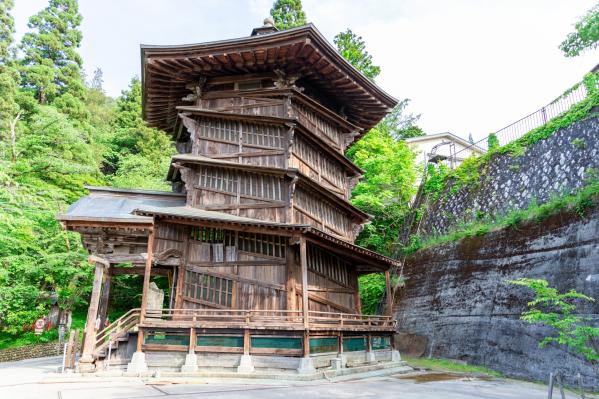
To the left of the main entrance path stands a tahoto pagoda associated with faith in the Lotus Sutra. Images of Shakyamuni Buddha and Prabhutaratna Buddha are carved into the body of the pagoda, and local tradition holds that striking the faces of the Buddhist figures three times with a stone will make a wish come true. When viewing the pagoda, visitors should follow local guidance and notices and be considerate of those around them.
At night, the castle tower is illuminated, revealing a fantastical appearance unlike its daytime aspect. Viewed from the opposite bank of Karatsu Bay or the Matsuura River, or from around Jonai Bridge, the castle appears to float beautifully along the waterfront. Because the hours and details of the illumination may change, visitors planning to enjoy the nighttime scenery are advised to check in advance.
Karatsu Castle does not have a surviving castle tower from the Edo period, but it conveys a broad range of Karatsu’s history, including its construction by Terasawa Hirotaka, its relationship with Nagoya Castle, the stone walls said to have involved daimyo from across Kyushu and the Ano-shu stonemasons, the administration of the castle town by successive domain lords, and regional culture such as Karatsu ware. In addition to panoramic views of the sea, river, pine groves, and castle town, visitors can enjoy the seasonal beauty of nature, including cherry blossoms and wisteria. It is an essential destination for anyone visiting Karatsu, offering history, culture, and magnificent scenery all in one place.
Saga Tourist Attractions
View List
Rainbow Pine Grove
Niji no Matsubara is one of Japan's three great pine forests, stretching approximately 4.5 km along the coastline of Karatsu City in Saga Prefecture, and it has been...

Takeo City Library and Historical Museum
Takeo City Library and Historical Museum is a new-style facility operated by Culture Convenience Club (CCC), integrating a library, bookstore, and cafe. Since its re...


Yoshinogari Historical Park
Yoshinogari Historical Park is a national park where visitors can experience Japan's Yayoi period, located on about 54 hectares of beautiful hills straddling Kanzaki...

Yutokuhinari Shrine
Yutoku Inari Shrine is located in Kashima City, Saga Prefecture, and is counted among the three great Inari shrines of Japan, along with Fushimi Inari and Kasama Ina...

Mifuneyama Rakuen
Mifuneyama Rakuen is a magnificent garden located in Takeo City, Saga Prefecture, created by Lord Nabeshima Shige Yoshin 1845. Spanning a vast area of 150,000 tsubo,...

Nanatsugama
Nanatsugama is a scenic spot in the Kanmon Straits designated as a national natural monument. It features a magnificent natural formation created by the erosion of b...

Hiyono Sato Okuwatayama
The secret kiln village of Okawauchi-yama is located in Imari City, Saga Prefecture, and was known during the Edo period as the official kiln of the Nabeshima family...