A historic shrine known as Gion-san
In the heart of Kyoto, it offers an easy way to connect with the city’s long-standing traditions and local religious life.
AI Summary
This is an AI-generated summary. Please check the official information for opening hours, fees, and closed days.
Known affectionately as Gion-san, this historic Kyoto shrine offers a taste of local tradition, seasonal scenery, and the famous Gion Festival.
At the eastern edge of Gion, Yasaka Shrine is the head shrine of Yasaka shrines across Japan. Its main hall is a National Treasure, and the grounds include many Important Cultural Properties. Best known for the Gion Festival, the shrine is also a pleasant place to visit year-round and pairs well with a stroll through nearby Maruyama Park.
In the heart of Kyoto, it offers an easy way to connect with the city’s long-standing traditions and local religious life.
Enjoy the architecture of the main hall, gates, and other buildings across the grounds.
Along with the Gion Festival, cherry blossoms and autumn foliage make nearby walks especially rewarding.
After visiting Yasaka Shrine, take a leisurely walk through Maruyama Park and the streets of Gion for a classic Kyoto outing.
Yasaka Shrine is an ancient shrine located in Higashiyama Ward, Kyoto City, and is widely known by the familiar name “Gion-san.” Its enshrined deities are Susanoo-no-Mikoto, Kushinadahime-no-Mikoto, and Yahashira no Mikogami, and it is believed to grant blessings such as protection from epidemics, warding off misfortune, matchmaking, and beauty.
According to shrine tradition, its founding dates back to the 2nd year of the Saimei era (656). It is said to have been enshrined here even before the capital was moved to Heian (794). Until the Meiji Restoration, it was called “Gion-sha” or “Kanshinin,” and as the head shrine of the Yasaka Shrines and Gion Shrines nationwide—said to number about 2,300 to 3,000—it holds especially important status.
“Gion Festival” and Faith
When people think of Yasaka Shrine, the most famous event is the “Gion Festival,” held every July. The festival is said to have begun in 869, when the imperial court performed a “Goryoe” ritual at Shinsen-en to pray for the expulsion of epidemics. Since then, the festival has continued for more than a thousand years and is still carried on today by the townspeople.
The splendid events such as the Yamahoko processions and the mikoshi procession are also called a “moving museum,” and their opulent beauty captivates people both in Japan and abroad. Even in the modern era after the COVID-19 pandemic, the wish to calm epidemics remains deeply rooted, and many people are once again recognizing the festival’s significance.
Architecture and Cultural Properties
Within the precincts of Yasaka Shrine are many historic structures, including the main hall, most of which are designated cultural properties.
● Main Hall (National Treasure)
The current main hall was reconstructed in 1654 by Tokugawa Ietsuna in the Edo period, and features a distinctive architectural style known as “Gion-zukuri.” After extensive restoration work in the Heisei era, it was completed in 2002 in vividly restored form. It is one of the largest shrine main halls in Japan and can be worshipped at 24 hours a day.
● West Tower Gate (Important Cultural Property)
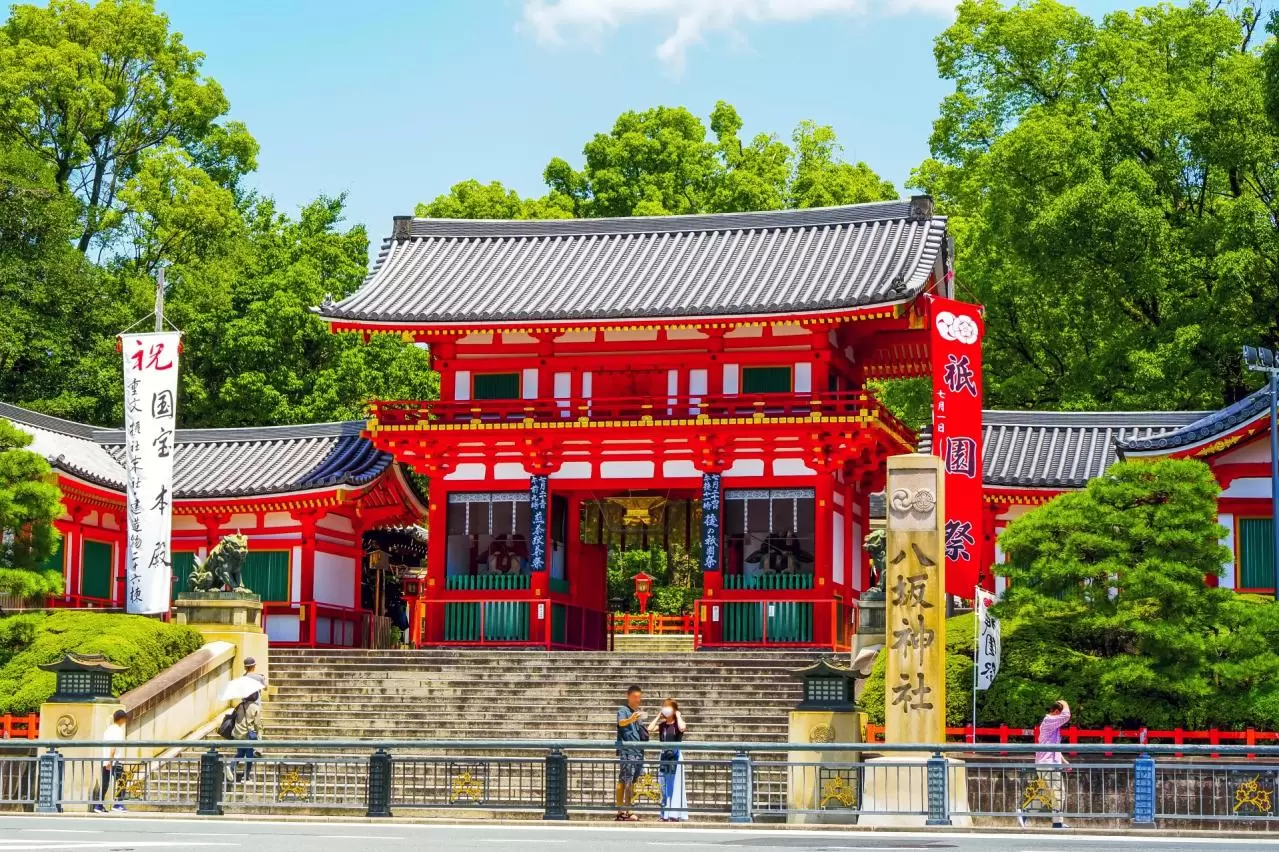
After being destroyed in the Onin War, the West Tower Gate was rebuilt in 1497. It was later re-roofed with tiles during the Eiroku era (1558–1570), and in 1913, when Shijo Street was widened, the gate was relocated and wing corridors were added, giving it its present appearance. Facing Shijo Street, it is one of the symbols of Gion, and is illuminated at night.
● South Tower Gate (Important Cultural Property)
Located directly in front of the main hall, the South Tower Gate serves as the shrine’s main gate. It stands beyond the stone torii gate (an Important Cultural Property), creating a solemn and majestic atmosphere. Compared with the West Tower Gate, the approach here is quieter and filled with a more reverent air.
● Other Cultural Properties
A total of 29 buildings within the precincts, including branch shrines and subsidiary shrines, are designated Important Cultural Properties, making Yasaka Shrine a site of exceptional cultural and historical value. Not only a place of worship, it also contains important remains from the perspective of architectural history.
The Shrine Crest and Its Origin
The shrine crest of Yasaka Shrine is a combination of the “mokko” crest and the “tomoe” crest. The mokko crest is said to have originated in China, where it was first used as a decorative pattern on garments and blinds. It later developed into a motif for headgear and came to be used as a family crest by aristocrats and ancient clans such as the Ki, Tomo, and Kusakabe families.
At Yasaka Shrine, the Ki clan has traditionally inherited shrine administration, and the current crest was formed by combining their mokko crest with the tomoe crest, a symbol of Susanoo-no-Mikoto, revered as a war deity.
Seasonal Attractions
Spring
Spring at Yasaka Shrine is highlighted by the cherry blossoms in the shrine grounds and in the adjoining Maruyama Park. They convey to the present day the prayer for health and prosperity embodied in Susanoo-no-Mikoto’s prophetic poem: “If a thousand cherry trees were to bloom in my garden, the lives of those who planted them would also flourish.” Many visitors come to admire the blossoms.
Summer
Through the Gion Festival, the ancient prayer to protect the capital from epidemics has been passed down. With the Yamahoko procession, the mikoshi procession, and the sounds of Gion Bayashi music, Kyoto’s true summer begins. A month filled with excitement and energy unfolds around Yasaka Shrine.
Autumn
As the trees of Higashiyama turn color, the precincts are enveloped in brilliant autumn leaves. Strolling through the shrine grounds in the clear air, with sunlight filtering through the crimson foliage, creates a special experience befitting the season of harvest.
Winter
On New Year’s Eve, the “Okera Mairi” ritual is held. Sacred fire from the okera lantern within the precincts is transferred to a fire rope and taken home to serve as the fire source for the household altar or hearth. The scent of white atractylodes fills the air, and the flames of the fire rope, spun continuously in the sacred darkness, create a mystical scene that has become a winter tradition in Kyoto.
Yasaka Shrine and the Gion District
Yasaka Shrine is located at the eastern edge of Gion, one of Japan’s most renowned geisha districts, and has long watched over the history and culture of the area. The name “Gion” is said to derive from India’s “Jetavana Monastery,” and is linked to the belief that Gozu Tennō, once enshrined at Yasaka Shrine, was the guardian deity of Jetavana. For this reason, Yasaka Shrine is also called “Gion-sha,” and it is said to be the origin of the district’s name.
Other Highlights
● Gekka Hyonin-ishi (Kien Hyonin-ishi)
This stone monument stands south of the South Tower Gate and was erected in 1839. The words “Jikata” and “Kyokata” are engraved on it, and it is thought to have served as a guide sign at the time. It is known as a stone that connects people by fate and is popular for prayers for matchmaking. Similar stones remain elsewhere in Kyoto, including at Seigan-ji Temple (Nakagyo Ward) and Kitano Tenmangu Shrine (Kamigyo Ward).
Yasaka Shrine has been protected and cherished by the people of Kyoto for more than a thousand years. As a shrine revered for warding off epidemics, it continues to attract many worshippers with its beautiful architecture, rich natural surroundings, and traditions and culture that convey the atmosphere of each season. As one of the most representative shrines of the ancient capital Kyoto, it will no doubt continue to foster enduring faith and lively energy in the years to come.
Kamigamo Shrine (Kamo-wake-ikazuchi Shrine) is one of the oldest shrines in Kyoto, dedicated to the god of thunder, Kamo-wake-ikazuchi no Ōkami. The shrine grounds h...
The Kyoto National Museum was opened in 1897 as the Imperial Kyoto Museum. Located in Kyoto, this museum houses approximately 14,600 artworks and cultural properties...
Fushimi Inari Taisha is the head shrine of approximately 30,000 Inari shrines located in Kyoto. It is believed that the deity Inari was enshrined here in the 4th yea...
Amanohashidate is a special scenic spot located in Miyazu Bay, facing the Sea of Japan in the northern part of Kyoto Prefecture. It is one of the "Three Views of Jap...
Kifune Shrine is an ancient shrine located in Kibune, Sakyo Ward, Kyoto City, and it is the head shrine of about 500 Kifune Shrines nationwide, dedicated to Takao Ka...
Heian Shrine was established in 1895 to commemorate the 1100th anniversary of the relocation of the capital to Heian-kyo, with Emperor Kanmu as its deity. Located in...
Tenryu-ji Temple is a Zen temple located in the Arashiyama district of Kyoto, registered as a UNESCO World Heritage Site. Originally, this site was the location of D...


![[京都|Kyoto]祇園 四条通りを散策|八坂神社、円山公園などの観光名所|Kyoto, Gion Shijo-Street Walking Tour(Vlog)](https://i.ytimg.com/vi/hpoegB1GL4A/mqdefault.jpg)
![[京都|Kyoto]神宮道から円山公園、祇園八坂神社までの名所・観光地を散策|Walking around famous places in Kyoto (Vlog)](https://i.ytimg.com/vi/eo63d0XCeoo/mqdefault.jpg)