Meisho Sengannen
Meisho Sengannen Movies


Basic Information
- Spot Name
- Meisho Sengannen
- Location
- 〒892-0871 9700-1 Yoshino-cho, Kagoshima City, Kagoshima Prefecture
- Access
- It takes about 50 minutes by Kagoshima City View bus from Kagoshima Chuo Station to get to "Senganen-mae." It is also approximately a 20-minute drive from Kagoshima Chuo Station.
- Parking
- Available
- Business Hours
- 9:00 AM to 5:00 PM
- Regular Holiday
- None
- Fees
- [Garden, Shoko Shuseikan, and Goten]
Adults and high school students and above: 1,600 yen
Elementary and junior high school students: 800 yen
[Garden and Shoko Shuseikan]
Adults and high school students and above: 1,000 yen
Elementary and junior high school students: 500 yen - Contact Information
- Phone Number: 099-247-1551
- Official Website
Map
Detailed Information
Sengan-en is a former villa of the Shimadzu family and a daimyo garden located in the Iso district of Yoshino-cho, Kagoshima City. It was built in 1658 by Shimadzu Mitsuhisa, the 19th head of the Shimadzu family and the second lord of the Satsuma Domain. Covering approximately 15,000 tsubo, or about 50,000 square meters, the expansive grounds were used by members of the Shimadzu family from the Edo period through the Meiji period. They also played an important role as a reception venue for distinguished guests from Japan and abroad.
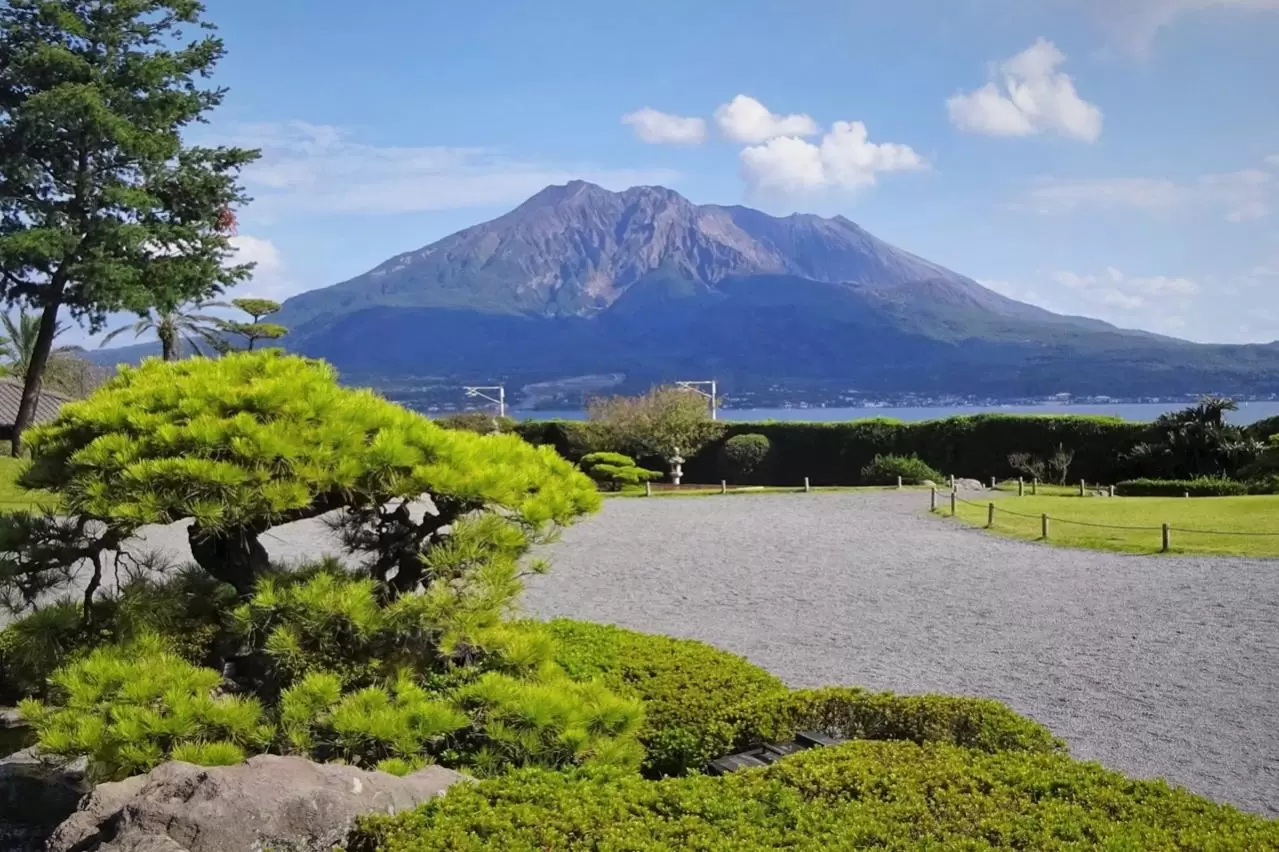
Sengan-en’s greatest feature is its magnificent scenery, which treats the majestic Sakurajima as a borrowed mountain and Kinko Bay as a pond. Rather than creating a large pond or artificial mountain within the garden, the garden incorporates distant mountains and the sea as part of its design through a technique known as shakkei, or “borrowed scenery.” The unified view of Sakurajima, Kinko Bay, the garden’s trees, and its stone arrangements is a masterpiece of daimyo garden design that makes the most of Kagoshima’s distinctive natural environment.
Sakurajima, viewed from the grounds, displays a variety of expressions depending on the weather and time of day. On clear days, its mountain profile stands out sharply beyond the blue waters of Kinko Bay, and visitors may sometimes see plumes of volcanic smoke rising from the crater. The scenery illuminated by the soft light of morning or evening, as well as Sakurajima veiled in rain or mist, has its own unique charm.
Recognizing its historical and artistic value as a garden, Sengan-en was designated a National Place of Scenic Beauty on May 15, 1958, under the official name “Sengan-en and the Hanakura Temporary Residence Garden.” Although the facility is generally written as “仙巌園” in its name, the official name of the nationally designated cultural property uses the old-style character “仙巖園.”
Even after its original construction, Sengan-en continued to be developed by successive heads of the Shimadzu family. In the middle of the Edo period, during the time of the 21st head, Shimadzu Yoshitaka, and the 22nd head, Shimadzu Tsugutoyo, gardens and buildings influenced by Chinese culture were added.
One of the most representative examples is the “Garden of the Winding Stream.” It was created for the Kyokusui-no-En ceremony, in which a sake cup is floated downstream along a winding watercourse. Participants compose a waka poem before the cup reaches them, and then drink the sake. The ceremony is still held in spring today, with participants dressed in costumes reminiscent of the Heian period composing waka poems beside the stream. It is one of Sengan-en’s signature events, offering visitors a sense of the garden’s history and traditional Japanese culture.
The “Kōnan Bamboo Grove,” located toward the rear of the grounds, is another place that reflects the historical exchange with China. It is planted with mōsō bamboo, said to have been brought from China through the Ryukyu Kingdom by the 21st head of the Shimadzu family, Yoshitaka. It is also said that the mōsō bamboo planted at Sengan-en later spread throughout Japan. However, because there are several theories about how mōsō bamboo was introduced to Japan, it cannot be definitively stated that Sengan-en was its sole place of origin.
The enormous rock wall carved into the mountainside, known as “Chihiro-iwa,” is another highlight. The three enormous characters, each said to be approximately 11 meters tall, were completed in 1814 at the order of the 27th head of the Shimadzu family, Narioki. It is said that approximately 3,900 people worked on the project over a period of three months. The idea of incorporating enormous characters into the garden’s natural landscape also shows the influence of Chinese culture.
The “Palace,” located at the center of the garden, was used as a villa and reception hall by the heads of the Shimadzu family. At the end of the Edo period, it was used by the 28th head, Shimadzu Nariakira, and became a place for receiving distinguished visitors from Japan and abroad. During the Meiji period, it became the main residence of the 29th head, Shimadzu Tadayoshi, who lived there until his death in 1897.
The Palace that remains today is centered on the building remodeled in 1884 and contains 25 rooms. Visitors can tour rooms such as the “Lord’s Living Room,” where the head of the family spent much of each day, and the “Audience Chamber,” where guests were received. Each room features distinct transoms and fusuma sliding doors, as well as fittings made from Yakushima cedar, allowing visitors to appreciate the prestige of the Shimadzu family and the outstanding skills of the craftsmen.
The nail-head covers, known as kugikakushi, which conceal the heads of nails in the pillars, also feature a wide variety of designs, including bats, Sakurajima radishes, and writing brushes. Exploring these details, rather than simply viewing the building as a whole, is one of the pleasures of touring the Palace.
The “Suzumon Gate,” located near the entrance to the Palace, is an imposing gate that served as the main gate during the Edo period. It was named for its roof, which is covered with sheets of tin, a specialty of Kagoshima. During the Edo period, it is said that only the domain lord and his heir were permitted to pass through it, and the gate continues to convey the status and prestige of the Shimadzu family.
The “Bōgakuro” is a Chinese-style building in the garden said to have been presented by the king of the Ryukyu Kingdom. Sengan-en hosted distinguished visitors from Japan and abroad, including Katsu Kaishu, a retainer of the shogunate; a delegation led by the Dutch naval officer Dirk de Graeff van Polsbroek—known in Japan as Kattendieke; and a delegation led by British Minister Harry Parkes. It is sometimes said that Shimadzu Nariakira and Katsu Kaishu held talks at the Bōgakuro. However, this account is chronologically impossible, as Nariakira died in 1858, while Katsu Kaishu visited Kagoshima in 1864. The Bōgakuro is a building that conveys the history of the Satsuma Domain’s deep connections with the Ryukyu Kingdom and overseas cultures.
The “Crane Lantern” is known as the place where Shimadzu Nariakira conducted experiments with gas lighting. It was named because the shape of the lantern resembles a crane spreading its wings. It is said that a gas pipe was connected to the top of the stone lantern, and gas was burned to produce light. Nariakira actively adopted Western science and technology, promoting the research and practical application of various technologies, including gas lighting, photography, telegraphy, and steam engines. Sengan-en was not only a beautiful garden but also a setting for experiments that contributed to Japan’s modernization.
The nationally rare “Cat Shrine” enshrines two of the seven cats that the 17th head of the Shimadzu family, Yoshihiro, took with him to Korea during the Bunroku and Keicho campaigns and that survived to return to Japan. It is said that, at the time, people determined the time of day by observing how widely the cats’ pupils were open. Today, the shrine is popular as a place to pray for the health and longevity of cats, and cat-themed votive plaques and amulets are also popular.
Sengan-en played a particularly important role in Japanese history during the time of the 28th head of the Shimadzu family, Nariakira. Concerned about the international situation as Western powers expanded into East Asia, Nariakira promoted modern industries in the Iso district, including ironmaking, shipbuilding, spinning, glass production, and printing. These enterprises became known as the Shuseikan Project and represented a pioneering effort in Japan’s modern industrialization.
Within the grounds are the foundations of a “reverberatory furnace,” built for casting cannon barrels. Referring to Dutch technical books and other sources, Nariakira and his associates attempted to construct the furnace using materials available in Japan and traditional Satsuma techniques. Rather than simply importing Western technology as it was, they interpreted limited information, combined it with existing local techniques, and repeatedly experimented through trial and error. The remains convey this history of technological adaptation.
In 2015, the Former Shuseikan was registered as a component site of the World Cultural Heritage property “Sites of Japan’s Meiji Industrial Revolution: Iron and Steel, Shipbuilding and Coal Mining.” The Former Shuseikan consists of three sites: the Former Shuseikan Reverberatory Furnace Ruins within Sengan-en; the Former Shuseikan Machinery Factory, now the main building of the Shoko Shuseikan Museum; and the Former Kagoshima Foreign Engineers’ Residence, built as housing for foreign engineers.
Accordingly, the entire Sengan-en garden was not independently registered as a World Heritage site. Rather, the registered property is the Former Shuseikan, including the reverberatory furnace ruins within the garden. Through its 23 component sites across Japan, this World Heritage property conveys the process by which Japan rapidly industrialized from the end of the Edo period through the Meiji period.
The adjacent Shoko Shuseikan is a museum introducing the history of the Shimadzu family and Satsuma. The museum’s main building is the former Shuseikan Machinery Factory, completed in 1865. It is considered the oldest surviving Western-style factory building in Japan. Throughout the building, visitors can see how its creators sought to construct a Western-style factory while making use of stone from Satsuma and traditional Japanese building techniques. The building is an Important Cultural Property of Japan and is also a component site of the World Cultural Heritage property.
The Shoko Shuseikan opened as a museum in 1923. It houses more than 10,000 items inherited by the Shimadzu family, including documents, works of art and craft, arms and armor, photographs, and materials related to the Shuseikan Project, and undertakes their preservation, exhibition, and scholarly research. Through its exhibits, visitors can learn about the history of the Shimadzu family since the Kamakura period, its exchanges with the Ryukyu Kingdom and overseas countries, and the modernization projects carried out at the end of the Edo period.
At the nearby Satsuma Kiriko glass factory, visitors can observe the production process of Satsuma Kiriko, one of Kagoshima’s representative glass crafts. Satsuma Kiriko is made by layering thick colored glass over clear glass and having craftsmen carve patterns into each piece by hand. The craft developed in the late Edo period under Shimadzu Nariakira’s policies promoting industry. However, production ceased by the early 1870s due to a combination of Nariakira’s sudden death, the destruction of the Shuseikan facilities during the Anglo-Satsuma War, and the social conditions of the early Meiji period. It was revived approximately 100 years later, and its techniques continue to be passed down by craftsmen today. For peace of mind, visitors should check the factory’s operating days and tour conditions in advance.
Sengan-en also offers beautiful seasonal scenery. From winter through spring, several varieties of cherry trees, including kanhizakura, bloom in succession. In early summer, fresh greenery and hydrangeas add color to the garden; summer brings lush vegetation; and in autumn, the scenery is adorned with autumn foliage and chrysanthemums. Events that evoke the culture passed down by the Shimadzu family and the changing seasons are also held, including the spring Kyokusui-no-En ceremony and the autumn Chrysanthemum Festival. Because the dates and content vary from year to year, it is recommended that visitors check the official information before visiting.
Today, combination tickets are available for Sengan-en, the Palace, and the Shoko Shuseikan. The garden is normally open from 9:00 a.m. to 5:00 p.m. and is generally open year-round, although it may be closed on occasions such as the day of the Kagoshima Marathon.
On March 15, 2025, Sengan-en Station on the JR Nippo Main Line opened, greatly improving access by rail. Visitors can also reach Sengan-en from Kagoshima-Chuo Station and central Kagoshima by local bus, sightseeing loop bus, or car. Admission fees, closure days, and public transportation schedules may change, so visitors should check the latest information before traveling.
Sengan-en is a place where visitors can do more than simply admire the beautiful view of Sakurajima. It offers an opportunity to learn in one place about the lifestyle of the Shimadzu family, Satsuma’s exchanges with the Ryukyu Kingdom and overseas countries, Japan’s modernization, and Kagoshima’s traditional crafts. By strolling through the garden with its borrowed scenery and visiting the Palace, the reverberatory furnace ruins, the Shoko Shuseikan, and the Satsuma Kiriko glass factory, visitors can experience the history of Kagoshima as it transitioned from the Edo period to the Meiji period in a vivid and multifaceted way. It is one of Kagoshima Prefecture’s foremost scenic sites, where the region’s nature, history, culture, and industries come together.
Kagoshima Tourist Attractions
View List
Saigo Takamori Statue
The statue of Saigo Takamori, a great figure born in Kagoshima, stands proudly near the top of Shiroyama. Saigo is well-known as a prominent leader of the Meiji Rest...

Yurigahama Beach
Yurigahama is a beautiful sandy beach created by nature, located in Yakushima Town, Kagoshima Prefecture. The approximately 8 km long stretch of white sand consists ...

Kirishima Shrine
Kirishima Shrine is a shrine located in Kirishima City, Kagoshima Prefecture, dedicated to Ninigi-no-Mikoto, the central figure in the myth of the descent of the hea...

Iowa World Kagosima Aquarium
Iow World Kagoshima Aquarium is located in a prime location with a spectacular view of Kagoshima's symbol, Sakurajima. It is one of the largest aquariums in Kyushu, ...

Ohama Seaside Park
Oohama Seaside Park is a nature-rich park located in Minamisatsuma City, Kagoshima Prefecture. This park, which combines the beautiful coastline of the southern coun...

Jomon Sugi
Jomon Sugi is the most famous giant tree among the Yakusugi trees located on Yakushima Island in Kagoshima Prefecture, with an estimated age ranging from 2,170 to 7,...

Sakurajima
Sakurajima is a composite active volcano known as a symbol of Kagoshima, featuring two main peaks: Kitadake (North Peak) and Minamidake (South Peak). Standing at 1,1...

Chiran Peace Museum
Chiran Peace Museum is located in Minamikyushu City, Kagoshima Prefecture, and serves as a facility to convey the history of the special attack units that launched f...