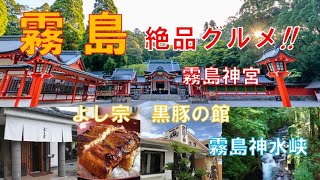
Kirishima Shrine
Kirishima Shrine Movies




Basic Information
- Spot Name
- Kirishima Shrine
- Location
- 〒899-4201 2608-5 Kirishimataguchi, Kirishima City, Kagoshima Prefecture, Japan
- Access
- From JR Nippo Main Line Kirishima Jingu Station, take the Kagoshima Kotsu bus bound for Kirishima Iwasaki Hotel for 13 minutes, and get off at Kirishima Jingu. It’s just a short walk from there. Approximately 40 minutes from the Kyushu Expressway "Mizobe Kagoshima Airport IC."
- Parking
- 500 cars
- Business Hours
- The temple grounds are open to the public, and the gift shop is open from 8:00 AM to 5:30 PM (closed).
- Regular Holiday
- Open all year round.
- Fees
- Free admission and worship.
- Contact Information
- Phone Number: 0995-57-0001
- Official Website
Map
Detailed Information
Kirishima Jingu Shrine, located in Kirishima-Taguchi, Kirishima City, Kagoshima Prefecture, is one of the leading Shinto shrines in southern Kyushu. Surrounded by the rich natural beauty of the Kirishima mountain range, its grounds feature vividly vermilion shrine buildings set amid deep green foliage, creating a distinctive landscape where mythology, volcanoes, history, and architectural culture come together. The shrine is known for enshrining the central figure of the myth of the descent of the heavenly grandson, and many worshippers visit throughout the year.
The shrine’s principal deity is Ame-nigishi Kuni-nigishi Amatsu-hitaka-hiko-ho-no-ninigi-no-Mikoto. He is generally known as Ninigi-no-Mikoto, or simply Ninigi. In Japanese mythology, he is the grandson of Amaterasu Ōmikami and is said to have descended from Takamagahara, the High Plain of Heaven, to “Takachiho in Hyūga” in order to rule the earthly realm. This event is known as the “Descent of the Heavenly Grandson.” At Kirishima Jingu, the site of this descent is identified as the nearby Mount Takachiho, which rises behind the shrine.
The deities enshrined alongside Ninigi-no-Mikoto include his consort, Konohanasakuya-hime-no-Mikoto; their son, Hikohohodemi-no-Mikoto, and his consort, Toyotama-hime-no-Mikoto; as well as Ugayafukiaezu-no-Mikoto, Tamayori-hime-no-Mikoto, and Kamu-yamato-iware-hiko-no-Mikoto. Kamu-yamato-iware-hiko-no-Mikoto is regarded as the historical figure who later became Emperor Jimmu, Japan’s first emperor. Because of this group of enshrined deities, Kirishima Jingu is regarded as a prestigious ancient shrine dedicated to deities connected with the ancestral gods of the Imperial Family.
According to shrine tradition, Kirishima Jingu was founded around the sixth century, although its origins are said to date back to the distant age of the gods. However, the present shrine buildings have not stood in the same location since the shrine was first established. The original buildings are said to have been erected at Seimonoka, located between Mount Takachiho and Mount Ohachi in the Kirishima mountain range. Mount Kirishima is an active volcanic area even today, and the shrine has repeatedly been destroyed by eruptions and subsequently relocated.
Around the year 950, during the Tenryaku era of the tenth century, the buildings are said to have been rebuilt and transferred to Takachiho-gawara by Shōku, a monk of the Tendai school of Buddhism. However, a major eruption in 1234 caused extensive damage once again to the shrine buildings and the monks’ quarters. Later, under the orders of Shimazu Tadamasa, the Shingon Buddhist monk Kenkei rebuilt the shrine buildings and related facilities in 1484.
Those buildings were subsequently destroyed by a fire that began at Karin-ji Temple, the shrine’s former administrative temple. The present shrine buildings were reconstructed in 1715 through a donation by Shimazu Yoshitaka, the 21st head of the Shimazu family and the fourth lord of the Satsuma domain. In this way, the history of Kirishima Jingu is deeply connected with the eruptions and fires of Mount Kirishima, as well as with the efforts of the people who rebuilt the shrine each time it was destroyed.
The present shrine buildings make skillful use of the slope of the grounds. From the Chokushiden Hall, visitors proceed along a covered ascending passageway to the Haiden worship hall, the Heiden offering hall, and finally the Honden main hall, with the buildings rising progressively higher along the way. In particular, the area from the Haiden to the Honden features steep stairways and a considerable difference in elevation. This creates a dynamic, three-dimensional view in which the shrine buildings appear to climb up the mountain.
The Honden, Heiden, and Haiden were designated National Treasures by an official gazette notice dated February 9, 2022. The three buildings are treated as a single connected structure, whose official designation is “Kirishima Jingu Honden, Heiden, and Haiden.” The ascending passageway and Chokushiden Hall, meanwhile, are Important Cultural Properties of Japan. Therefore, it is accurate to describe Kirishima Jingu as a group of buildings comprising both National Treasures and Important Cultural Properties, rather than saying that all of the shrine buildings are National Treasures.
The shrine buildings are predominantly vivid vermilion and feature splendid designs incorporating lacquerwork and brilliant polychrome decoration in key areas. Their details include pillars carved with three-dimensional dragons, as well as carvings of plants, animals, and human figures, murals, and elaborate bracket complexes. The buildings are highly regarded not only for their scale but also for the quality of their architecture and decoration, and are considered one of the finest expressions of the ornamental design traditions that developed in Shinto architecture during the Edo period.
The shrine’s dragon pillars, which are representative examples of a tradition found in southern Kyushu, are particularly important from a cultural and historical perspective. However, certain interior features and decorations are not normally open to the public, including the “Twenty-Four Paragons of Filial Piety” paintings depicting Chinese stories of filial devotion on the exterior walls of the Honden, as well as the dragon pillars of the Heiden. Special viewings are occasionally held, but their dates are limited. Visitors who wish to attend should check the official website in advance.
The approach to the shrine is another major attraction of Kirishima Jingu. Along the main approach, visitors cross a vividly vermilion shrine bridge and climb approximately 80 steep stone steps. Beyond them, a lush approach continues toward the second and third torii gates. Surrounded by enormous cedar trees, the path is quiet, allowing visitors to walk while listening to birdsong and the sound of leaves moving in the breeze. The contrast between the brilliant vermilion shrine buildings and the deep green of the surrounding forest is beautiful and has become one of the landscapes most closely associated with Kirishima Jingu.
The sacred tree standing within the grounds is a cedar estimated to be approximately 800 years old. It is sometimes called the ancestor of the cedars of southern Kyushu and has watched over the shrine’s history for many centuries. When part of its branches is viewed from below, it is said to resemble a Shinto priest wearing an eboshi hat and ceremonial robes. Because its appearance changes depending on the viewing angle, looking for this figure can be an enjoyable part of a visit, provided that visitors take care not to damage the sacred tree or surrounding nature and do not obstruct other worshippers.
The grounds are also home to a “sazare-ishi,” or conglomerate rock, mentioned in the lyrics of Japan’s national anthem, “Kimigayo.” The word sazare-ishi originally means small stones. The rock at the shrine was formed when numerous small stones became bonded together over a long period by calcareous material, eventually taking the form of one large boulder. The transformation of tiny stones into a great rock over time is cherished as a symbol of continuity and prosperity.
Kirishima Jingu has long preserved nine masks known as the “Kumen.” Because the word Kumen sounds similar to kument, meaning the management or arranging of money and various matters, these masks have attracted a unique form of devotion as lucky charms associated with financial fortune, business, and managing everyday life. Amulets and other protective items featuring the nine masks are also available, and they are cherished as part of the distinctive culture of Kirishima Jingu.
A local performing art inspired by the nine masks is the Tenson Kōrin Kirishima Kumen Taiko. Performers dress in white or pale purple costumes, wear the nine masks, and portray the deities of Japanese mythology while powerfully playing taiko drums and conch shells. On New Year’s Day, the performance is generally dedicated at the shrine at midnight and again at 2:00 a.m. It may also be presented in connection with other festivals, such as the Kigensai Festival, although the schedule can vary from year to year. The New Year’s Day performance may also be canceled in rainy weather, so visitors who wish to watch it should check the latest information in advance. The City of Kirishima provides information under the title “New Year’s Day Dedication of the Tenson Kōrin Kirishima Kumen Taiko.”
Legends known as the “Seven Mysteries of Kirishima” also remain along the former approach to the shrine and in the surrounding area. They include the “Seeds That Were Never Sown,” said to have grown naturally from seeds brought down from Takamagahara during the descent of the heavenly grandson; “Monji-iwa,” a rock whose inner surface bears patterns resembling writing; “Kame-ishi,” a natural stone shaped like a turtle; and “Kazahana,” a rock cave from which wind was once said to blow.
The other mysteries include the Mitarai River, whose water volume changes dramatically depending on the season; the Ryōdo River, which is said to flow twice during the year; and “Midnight Kagura,” the mysterious sound of kagura music said to be heard late at night. Regarding Kazahana, visitors are currently informed that wind is no longer coming from the cave. It is therefore best understood not as a phenomenon that continues to occur constantly, but as a historical legend passed down in the region.
From the observation point on the western side of the shrine grounds, visitors may be able to see Kagoshima Bay, also known as Kinko Bay, Sakurajima, and the urban area of Kagoshima City when the weather is clear. On exceptionally clear days, it may even be possible to see in the direction of Mount Kaimondake farther to the south. Despite being located in the mountains of Kirishima, the shrine offers sweeping views of the sea and volcanoes that represent Kagoshima, allowing visitors to appreciate how richly endowed its setting is with natural scenery.
The landscape changes with the seasons: cherry blossoms in spring, vivid fresh greenery in early summer, autumn foliage, and quiet, clear air in winter. Cherry blossoms are generally at their best around late March, while the autumn foliage is usually at its peak from late November to early December. However, the timing of flowering and leaf coloration varies depending on the temperatures and weather conditions each year. In autumn especially, the red and yellow leaves combine with the vermilion of the torii gates and shrine buildings, enveloping the grounds in a particularly brilliant atmosphere.
Kirishima is also known as a place visited in 1866 by the late-Edo-period revolutionary Sakamoto Ryōma and his wife, Oryō. It is said that they treated Ryōma’s wounds from the Teradaya Incident at places such as Shiohitashi Onsen, then climbed Mount Takachiho and saw the Ama-no-Sakahoko spear at the summit. This journey is sometimes called “Japan’s first honeymoon.”
It is documented that the couple visited Kirishima and climbed Mount Takachiho, but it is necessary to be cautious when stating whether they also worshipped at Kirishima Jingu. Because of the couple’s connection with Kirishima, and because Ninigi-no-Mikoto and Konohanasakuya-hime-no-Mikoto are enshrined together, some visitors come to pray for success in love and marital harmony.
Kirishima Jingu is approximately a one-hour-and-twenty-minute drive from Kagoshima-Chūō Station, although travel times vary depending on the route and road conditions. Visitors using public transportation can take a bus from JR Kirishima Jingu Station or Kagoshima Airport. The bus ride from JR Kirishima Jingu Station to the shrine generally takes about 13 to 15 minutes. However, routes, services, the number of buses, and ticketing systems may change, so it is important to check the latest timetable before visiting.
The shrine grounds are freely open for worship, and there is no admission fee. Applications for prayers and services at the amulet office are generally accepted from 8:00 a.m. to 5:00 p.m., although these hours may change due to festivals and special events. Free parking is available, but the surrounding roads and parking areas may become crowded during the New Year season and the cherry blossom and autumn foliage periods.
Kirishima Jingu is not simply a place to view beautiful vermilion shrine buildings. It is a place where visitors can experience, all at once, the myth of the descent of the heavenly grandson, the history of eruptions and reconstruction at Mount Kirishima, the architectural culture left by the Shimazu family, and the beliefs and legends passed down through the local community. By walking slowly along the approach and visiting the National Treasure shrine buildings, sacred tree, sazare-ishi, observation point, and other sites, visitors can gain a deeper appreciation of the history shaped over many centuries by Kirishima’s natural environment and the prayers of its people.
Kagoshima Tourist Attractions
View List
Jomon Sugi
Jomon Sugi is the most famous giant tree among the Yakusugi trees located on Yakushima Island in Kagoshima Prefecture, with an estimated age ranging from 2,170 to 7,...

Sakurajima
Sakurajima is a composite active volcano known as a symbol of Kagoshima, featuring two main peaks: Kitadake (North Peak) and Minamidake (South Peak). Standing at 1,1...

Meisho Sengannen
Sengan-en is a villa built by Shimizu clan's 19th generation leader, Mitsuhisa, in the first year of Manji (1658). It is a grand feudal lord's garden designed with S...

Iowa World Kagosima Aquarium
Iow World Kagoshima Aquarium is located in a prime location with a spectacular view of Kagoshima's symbol, Sakurajima. It is one of the largest aquariums in Kyushu, ...

Ohama Seaside Park
Oohama Seaside Park is a nature-rich park located in Minamisatsuma City, Kagoshima Prefecture. This park, which combines the beautiful coastline of the southern coun...

Yurigahama Beach
Yurigahama is a beautiful sandy beach created by nature, located in Yakushima Town, Kagoshima Prefecture. The approximately 8 km long stretch of white sand consists ...

Saigo Takamori Statue
The statue of Saigo Takamori, a great figure born in Kagoshima, stands proudly near the top of Shiroyama. Saigo is well-known as a prominent leader of the Meiji Rest...

Chiran Peace Museum
Chiran Peace Museum is located in Minamikyushu City, Kagoshima Prefecture, and serves as a facility to convey the history of the special attack units that launched f...