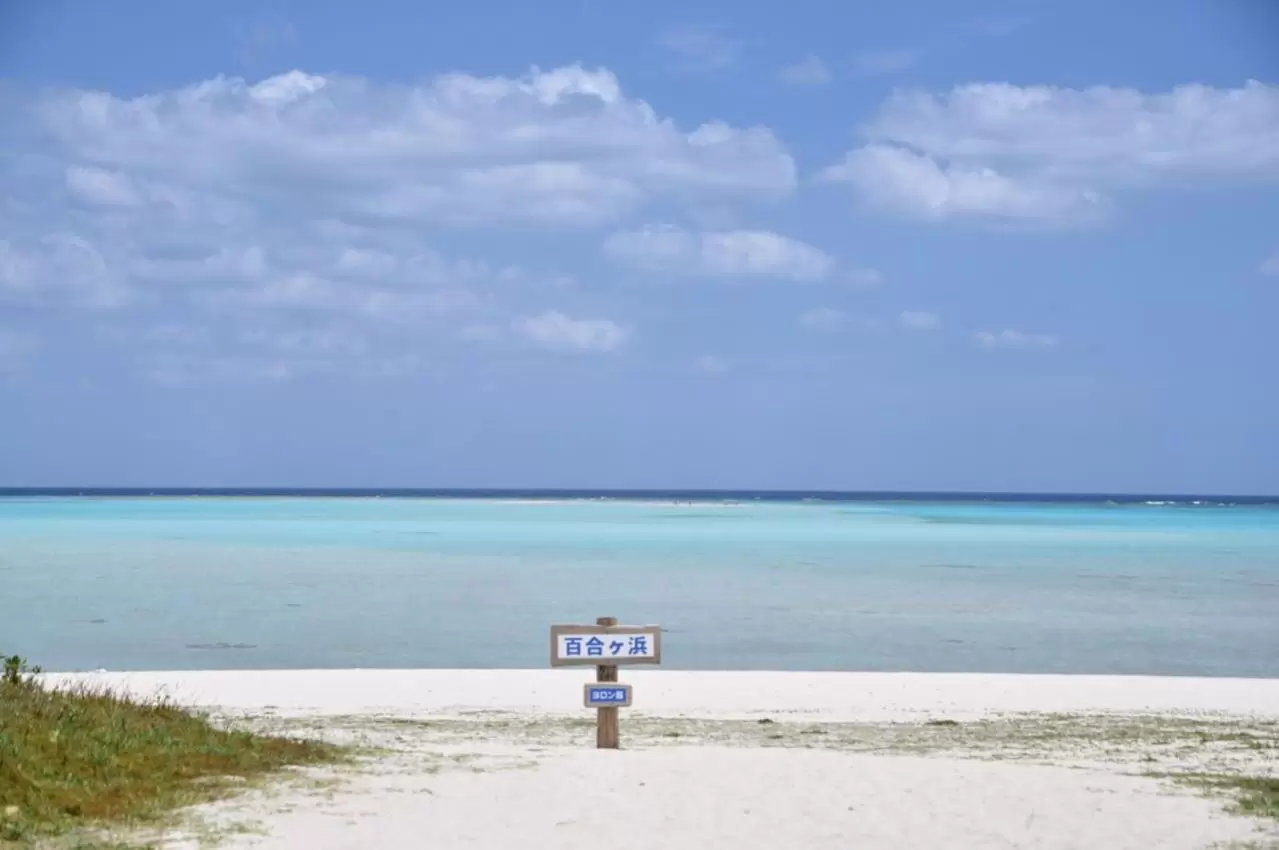
Yurigahama Beach
Yurigahama Beach Movies


Basic Information
- Spot Name
- Yurigahama Beach
- Location
- 891-9307 Kagoshima Prefecture, Oshima District, Yoron Town, Ozaki Furusato
- Access
- It takes 20 minutes by taxi from Yoron Airport to Okinikuhama Beach, and 10 minutes by glass boat to Yuriga-hama (40 minutes with a sightseeing tour).
- Parking
- Parking available
- Business Hours
- None in particular.
- Regular Holiday
- None in particular.
- Contact Information
- Phone Number:0997-97-5151
FAX Number:0997-97-4610
- Official Website
Map
Detailed Information
Yurigahama is a white sandbar that emerges from the sea with the changing tides on Yoron Island in Yoron Town, Oshima District, Kagoshima Prefecture. It lies in shallow waters approximately 1.5 kilometers offshore from Ōgane-ku Coast on the eastern side of Yoron Island. Because it appears only for a limited time, it is known as a “phantom beach.”
Yurigahama is not a beach in Yakushima Town; it is one of the most famous tourist attractions on Yoron Island, the southernmost island in Kagoshima Prefecture. Nor is it a permanent beach extending for approximately eight kilometers. Rather, it is a natural sandbar formed when sand deposited in shallow waters rises above the surface under the right conditions, including the tide level, wind, and waves.
The waters around Yurigahama are exceptionally clear and surrounded by coral reefs. Near the shore, the sea is a pale blue; as it becomes deeper, it changes to emerald green and then to a deep blue farther offshore. The sight of the brilliant white sandbar emerging from these waters is beautiful and widely known as one of the signature landscapes of Yoron Island.
The white sand of Yurigahama is believed to contain many particles derived from organisms whose main component is calcium carbonate, including coral, shells, and foraminifera. These materials are finely broken down and carried by waves and currents before accumulating in shallow waters, forming the white sandbar. In some areas, visitors can enjoy the fine texture of the sand, while the beautiful patterns etched into its surface by waves and currents are another highlight.
The sandbar is not fixed in one location. Because the sand shifts with the currents, its position, size, and shape differ from day to day. On some days, a broad stretch of sand appears, while on others, only a very small area emerges above the water. As the tide begins to rise, the sandbar gradually shrinks and eventually disappears beneath the sea once again. The way the landscape can change dramatically within a short time is part of Yurigahama’s mysterious appeal.
Yurigahama is generally more likely to appear from spring through autumn during low tide, particularly during medium to spring tides. However, it does not necessarily appear on every spring-tide day during this period. Depending on the natural conditions on a given day—including not only the tide level but also the wind, waves, and condition of the sand on the seabed—it may not emerge. Conversely, it may sometimes appear on days not listed in the forecast.
The Yoron Island Tourism Association publishes a “Yurigahama Appearance Forecast Calendar” based on tide tables. The calendar lists days when the sandbar is likely to appear, along with approximate low-tide times, but it is only a forecast. It can be useful when planning a trip, but whether Yurigahama actually appears, whether boats can operate, and whether visitors can land there must be determined by marine operators after checking the sea conditions on the day.
There are no bridges or roads leading to Yurigahama. Since it is approximately 1.5 kilometers offshore and the currents and water depth change constantly, attempting to walk or swim there independently is dangerous. Visitors generally use glass-bottom boats, small vessels, or personal watercraft operated by marine tour companies on the island.
Boats depart from locations such as Ōgane-ku Coast, Mugiya Fishing Port, and Mita Coast. However, the meeting place and type of transportation vary depending on the marine operator or tour. Tours are scheduled around low tide, so departure times also differ from day to day. For peace of mind, make a reservation in advance and confirm the meeting place, meeting time, price, duration, and any items you need to bring.
The boat ride from Ōgane-ku Coast to Yurigahama is relatively short, but on a glass-bottom boat, you may be able to observe coral and tropical fish through the viewing windows in the hull. If you are lucky, you may even see a sea turtle. However, the marine life that can be seen varies depending on the route, sea conditions, and season, so sightings are not guaranteed.
Tours may be changed or canceled because of strong winds, high waves, lightning, or an approaching typhoon. Even if a boat departs, the sandbar may not emerge sufficiently for visitors to land. Some tours may be changed to cruises around the surrounding waters if landing is not possible, but the response varies by operator. Since Yurigahama is created by a natural phenomenon, visitors should understand that it may not be possible to see it as planned.
After landing on Yurigahama, visitors can enjoy an open landscape surrounded by emerald-green water. You can spend time walking on the white sand, admiring the sand patterns, and taking photographs with the sea in the background. Watching the boundary between the water and the sandbar move, and observing the sandbar change shape as time passes, is another experience unique to this place.
Yurigahama is associated with a local legend that says you will become happy if you find as many star sands as your age. Star sand is not ordinary mineral sand; it consists of the star-shaped shells of foraminifera. If you search carefully through the sand, you may find some, making this a popular activity at Yurigahama.
Even when looking for star sand, do not take large quantities of sand or shells home, and follow the guidance and rules of local tour operators. Collecting a small amount of star sand is not uniformly prohibited, but it is important not to collect more than necessary in order to protect the natural landscape.
Tours around Yurigahama may also include marine activities such as snorkeling and stand-up paddleboarding. In the clear waters, you may be able to observe coral and colorful fish. When snorkeling, be careful not to stand on, touch, or break living coral. You should also avoid chasing fish or sea turtles or feeding them.
Yurigahama itself has no permanent facilities such as the toilets, changing rooms, shops, or shaded areas found at ordinary swimming beaches. Make the necessary preparations before departing, and ask the tour operator about the facilities and services available. Leaving food or garbage behind can affect the marine ecosystem and landscape, so be sure to take everything you bring with you back home.
Although the surrounding sea may appear calm, the water depth can change suddenly because of fluctuations in the tide level and currents. Even strong swimmers should avoid acting alone and follow the instructions of guides and tour operators. Whether on board or in the water, everyone should wear a life jacket correctly as instructed by the operator, regardless of age or swimming ability. This is especially important when traveling with children: an adult should stay close and keep them under constant supervision.
When landing on the sandbar, clothing that can get wet and marine shoes or sandals with secure heel straps are suitable. Since you may need to enter the water when boarding or disembarking, it is safer to avoid long skirts and slippery footwear.
There is very little shade at Yurigahama, so protection from ultraviolet rays and heatstroke is essential. Bring a hat, sunscreen, a rash guard, and drinking water. If you bring a smartphone or camera, using a waterproof case or dry bag is recommended. Your clothing and belongings may get wet from seawater or spray, so it is also a good idea to bring a towel and a change of clothes. If you are concerned about seasickness, you may wish to take motion-sickness medication in advance.
Ōgane-ku Coast, a popular departure point for Yurigahama, is also one of Yoron Island’s beautiful signature beaches. Its white sand and shallow waters stretch along the coast, and even on days when Yurigahama does not appear, visitors can enjoy swimming, walking, and taking in the beautiful sea. Ōgane-ku Coast has facilities such as parking and toilets, but these facilities are not located on Yurigahama offshore. Ōgane-ku Coast is approximately 20 minutes by car from Yoron Airport or Yoron Port.
Yoron Island lies at the southernmost end of the Amami Islands, approximately 23 kilometers north of Cape Hedo, the northernmost point of Okinawa’s main island. It is known as a relatively flat island formed by uplifted coral reefs and is surrounded by coral reefs and exceptionally clear waters.
Yoron Island can be reached by air or ferry from Kagoshima, Amami, Okinawa, and other locations. However, departure and arrival points, operating days, and transfer procedures vary depending on the transportation provider, and services may be canceled because of typhoons, high waves, or other conditions. Be sure to check the latest schedules and operating information before your trip.
When planning your trip, check not only the Yurigahama appearance forecast but also flight and ferry operating conditions, the local weather, and wave information. Because Yurigahama is a natural phenomenon, it is not guaranteed to be visible even if you visit Yoron Island. Including other attractions on the island—such as Ōgane-ku Coast, the ruins of Yoron Castle, the Southern Cross Center, and Yoron Folk Village—in your itinerary can make it easier to adapt if the weather or sea conditions change.
The appeal of Yurigahama lies not only in the beauty of its white sand. It is also the experience of watching it emerge from the sea as the tide recedes and then disappear beneath the waves again after a certain amount of time. Because its location, shape, and size differ each time, the landscape you see on any given day will never be exactly the same again.
The white sand illuminated by the sun, the sea changing through layers of blue, the sand patterns drawn by the waves, and the coral reefs spreading around the sandbar are all the products of Yoron Island’s abundant natural environment, shaped over a long period of time. By checking the appearance forecast and the sea conditions on the day of your visit, and by taking care to stay safe and protect the natural environment, you can enjoy a truly special experience unique to Yoron Island at Yurigahama.
Kagoshima Tourist Attractions
View List
Sakurajima
Sakurajima is a composite active volcano known as a symbol of Kagoshima, featuring two main peaks: Kitadake (North Peak) and Minamidake (South Peak). Standing at 1,1...

Saigo Takamori Statue
The statue of Saigo Takamori, a great figure born in Kagoshima, stands proudly near the top of Shiroyama. Saigo is well-known as a prominent leader of the Meiji Rest...

Kirishima Shrine
Kirishima Shrine is a shrine located in Kirishima City, Kagoshima Prefecture, dedicated to Ninigi-no-Mikoto, the central figure in the myth of the descent of the hea...

Chiran Peace Museum
Chiran Peace Museum is located in Minamikyushu City, Kagoshima Prefecture, and serves as a facility to convey the history of the special attack units that launched f...

Ohama Seaside Park
Oohama Seaside Park is a nature-rich park located in Minamisatsuma City, Kagoshima Prefecture. This park, which combines the beautiful coastline of the southern coun...

Meisho Sengannen
Sengan-en is a villa built by Shimizu clan's 19th generation leader, Mitsuhisa, in the first year of Manji (1658). It is a grand feudal lord's garden designed with S...

Jomon Sugi
Jomon Sugi is the most famous giant tree among the Yakusugi trees located on Yakushima Island in Kagoshima Prefecture, with an estimated age ranging from 2,170 to 7,...

Iowa World Kagosima Aquarium
Iow World Kagoshima Aquarium is located in a prime location with a spectacular view of Kagoshima's symbol, Sakurajima. It is one of the largest aquariums in Kyushu, ...