Jomon Sugi
Jomon Sugi Movies


![[屋久島旅行] 縄文杉トレッキング -3時半起床、22キロの山道を7時間半歩く- | 一生に一度は行きたい九州10日間の旅 #3](https://i.ytimg.com/vi/9Ds-V5GnalE/mqdefault.jpg)


Basic Information
- Spot Name
- Jomon Sugi
- Location
- 〒891-4205 Yakushima Town, Kumage District, Kagoshima Prefecture
- Access
- From the entrance of Miyanoura Port, take the bus to Yakusugi Nature Museum operated by Tanegashima and Yakushima, which takes 43 minutes. At the last stop, transfer to the Arakawa Mountaineering Bus (not operating in winter) for 35 minutes. Get off at the last stop and walk for 5 hours.
- Parking
- [March to November]
Approximately 160 cars in front of the Yakusugi Nature Museum
[December to February]
Approximately 20 cars at the Arakawa Trailhead - Business Hours
- Open for visits.
- Contact Information
- Phone Number:0997-43-5900
- Official Website
Map
Detailed Information
Jomon Sugi is a particularly famous ancient giant among the Yaku cedars growing deep in the mountains of Yakushima, Kagoshima Prefecture. It stands at an elevation of approximately 1,328 meters within an area registered as a World Natural Heritage Site. With its majestic appearance, it is widely recognized as a symbol of Yakushima’s natural environment.
According to the latest survey, conducted from 2022 to 2023, Jomon Sugi was measured at 22.2 meters in height, with a circumference of 16.1 meters at breast height. Earlier tourism materials widely cited figures of 25.3 meters in height and 16.4 meters in circumference at breast height, but the official website of Yakushima Town now lists the latest measurements. Jomon Sugi is considered the largest Yaku cedar currently known to exist.
On Yakushima, naturally growing cedars that are generally more than 1,000 years old are called “Yaku sugi,” while younger cedars are called “kosugi.” Yaku cedars are not a separate plant species; botanically, they are the same species as the cedars growing on Japan’s main islands. However, because they grow over many centuries in Yakushima’s distinctive natural environment, they develop an appearance unlike that of cedars on the mainland.
Yakushima is an island formed on a granite foundation, and its mountainous areas contain extensive nutrient-poor soil. The island also receives extraordinarily heavy rainfall and is frequently exposed to typhoons and strong winds. Yaku cedars have grown slowly under these harsh conditions. Because of their slow growth, they have fine annual rings, and their wood contains large amounts of resin. As a result, they are resistant to decay and are thought to be capable of surviving for exceptionally long periods.
In Yakushima’s forests, cedars become increasingly prominent from around 500 meters above sea level. As the elevation rises, they form rich forests mixed with a variety of other trees, including firs, hemlocks, and Japanese stewartias. Mosses, ferns, shrubs, and other plants grow on the trunks and branches of giant trees, and in some cases a single Yaku cedar creates an environment resembling a small forest.
The exact age of Jomon Sugi is unknown. It has traditionally been introduced as having an estimated age ranging from approximately 2,170 to 7,200 years. Official information from Yakushima Town likewise gives its estimated age as “between 2,000 and 7,200 years.”
Meanwhile, a survey of giant and notable Yaku cedars conducted from 2022 to 2023 by the Kyushu Regional Forest Office and other organizations estimated Jomon Sugi’s age at between 1,300 and 3,600 years, with a median estimate of 2,400 years, based on references including cross-sectional samples from Yaku cedars. Because estimates vary greatly depending on the surveying method, none of these figures definitively establishes the exact age of Jomon Sugi.
The central part of Jomon Sugi’s trunk is hollow, so its age cannot be determined by the usual method of directly counting the annual rings all the way to the center. Scientific measurements of samples taken from the interior have indicated an age of approximately 2,170 years, but this figure also does not establish the exact age of the entire tree. Consequently, several theories give widely varying estimates of Jomon Sugi’s age.
There are also several theories about the origin of the name “Jomon Sugi.” One theory is that it refers to a cedar so old that it has survived since the Jomon period. Another is that the deeply twisted surface of its trunk resembles the patterns found on Jomon pottery. If the 7,200-year estimate is correct, the tree would date back to the Jomon period, but this has not been scientifically confirmed. It is therefore more appropriate to describe Jomon Sugi not as a tree definitively known to have lived since the Jomon period, but as an ancient giant that may have survived for several thousand years.
Like other Yaku cedars that have endured Yakushima’s frequent typhoons, Jomon Sugi is not exceptionally tall. Instead, it has a stocky form with an extremely thick trunk. Large knobs and deep grooves cover the surface of the trunk, while its branches extend in complex patterns. Its rugged and powerful appearance is very different from that of smooth, straight cedars.
Cedar logging was actively carried out on Yakushima from the Edo period onward. Logged Yaku cedars were processed into roofing materials known as “hiraki” and submitted as taxes. However, Jomon Sugi’s heavily uneven trunk would have been difficult to process as lumber, and it is thought that this may be why it escaped being cut down. In this sense, the complex shape that made the tree difficult for people to use may ultimately have allowed Jomon Sugi to survive to the present day.
Jomon Sugi appears to have been known to local people for some time, but it was officially identified in 1966 by Teiji Iwakawa, then an employee of the Yakucho Town Office. It became widely known after being featured in newspapers the following year. It was initially sometimes called “Oiwa Sugi,” but the name “Jomon Sugi” eventually became established. In 1990, it was also selected as one of the “New Hundred Famous Trees of Japan.”
On Yakushima, vegetation changes according to climate and elevation, from the coast to the mountain peaks, including Mount Miyanoura, which reaches approximately 1,936 meters. One of Yakushima’s defining characteristics is its vertical distribution of vegetation, in which plants ranging from those found in the subtropics near the coast to cool-temperate species near the mountain summits can be observed in continuous succession.
This vertical distribution of vegetation, along with Yakushima’s unique ecosystems and landscapes, including natural forests where Yaku cedars more than 1,000 years old grow alongside other trees, was highly valued. As a result, Yakushima was registered in 1993, together with the Shirakami-Sanchi mountains, as one of Japan’s first World Natural Heritage Sites. Jomon Sugi grows within the registered World Natural Heritage area, but the single tree itself is not individually registered as a World Heritage site. It is one of the important elements of Yakushima’s outstanding natural environment.
Visitors are currently not allowed to approach the base of Jomon Sugi or touch its trunk. In the past, hikers were able to enter the area around the tree, but after Yakushima was registered as a World Natural Heritage Site, the number of visitors increased, and damage to the roots caused by trampling, as well as impacts on the surrounding vegetation, became a concern.
To protect Jomon Sugi, a wooden observation deck was installed in 1996 at a certain distance from the base of the tree. Today, several viewing areas have been developed from which visitors can observe Jomon Sugi. Hikers can view the trunk and branches from different directions without stepping on the roots or surrounding vegetation. Although visitors cannot touch the tree up close, viewing it from the observation areas allows them to appreciate its enormous size and its relationship with the surrounding forest.
The most popular hiking route to Jomon Sugi is the round trip from the Arakawa Trailhead. The total distance is approximately 22 kilometers, and the standard time required is about nine to ten hours, including breaks. Even one way takes approximately four to five hours. However, the hike may take considerably longer depending on the hiker’s physical condition, the weather, the state of the trail, and the level of congestion.
This is a full-day, serious trek that begins early in the morning and requires returning by evening; it is not a short walking trail at an ordinary tourist attraction. Sufficient physical fitness, proper hiking equipment, and careful time management are essential for this mountain route.
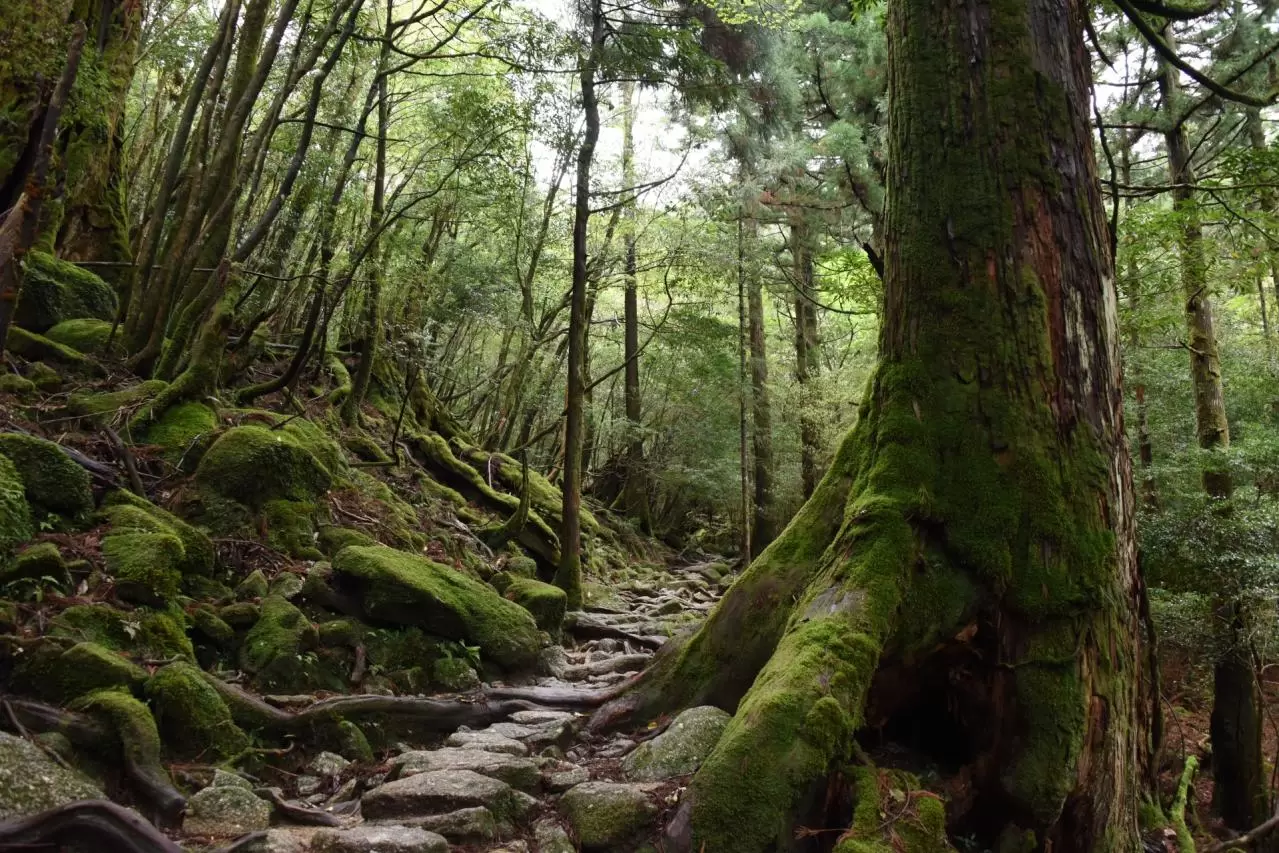
For a while after leaving the Arakawa Trailhead, hikers follow a forest railway track, commonly called the “trolley trail,” which was once used to transport logged timber. The trolley trail is relatively gentle, but the long stretches of sleepers and wooden walkways can place considerable strain on the feet and knees.
There are also narrow bridges and places where handrails are inadequate. In wet weather, the sleepers and wooden walkways become slippery, so hikers must watch their footing and proceed carefully. Even on gentle sections, it is easy to trip over the sleepers while looking at the scenery, so caution is necessary.
Along the route is the site of Kosugidani Settlement, which once prospered as a forestry community. Kosugidani had a school, houses, shops, and other facilities, and many people lived there. However, as the forestry industry changed and the national forest office was closed, the settlement was shut down and abandoned in 1970. Today, remains such as the former school site convey the history of Yakushima’s forests and the lives of the people who lived there.
Beyond the entrance to the Okabu Trail, located near the end of the trolley trail, the route becomes a proper mountain path. Steep stairs, slopes with exposed tree roots, and rocky sections continue from there, requiring more physical strength and attention than the trolley trail.
After rain, the trail becomes muddy, and rocks and exposed roots become slippery. Yakushima receives extremely heavy rainfall, and the weather can change in the mountains even if the sky is clear at the trailhead. High-quality waterproof rainwear is therefore essential.
One of the major highlights along the way is the Wilson Stump. This is the enormous stump of a Yaku cedar said to have been felled during the time of Toyotomi Hideyoshi. The cut surface is more than four meters in diameter. The hollow interior is approximately the size of ten traditional tatami mats, and visitors can enter it. Clear water springs from inside the stump, where a small shrine is also enshrined.
When visitors look up at the sky from a particular spot inside, the opening of the stump appears heart-shaped, making it a popular photography location. However, the shape changes depending on the position and angle, so visitors should watch their footing while looking for the best place to take photographs.
The Wilson Stump was named after Ernest Henry Wilson, a British-born plant collector who studied Yakushima’s flora. Wilson visited Yakushima in the early twentieth century, photographed this enormous stump, and introduced it to the wider world. He collected plants for institutions including the Arnold Arboretum of Harvard University in the United States, so he had strong connections with the United States, but he was British by birth.
Along the Okabu Trail, visitors can also see other famous Yaku cedars, including Daio Sugi and the Meoto Sugi. Before Jomon Sugi became widely known, Daio Sugi was admired as one of Yakushima’s largest and most representative cedars and was affectionately known as the “Great King.”
Meoto Sugi is a pair of Yaku cedars whose branches are connected in midair approximately ten meters above the ground, forming what is known as a “fused-branch tree.” The trees were named because their appearance resembles a married couple holding hands. By observing these giant trees in succession, hikers can appreciate not only Jomon Sugi but also the profound character of the Yaku cedar forest as a whole.
For the hike to Jomon Sugi, visitors need well-worn hiking boots with good traction, highly waterproof two-piece rainwear, warm clothing, a hat, gloves, drinking water, lunch, high-energy snacks, a headlamp, a map, and other essentials. A folding umbrella alone is not adequate rain protection because it prevents the use of both hands on the mountain trail and is vulnerable to strong winds.
If setting out while it is still dark in the early morning, or in case the return takes longer than planned, bring a headlamp and spare batteries. It is useful to download a hiking map app to your phone in advance and carry a portable charger, but some areas have no reception, so it is important not to rely solely on a smartphone.
There are only a limited number of toilets along the trail, and they may be unavailable because of malfunctions or congestion. Portable-toilet booths are installed at some locations, so carrying a portable toilet is recommended. Used portable toilets must not be left in the mountains; they must be placed in designated collection boxes at locations such as the trailhead. Carrying sealable bags is also advisable.
Every year, from March 1 through November 30, private vehicles are restricted on the road leading to the Arakawa Trailhead. During this period, hikers generally take the Arakawa Trailhead bus from in front of the Yakusugi Museum.
The operating period, timetable, ticket sales procedures, fares, and other details may change from year to year. Buses may also be suspended, and roads may be closed because of heavy rain, typhoons, or road conditions. It is important to check the latest hiking and transportation information announced by Yakushima Town or the Yakushima Tourism Association on the day before setting out.
People who are unsure about their physical fitness or hiking experience should consider hiring a hiking guide. In addition to adjusting the walking pace and timing of breaks, a guide can assess the weather and trail conditions and explain the Yaku cedars, local plants, and the history of forestry.
However, even with a guide, hikers must walk the approximately 22-kilometer round-trip route on their own feet. It is important to build the required stamina before the trip through long walks, climbing and descending stairs, and similar training. If you feel unwell or the weather is exceptionally bad, do not force yourself to proceed; be prepared to cancel the hike or turn back.
During the hike to Jomon Sugi, it is also important to remain on designated trails and wooden walkways. Stepping into areas beside the trail can damage plants and lead to soil erosion or exposure of the roots of Yaku cedars. Even when the trail is crowded, do not leave the designated path. Follow the rules for protecting nature, including taking all garbage with you and refraining from collecting plants or moss.
In Yakushima, visitors are encouraged to contribute to the “Mountain Area Environmental Conservation Cooperation Fund,” which supports the maintenance of mountain trails and toilets and the conservation of the natural environment. The understanding and cooperation of every hiker are essential to passing on Yakushima’s precious natural environment, including Jomon Sugi, to future generations.
After crossing the long trolley trail and rugged mountain paths, visitors finally encounter Jomon Sugi standing deep in the forest. At that moment, they can feel not only the tree’s enormous size but also the weight of a passage of time that may span several thousand years. The trunk, which has continued to live through Yakushima’s harsh natural conditions—including heavy rain, typhoons, strong winds, lightning strikes, and snow—seems to bear the entire long history of the island.
Jomon Sugi is not an ordinary tourist attraction that can be visited casually. Reaching it requires walking approximately 22 kilometers round trip, as well as sufficient physical fitness, proper equipment, careful time management, and a strong awareness of safety. Yet it is precisely because visitors spend so much time walking through the forest that they can experience not only the Yaku cedars, but also moss-covered woods, clear mountain streams, the history of forestry at Kosugidani, and ongoing efforts to protect the forest.
Encountering Jomon Sugi is more than simply seeing a famous giant tree. It is a special experience that encourages deep reflection on the power of life that has survived through the ages and on the relationship between Yakushima’s natural environment and the people who live there.
#Superb view/Scenic spot #flowers/plants #mountain/plateau #Climbing/Hiking
Kagoshima Tourist Attractions
View List
Sakurajima
Sakurajima is a composite active volcano known as a symbol of Kagoshima, featuring two main peaks: Kitadake (North Peak) and Minamidake (South Peak). Standing at 1,1...

Ohama Seaside Park
Oohama Seaside Park is a nature-rich park located in Minamisatsuma City, Kagoshima Prefecture. This park, which combines the beautiful coastline of the southern coun...

Meisho Sengannen
Sengan-en is a villa built by Shimizu clan's 19th generation leader, Mitsuhisa, in the first year of Manji (1658). It is a grand feudal lord's garden designed with S...

Kirishima Shrine
Kirishima Shrine is a shrine located in Kirishima City, Kagoshima Prefecture, dedicated to Ninigi-no-Mikoto, the central figure in the myth of the descent of the hea...

Saigo Takamori Statue
The statue of Saigo Takamori, a great figure born in Kagoshima, stands proudly near the top of Shiroyama. Saigo is well-known as a prominent leader of the Meiji Rest...

Chiran Peace Museum
Chiran Peace Museum is located in Minamikyushu City, Kagoshima Prefecture, and serves as a facility to convey the history of the special attack units that launched f...

Iowa World Kagosima Aquarium
Iow World Kagoshima Aquarium is located in a prime location with a spectacular view of Kagoshima's symbol, Sakurajima. It is one of the largest aquariums in Kyushu, ...

Yurigahama Beach
Yurigahama is a beautiful sandy beach created by nature, located in Yakushima Town, Kagoshima Prefecture. The approximately 8 km long stretch of white sand consists ...