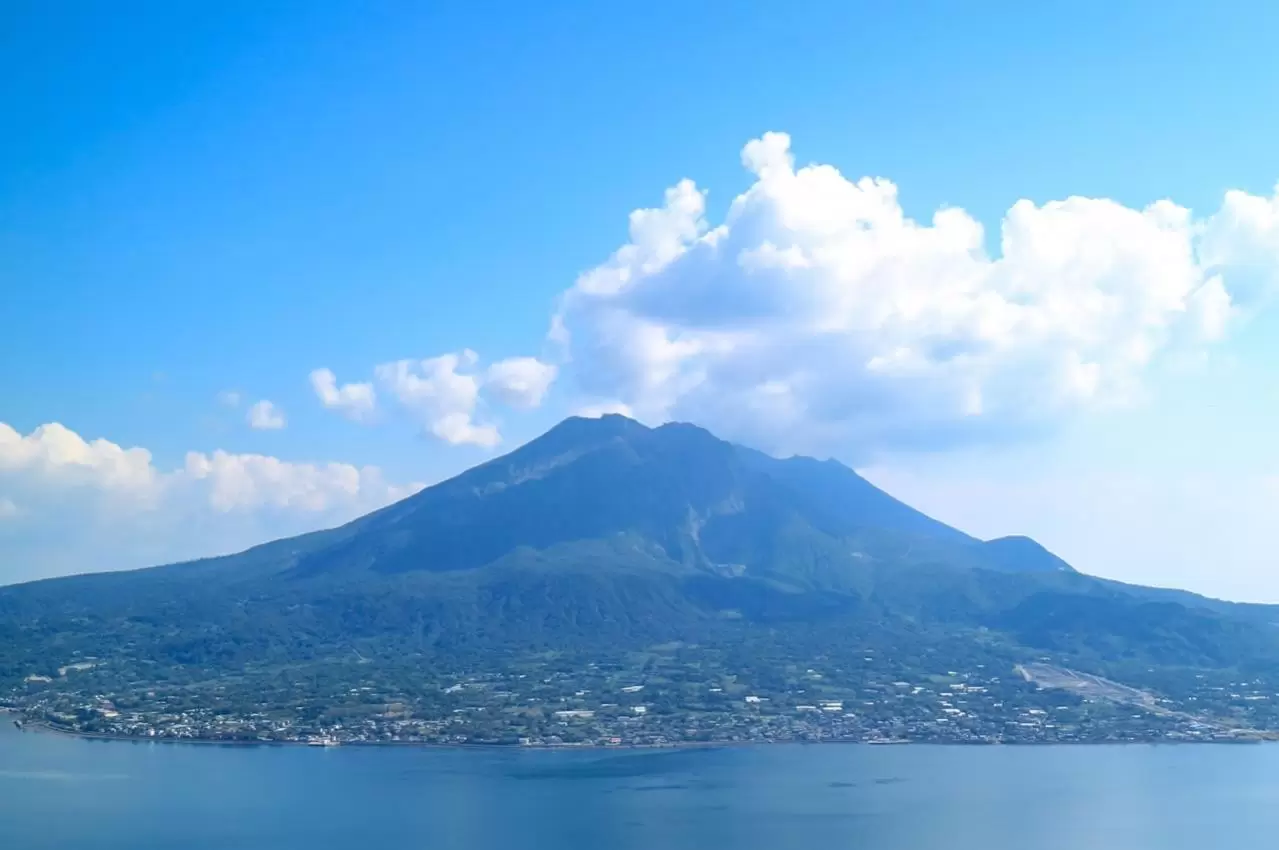
Sakurajima
Visitors can enjoy the blessings of the volcano, such as hot springs and local specialties like Sakurajima small mandarins and Sakurajima radishes, while approximately 4,600 residents (as of 2015) coexist with the volcano. The island is easily accessible by a 15-minute ferry from Sakurajima Port, and bus tours to major tourist spots on the island are also recommended. Sakurajima attracts tourists from around the world, providing an opportunity to experience a living volcano, making it a true place to feel the "heartbeat of the living Earth."
Sakurajima Movies


Basic Information
- Spot Name
- Sakurajima
- Location
- Yokoyama-cho, Sakurajima, Kagoshima City, Kagoshima Prefecture
- Access
- Sakurajima Ferry, by car
- Parking
- Parking available
Map
Detailed Information
Sakurajima is an active volcano rising from the central part of Kagoshima Bay, also known as Kinko Bay, and is an iconic symbol of Kagoshima Prefecture. Its magnificent form, viewed across the bay from downtown Kagoshima, has long been cherished by people. Still active today, Sakurajima is a volcanic region of worldwide interest, where visitors can see both its rugged mountain slopes sending plumes of smoke into the sky and the everyday lives of the people living at its foot.
Sakurajima is a composite volcano consisting primarily of Kita-dake and Minami-dake, along with Naka-dake between them and several parasitic volcanoes. Its highest peak is Ontake on Kita-dake, at an elevation of 1,117 meters. The volcano measures approximately 12.2 kilometers from east to west and 9.5 kilometers from north to south, with a circumference of about 52 kilometers and an area of approximately 80 square kilometers. It was once an island in Kinko Bay, but lava that flowed out during the great Taisho Eruption of 1914 filled the strait on its eastern side, connecting it to the Osumi Peninsula. Geographically, it is now a peninsula, but it continues to be popularly known as “Sakurajima.”
The birth of Sakurajima and its volcanic activity have an extremely long history. About 29,000 years ago, a massive eruption occurred in what is now the northern part of Kinko Bay, forming the Aira Caldera. Approximately 3,000 years later, around 26,000 years ago, new volcanic activity began at the southern edge of the Aira Caldera, giving birth to Sakurajima. In its early stages, eruptions occurred repeatedly around Kita-dake. Activity at Kita-dake is thought to have ceased about 5,000 years ago, after which activity at Minami-dake began approximately 4,500 years ago.
Since written records began, Sakurajima has experienced numerous major eruptions, including the Tenpyo-Hoji Eruption of 764, the Bunmei Eruption that began in 1471, the An-ei Eruption that began in 1779, the Taisho Eruption of 1914, and the Showa Eruption of 1946. Among these, the great Taisho Eruption was one of Japan’s most significant volcanic disasters of the modern era.
The great Taisho Eruption began on January 12, 1914, releasing enormous quantities of volcanic ash, pumice, and lava. The eruption column is believed to have reached approximately 18,000 meters into the sky, and earthquakes with a magnitude of around 7 also occurred. The vast amount of lava that flowed out filled the Seto Strait between Sakurajima and the Osumi Peninsula, connecting what had been an island to the peninsula. The eruption and earthquakes caused extensive damage not only on Sakurajima but also in downtown Kagoshima across the bay. The total number of people killed or reported missing is said to have reached 58.
The Kurokami Buried Shrine Gate in the Kurokami district of eastern Sakurajima conveys the power of the great Taisho Eruption to the present day. The torii gate at Haragosha Shrine, which stood approximately 3 meters high, was buried under massive amounts of pumice and volcanic ash. Today, only the upper kasagi section remains visible above ground.
After the eruption, there was a proposal to excavate the torii gate, but the village head of Higashi-Sakurajima is said to have decided to preserve it as it was in order to pass on the threat of the eruption to future generations. The Kurokami Buried Shrine Gate and the gateposts remaining at the nearby Nagano family residence were designated Natural Monuments of Kagoshima Prefecture in 1958. They are precious relics representing Sakurajima and conveying both the threat of nature and the importance of disaster preparedness.
Sakurajima remains volcanically active today, particularly around the summit crater of Minami-dake. Volcanic activity is monitored around the clock by the Japan Meteorological Agency and other relevant organizations using seismometers, infrasound sensors, tiltmeters, surveillance cameras, GNSS, and other equipment. Access restrictions are imposed according to the volcanic alert level, so visitors should check the latest information issued by the Japan Meteorological Agency, Kagoshima City, and other authorities before traveling.
The gateway to sightseeing on Sakurajima is Sakurajima Port. From Kagoshima Port on the downtown side of Kagoshima City, the Sakurajima Ferry usually reaches Sakurajima in about 15 minutes. The ferry carries not only passengers but also cars, bicycles, and motorcycles, making it convenient for walking tours as well as driving and cycling. From the deck, passengers can enjoy beautiful views of Sakurajima as it gradually draws closer, downtown Kagoshima, and Kinko Bay.
Beginning in October 2025, the Sakurajima Ferry revised its late-night service schedule and no longer operates throughout the night. Those planning to use the ferry in the early morning or late at night should check the latest timetable and service status on the official Kagoshima City website.
A recommended first stop for visitors to Sakurajima is the Sakurajima Visitor Center, located about a 10-minute walk from Sakurajima Port. Inside, visitors can learn about Sakurajima’s eruption history, how volcanic activity works, changes in the landscape caused by eruptions, and shifts in plant life through videos, photographs, topographical models, and explanatory panels. The center also introduces the natural environment of the Sakurajima–Kinko Bay area and Kirishima-Kinkowan National Park, making it a useful base for gathering sightseeing information. Learning about the formation of Sakurajima here before exploring the island helps visitors gain a deeper understanding of the lava fields and the views from its observatories.
Near the Visitor Center is Sakurajima Lava Nagisa Park. Located along the coast, the park features one of Japan’s largest foot baths, measuring approximately 100 meters in length, which visitors can use free of charge. The foot bath uses natural hot-spring water that rises from about 1,000 meters underground and is characterized by its reddish-brown color. With tranquil Kinko Bay in front and magnificent Sakurajima behind, it is a relaxing place to soothe tired legs while experiencing the blessings of the volcano. It is normally open from 9:00 a.m. until sunset.
The approximately 3-kilometer-long Lava Nagisa Promenade extends from the area near the park toward the Karasujima Observatory. Selected as one of Japan’s “Top 100 Walking Trails,” it follows the shore of Kinko Bay, allowing visitors to observe lava that flowed out during the Taisho Eruption as well as plants such as black pine trees taking root on the lava.
One of Sakurajima’s signature viewpoints is Yunohira Observatory, located at an elevation of 373 meters on the fourth station of Kita-dake. It is the highest point on Sakurajima accessible to ordinary visitors, offering powerful views of the rugged mountain slopes looming directly before them.
Below, Kinko Bay and downtown Kagoshima spread out across the landscape. On clear days, visitors may also be able to see the Kirishima mountain range to the north and Mount Kaimondake to the south. Seven heart shapes are hidden throughout the observatory, adding an enjoyable element of discovery. At night, the observatory is also known as a spot for viewing the lights of downtown Kagoshima across Kinko Bay.
Arimura Lava Observatory on the southern side of the island is another essential stop on any Sakurajima tour. Built on a lava field formed by the Showa Eruption of 1946, it features a promenade approximately 1 kilometer long, from which visitors can view Minami-dake, the Showa Crater area, and Kinko Bay.
Black, rugged lava stretches across the surrounding area, while plants such as black pine trees take root between the lava rocks, creating a distinctive landscape. It is also a place where visitors can observe the process of ecological succession, as nature that was once destroyed by a volcanic eruption gradually recovers over many years. Depending on the wind direction and the level of volcanic activity, visitors may even experience volcanic smoke or rumbling sounds.
Akamizu Observation Square was developed on the former site of the Sakurajima All Night Concert held by singer-songwriter Tsuyoshi Nagabuchi in 2004. To commemorate the concert, which drew approximately 75,000 people, a monument titled “The Portrait of a Scream” was created by stacking Sakurajima lava and installed at the site.
“The Portrait of a Scream” depicts Tsuyoshi Nagabuchi’s face as he cries out toward Sakurajima, along with an arm holding a guitar aloft. Its powerful form evokes the volcanic energy of Sakurajima, making it a popular spot for commemorative photographs. From the square, visitors can enjoy views of Sakurajima’s mountain slopes extending in both directions and downtown Kagoshima across Kinko Bay.
For efficiently exploring the island, the Sakurajima sightseeing bus, Sakurajima Island View, is a convenient option. Operating from Sakurajima Port, it makes a circuit of the major sightseeing spots on the western side of the island, including Akamizu Observation Square, Yunohira Observatory, and the area around the Sakurajima Visitor Center. Those wishing to explore the entire island, including the Kurokami Buried Shrine Gate and Arimura Lava Observatory, will find it more convenient to use a car or sightseeing taxi.
Sakurajima is not only a land of volcanic threat but also a source of abundant blessings. In well-drained soil containing volcanic ash, farmers cultivate Sakurajima daikon, known as one of the largest radishes in the world, and Sakurajima komikan, a tiny citrus fruit whose sweetness is intensely concentrated.
At Michi-no-Eki Sakurajima Hinoshima Megumikan, a roadside station near Sakurajima Port, visitors can purchase these agricultural products along with processed foods, sweets, seasonings, and other items. The facility also has a restaurant serving dishes made with ingredients from Sakurajima and Kagoshima, including Sakurajima daikon, making it a recommended place for a meal or souvenir shopping.
Preparing for falling ash is also important when visiting Sakurajima. Depending on the eruption conditions and wind direction, volcanic ash may fall, so it is reassuring to bring a mask, hat, glasses, and a hooded jacket. A folding umbrella may also help protect against falling ash, but it can be difficult to use in strong winds, making a hat or hood more practical.
People who wear contact lenses should also bring glasses, as volcanic ash entering the eyes can cause pain and inflammation. Before setting out, be sure to check the volcanic alert level, ash-fall forecasts, and the operating status of ferries and buses. It is essential never to enter restricted areas.
The volcanic smoke, lava fields, hot springs, agricultural products, and the livelihoods of people living alongside the volcano are all deeply connected to Sakurajima as an active volcano. Visitors may encounter unexpected ashfall or sudden changes in weather, but these are experiences unique to traveling to a living volcano.
By learning not only about the magnificent natural scenery but also about the history of eruptions, disaster-prevention efforts, and the benefits brought by the volcano, visitors can appreciate Sakurajima on an even deeper level. Sakurajima is truly a place where one can experience at close range both “the heartbeat of the living Earth” and the way people coexist with nature.
Kagoshima Tourist Attractions
View List
Chiran Peace Museum
Chiran Peace Museum is located in Minamikyushu City, Kagoshima Prefecture, and serves as a facility to convey the history of the special attack units that launched f...

Iowa World Kagosima Aquarium
Iow World Kagoshima Aquarium is located in a prime location with a spectacular view of Kagoshima's symbol, Sakurajima. It is one of the largest aquariums in Kyushu, ...

Jomon Sugi
Jomon Sugi is the most famous giant tree among the Yakusugi trees located on Yakushima Island in Kagoshima Prefecture, with an estimated age ranging from 2,170 to 7,...

Yurigahama Beach
Yurigahama is a beautiful sandy beach created by nature, located in Yakushima Town, Kagoshima Prefecture. The approximately 8 km long stretch of white sand consists ...

Meisho Sengannen
Sengan-en is a villa built by Shimizu clan's 19th generation leader, Mitsuhisa, in the first year of Manji (1658). It is a grand feudal lord's garden designed with S...

Saigo Takamori Statue
The statue of Saigo Takamori, a great figure born in Kagoshima, stands proudly near the top of Shiroyama. Saigo is well-known as a prominent leader of the Meiji Rest...

Kirishima Shrine
Kirishima Shrine is a shrine located in Kirishima City, Kagoshima Prefecture, dedicated to Ninigi-no-Mikoto, the central figure in the myth of the descent of the hea...

Ohama Seaside Park
Oohama Seaside Park is a nature-rich park located in Minamisatsuma City, Kagoshima Prefecture. This park, which combines the beautiful coastline of the southern coun...