Jigokudani Yaenkoen
Jigokudani Yaenkoen Movies


![【長野県観光】地獄谷野猿公苑には温泉に入るサルや温泉を飲むサル!世界初![Nagano Prefecture Tourism] Monkeys bathing in hot springs](https://i.ytimg.com/vi/4xx08lbG6Qc/mqdefault.jpg)


Basic Information
- Spot Name
- Jigokudani Yaenkoen
- Location
- 〒381-0401 6845 Heion, Yamanochi Town, Shimo-Takai District, Nagano Prefecture
- Access
- Get off at Yudanaka Station on the Nagano Electric Railway Nagano Line, then take a bus for 15 minutes.
15 km from Shinshu Nakano IC, approximately 20 minutes. - Parking
- Parking available
- Business Hours
- 8:30 AM to 5:00 PM (closed), from November to March 9:00 AM to 4:00 PM
- Regular Holiday
- None
- Fees
- Adults (18 years and older) 800 yen, Children (elementary to high school students) 400 yen, Children (under 6 years old) free.
- Contact Information
- Phone Number:0269-33-4379
- Official Website
Map
Detailed Information
Jigokudani Monkey Park is a facility located within Joshinetsu Kogen National Park in northern Nagano Prefecture, where visitors can observe wild Japanese macaques up close. It lies along the Yokoyu River valley, which originates in the Shiga Highlands, and is surrounded by steep cliffs in a richly natural environment.
This area sits at an elevation of about 850 meters, and winters are extremely severe. In winter, temperatures can drop below minus 10°C, and snowfall can exceed one meter. The winter season is long, with many days when the entire area is covered in snow, making it an extremely cold and harsh place.
The area is also characterized by many steep, rugged cliffs, and a distinctive landscape where steam and smoke rise from hot springs all around. Because of this, people came to call it “Jigokudani,” meaning “Hell Valley.”
History of the Park’s Opening and Global Attention
Jigokudani Monkey Park opened in 1964. Since then, it has been loved by many visitors from Japan and abroad as a place where they can closely observe the fascinating behavior of wild Japanese macaques.
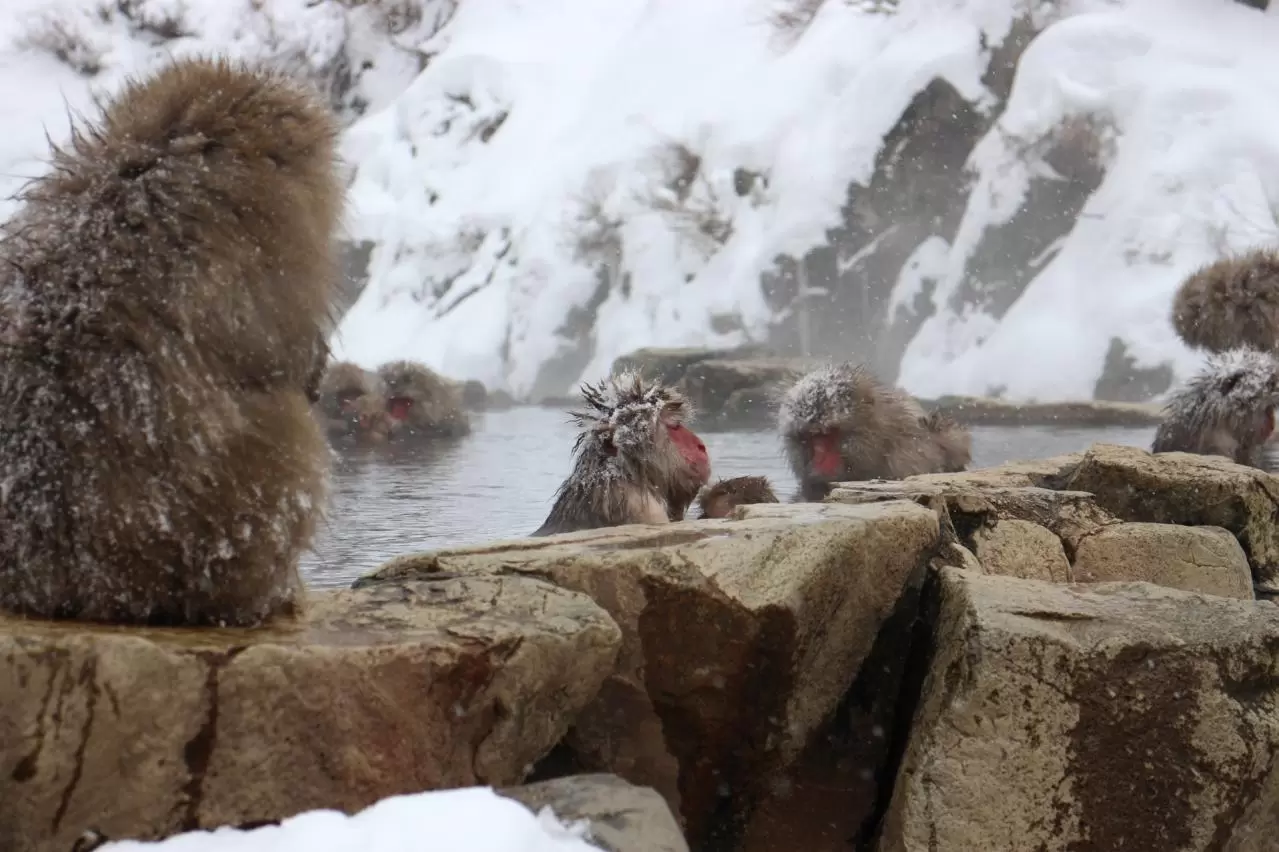
The most famous sight is the macaques bathing in hot springs during the cold, snowy winter. This unusual scene drew worldwide attention, and in 1970 it was featured on the cover of America’s LIFE magazine and widely reported overseas.
Furthermore, during the 1998 Nagano Winter Olympics, the park became even more widely known as athletes, journalists, and visitors from around the world came to Nagano.
Wild Japanese Macaques and the Feeding Method
Japanese macaques live in mountain forests throughout Japan, excluding Hokkaido and Okinawa. However, wild monkeys in the mountains are not easy for people to find, and even when spotted, they are often far away or move quickly, making close observation difficult.
For this reason, Jigokudani Monkey Park uses a method called “feeding” to create an environment where the monkeys are more likely to gather in the park. Feeding involves providing food that is slightly better than what they normally eat, so that they learn, “There is food here,” and develop a habit of coming.
At the same time, the park also practices “habituation to humans,” helping the monkeys learn that people are not dangerous. Care is taken with the amount and type of food so that the monkeys’ natural behavior is not harmed and they do not become overnourished.
Visitors are not allowed to feed the monkeys, and no food is sold at the park. Feeding is done solely for observation purposes; it is not intended as a way to simply give food to the monkeys.
An Observation Style Without Cages or Fences
One of the park’s major features is that visitors can observe Japanese macaques in a natural-like setting, basically without cages or fences separating monkeys and humans.
This allows visitors to observe troop life, communication among group members, and parent-child behavior from very close range.
However, since they are wild animals, touching the monkeys is prohibited, and visitors must follow the rules for safety.
How the Hot-Spring Bathing Monkeys Came to Be and the Monkeys’ Exclusive Open-Air Bath
Jigokudani Monkey Park did not originally become famous for monkeys bathing in hot springs.
As feeding succeeded and the monkeys spent longer periods in the park, they had more time to relax while waiting for food. According to one story, a young monkey accidentally learned to enter the open-air bath at a nearby ryokan, Korakukan. In the cold winter, the hot spring likely felt warm and pleasant.
This behavior gradually spread to other monkeys in the troop, and many of them began bathing in the hot springs. However, because it is not hygienic for monkeys to enter human hot springs, an open-air bath exclusive to the monkeys was created within the park.
Since then, this behavior has been passed down from generation to generation, and even now many monkeys can be seen bathing in the hot springs in winter.
Why They Enter the Hot Spring and Seasonal Differences
It is thought that the monkeys bathe in the hot springs as one of the behaviors they developed to endure the harsh winter cold of Jigokudani. On especially cold days or during heavy snowfall, more monkeys may choose to soak in the hot spring.
On the other hand, during the hot summer months or milder seasons, they have less need to bathe, so such behavior is not seen as often.
Bathing in the hot spring is part of the monkeys’ daily life, and not all monkeys do it. Some do not like the hot spring, and even those that do may sometimes find eating or socializing with others more important.
The monkeys do not enter the hot spring to wash themselves and stay clean like humans do; rather, it is believed they simply enjoy the warmth and comfort. Some monkeys even close their eyes and doze off while soaking, and their expressions are highly memorable.
Scenes of the Monkeys Throughout the Year
At Jigokudani Monkey Park, visitors can observe various aspects of Japanese macaque life throughout the four seasons.
- Spring (late April to early June) is the birthing season, when newborn baby monkeys can be seen.
- In summer, baby monkeys are energetic and playful, and their active behavior increases.
- Autumn is the season of romance, when changes can be seen in relationships and behavior within the troop.
- In winter, the chances of seeing monkeys bathing in the snowy landscape are highest, making it the park’s most famous season.
In this way, the ability to observe the natural life of wild Japanese macaques throughout the year is one of Jigokudani Monkey Park’s greatest attractions.
Visitor Notes
Because Jigokudani Monkey Park is deep in the mountains, visitors should prepare clothing and equipment appropriate for the season. In winter especially, there is heavy snow and slippery paths, so cold-weather protection and sturdy walking shoes are essential.
Also, because the monkeys are wild animals, there are times when they may not be in the park even during opening hours. In addition, seeing them bathing in the hot spring depends on the weather and the monkeys’ mood, so it cannot be guaranteed.
Feeding by visitors and touching the monkeys are prohibited inside the park. For safety, it is important to follow the rules and observe the monkeys from a distance.
Enjoying the Surrounding Area
Around Jigokudani Monkey Park are famous hot spring towns such as Shibu Onsen and Yudanaka Onsen, so visitors can enjoy them along with sightseeing. After observing the monkeys’ lives in Jigokudani, relaxing in a hot spring town makes for a more fulfilling trip.
Jigokudani Monkey Park is located within Joshinetsu Kogen National Park in northern Nagano Prefecture, and it is a valuable facility where wild Japanese macaques can be observed up close in the harsh natural environment at an elevation of 850 meters. Since opening in 1964, it has become world-famous for the monkeys bathing in hot springs, attracting many tourists, researchers, and photographers.
Its great appeal lies in the opportunity to observe the monkeys’ various aspects of life throughout the four seasons in a natural-like environment with basically no cages or fences separating them from visitors. In particular, the sight of monkeys soaking in hot springs amid the snowy winter landscape is a special view unique to Jigokudani Monkey Park, drawing many people from around the world.
Nagano Tourist Attractions
View List

Matsumoto Castle
Matsumoto Castle is one of Japan's five great castles and is designated as a national treasure, a gem of historical architecture. Alongside Himeji Castle, Hikone Cas...

Tsumagoshuku
Tsumago-juku is a post town located in Nagano Prefecture along the Nakasendo, and it is the 42nd of the 69 stations connecting Edo and Kyoto. With Ise Mountain to th...

Ueda Castle
Ueda Castle, located in Ueda City, Nagano Prefecture, is a historic castle built by Sanada Masayuki. It gained fame for repelling the Tokugawa forces during the Firs...


Togakushi Shrine
The highly popular power spot "Togakushi Shrine" consists of five historic shrines: Okusha, Nakasha, Hobokusha, Kuzuryu Shrine, and Hi no Mikokami Shrine. Togakushi ...

Utsukushigahara
Utsukushigahara Plateau is an expansive highland that stretches approximately 2,000 meters above sea level and is located in Matsumoto City, Nagano Prefecture. Durin...

Senjōji Kōdō
Senjojiki Cirque is a bowl-shaped landform formed by glacial erosion, located at Komagatake in the Central Alps. From the "Senjojiki" station at an elevation of 2,61...