Ueda Castle
Ueda Castle Movies



Basic Information
- Spot Name
- Ueda Castle
- Location
- 〒386-0026 Ninomaru, Ueda City, Nagano Prefecture
- Access
- 15-minute walk from Ueda Station on the JR Hokuriku Shinkansen.
- Parking
- Parking available.
- Business Hours
- Free to visit
The Ueda Castle South Tower, North Tower, and Yagura Gate viewing is from 8:30 AM to 5:00 PM (entry until 4:30 PM) - Regular Holiday
- Closed on Wednesdays, the day after holidays, and during the New Year period.
- Fees
- Admission is free. Viewing of Ueda Castle's South Turret, North Turret, and Turret Gate is 300 yen for adults, 200 yen for high school students and above, and 100 yen for elementary and junior high school students.
- Contact Information
- Phone Number: 0268-23-5408
- Official Website
Map
Detailed Information
Ueda Castle is a historic castle located in Ueda City, Nagano Prefecture, and is a celebrated stronghold built by Sanada Masayuki during the Sengoku period. Constructed in 1583, it is known as a flatland castle situated almost at the center of the Ueda Basin. However, it was uniquely designed to take advantage of natural features such as the cliff called Amagafuchi and nearby rivers, making it a highly defensible fortress.
Ueda Castle played an important role from the Sengoku period through the Edo period, and has a history spanning about 400 years as a castle built by the Sanada clan, restored by the Sengoku clan, and inherited and preserved by the Matsudaira clan. Since the Meiji period, it has also been developed through the efforts of local citizens, and its appeal has been passed down to the present day.
Ueda Castle as an “Impregnable Castle”
Ueda Castle is famous nationwide as an “impregnable castle.” This is because it successfully repelled large Tokugawa forces on two occasions. Among castles throughout Japan, it is extremely rare to have two actual battlefield victories, and this has greatly enhanced Ueda Castle’s historical value.
First Battle of Ueda (1585)
The First Battle of Ueda took place in 1585, when Sanada forces of about 2,000 faced an overwhelming Tokugawa army of around 7,000. However, Sanada Masayuki used a tactic of luring the Tokugawa troops close to the castle and then striking from behind, throwing the enemy into confusion and forcing their retreat. It is also said that Tokugawa Ieyasu abandoned the assault and withdrew after learning that Uesugi forces might come to Sanada’s aid. This victory spread Masayuki’s name throughout the country.
Second Battle of Ueda (1600)
The Second Battle of Ueda occurred in 1600, just before the Battle of Sekigahara. It began when Tokugawa Ieyasu’s son, Tokugawa Hidetada, attacked Ueda Castle, a strategic point on the Nakasendo, while en route to Sekigahara.
Although the Tokugawa army numbered about 38,000, while the Sanada forces are said to have been only about 2,500 to 3,000, Ueda Castle did not fall, and Hidetada’s troops were delayed. As a result, Hidetada failed to arrive in time for the decisive battle at Sekigahara, and there is an anecdote that Ieyasu was furious after the war. In this way, Ueda Castle became a very important stage in Sengoku history.
Sanada Strategy and Their Fate After Sekigahara
Around the time of the Second Battle of Ueda, Sanada Masayuki and his younger son Yukimura (Nobushige) fought against the Tokugawa on the Western Army side, while Masayuki’s eldest son, Sanada Nobuyuki (Nobushige), joined the Eastern Army. It is said that this was a Sanada family strategy to ensure the clan’s survival no matter which side won.
However, after the Battle of Sekigahara, Masayuki and Yukimura were exiled to Kudoyama as defeated commanders. Meanwhile, Nobuyuki, who had sided with the Eastern Army, was granted the Ueda domain by Tokugawa Ieyasu. Since Ueda Castle had already been demolished, Nobuyuki reportedly did not undertake a large-scale restoration of the castle and instead established his residence in the third bailey to govern the domain.
Demolition and Restoration: The Sengoku Clan Era
Ueda Castle was demolished after the Battle of Sekigahara, but when Nobuyuki was transferred to Matsushiro in 1622, Sengoku Hidehisa became the new lord of Ueda Castle.
Under the Sengoku clan, restoration progressed, and from the time of Sengoku Tadamasa around 1626, work was carried out on the main and second baileys, along with re-digging the moats. Seven turrets and two turret gates were built in the main bailey, but the construction was interrupted by Tadamasa’s death. The “West Turret” that remains today is believed to date from the Sengoku period and is a valuable surviving structure.
The Sengoku family governed Ueda Castle for more than 80 years, from 1622 to 1706, across three generations.
Matsudaira Rule and Repairs
After the Sengoku clan, the Fujii-Matsudaira clan became the castle lords and governed Ueda for about 160 years across seven generations. During the Matsudaira period, repairs were carried out on stone walls and turrets damaged by floods of the Chikuma River and by earthquakes, and maintenance of the castle continued.
Abandonment and Revival by Citizens
In 1871, after the Meiji Restoration, Ueda Castle was abolished. The castle grounds and buildings were later auctioned off, and the turrets were gradually dismantled. Of the seven turrets, four were lost and their whereabouts are unknown. Of the remaining three, the West Turret still stood within the castle grounds, while the North and South Turrets were relocated outside the castle and were even used for a time as rented spaces and other purposes.
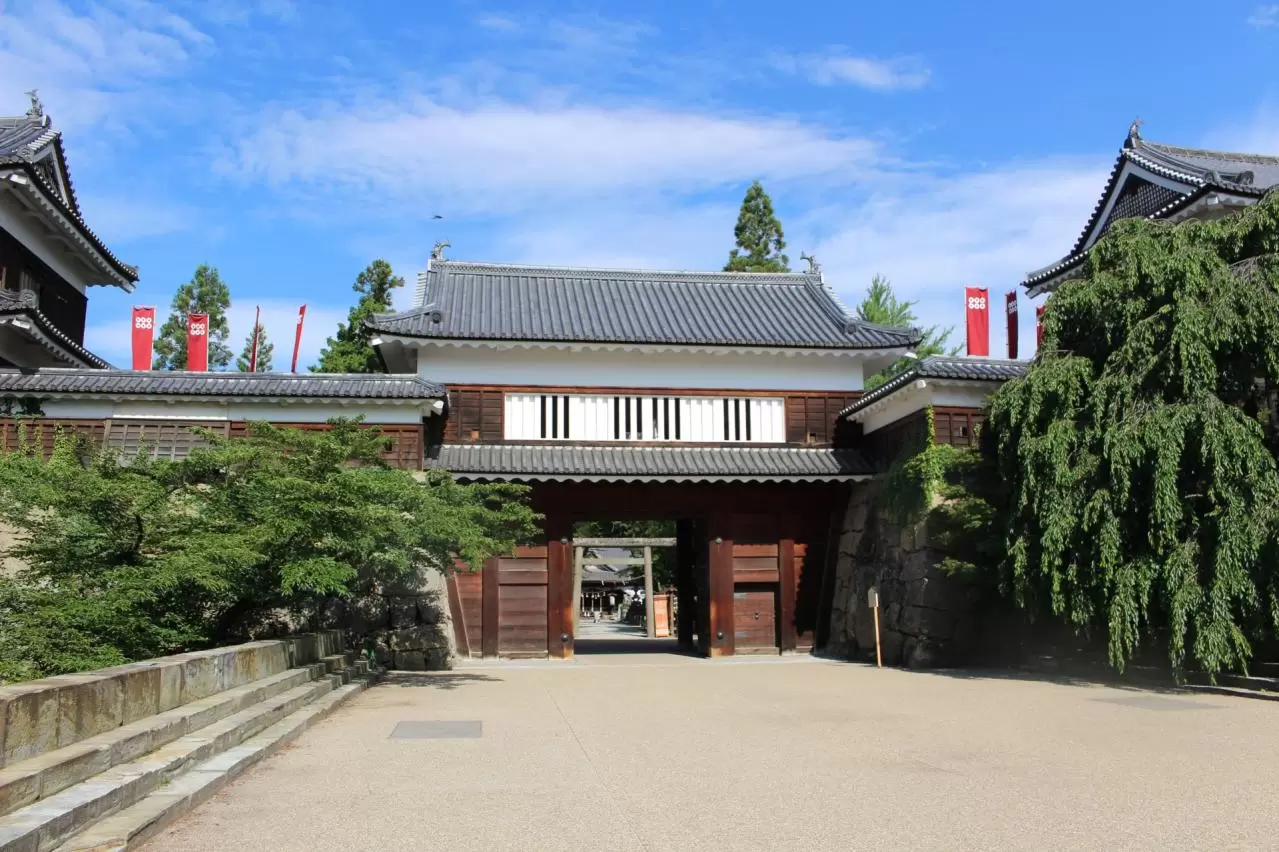
However, due to strong demands from the citizens of Ueda, the North and South Turrets were moved back inside the castle grounds and restored to their original location in 1949, about 70 years later. In addition, the East Koguchi Turret Gate was reconstructed in 1994, bringing back the appearance of the castle as it once was.
Today’s Ueda Castle: The Appeal of Ueda Castle Ruins Park
Today, Ueda Castle has been developed as Ueda Castle Ruins Park, a relaxing space where history and nature harmonize. Throughout the park, remnants such as stone walls, moats, and earthen ramparts remain in various places, allowing visitors to experience the atmosphere of a castle from the Sengoku to Edo periods.
Among the most notable sights are the turrets and turret gates remaining in the main bailey, as well as the massive stone known as “Sanada Ishi.” Sanada Ishi is located near the East Koguchi Turret Gate and measures about 2.5 meters in height and 3 meters in width. It is said to have been placed to demonstrate the lord’s power and wealth, and visiting daimyo were reportedly expected to praise the size of the stone as a matter of etiquette.
Main Highlights of Ueda Castle
Turrets and Turret Gates
In the past, the main bailey had seven turrets and two turret gates, but today three turrets and one turret gate can be seen. The North and South Turrets are sometimes open to the public, allowing visitors to learn about the castle’s structure at the time.
Sanada Shrine and Sanada Well
There is a Sanada Shrine in the park, and many visitors come as a place associated with the Sanada family. Within the shrine grounds is a well called “Sanada Well,” which is also said in legend to have been a secret passage leading outside the castle to the north.
Ueda City Museum
The Ueda City Museum is located in the former second bailey and displays armor belonging to successive castle lords and materials related to the Ueda domain. It is popular as a facility where visitors can learn more deeply about Ueda Castle’s history.
Ueda High School and the Site of the Third Bailey
Ueda High School now stands on the site of the former residence of the lord of Ueda Domain. The area is still surrounded by moats and earthen walls, and the former main gate of the lord’s residence in the third bailey is used as the school’s main gate, making it a place where traces of history can still be felt.
Seasonal Scenery and Events
Ueda Castle Ruins Park is cherished as a sightseeing spot where the beauty of nature in every season harmonizes with the historic landscape.
In spring, the Ueda Castle Senbonzakura Festival is held, attracting many tourists from both inside and outside the prefecture as a famous cherry blossom spot. In autumn, the Ueda Castle Autumn Leaves Festival offers scenic views of the castle ruins colored by brilliant foliage.
There are also history-themed events such as the Ueda Sanada Festival, and the area becomes lively with various events during the tourist season. To allow more people to experience Ueda Castle’s charm and historical value, Ueda City is also promoting initiatives such as restoring and improving the seven turrets and turret gates of the main bailey, and the area around the East Koguchi of the second bailey.
Connection to Popular Culture
Ueda Castle is not only historically significant, but also appears in modern popular culture. In the 2009 animated film Summer Wars, Ueda Castle appears as the gate of the Jinnouchi family estate, the heroine’s family home, and drew much attention. Since then, many fans have visited the site, and it is also known as a pilgrimage spot for anime fans.
Ueda Castle was built in 1583 by Sanada Masayuki and earned fame as an “impregnable castle” by repelling large Tokugawa forces twice in the First and Second Battles of Ueda. Although it was demolished after the Battle of Sekigahara, it was later restored by the Sengoku clan and then inherited by the Matsudaira clan, surviving and being preserved through the centuries until the present day.
Today, it has been developed as Ueda Castle Ruins Park, where visitors can explore turrets, turret gates, stone walls, moats, and other remains, as well as Sanada Shrine and a museum, making it an attractive place to stroll while learning about history. With the beauty of seasonal scenery such as cherry blossoms and autumn leaves, along with the energy of festivals and events, it is a highly popular destination for both history enthusiasts and tourists alike.
As a place where people can experience the 400-year story of Ueda Castle, passed down from the Sengoku period to the present, it remains beloved by many as a site where one can feel the hopes and feelings of those who have carried its legacy across the ages.
Nagano Tourist Attractions
View List

Matsumoto Castle
Matsumoto Castle is one of Japan's five great castles and is designated as a national treasure, a gem of historical architecture. Alongside Himeji Castle, Hikone Cas...

Utsukushigahara
Utsukushigahara Plateau is an expansive highland that stretches approximately 2,000 meters above sea level and is located in Matsumoto City, Nagano Prefecture. Durin...

Togakushi Shrine
The highly popular power spot "Togakushi Shrine" consists of five historic shrines: Okusha, Nakasha, Hobokusha, Kuzuryu Shrine, and Hi no Mikokami Shrine. Togakushi ...


Tsumagoshuku
Tsumago-juku is a post town located in Nagano Prefecture along the Nakasendo, and it is the 42nd of the 69 stations connecting Edo and Kyoto. With Ise Mountain to th...

Senjōji Kōdō
Senjojiki Cirque is a bowl-shaped landform formed by glacial erosion, located at Komagatake in the Central Alps. From the "Senjojiki" station at an elevation of 2,61...

Jigokudani Yaenkoen
Jigokudani Monkey Park is located in the northern part of Nagano Prefecture within the Joshinetsu Kogen National Park, at an elevation of 850 meters in a harsh envir...