Konjikido Hall
This National Treasure, covered in gold leaf, offers a close look at the refined craftsmanship of the late Heian period.
AI Summary
This is an AI-generated summary. Please check the official information for opening hours, fees, and closed days.
Centered on the glittering Konjikido Hall, this World Heritage site offers a quiet journey through Heian-period art and the history of Hiraizumi.
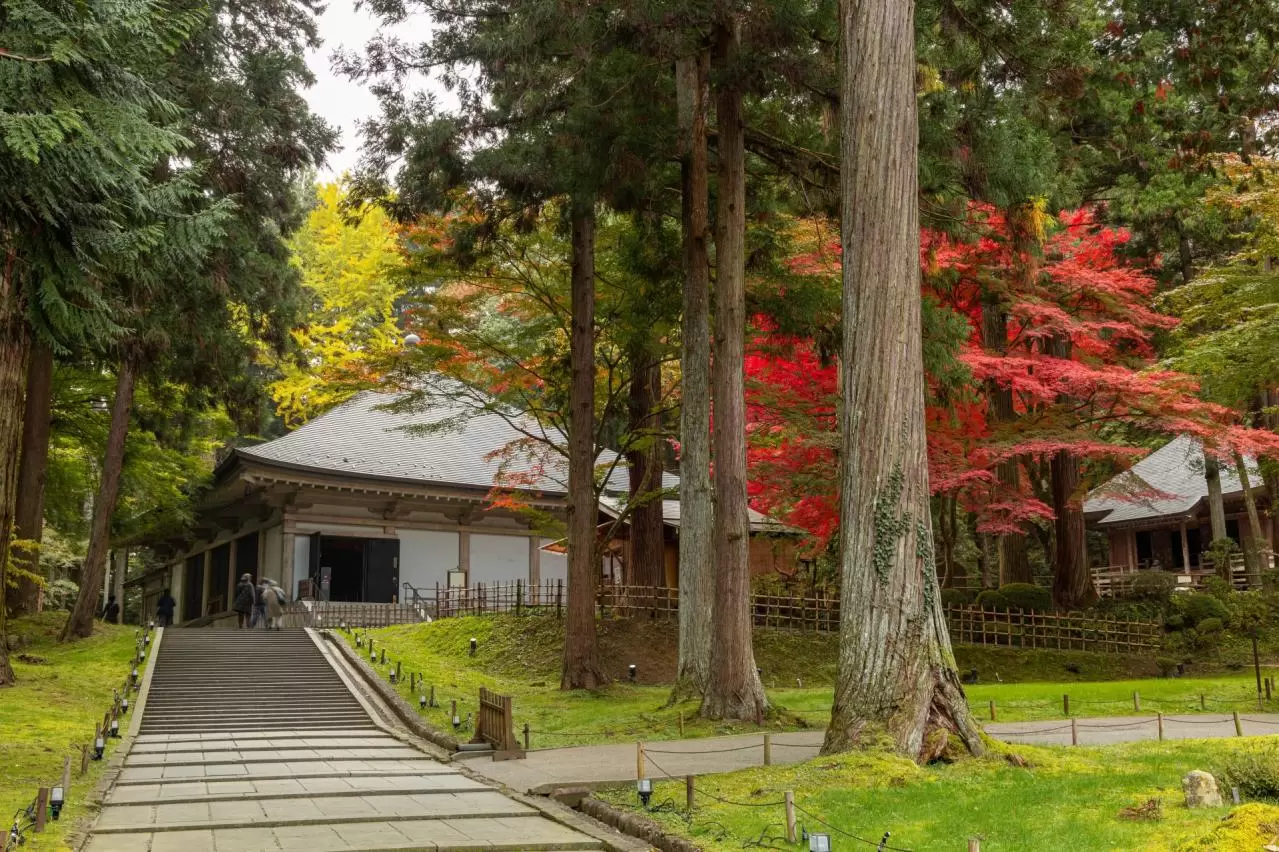
Chusonji is a historic temple complex established by the Oshu Fujiwara clan as a prayer for peace. Its highlights include the gold-leaf-covered Konjikido Hall, a National Treasure, along with many other important cultural properties and finely detailed craftsmanship. The grounds take on a different character with each season, from spring blossoms to winter snow.
This National Treasure, covered in gold leaf, offers a close look at the refined craftsmanship of the late Heian period.
Learn about the temple’s history of mourning those lost in war and striving to create a Buddhist paradise.
The grounds change with the seasons, from cherry blossoms and lush greenery to autumn leaves and snowy scenes.
From Hiraizumi Station, walk up Tsukimizaka and explore the grounds, focusing on Konjikido Hall and Sankozo Treasure Hall for a concise introduction to Chusonji.
Chūson-ji Temple was founded in 850 by Jikaku Daishi Ennin, a high-ranking monk of Enryaku-ji on Mount Hiei. In the early 12th century, Fujiwara no Kiyohira, the first ruler of the Northern Fujiwara clan in Oshu, undertook large-scale construction of halls and pagodas, establishing the temple’s foundation.
The background to Kiyohira’s establishment of Chūson-ji was the series of wars that plagued the Tohoku region in the latter half of the 11th century, including the Former Nine Years’ War and the Later Three Years’ War. Kiyohira resolved to mourn all those who had lost their lives in battle, without distinction between friend and foe, and to build a peaceful utopia based on Buddhist teachings—a “Pure Land of Buddha” (bukkokudo)—in this Michinoku land. This was also the strong wish of Kiyohira, who had lost his father, wife, and children to warfare and had deeply vowed never to support war.
Konjikido, the temple’s symbol, is an Amida hall that was completed in 1124 and shines with an all-over gilt brilliance, both inside and out. The term “kaikonjiki,” meaning “entirely golden,” is also derived from Buddhist scriptures and symbolizes the pure world of Buddha. Inside, it is filled with the refined craftsmanship of the late Heian period, including mother-of-pearl inlay, openwork metal fittings, and lacquer maki-e decoration, making the entire hall resemble a single work of art. Konjikido has been designated Japan’s first National Treasure building, and it enshrines the remains and heads of Kiyohira, his son Motohira, and his grandson Hidehira.
According to the Kamakura-period record Azuma Kagami, the former Chūson-ji boasted a magnificent temple complex with 40 temple buildings and 300 zensō, monks’ lodgings. However, a fire in 1337, during the Kenmu era of the 14th century, destroyed many halls, pagodas, and treasures, after which the temple declined. Even so, more than 3,000 National Treasures and Important Cultural Properties, including Konjikido as well as Buddhist statues, sutras, and handicrafts, have been preserved to the present day, and the temple is renowned as the foremost treasure house of Heian Buddhist art in eastern Japan.
In addition to Konjikido, the temple grounds feature many highlights, such as Benkeido, associated with Benkei; Yakushido, whose principal deity is Yakushi Nyorai; and the Main Hall, the center of worship. At the treasure repository Sankozō, which houses valuable cultural properties, visitors can systematically appreciate the history and art of Chūson-ji.
Chūson-ji also reveals beauty throughout the four seasons, with cherry blossoms in spring, lush greenery in summer, brilliant autumn foliage, and snowy winter landscapes. This scenery, created by the harmony of nature and architecture, has captivated countless worshippers and visitors.
In 2011, it was inscribed as a UNESCO World Cultural Heritage site as part of the “Historic Monuments and Sites of Hiraizumi,” and it is highly regarded both in Japan and abroad as a precious historical legacy that conveys the prosperity of the Northern Fujiwara clan and their prayers for peace.
Koiwai Farm Makiba Park is one of Japan’s largest private comprehensive farms, boasting a history of over 130 years since its establishment in 1891. Covering an area...
The Iwate Tsunami Memorial, located within the Takada Matsubara Tsunami Restoration Memorial Park in Iwate Prefecture, opened on September 22, 2019. This facility ai...
The Iwate Bank Red Brick Building was established in 1911 as the main branch of Morioka Bank. This beautiful red brick structure was designed by the architectural fi...
Tono Furusato Village is a wonderful place where nostalgic rural landscapes unfold. It has recreated an old-fashioned village by relocating traditional curved houses...
The Iwate Prefectural Museum of Art was opened in 2001 in the new cultural zone of Central Park in Morioka City. The museum's collection focuses on works by local ar...
Moeji Temple is a unique temple that is designated as both a World Heritage Site and as a special historic site and special scenic spot by the Japanese government, a...
Geibikei is a beautiful gorge selected as one of Japan's top 100 scenery spots, featuring approximately 2 kilometers of cliffs that rise around 100 meters on both si...
Jodogahama is a beautiful coastline located in Iwate Prefecture, Japan, and serves as the centerpiece of the Sanriku Reconstruction National Park and Sanriku Geopark...


![【 世界文化遺産巡り】岩手県平泉『中尊寺』散策👟[World Cultural Heritage] “Chusonji” in Iwate Prefecture](https://i.ytimg.com/vi/fF3IbD39Rk4/mqdefault.jpg)