Sado Gold Mine
Sado Gold Mine Movies


Basic Information
- Spot Name
- Sado Gold Mine
- Location
- 〒952-1501 1305 Shimoaikawa, Sado City, Niigata Prefecture, Japan
- Access
- Approximately 50 minutes by car from Ryotsu Port.
- Parking
- 500 vehicles
- Business Hours
- 8:00 AM to 5:30 PM (April to October), 8:30 AM to 5:00 PM (November to March)
- Regular Holiday
- Open year-round.
- Fees
- Doyug坑 (Modern Course) Adults: 1,000 yen, Junior High Students: 500 yen
Soutaoy坑 (Edo Period Course) Adults: 1,000 yen, Junior High Students: 500 yen
Combined Ticket for Soutaoy坑 and Doyug坑 Adults: 1,500 yen, Junior High Students: 750 yen - Contact Information
- Phone Number:0259-74-2389
- Official Website
Map
Detailed Information
The Sado Kinzan Historic Site is one of Japan’s largest remaining gold and silver mine ruins, located on Sado Island in Niigata Prefecture, and it is a valuable historic site that conveys about 400 years of mining history. The mine is said to have opened in 1601, and during the Edo period it was managed directly by the Tokugawa shogunate as tenryo (shogunal land), producing large quantities of gold and silver. The gold and silver produced here were used as coins such as koban and played an important role in supporting the shogunate’s finances.
A major feature of Sado Kinzan is that the entire process, from mining and ore dressing to smelting, refining, and even koban production, took place within the same region. In particular, in the Aikawa area, not only ore extraction but also the processes for extracting gold and silver, along with a division of labor among workers, developed into a large-scale production system. In addition, because many people from across Japan were drawn there by shogunal policy, Sado’s unique mining culture and townscape took shape, making the area historically and culturally highly valuable.
Another major characteristic of Sado Island’s mines is that they are composed of two mines with different characteristics: the Aikawa-Tsurushi gold and silver mine and the Nishimikawa placer gold mine. The development of mining techniques and production systems to suit these different ore deposits was highly valued, and on July 27, 2024, they were registered as a World Cultural Heritage site.
Today, the tourism facility “Sado Kinzan Historic Site” manages and preserves the Aikawa area, one of the main mines that make up the World Heritage property “Gold Mines of Sado Island,” while opening part of it to the public for tourism. Here, visitors can experience the changes in mining technology and mine management from the Edo period to the modern era through actual mine tunnels and industrial ruins.
One highlight is the “Edo Gold Mine Picture Scroll” course in the Sodayu Mine tunnel. The workings of Edo-period mining are faithfully recreated with dolls, allowing visitors to vividly learn about the harsh conditions in which miners at the time manually carved through rock in narrow tunnels. As you walk through the tunnel, you can learn about mining ingenuity and working conditions, making it a popular introduction to the history of Sado Kinzan.
Another representative course is the “Meiji Government-Operated Mine” course through the Doyu Mine tunnel. Here, tunnels and facilities remain that convey the modernization of the mine from the Meiji period onward, and visitors can learn how mining shifted toward mechanization through features such as a trolley system and machine workshops. Another major attraction is the chance to see up close the “Doyu no Warito,” one of the symbols of Sado Kinzan. This distinctive landscape, where the mountain appears dramatically split open, was created by years of mining and conveys the power unique to Sado Kinzan.
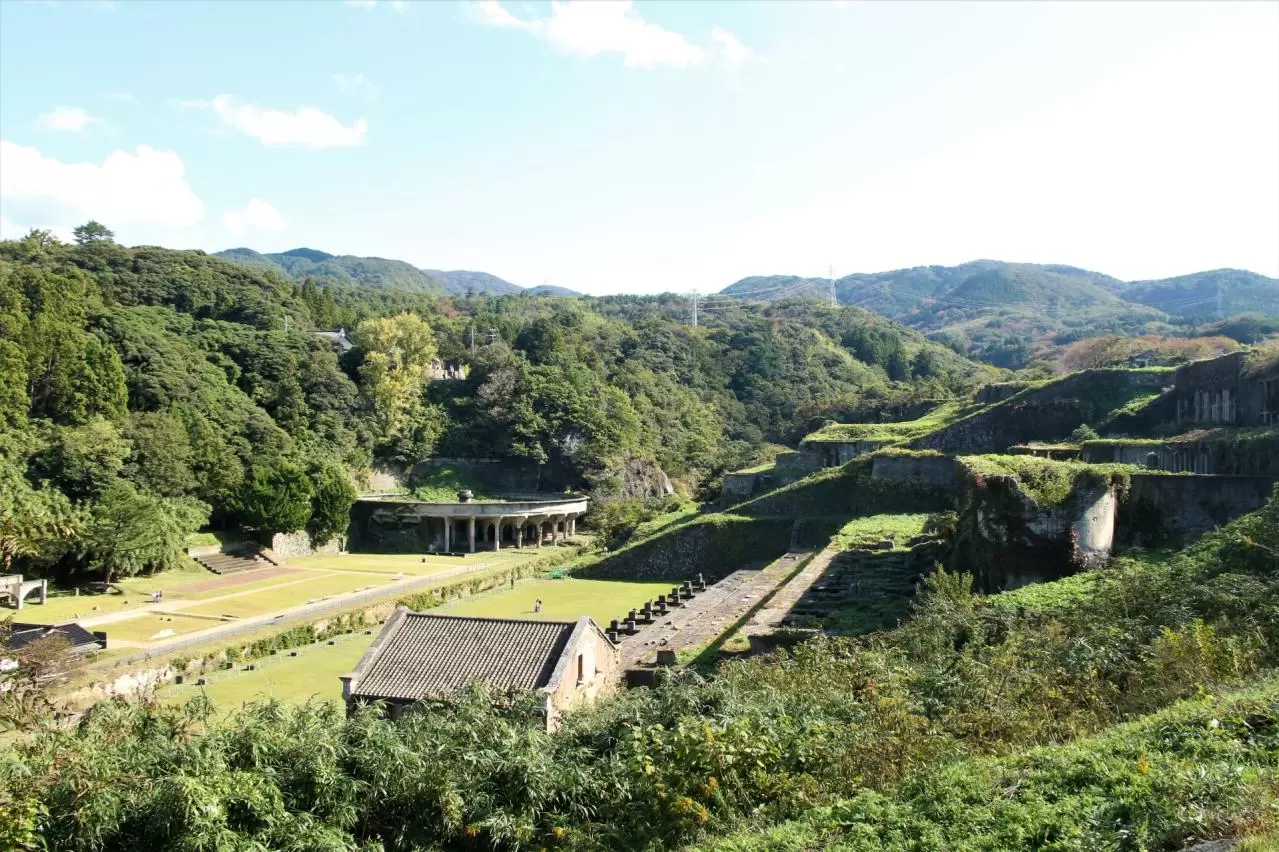
In the surrounding area, many large-scale facilities that supported modern mining remain in good condition, including the ruins of the Kitazawa Flotation Plant, once called “the world’s best ore dressing plant in the East.” The landscape of massive concrete structures gives visitors a strong sense of the scale of industry in that era. Also notable are facilities that symbolize advances in mining technology, such as the Odate vertical shaft, said to be Japan’s first Western-style vertical shaft. These modern industrial heritage sites are preserved and opened to the public as historic sites separate from the World Heritage components, and they play an important role in conveying the modernization of Sado Kinzan.
Mining at Sado Kinzan continued through repeated periods of boom and bust until operations ceased in 1989, and the total output during that time is said to have reached 78 tons of gold and 2,330 tons of silver. The tunnels dug for mining extend in a complex network, with a total length said to be about 400 km, making it one of Japan’s foremost mine ruins. Because of this historical scale and high value, many of the tunnel remains and mining and smelting-related facilities are protected as historic sites, cultural properties, and modern industrial heritage.
At Nishimikawa placer gold mine, a method called “o-nagashi” was used to efficiently recover visible gold dust. By digging into the mountain and using the force of water, miners carried out a distinctive form of extraction. Meanwhile, at Aikawa-Tsurushi gold and silver mine, techniques and processes were developed to extract “invisible gold” from ore veins in bedrock by crushing and processing the ore. The introduction and development of techniques suited to different ore deposits is an important element supporting the value of the Gold Mines of Sado Island.
In addition, Sado Kinzan offers not only tunnel and facility visits, but also guided tours of industrial heritage sites and hands-on courses where visitors can wear equipment and explore the tunnels, making it possible to enjoy a deeper learning experience. The appeal of Sado Kinzan lies in the chance to experience in one place everything from traditional handcraft mining to the path toward modernization.
In this way, the Sado Kinzan Historic Site is an important mine ruin that supported Japan’s monetary economy and industrial history, and it is a place where visitors can feel a grand sense of historical romance. Because it allows people to learn about the transition of mining from the Edo period to the Meiji period and into modern times through actual tunnels and industrial remains, it is recommended not only for history enthusiasts but also for first-time visitors.
Niigata Tourist Attractions
View List
Hakusan Park
Hakusan Park is located in the center of Niigata City and was designated as one of Japan's first urban parks in 1873 (the sixth year of the Meiji era). In October 20...

Naena Falls
Naena Falls is a spectacular waterfall selected as one of Japan's Top 100 Waterfalls, boasting a height of 55 meters. It flows over the Sekigawa River, which marks t...

Bijinbayashi Forest
Bijinbayashi is a beech forest about 100 years old, located in Matsunoyama, Tokamachi City. It was cut down for charcoal production at the end of the Taisho era, but...

Kiyotsu Gorge
Kiyotsu Gorge is one of Japan's three great gorges, alongside the Kurobe Gorge in Toyama Prefecture and Osu Valley in Mie Prefecture. This magnificent landscape was ...

Yahiko Shrine
Yahiko Shrine is an ancient shrine that has long been revered as the first shrine of Echigo. Known affectionately as "Oyahiko-sama," it attracts over 200,000 visitor...

Sasagawa Nagare
Sasakawa Nagare, located from Hamashinbo (Torigoeyama) in Murakami City, Niigata Prefecture, to Samukawa (Kitsuzaki), is a beautiful coastline boasting some of the b...

Northern Culture Museum
The Northern Culture Museum preserves and opens to the public the former grand residence of the Ito family, one of the most affluent farming families in Niigata. The...

Niigata City Aquarium Marinepia Nihonkai
Marinepia Nihonkai is one of the largest aquariums on the Sea of Japan coast, where you can encounter approximately 500 species and 20,000 aquatic organisms. Notably...