Northern Culture Museum
Northern Culture Museum Movies


Basic Information
- Spot Name
- Northern Culture Museum
- Location
- 〒950-0205 2-15-25 Sawami, Konan Ward, Niigata City, Niigata Prefecture
- Access
- About a 20-minute drive from JR Niigata Station
About a 10-minute drive from JR Shin'etsu Line "Niitsu Station"
About a 10-minute drive from Niigata-Kameda IC on the Nihonkai-Tohoku Expressway
About a 10-minute drive from Niitsu IC on the Ban'etsu Expressway - Parking
- 400 parking spaces
- Business Hours
- April to November: 9:00 AM to 5:00 PM, December to March: 9:00 AM to 4:30 PM
- Regular Holiday
- Open daily.
- Fees
- Adults: 800 yen
Elementary and Middle School Students: 400 yen - Contact Information
- Phone Number: 025-385-2001
- Official Website
Map
Detailed Information
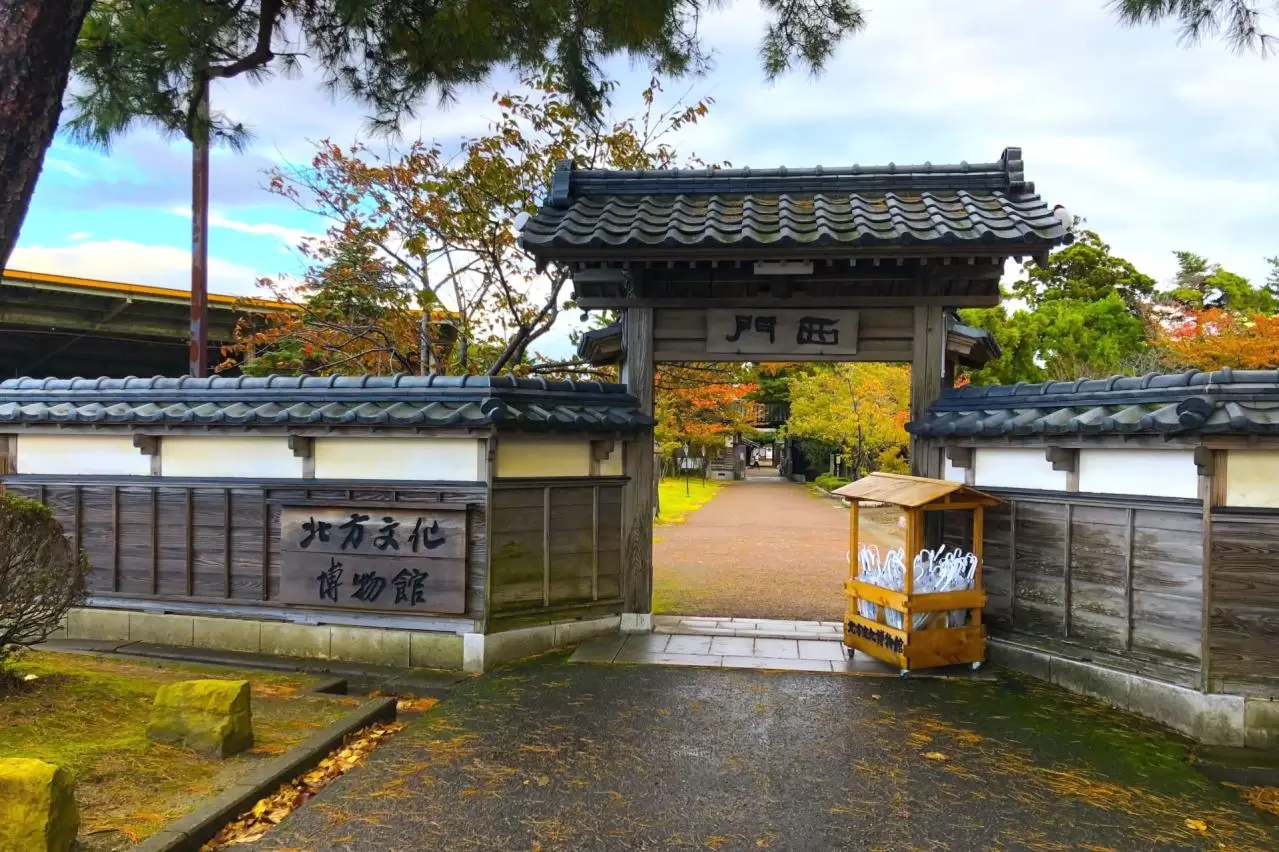
The Northern Culture Museum is a museum in Kōnan Ward, Niigata City, Niigata Prefecture, that preserves and opens to the public the former grand residence of the Ito family, known as Niigata’s foremost wealthy farming family. It conveys to the present day the history of the Ito family, one of Echigo’s leading landowners, along with local culture in Niigata and the way of life of wealthy farmers, while retaining the appearance of the time. Owing to its magnificent scale and formality, it is also known as the “mansion of a wealthy farmer.”
The grounds cover approximately 8,800 tsubo and contain the main house, a large hall wing, a tea room, storehouses, and a gate storehouse. The main house is a pure Japanese-style mansion with a total floor area of about 1,200 tsubo and 65 rooms, surrounded by earthworks, walls, and moats. With its grand entrance built entirely of zelkova and its karahafu gable, as well as its gate made of storehouse-style construction, it is among the largest and most imposing surviving wealthy-farmer residences in Niigata.
The Ito family’s main residence was completed in 1889, after eight years of construction. The main house wing was built around 1887 by the fifth head of the family as a modern Japanese-style mansion, and showcases the advanced building techniques of the time, including beams stacked in seven tiers and round beams extending some 30 meters. At one time, as many as 60 servants worked here, and the spacious kitchen, hearth, and earthen-floored passageways evoke the lively daily life of a wealthy farming household.
Connected to the main house by a corridor, the large hall wing contains a vast shoin-style sitting room of about 100 tatami mats. It is the most formal space, directly linked to the grand entrance built entirely of zelkova, and was used only a few times a year for special events. Its design, which minimizes the number of pillars, creates a sense of unity with the garden and results in an open, dignified space.
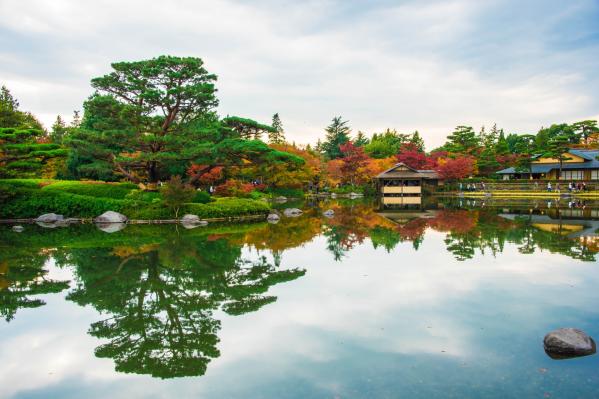
Within the grounds lies a pond-strolling garden with five tea houses. This garden was designed by landscape architect Tanzaemi Tanaka of Kashiwazaki, in keeping with the vision of the seventh head of the family, who imagined “a garden to host a thousand tea masters.” Tanaka, famed for excavating and restoring the stone arrangements associated with Ginkaku-ji, completed the garden over five years. Finished in 1958, the garden has carefully planned views from each building and presents different expressions in every season.
One of the symbols of the Northern Culture Museum is the great wisteria tree, over 150 years old, standing in the center of the grounds. The wisteria trellis spreading from a single tree covers about 80 tatami mats, and every year from early to mid-May, it droops with violet flower clusters. Some grow to nearly one meter in length, filling the air with an elegant sweet fragrance. During the blooming season, the tree is also illuminated at night, allowing visitors to enjoy a fantastical beauty different from that of the daytime.
In the second garden, “Yatōen,” developed in honor of the eighth head of the family, Bunkichi Ito, who loved wisteria, eight varieties of wisteria—including white, purple, pink, mixed, and long racemes—are arranged in a key-shaped layout, brightening the spring scenery.
In addition, “Sanrakutei,” a triangular sukiya-style shoin building, was designed by the sixth head of the family himself and completed in 1891. It was used as a study and tea room, and is also said to have been a place where the head of the family meditated. Even the interior pillars, fittings, and tatami mats are decorated with triangular and diamond-shaped motifs.
The museum also displays precious works of art collected by successive heads of the Ito family, including Nabeshima ware and Imari ware. There are also old farmhouses relocated from Kariwa and Yoshikigawa, and the Kariwa farmhouse in particular is preserved as a valuable cultural property retaining the appearance of the early Edo period.
In the garden, visitors can enjoy seasonal scenery throughout the year: cherry blossoms in spring, wisteria in early summer, Ōga lotus in summer, autumn foliage in fall, and yukitsuri snow supports in winter. During the autumn foliage season, the reds and yellows stand out against the green pines, and the view from the 100-tatami hall is as beautiful as a brocade-covered mountain. In winter, the snow supports are put in place, creating a tranquil snow-covered landscape.
The Northern Culture Museum is a place where the essence of the wealthy-farmer culture built by the Ito family, the natural beauty of Niigata, and the skill of artisans come together. Through its architecture, gardens, history, and the changing seasons, it is a representative cultural facility of Niigata Prefecture where visitors can deeply feel the culture and spirit of Niigata.
#Castle/Garden #flowers/plants #Museums/Museums #Cultural assets/historic sites
Niigata Tourist Attractions
View List
Hakusan Park
Hakusan Park is located in the center of Niigata City and was designated as one of Japan's first urban parks in 1873 (the sixth year of the Meiji era). In October 20...

Sasagawa Nagare
Sasakawa Nagare, located from Hamashinbo (Torigoeyama) in Murakami City, Niigata Prefecture, to Samukawa (Kitsuzaki), is a beautiful coastline boasting some of the b...

Sado Gold Mine
Sado Gold Mine is a historical site that boasts a 400-year history as Japan's largest gold and silver mine. It was opened in 1601, and during the Edo period, it was ...

Naena Falls
Naena Falls is a spectacular waterfall selected as one of Japan's Top 100 Waterfalls, boasting a height of 55 meters. It flows over the Sekigawa River, which marks t...

Bijinbayashi Forest
Bijinbayashi is a beech forest about 100 years old, located in Matsunoyama, Tokamachi City. It was cut down for charcoal production at the end of the Taisho era, but...

Niigata City Aquarium Marinepia Nihonkai
Marinepia Nihonkai is one of the largest aquariums on the Sea of Japan coast, where you can encounter approximately 500 species and 20,000 aquatic organisms. Notably...

Kiyotsu Gorge
Kiyotsu Gorge is one of Japan's three great gorges, alongside the Kurobe Gorge in Toyama Prefecture and Osu Valley in Mie Prefecture. This magnificent landscape was ...

Yahiko Shrine
Yahiko Shrine is an ancient shrine that has long been revered as the first shrine of Echigo. Known affectionately as "Oyahiko-sama," it attracts over 200,000 visitor...