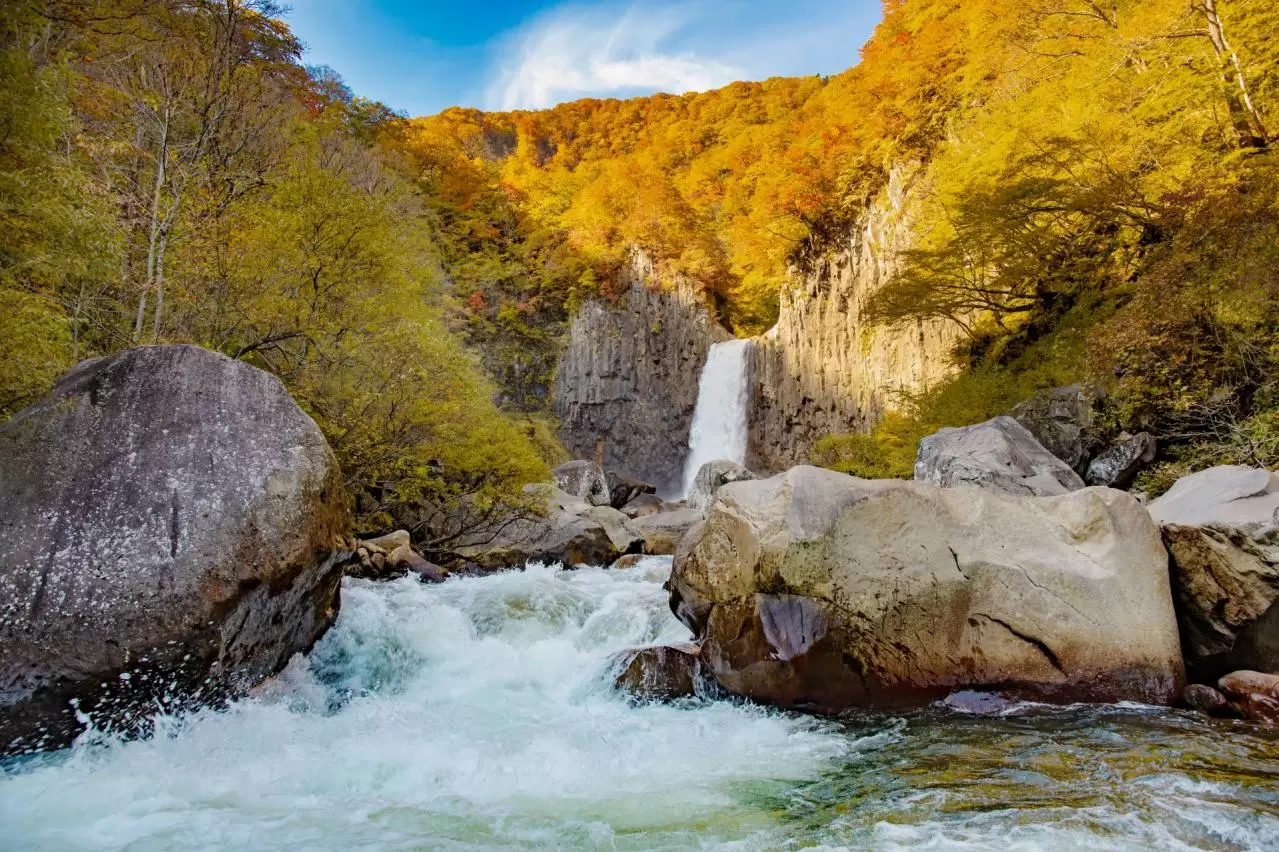
Naena Falls
Naena Falls Movies


Basic Information
- Spot Name
- Naena Falls
- Location
- 〒949-2113 Suginosawa, Myoko City, Niigata Prefecture
- Access
- From Myoko Kogen Station on the Toki-Tetsu Myoko Haneuma Line, it takes 20 minutes by bus. From Suginosawa Onsen, transfer to the shuttle bus for 10 minutes, followed by a 15-minute walk after getting off the bus.
From Myoko Kogen IC on the Joshinetsu Expressway, it takes 15 minutes by car, followed by a 15-minute walk after getting off. - Parking
- Available
- Business Hours
- Open for visitation.
- Regular Holiday
- Mid-April to late November (closed in winter, duration may vary)
- Contact Information
- Phone Number:0255-86-3911
- Official Website
Map
Detailed Information
Naena Falls is a waterfall on the Sekigawa River, which flows near the border between Niigata and Nagano prefectures. It is a famous waterfall selected as one of Japan’s Top 100 Waterfalls. With a height difference of 55 meters, its powerful plunge sends up sprays of water and leaves a strong impression on visitors. The dynamic scenery created by the sound of the falls and the abundant flow of water also makes it a popular power spot.
One of Naena Falls’ greatest attractions is the way it reveals different expressions in every season. The best time to visit is in spring, when melted snow dramatically increases the water volume and the falls are at their most impressive. Autumn, when the surrounding trees turn vivid shades of red and gold, is also especially beautiful, offering a superb combination of the waterfall and the scenic gorge. In summer, the area feels pleasantly cool, making it a great place to escape the heat.
Because its thunderous roar can feel almost like an earthquake, Naena Falls has long been known by the alternate name “Jishin Taki” or “Earthquake Falls.” The sound of the water crashing down echoes through the surrounding forest and is so intense that it seems to rumble through the ground; experiencing it in person makes the origin of the name entirely understandable. Another tradition says that in old Japan, earthquakes were called “nawi,” and that “nawi no taki” (earthquake waterfall) eventually became “Naena Taki.” There is also a theory that the name “Naena Falls” came from the word “nae” being used because the water nourishes the rice fields of the Takada Plain.
The surrounding landscape and rock walls are also highlights of Naena Falls. In the area around the falls, there are impressive cliffs marked by well-developed columnar jointing, formed when magma cooled and solidified, allowing visitors to observe powerful natural rock formations. In addition, on the cliff above the walking path, you can see lava with plate-like fractures known as banjo setsuri, resembling many stacked boards. This makes the site fascinating not only for the waterfall itself, but also from a geological perspective.
Naena Falls is also appealing because it is easy to visit. A well-maintained walking path leads from the parking area to the waterfall observation point in about 15 minutes on foot. Along the way, there is a suspension bridge, and crossing the first bridge takes you over the Sekigawa River and into Nagano Prefecture, adding a special border-area atmosphere to the experience. If you continue to the viewing area near the basin, you can feel the spray and roar from even closer, fully experiencing the waterfall’s power.
In addition, Naena Falls is the starting point or endpoint of the Myoko Kogen Nature Trail, which has been designated as a forest therapy road. For that reason, it is popular not only as a place to admire the waterfall, but also as a walking spot where visitors can refresh both body and mind while surrounded by nature. Time spent amid the gorge scenery, the scent of the trees, and the sound of the flowing river is perfect for recharging.
There are also places to stop nearby. Around the trail entrance, you’ll find a restaurant famous for nagashi somen, as well as a café popular for soft-serve ice cream topped with blueberries, raspberries, and other ingredients. Being able to enjoy local food along with the waterfall sightseeing is another pleasant feature of the area.
In this way, Naena Falls is a celebrated destination where you can enjoy, all at once, a dramatic 55-meter drop, a thunderous roar worthy of its name “Earthquake Falls,” distinctive cliff formations created by columnar jointing, and the beauty of each season. It is easy to access and enjoyable to explore, making it a highly recommended waterfall for anyone who wants to experience both the power and the healing energy of nature.
#Superb view/Scenic spot #Waterfalls, valleys, limestone caves
Niigata Tourist Attractions
View List
Hakusan Park
Hakusan Park is located in the center of Niigata City and was designated as one of Japan's first urban parks in 1873 (the sixth year of the Meiji era). In October 20...

Northern Culture Museum
The Northern Culture Museum preserves and opens to the public the former grand residence of the Ito family, one of the most affluent farming families in Niigata. The...

Sado Gold Mine
Sado Gold Mine is a historical site that boasts a 400-year history as Japan's largest gold and silver mine. It was opened in 1601, and during the Edo period, it was ...

Niigata City Aquarium Marinepia Nihonkai
Marinepia Nihonkai is one of the largest aquariums on the Sea of Japan coast, where you can encounter approximately 500 species and 20,000 aquatic organisms. Notably...

Kiyotsu Gorge
Kiyotsu Gorge is one of Japan's three great gorges, alongside the Kurobe Gorge in Toyama Prefecture and Osu Valley in Mie Prefecture. This magnificent landscape was ...

Sasagawa Nagare
Sasakawa Nagare, located from Hamashinbo (Torigoeyama) in Murakami City, Niigata Prefecture, to Samukawa (Kitsuzaki), is a beautiful coastline boasting some of the b...

Yahiko Shrine
Yahiko Shrine is an ancient shrine that has long been revered as the first shrine of Echigo. Known affectionately as "Oyahiko-sama," it attracts over 200,000 visitor...

Bijinbayashi Forest
Bijinbayashi is a beech forest about 100 years old, located in Matsunoyama, Tokamachi City. It was cut down for charcoal production at the end of the Taisho era, but...