Yahiko Shrine
Yahiko Shrine Movies


![【新潟県 弥彦村】桜舞う 彌彦神社さんぽ[4K]](https://i.ytimg.com/vi/b8eKwJHrIJM/mqdefault.jpg)


Basic Information
- Spot Name
- Yahiko Shrine
- Location
- 〒959-0393 2887-2 Yahiko, Yahiko Village, Nishikambara District, Niigata Prefecture, Japan
- Access
- Approximately 15 minutes walk from JR "Yahiko Station"
About 30 minutes by taxi from JR "Tsubamesanjo Station"
About 40 minutes by taxi from JR "Higashisanjo Station"
About 10 minutes by taxi from JR "Yoshida Station"
Approximately 30 minutes from "Sanjo Tsubame IC" on the Hokuriku Expressway
Approximately 30 minutes from "Maki-Katahigashi IC" on the Hokuriku Expressway - Parking
- Approximately 2,000 vehicles.
- Business Hours
- The shrine grounds are freely accessible (Treasure Hall: 9:00 AM - 4:00 PM, last admission at 4:30 PM).
- Regular Holiday
- None
- Contact Information
- Phone Number:0256-94-2001
- Official Website
Map
Detailed Information
Yahiko Shrine is a historic shrine enshrined in Yahiko Village, Nishikanbara District, Niigata Prefecture, and has long attracted deep devotion as the ichinomiya, or principal shrine, of Echigo Province. Locally, it is affectionately called “Oyahiko-sama,” and it continues to welcome many worshippers today as one of Niigata Prefecture’s most representative shrines. During the New Year’s visit period, it draws large numbers of visitors each year, with the total usually exceeding 200,000.
The enshrined deity is Amenokagoyama-no-Mikoto, also known as Iyahiko-no-Okami. Amenokagoyama-no-Mikoto is a great-grandchild of Amaterasu Omikami, the ancestral deity of the imperial line, and is also called Takakuraji-no-Mikoto. His father is Nigi-hayahи-no-Mikoto, and his mother is Amenomichihime-no-Mikoto, and he is said to have descended to earth in the company of the heavenly grand descent.
According to mythology, when Amenokagoyama-no-Mikoto was living in Kumano in Kii Province, Emperor Jimmu, on his eastern campaign, fell into a coma at Kumano Arasaka Bay due to the enemy’s poisonous miasma. In a divine dream sent by Amaterasu Omikami and Takemikazuchi-no-Mikoto, Amenokagoyama-no-Mikoto presented the sacred sword Futsunomitama-no-Tsurugi to Emperor Jimmu. With the power of this holy sword, Emperor Jimmu and the imperial forces escaped danger, accomplished the eastern expedition, and later Emperor Jimmu is said to have ascended the throne as the first emperor at Kashihara Palace.
In the fourth year of Emperor Jimmu’s reign, 657 BCE, Amenokagoyama-no-Mikoto was ordered to pacify the land of Koshi, crossed the Sea of Japan, and landed at Misuura (around present-day Nozumi, Nagaoka City). Thereafter, he is said to have taught the people techniques for fishing, salt production, and sake brewing, laid the foundations for rice cultivation and various industries, and opened up the land of Echigo. For this reason, Amenokagoyama-no-Mikoto is revered as the ancestral deity of Echigo’s development and as a god who bestows vitality and life force upon people.
According to the shrine’s tradition regarding its founding, Yahiko Shrine began in the first year of Emperor Kōan’s reign, 392 BCE, after Amenokagoyama-no-Mikoto passed away and was buried on Mt. Kamitsurugi (Mt. Yahiko), when his child, Ame-no-Tane-no-Mikoto, built a shrine and enshrined him there. Later, during the reign of Emperor Sujin, Takenomorozumi-no-Mikoto constructed the shrine buildings by imperial command, and in 711, the fourth year of the Wadō era under Empress Genmei, the sacred precincts were expanded. From this history, Yahiko Shrine is regarded as having a history of more than 2,400 years.
In ancient times, it was written as “Iyahiko Shrine” and read “Iyahiko,” and its name appears in the Man’yōshū, Japan’s oldest anthology of poetry, in the verse:
“Iyahiko, by nature divine and venerable; even on a day when blue clouds linger, the light rain falls.”
It is a venerable shrine whose name has been preserved since the age of Man’yō. Since ancient times, it has been deeply revered by the imperial court, as well as by successive shogunates and military commanders.
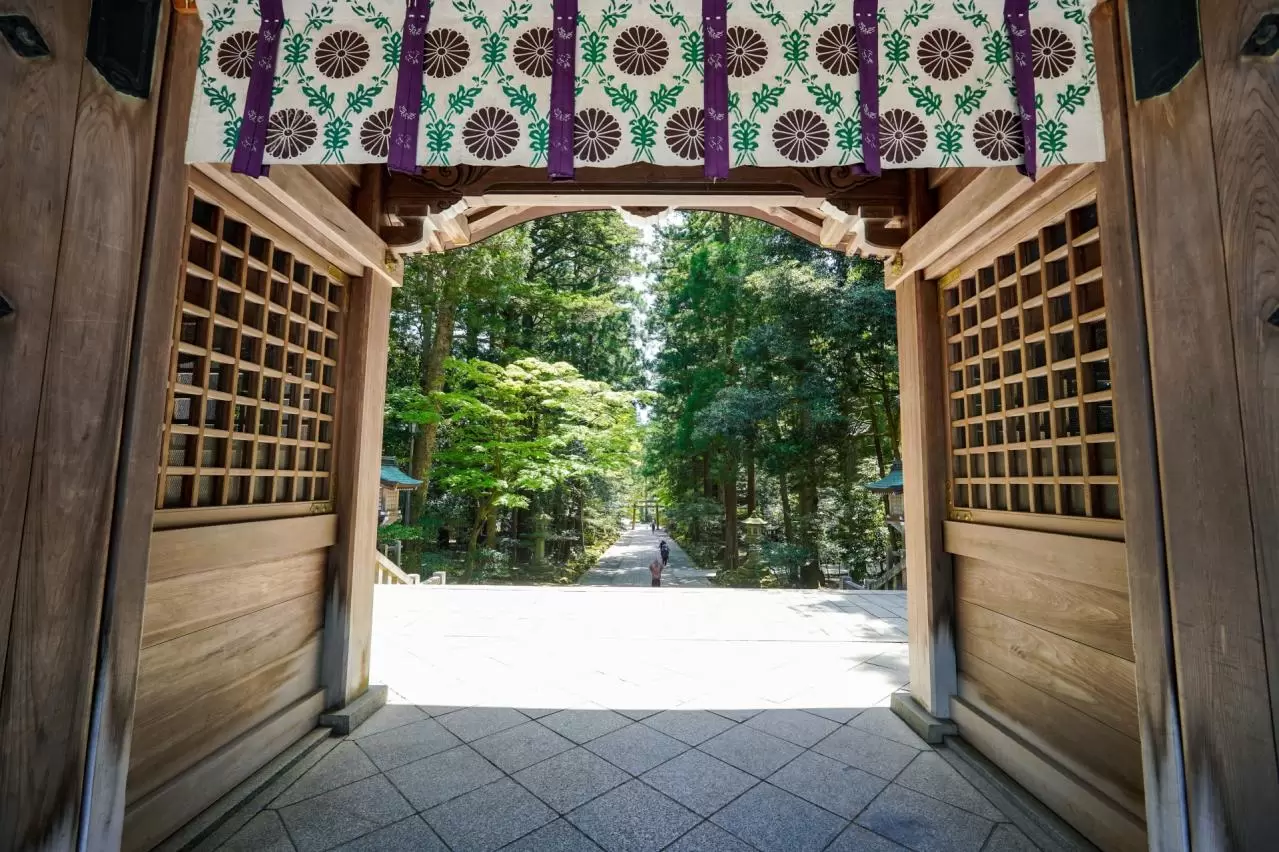
The grounds are surrounded by a magnificent sacred forest lined with ancient trees over 400 years old, creating a solemn and sacred atmosphere. It is also known as a famous spot for forest bathing and autumn foliage, where visitors can enjoy nature throughout the seasons. The present worship hall was rebuilt in 1916 by the architect Chuta Ito, and it continues to convey the shrine’s dignity today. Another distinctive feature is the worship ritual, which consists of two bows, four claps, and one bow, unlike the more common pattern used at most shrines.
Within the precincts is a divination stone known as the “Fireball Stone” or “Heavy-Light Stone.” Visitors hold the stone while focusing on a wish; if it feels light, the wish is said to come true, while if it feels heavy, it is said to be difficult to realize. It is a popular spot that many visitors like to try.
In addition, because the enshrined deity and the princess deity are said to have enjoyed a harmonious relationship, Yahiko Shrine is also known as a shrine that brings blessings for matchmaking and marriage. At the summit of Mt. Yahiko stands Yahiko Shrine Goshinbyo, the inner sanctuary, where Amenokagoyama-no-Mikoto and his consort, Umasihohime-no-Mikoto, are enshrined. It is also a popular power spot for those wishing for romance and good relationships.
Mt. Yahiko stands at 634 meters above sea level, and the base station of the Yahiko Ropeway is about a 10-minute walk from the shrine, making the summit easily accessible. A free shuttle bus also operates between the shrine and the ropeway station, and by car, visitors can use the Yahiko Skyline road.
Access is also very convenient: the shrine is within walking distance of JR Yahiko Station, and by car it can be reached from the Sanjō-Tsubame Interchange. Free parking is available in the surrounding area.
For those who would like to learn more about Yahiko Shrine’s history and the highlights of its grounds, the “Yahiko Tourist Volunteer Guide” is also recommended.
Yahiko Shrine is Niigata’s representative shrine, where a long history, rich nature, and the faith of the people live on. For those who wish to fully savor its solemn atmosphere, a visit in the quiet early morning hours is especially recommended.
Niigata Tourist Attractions
View List
Bijinbayashi Forest
Bijinbayashi is a beech forest about 100 years old, located in Matsunoyama, Tokamachi City. It was cut down for charcoal production at the end of the Taisho era, but...

Hakusan Park
Hakusan Park is located in the center of Niigata City and was designated as one of Japan's first urban parks in 1873 (the sixth year of the Meiji era). In October 20...

Niigata City Aquarium Marinepia Nihonkai
Marinepia Nihonkai is one of the largest aquariums on the Sea of Japan coast, where you can encounter approximately 500 species and 20,000 aquatic organisms. Notably...

Sasagawa Nagare
Sasakawa Nagare, located from Hamashinbo (Torigoeyama) in Murakami City, Niigata Prefecture, to Samukawa (Kitsuzaki), is a beautiful coastline boasting some of the b...

Northern Culture Museum
The Northern Culture Museum preserves and opens to the public the former grand residence of the Ito family, one of the most affluent farming families in Niigata. The...

Naena Falls
Naena Falls is a spectacular waterfall selected as one of Japan's Top 100 Waterfalls, boasting a height of 55 meters. It flows over the Sekigawa River, which marks t...

Sado Gold Mine
Sado Gold Mine is a historical site that boasts a 400-year history as Japan's largest gold and silver mine. It was opened in 1601, and during the Edo period, it was ...

Kiyotsu Gorge
Kiyotsu Gorge is one of Japan's three great gorges, alongside the Kurobe Gorge in Toyama Prefecture and Osu Valley in Mie Prefecture. This magnificent landscape was ...