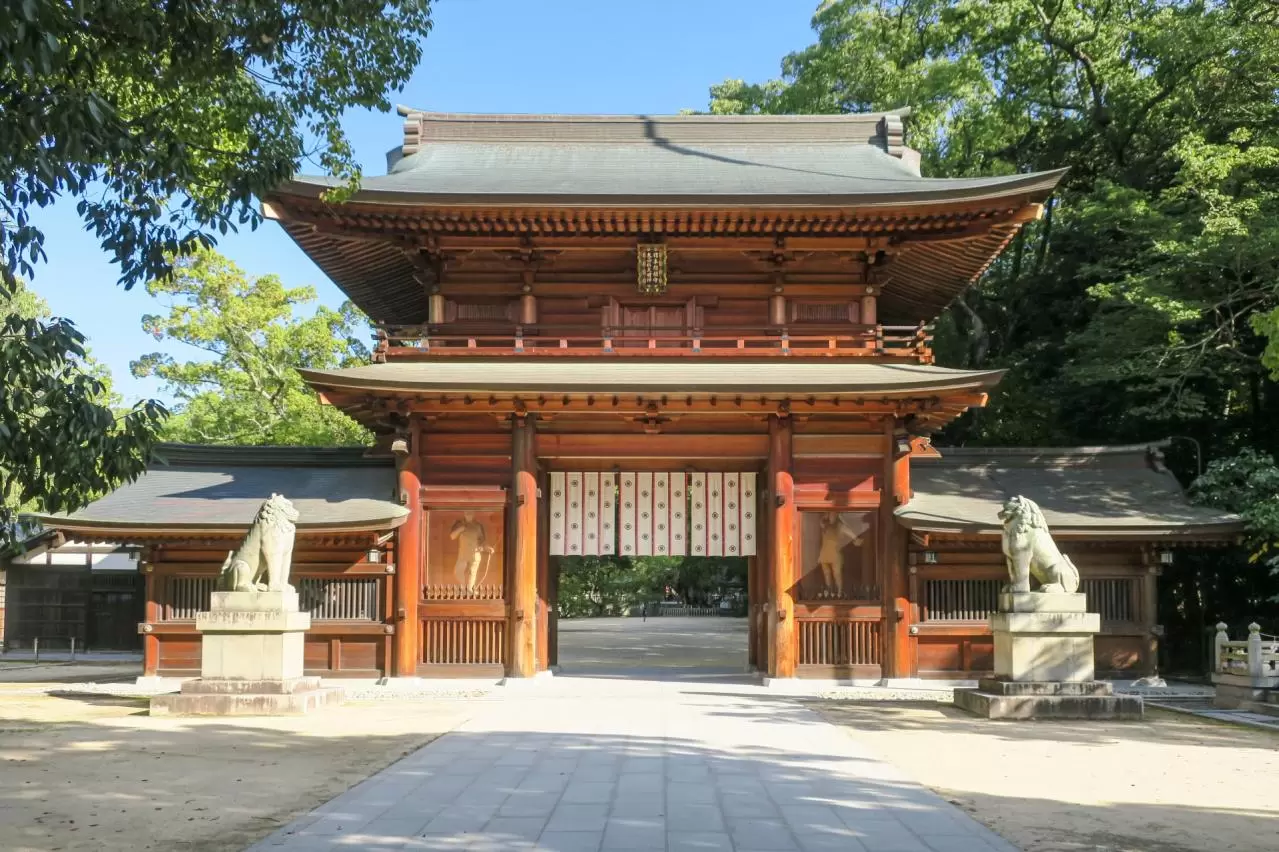
Oyamazumi Shrine
Oyamazumi Shrine Movies


Basic Information
- Spot Name
- Oyamazumi Shrine
- Location
- 〒794-1304 3327 Miura, Omishima Town, Imabari City, Ehime Prefecture, Japan
- Access
- From Imabari Station on the JR Yosan Line, take the Setouchi Highway express bus to Omishima for 1 hour, and get off at the Ōyamazumi Shrine-mae stop. It takes about 15 minutes from the "Omishima IC" on the Nishiseto Expressway (Setouchi Shimanami Kaido).
- Parking
- Available
- Business Hours
- The shrine is open freely, and the treasure museum is open from 8:30 to 16:30 (last admission at 17:00).
- Regular Holiday
- Open all year round.
- Fees
- [Oyamazumi Shrine] Free
[Treasure Museum / Maritime Museum] Adults 1000 yen / High school and university students 800 yen / Elementary and junior high school students 400 yen - Contact Information
- Phone Number:0897-82-0032
- Official Website
Map
Detailed Information
Oyamazumi Shrine is a venerable shrine located in Miyaura, Omishima-cho, Imabari City, Ehime Prefecture. It is known as the head shrine of the approximately 10,000 Yamazumi Shrines and Mishima Shrines throughout Japan. Situated on Omishima, the largest island of the Geiyo Islands in the approximate center of the Seto Inland Sea, it has long been respectfully referred to as the “Guardian Shrine of All Japan.” Said to be the oldest shrine in Ehime Prefecture, it is a major center of history, culture, and religious faith along the Shimanami Kaido and attracts many worshippers.
The principal deity enshrined here is Oyamatsumi no Okami. Oyamatsumi no Okami appears in the *Kojiki* and the *Nihon Shoki*. In addition to being a deity of the mountains, he is also worshipped as a deity of the sea and of safe passage. He is the father of Konohanasakuya-hime no Mikoto, the consort of the heavenly grandson Ninigi no Mikoto, and is revered as a deity deeply connected with the founding of Japan.
## History of Oyamazumi Shrine
The history of Oyamazumi Shrine dates back to ancient times. According to shrine tradition, before Emperor Jimmu’s eastern expedition, Ochi no Mikoto, a descendant of Oyamatsumi no Okami, enshrined his ancestral deity on Omishima. This is said to have marked the shrine’s beginning.
The shrine was originally located near present-day Seto in Kamiura-cho, but tradition holds that it was moved to its current location in Miyaura on April 22, 719, during the third year of the Yoro era. The date of this relocation remains the origin of an important annual festival.
Since ancient times, the shrine has been deeply revered as the guardian deity of sea routes across the Seto Inland Sea. During the medieval period, it attracted the devotion of many military leaders and naval forces, including the Minamoto and Taira clans. In particular, warriors such as the Kono clan and the Murakami Suigun, who were active in the Seto Inland Sea, held the shrine in especially high regard. Numerous weapons and pieces of armor were dedicated to the shrine as offerings for prayers for victory and reports of military success.
In 1915, the shrine was designated the only Imperial Government Shrine of the highest rank in Shikoku. It continues to be revered as the head shrine of Yamazumi Shrines and Mishima Shrines throughout Japan.
## The Enshrined Deity and Divine Blessings
Oyamatsumi no Okami, the principal deity of Oyamazumi Shrine, is worshipped as a deity possessing many divine virtues.
The shrine’s principal blessings are said to include:
- Protection of mountains
- Safety at sea
- Safe voyages
- Traffic safety
- Prayers for victory
- Prosperity in business
- Bountiful harvests
- Household safety
- Health and longevity
- Safe childbirth and blessings for children
Because Oyamatsumi no Okami embodies both the characteristics of a mountain deity and a sea deity, the shrine has long attracted the devotion of fishermen, sailors, and warriors.
## The Sacred Camphor Tree Said to Be More Than 2,600 Years Old
The most famous feature of the shrine grounds is the enormous sacred camphor tree towering in front of the main sanctuary.
Known as the “Camphor Tree Planted by Ochi no Mikoto,” it is said, according to shrine tradition, to have been planted by Ochi no Mikoto when he enshrined his ancestral deity. Its estimated age is said to be approximately 2,600 years, making it one of the oldest trees in Japan.
Its massive trunk gives it an overwhelming presence. Its mysterious appearance captivates visitors and makes it one of the most important symbols of faith at Oyamazumi Shrine.
The group of camphor trees on the shrine grounds has also been designated a Natural Monument of Japan under the name “The Camphor Trees of Oyamazumi Shrine.”
## The Main Sanctuary and Worship Hall
### Nationally Designated Important Cultural Properties
Both the main sanctuary and the worship hall of Oyamazumi Shrine have been designated Important Cultural Properties of Japan.
### Main Sanctuary
The main sanctuary is a three-bay nagare-zukuri structure reconstructed in the early Muromachi period.
Its vermilion-lacquered walls and white plaster walls are beautifully complemented by a cypress-bark roof. It is highly regarded as a valuable example of medieval shrine architecture.
### Worship Hall
The worship hall is also believed to have been reconstructed in the early Muromachi period. It is a dignified structure featuring a kirizuma-style gabled roof and a karahafu curved gable above the entrance porch.
Its calm atmosphere conveys the weight of its long history, and many worshippers offer their prayers here.
## Kamitsu-yashiro and Shimotsu-yashiro
At Oyamazumi Shrine, not only the main sanctuary but also the subsidiary shrines Kamitsu-yashiro and Shimotsu-yashiro are important objects of worship.
Kamitsu-yashiro enshrines Oikazuchi no Kami, while Shimotsu-yashiro enshrines Takaokami no Kami.
Today, the main shrine, Kamitsu-yashiro, and Shimotsu-yashiro continue to be worshipped collectively as Oyamazumi Shrine.
## The Treasure Museum, Home to National Treasures and Important Cultural Properties
One of the greatest highlights of Oyamazumi Shrine is its Treasure Museum.
The museum houses an exceptionally valuable collection of weapons, armor, swords, and other military artifacts.
Among the collection are weapons said to have connections with Minamoto no Yoshitsune and Minamoto no Yoritomo, as well as armor and swords dedicated by generations of military leaders. Numerous items have been designated National Treasures or Important Cultural Properties.
The museum is one of the largest collections of arms and armor in Japan and is said to house approximately 80 percent of the weapons and armor designated as National Treasures or Important Cultural Properties throughout the country.
For this reason, Oyamazumi Shrine is also known as “the shrine that houses Japan’s largest collection of weapons designated as National Treasures and Important Cultural Properties.”
## Shrine Crest
The crest of Oyamazumi Shrine is called “Sumikiri Oshiki Chijimi Sanmonji.”
It features three wave-shaped characters arranged inside an oshiki, a ceremonial tray used in Shinto rituals, and has long been used as a symbol of the shrine.
The crest is also known for having been adopted as a family crest by the Kono and Murakami clans, who held Oyamazumi Shrine in deep reverence.
## Highlights of the Shrine Grounds
In addition to historic buildings and Natural Monuments, the shrine grounds preserve numerous cultural assets.
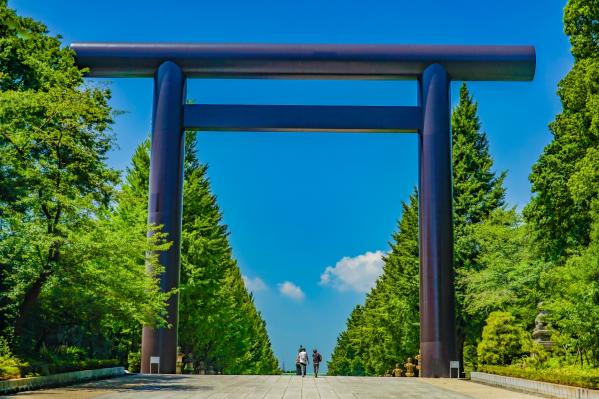
The main gate, reconstructed in 2010, is made entirely of Japanese cypress and stands approximately 12 meters tall.
The stone monument bearing the name “Oyamatsumi Daimyojin, Guardian Shrine of All Japan” was inscribed by Hirobumi Ito, Japan’s first prime minister, when he visited the shrine in 1909.
From the shrine grounds, visitors can also see Mount Washigato, Mount Anjin, and Mount Omiyama. These mountains are regarded as sacred mountains associated with the main shrine, Kamitsu-yashiro, and Shimotsu-yashiro. Together, the shrine and the surrounding natural landscape create a serene and sacred vista.
## A Sacred Destination Representative of the Shimanami Kaido
Omishima, where Oyamazumi Shrine stands, is also known as the “Island of the Gods.”
Located almost at the center of the Shimanami Kaido, the island is famous as a popular destination for cyclists and tourists.
The area surrounding the shrine offers beautiful views of the Seto Inland Sea, creating a distinctive atmosphere where history, nature, and religious faith come together.
## Conclusion
Oyamazumi Shrine is a venerable shrine known as the head shrine of Yamazumi Shrines and Mishima Shrines throughout Japan. Enshrining Oyamatsumi no Okami, it has long attracted deep devotion as a place dedicated to the deity of mountains, the deity of the sea, and the deity of safe voyages.
The shrine grounds are home to a sacred camphor tree said to be approximately 2,600 years old, while the main sanctuary and worship hall have been designated Important Cultural Properties of Japan. The Treasure Museum houses numerous valuable weapons and pieces of armor, including National Treasures and Important Cultural Properties, making the shrine one of Japan’s foremost repositories of historical and cultural treasures.
As one of the central attractions along the Shimanami Kaido, Oyamazumi Shrine is highly recommended not only for those interested in history and culture, but also for anyone wishing to experience the magnificent scenery of the Seto Inland Sea and the shrine’s sacred atmosphere.
Ehime Tourist Attractions
View List
Kumano San Ishiteji
Ishiteji Temple is the 51st temple of the Shikoku 88 Temple Pilgrimage, located near Dogo Onsen. It features important cultural properties including the National Tre...

Matsuyama Castle
Standing at an elevation of 132 meters, Matsuyama Castle is a magnificent structure that symbolizes Japan's history and culture. Construction was initiated by Kato Y...

Kirishima Tenbou Kouen
Located at the southern tip of Oshima, Kamero Mountain Observatory Park boasts one of the best views along the Shimanami Kaido. From its observation deck at an altit...

Shikoku Karst
Shikoku Karst is a treasure trove of nature that stretches along the border between Ehime Prefecture and Kochi Prefecture. Spanning approximately 25 km from east to ...

Imabari Castle
Imabari Castle is a flat-topped castle built by the renowned castle architect Todo Takatora after the Battle of Sekigahara and is one of Japan's three major seaside ...

Bocchan Train
The "Botchan Train" is a diesel locomotive based on a steam engine that was beloved by the citizens of Matsuyama for 67 years starting from 1888. It gets its name fr...

Dogo Onsen Honkan
The hot springs are said to have been opened during the Jomon period and were visited by Prince Shotoku. Many famous figures, including Masaoka Shiki, have connectio...

Uwajima Castle
Uwajima Castle is one of the 12 existing tenshu (castle keeps) and was built by Date Munenori as a stronghold. Facing Uwajima Bay, it features an irregular pentagona...