Imabari Castle
Imabari Castle Movies


![【今治城】訪ねる前に見てほしい。お城巡りが数倍楽しくなる?築城名人が作った最高傑作【愛媛県今治市】[Imabari Castle]Masterpiece made by a castle master](https://i.ytimg.com/vi/AR4yBkW4wkk/mqdefault.jpg)


Basic Information
- Spot Name
- Imabari Castle
- Location
- 〒794-0036 3-1-3 Tsuji-cho, Imabari City, Ehime Prefecture
- Access
- About a 20-minute walk from JR Imabari Station.
Approximately a 10-minute drive from the Setouchi Shimanami Expressway Imabari IC. - Parking
- Approximately 66 vehicles.
- Business Hours
- 9:00 AM to 5:00 PM (closed)
- Regular Holiday
- Closed for three days at the end of the year (December 29 to December 31) / Other specified dates.
- Fees
- General admission: 520 yen, Student: 260 yen, Free for high school students and under or those under 18 years old.
- Contact Information
- Phone Number:0898-31-9233
- Official Website
Map
Detailed Information
Imabari Castle is a renowned flatland castle located in Torimachi, Imabari City, Ehime Prefecture. It was built by Todo Takatora, a master castle architect known for his exceptional skill in castle construction. Built along the coast facing the Seto Inland Sea, it featured extensive moats filled with seawater and one of the largest ship entrances in Japan. For this reason, it is recognized as one of Japan’s most representative coastal and water castles.
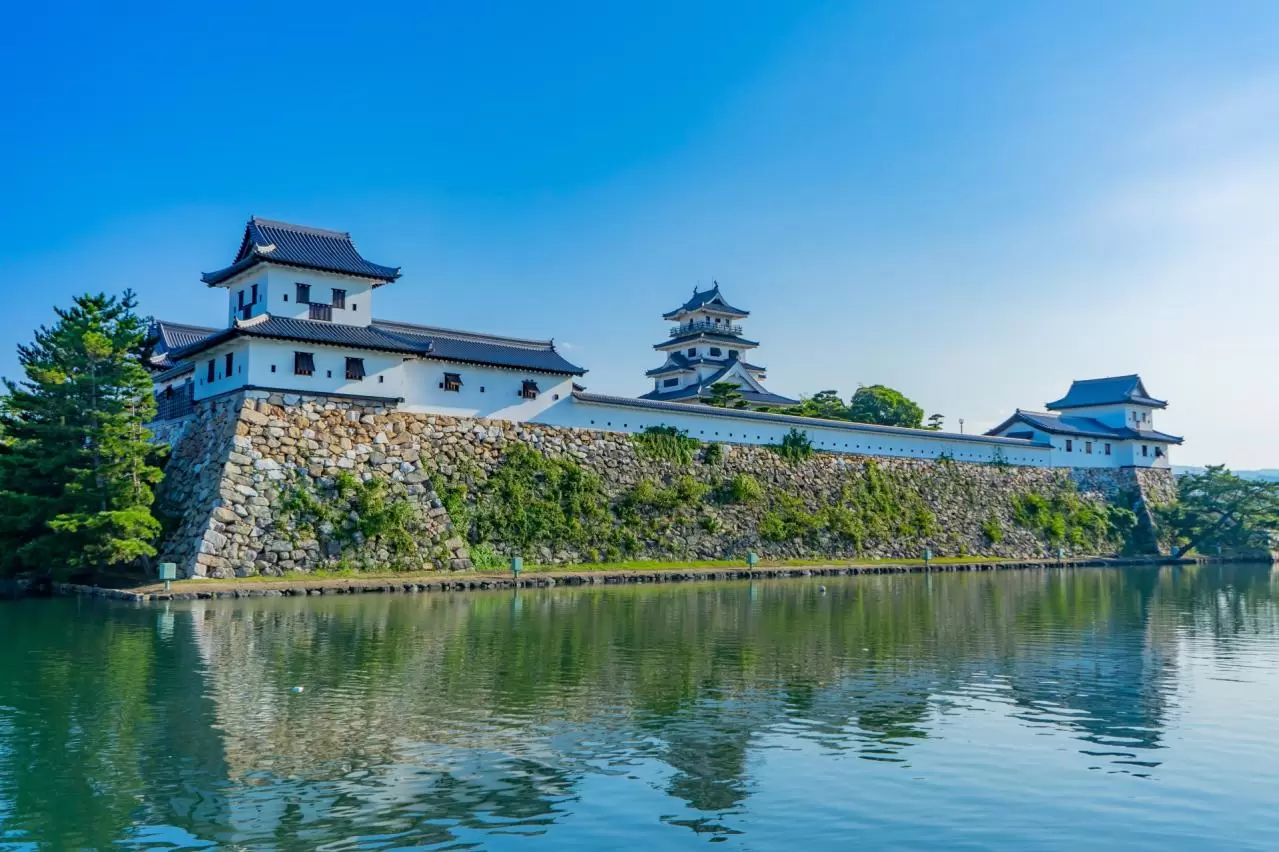
Together with Takamatsu Castle in Kagawa Prefecture and Nakatsu Castle in Oita Prefecture, it is counted among the “Three Great Water Castles of Japan.” It is also fondly known by its alternate name, Fukiage Castle. Today, its broad inner moat and stone walls remain well preserved, and visitors can enjoy a beautiful castle landscape in which the reconstructed keep, turrets, and gates are reflected on the water.
## History of Imabari Castle
Imabari Castle was built by Todo Takatora after he distinguished himself as a member of the Eastern Army in the Battle of Sekigahara and was granted half of Iyo Province, worth 200,000 koku.
Construction began in 1602, and the main sections are believed to have been completed around 1604. The entire castle complex, including its buildings, was likely completed around 1608.
Todo Takatora was a military commander who was active from the Warring States period through the early Edo period. He is known as a master castle architect who was involved in the construction and renovation of many castles, including Uwajima Castle, Imabari Castle, Iga-Ueno Castle, and Tsu Castle. Imabari Castle also displays Takatora’s characteristic rational and practical design philosophy in many places.
After Todo Takatora was transferred to Ise and Iga, his adopted son, Todo Takayoshi, entered the castle as its lord’s representative. Later, in 1635, Matsudaira Sadafusa took up residence at the castle. From then until the Meiji Restoration, the Hisamatsu-Matsudaira family governed the area as lords of the Imabari domain.
## One of Japan’s Three Great Water Castles
One of Imabari Castle’s greatest features is its location as a coastal castle that makes use of its proximity to the Seto Inland Sea.
At the time of its construction, Imabari Castle was an extensive fortress with three layers of moats, which were supplied with seawater from the Seto Inland Sea. A ship entrance was built inside the castle to allow vessels to come and go, and the castle played an important role as a base for maritime transportation, military operations, and logistics.
Because of this structure, Imabari Castle is known, together with Takamatsu Castle and Nakatsu Castle, as one of the “Three Great Water Castles of Japan.” The integrated design of sea and castle clearly reflects Imabari’s role as a key center for transportation, logistics, and military activity on the Seto Inland Sea.
## The Alternate Name “Fukiage Castle”
Imabari Castle is also called “Fukiage Castle.”
The name is said to derive from Fukiage Beach, the area where the castle was built. The beach was formed by sand blown up by sea winds.
Although constructing a large castle on sandy coastal land was no easy task, Todo Takatora devised the structure of the stone walls and moats to create a strong fortress on unstable ground. This is another indication of the high level of Takatora’s castle-building expertise.
## The Inner Moat Filled with Seawater
One of the highlights of Imabari Castle is its vast inner moat, which remains today.
The moat is approximately 50 meters wide, and seawater still flows in and out of it. As a result, marine fish such as mullet and sea bream can sometimes be seen swimming in the moat, along with rays on occasion. Unlike ordinary freshwater moats, this unique landscape is connected directly to the sea and is characteristic of Imabari Castle.
The stone walls, castle keep, and turrets reflected on the water create a beautiful view that delights visitors both day and night.
## Stone Walls and the Inubashiri
Imabari Castle retains stone walls that demonstrate Todo Takatora’s castle-building techniques.
Although the castle was built on sandy ground, stone walls more than 10 meters high were constructed around the main enclosure. A level area known as an “inubashiri” was created at the base of the stone walls, revealing an ingenious solution for dealing with the unstable ground.
Large stones were also used throughout the castle grounds. One of the best known is the “Kanbe Stone,” named after Watanabe Kanbe, who served as the construction magistrate.
## Reconstructed Keep and Turrets
After the Meiji Restoration, many of Imabari Castle’s buildings were demolished, leaving only the inner moat and the stone walls of the main enclosure.
Later, in 1953, the site of the main enclosure and the inner moat were designated as an Ehime Prefectural Historic Site. In 1980, the castle keep, Bugu Turret, and Tamon Turret were reconstructed. Reconstruction and restoration work continued afterward, including the Gokin Turret, Yamazato Turret, and Kurogane Gate. Today, the castle presents an appearance that allows visitors to experience the atmosphere of the original fortress.
## The Castle Keep and Museum
The present keep of Imabari Castle is a five-story, six-level building reconstructed in 1980.
The current keep is not a complete historically accurate reconstruction of the original keep, and there are various theories about what the original looked like. Nevertheless, it is widely loved as a symbol of Imabari Castle.
The interior of the keep is used as a museum, displaying materials related to the history of Imabari Castle and the Imabari domain, as well as weapons and armor, ancient documents, and historical materials from the region.
The top floor serves as an observation deck, offering panoramic views of Imabari City, the Seto Inland Sea, the Shimanami Kaido, and the Kurushima Strait. On clear days, visitors can enjoy beautiful views of the islands scattered across the Seto Inland Sea.
## Exhibition Facilities within the Castle Grounds
In addition to the castle keep, Imabari Castle has several other exhibition facilities.
The Bugu Turret houses exhibits related to weapons and armor, including samurai armor and swords. At the Gokin Turret, visitors can view local art and materials and works associated with the region. The Yamazato Turret also features exhibits on Imabari’s natural environment and culture.
A combination ticket allows visitors to tour several facilities, making it possible to learn about Imabari’s history, culture, and art as well as the castle itself.
## Kurogane Gate
One of the highlights of Imabari Castle is the Kurogane Gate, reconstructed in 2007.
The Kurogane Gate was once an important defensive structure of Imabari Castle. Its reconstruction has restored the imposing atmosphere characteristic of a Japanese castle. The scenery created by the gate, turrets, stone walls, and inner moat makes this an excellent photo spot that captures the distinctive beauty of Imabari Castle.
## Fukiage Shrine
Fukiage Shrine stands near the castle keep.
The shrine was established during the Meiji period by enshrining together several shrines that had previously stood within the castle and in the surrounding castle town. It remains popular with local residents today. It becomes especially busy with visitors during New Year’s celebrations, and many people visit the shrine as part of a stroll around Imabari Castle.
## Nighttime Illumination
Imabari Castle is also popular for its nighttime illumination.
After sunset, the castle keep, turrets, and stone walls are lit up, creating an enchanting atmosphere quite different from the daytime view. The lights reflected on the water, together with the silhouette of the castle, create a beautiful scene that makes the castle appear to float on the sea.
The illumination was designed by lighting designer Haruki Kaito. Approximately 100 lights are used to create a three-dimensional effect that makes the entire castle appear to emerge from the darkness. It is highly recommended for visitors exploring Imabari at night.
## One of Japan’s Top 100 Castles
Imabari Castle has also been selected as one of the “Top 100 Castles of Japan” by the Japan Castle Foundation.
As one of the representative castles built by the master architect Todo Takatora, it has been highly praised for its distinctive design as a water castle supplied with seawater, its surviving inner moat and stone walls, and its reconstructed castle scenery.
The castle offers plenty to see not only for castle enthusiasts, but also for anyone interested in history and architecture or wishing to enjoy the scenery of the Seto Inland Sea.
## Conclusion
Imabari Castle is one of Japan’s finest coastal castles, built by Todo Takatora, and is counted alongside Takamatsu Castle and Nakatsu Castle as one of the “Three Great Water Castles of Japan.” Its location facing the Seto Inland Sea, along with its seawater-filled moats and one of the largest ship entrances in Japan, demonstrates Imabari’s historical importance as a center of maritime transportation.
The extensive inner moat and stone walls remain today, while the reconstructed castle keep, turrets, and Kurogane Gate convey the atmosphere of the original fortress. Inside the keep, visitors can learn about the history of Imabari Castle and the surrounding region, while the top floor offers spectacular panoramic views of the Seto Inland Sea and the Shimanami Kaido.
With its beautiful castle scenery reflected on the water by day and its enchanting nighttime illumination after dark, Imabari Castle is one of the leading tourist attractions in Imabari City, Ehime Prefecture. It is a magnificent castle well worth visiting in conjunction with a trip along the Shimanami Kaido.
Ehime Tourist Attractions
View List
Shikoku Karst
Shikoku Karst is a treasure trove of nature that stretches along the border between Ehime Prefecture and Kochi Prefecture. Spanning approximately 25 km from east to ...

Bocchan Train
The "Botchan Train" is a diesel locomotive based on a steam engine that was beloved by the citizens of Matsuyama for 67 years starting from 1888. It gets its name fr...

Uwajima Castle
Uwajima Castle is one of the 12 existing tenshu (castle keeps) and was built by Date Munenori as a stronghold. Facing Uwajima Bay, it features an irregular pentagona...

Dogo Onsen Honkan
The hot springs are said to have been opened during the Jomon period and were visited by Prince Shotoku. Many famous figures, including Masaoka Shiki, have connectio...

Matsuyama Castle
Standing at an elevation of 132 meters, Matsuyama Castle is a magnificent structure that symbolizes Japan's history and culture. Construction was initiated by Kato Y...

Kumano San Ishiteji
Ishiteji Temple is the 51st temple of the Shikoku 88 Temple Pilgrimage, located near Dogo Onsen. It features important cultural properties including the National Tre...

Oyamazumi Shrine
Oyamazumi Shrine is the head shrine of all Yamazumi shrines and Mishima shrines across the country, and it is the oldest shrine in Ehime Prefecture. Within the groun...

Kirishima Tenbou Kouen
Located at the southern tip of Oshima, Kamero Mountain Observatory Park boasts one of the best views along the Shimanami Kaido. From its observation deck at an altit...