Daibo Mountain Eihei-ji
Daibo Mountain Eihei-ji Movies




Basic Information
- Spot Name
- Daibo Mountain Eihei-ji
- Location
- 〒910-1294 5-15 Shihi, Eiheiji Town, Yoshida District, Fukui Prefecture
- Access
- From Fukui Station East Exit, take the Keifuku Bus "Express Eiheiji Liner" for a direct trip of about 30 minutes. Alternatively, from Echizen Railway Fukui Station, take the Katsuyama Eiheiji Line to "Eiheiji-guchi Station," then transfer to the Keifuku Bus bound for "Eiheiji" and get off at the last stop, which is a 5-minute walk (total time is approximately 45 minutes). If you are driving, take the Hokuriku Expressway from Fukui North IC, then exit at the Eiheiji Sando IC on the Chubu Jukkan Road (free section) and drive for 15 minutes via National Route 364.
- Parking
- Parking available
- Business Hours
- Visiting hours: 8:30 AM to 5:00 PM. Note: From November to April, the hours are 8:30 AM to 5:00 PM.
- Regular Holiday
- Open every day.
- Fees
- Admission Fee
Adults: 700 yen
Elementary and Junior High School Students: 300 yen
Persons with Disability Certificate: 300 yen
Preschool Children: Free - Contact Information
- Phone Number:0776-63-3102
- Official Website
Map
Detailed Information
Mount Eiheiji is a Zen training monastery for zazen practice, founded by Zen Master Dogen in 1244. Known as a head temple of the Soto school, it remains a place where many monks continue their rigorous daily training.
The origins of Eiheiji date back to when Dogen Zenji came to Echizen at the invitation of Lord Hatano Yoshishige, opened Daibutsuji the following year, and renamed it “Eiheiji” two years later. Since then, Eiheiji has developed as a leading training monastery of the Soto school. In the early Edo period, the Tokugawa shogunate issued the Eiheiji Rules, further clarifying its position.
Nestled in the mountains of Fukui Prefecture, Eiheiji is a renowned temple surrounded by the quiet of deep mountains and valleys and an atmosphere of dignified serenity. Within its vast grounds, more than 70 buildings stand centered around the seven principal halls, creating a magnificent landscape integrated with the natural mountain setting. Many of the current buildings were constructed after repeated fires since the temple’s founding, and were gradually completed from the early modern to modern periods.
Features of Eiheiji
A major feature of Eiheiji is that it is not merely a tourist attraction, but still a “living training monastery.” The monk trainees practice not only zazen and chanting sutras, but also make every aspect of daily life—cleaning, meals, bathing, and more—part of their training. The ascetic life based on Dogen Zenji’s teachings continues to this day.
As you walk through the grounds, the arrangement of the halls connected by corridors and stairways conveys the solemn order characteristic of a Zen temple. Visitors can sense firsthand the tension and tranquility of a place devoted to rigorous practice.
About the Seven Principal Halls
Especially important at Eiheiji are the seven buildings known as the “seven principal halls.” These are the central structures essential to Zen training: the Sanmon gate, Butsuden hall, Hodo hall, Sodo hall, Daikuin kitchen hall, bathhouse, and toilet hall. From the Sanmon gate to the Chujumon gate, Butsuden, and Hodo, the buildings are aligned in a straight line, while the Daikuin and Sodo are connected by corridors.
The seven principal halls are truly the center of the monks’ daily life and training. Zazen, chanting sutras, meals, samu work, and many other aspects of daily practice take place in this area. When visiting Eiheiji, carefully exploring these seven halls is an important experience for coming into contact with Zen teachings and the essence of the temple.
Main Highlights
Sanmon
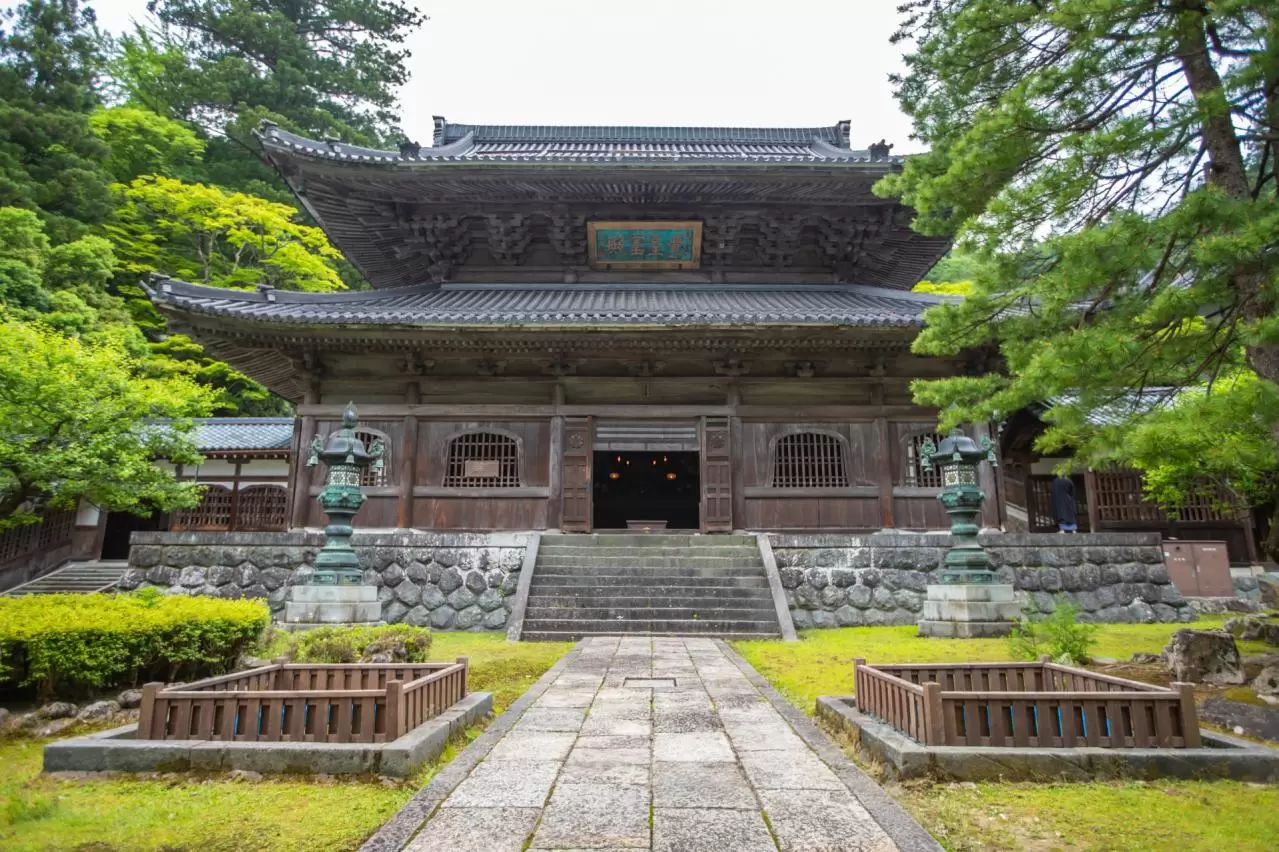
The Sanmon is one of the most symbolic buildings at Eiheiji. It is known as the special gate through which monks formally enter the mountain monastery. Among the surviving main halls, it is one of the oldest structures, a magnificent two-story gate. The lower level is said to enshrine the Four Heavenly Kings, and the upper level the Five Hundred Arhats.
Butsuden
The Butsuden is located at the center of the seven principal halls and is an important building that enshrines the temple’s main deity. It forms the core of the layout extending from the Sanmon to the Chujumon, Butsuden, and Hodo, and is one of Eiheiji’s spiritual centers.
Hodo
The Hodo is the hall where sermons and Buddhist services are held, and together with the Butsuden it is one of Eiheiji’s most important buildings. Located at the innermost point of the temple’s straight-line arrangement, it creates an especially solemn atmosphere within the grounds.
Sodo
The Sodo is the center of monastic life, where monk trainees engage in zazen, meals, and other practices. In Zen temples, the Sodo is especially important, and at Eiheiji it serves as the core of daily training.
Daikuin
The Daikuin is an important building that supports meals and the operation of the temple. As one of the seven principal halls, it is connected by corridors to the Sodo and serves as the center of practical support for monastic life.
To-sui
The To-sui is the toilet used by the monk trainees, and together with the bathhouse and Sodo it is an important part of monastic life. In Zen teachings, every aspect of daily life is considered training, and this spirit is clearly reflected here.
Bathhouse
The bathhouse is also one of the places of practice. In Zen temples, there is a tradition of bathing on the 4th and 9th days of the month, carried out solemnly according to proper etiquette. It is valued not only as a place to cleanse the body, but also to refine the mind.
Main Buildings Other Than the Seven Principal Halls
Karamon
The Karamon is known as the gate used when welcoming a new head priest. It is not a gate freely passed through by visitors; rather, its stately presence is viewed from outside.
Tsuuyoumon
The Tsuuyoumon is the gate used by general visitors. It is the entrance to Eiheiji for pilgrims and visitors.
Kissho-kaku
Kissho-kaku is the building that houses the reception area and visitor facilities. It is the starting point for a visit, from which visitors proceed to the various halls.
Sanshokaku
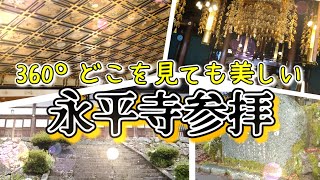
Sanshokaku is one of Eiheiji’s most famous highlights. The current building was rebuilt over a period of two years starting in 1993 as part of the commemorative project for the 750th memorial service of Dogen Zenji. On the second floor is a large hall with 156 tatami mats, into which the restored ceiling paintings from 1930 have been installed. The 230 paintings were created by 144 well-known painters of the time and include flowers, birds, carp, lions, and squirrels.
Shoyo-den
Shoyo-den is the mausoleum of the sect’s founder, Dogen. It is one of the most sacred places within Eiheiji and the central space for honoring Zen Master Dogen.
Shido-den
Shido-den is the hall where memorial services such as burial rites and memorial offerings are performed for the general public. Inside the hall are memorial tablets donated by believers from all over Japan.
Rurishohokaku
Rurishohokaku is a treasure museum that serves as both an exhibition space and a storage facility. It houses and displays many valuable cultural properties transmitted through Eiheiji, including calligraphy, paintings, utensils, and old documents. Among them, the “Fukanzazengi,” said to have been written by Dogen Zenji himself, is designated as a National Treasure.
Visiting and Experiences
At Eiheiji, in addition to ordinary worship, visitors can also experience the world of Zen.
Zazen Experience
Day-trip zazen experiences are available three times a day without prior reservation. The sessions are held at 10:00, 13:30, and 15:30, and last about 50 minutes. However, they may not be held depending on the monastery’s circumstances.
Morning Service
Morning service is held every day of the year, 365 days a year. If you wish to participate, you must contact the main reception by 5:00 p.m. the day before and go to the reception desk at least 40 minutes before it begins. The morning chanting, in which dozens of monks recite sutras in unison, is a uniquely solemn experience at Eiheiji.
Copying Sutras
Copying sutras is currently suspended as a measure to prevent the spread of infectious diseases.
The Lives of the Monks and the Spirit of Eiheiji
At Eiheiji, monk trainees are called “unsui.” The word is widely known as referring to those who walk the path of training without attachment, like clouds and water. Under strict discipline, the unsui live each day as training, not only through zazen and sutra chanting but through even the smallest details of daily life.
A defining feature of Eiheiji’s teaching is that it does not view zazen alone as practice, but rather embraces daily life itself as the Buddhist path. This way of training is one of the great characteristics of Eiheiji, carrying Dogen Zenji’s teachings into the present day.
Scale of the Grounds and Cultural Value
Eiheiji’s grounds contain many buildings, 19 of which are designated as Important Cultural Properties of Japan. These include the Sanmon, Butsuden, Hodo, Sodo, Daikuin, the main hall and worship hall of Shoyo-den, and Shido-den. The temple is highly regarded as a magnificent Zen temple complex integrated with the natural mountain environment.
These buildings are not only beautiful as architecture, but also cultural heritage that conveys the function and spirituality of a training monastery to the present day.
Charm of the Temple Town
The temple town in front of Eiheiji features souvenir shops and restaurants, creating a calm atmosphere where visitors can stop before or after their visit. Along with visiting Eiheiji, strolling through the temple town and enjoying Fukui’s local food and atmosphere is one of its attractions.
Conclusion
Mount Eiheiji is a Zen training monastery representative of the Soto school, founded in 1244 by Zen Master Dogen. Within its vast grounds, many buildings stand centered around the seven principal halls, and the tradition of training continues to this day.
In the halls such as the Sanmon, Butsuden, Hodo, Sodo, and Daikuin, Zen teachings live on in everyday life, and visitors can experience Eiheiji’s unique spiritual world amid its quiet and tension-filled atmosphere. In particular, the painted ceiling of Sanshokaku, Shoyo-den, and Rurishohokaku offer many highlights, allowing visitors to feel the depth of history, culture, and faith.
Moreover, through zazen experiences and participation in morning services, visitors can come into contact with the spirit of Zen in a way that simply viewing the buildings cannot provide. Eiheiji is a special place representing Fukui, where nature, history, culture, faith, and training experiences come together as one.
Fukui Tourist Attractions
View List
Maruoka Castle
Maruoka Castle, also known as Kasumiga Castle, was built by Katsuie Shibata's nephew, Katsutoyo. The name "Kasumiga Castle" comes from a legend in which a giant serp...

Ichijo-dani Asakura Site
The Ichijodani Asakura Clan Ruins is a valuable archaeological site where the remains of the castle town ruled by the Asakura clan during the Sengoku period have bee...

Mikata Goko
Mikata Five Lakes is the collective name for five lakes located in Mihama and Wakasa towns in Fukui Prefecture. They consist of Mikata Lake, Suigetsu Lake, Suga Lake...

Fukui Prefectural Dinosaur Museum
The Fukui Prefectural Dinosaur Museum, one of the largest dinosaur-themed museums in Japan, provides visitors with an opportunity to learn about dinosaurs and the hi...


Shibamasa World
Shibamasa World is a large theme park covering an expansive area of 560,000 square meters facing the Sea of Japan. During the summer, it opens one of Japan's largest...

Echizen Matsushima Aquarium
Echizen Matsushima Aquarium is an interactive aquarium themed around "see, touch, and learn with fun." It features enjoyable attractions such as dolphin shows and pe...