Oshino Hakkai
Oshino Hakkai Movies




Basic Information
- Spot Name
- Oshino Hakkai
- Location
- 〒401-0511 Shinjo, Oshino Village, Minamitsuru District, Yamanashi Prefecture
- Access
- 15 minutes by bus from Fujiyoshida Station on the Fujikyu Railway.
Get off at the Oshino Hakkai bus stop and walk for 5 minutes.
20 minutes from Kawaguchiko IC on the Chuo Expressway.
10 minutes from Yamanakako IC on the Higashi-Fuji Goko Road. - Parking
- Please use the nearby paid parking.
- Business Hours
- Open for visits
- Regular Holiday
- Open every day.
- Contact Information
- Phone Number:0555-84-4222
- Official Website
Map
Detailed Information
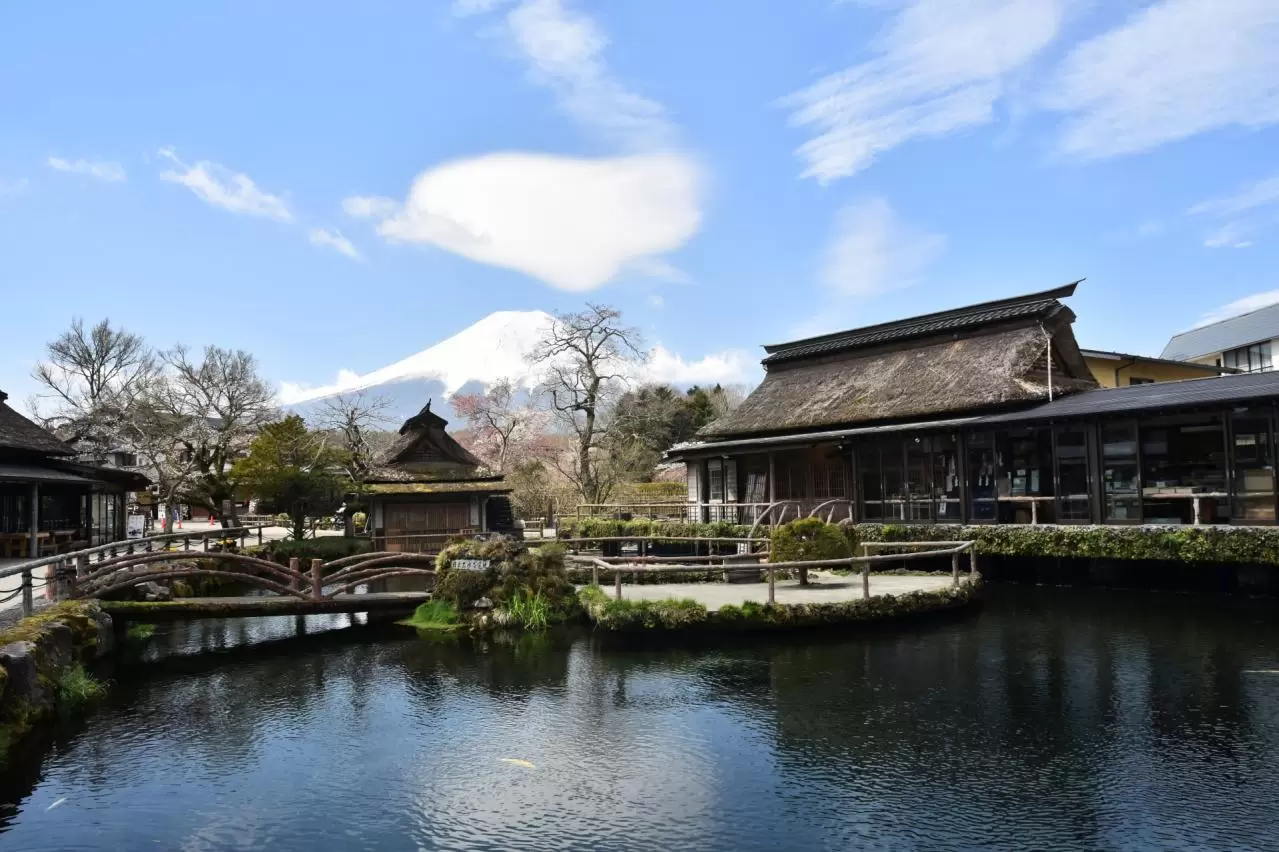
Oshino Hakkai is a representative group of spring-fed ponds in Oshino Village, Minamitsuru District, Yamanashi Prefecture, nourished by groundwater from Mount Fuji. The area that is now Oshino Village is said to have once been a lake called “Oshino Lake,” or its predecessor, “Lake Utsu.” Over time, as a result of Mount Fuji’s eruptions and changes in the terrain, the lake that had spread between the foothills of Mount Fuji and the Misaka mountain range gradually lost its water and dried up. Even so, spring ponds where Fuji’s underground water emerged remained scattered throughout the area. The best-known of these is “Oshino Hakkai,” the collective name for eight spring ponds.
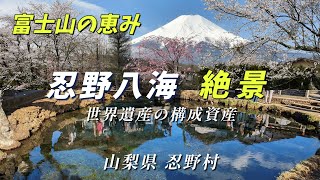
The greatest feature of Oshino Hakkai is the astonishing clarity of its water. Rain and snowmelt that fall on Mount Fuji seep into the ground, are naturally filtered over decades as they pass through layers such as lava strata, and then rise to the surface as pure spring water. The water is so clear that you can see all the way to the bottom of the ponds, and depending on the light, it can appear deep blue. The sight of aquatic plants and fish seeming to float in midair is truly mystical. In addition, when weather and wind conditions are favorable, visitors can enjoy “reverse Fuji,” in which Mount Fuji is reflected on the water’s surface—one of the area’s great attractions.
Oshino Hakkai is important not only as a natural landscape but also in terms of faith and history. It has long been known as a sacred site of Fuji worship, and during the Edo period it was used by followers of Fuji-kō as a place for misogi purification through water rites before ascending Mount Fuji. It is also said to have been one of the training grounds of Hasegawa Kakugyō, who is regarded as the founder of Fuji-kō. In addition, each of the eight ponds is dedicated to one of the Eight Great Dragon Kings, and stone monuments inscribed with their names and poems have been erected, preserving the atmosphere of a sacred site to this day.
However, due to factors such as the anti-Buddhist movement of the Meiji era, Fuji worship gradually declined, and the water rites once performed at Oshino Hakkai were gradually discontinued. After World War II, practitioners were reportedly rarely seen. On the other hand, around 1965, the natural scenery and beauty of the water at Oshino Hakkai began attracting attention, and when it was selected by the Environmental Agency (now the Ministry of the Environment) as one of the “100 Best Waters of Japan” in 1985, its nationwide fame grew and it developed as a tourist destination.
Because of these highly valued natural and cultural qualities, Oshino Hakkai was designated a National Natural Monument in 1934. Furthermore, in 1985 it was selected as one of Japan’s “100 Best Waters,” and in 1993 it was designated as a prefectural “Fugaku Hyakkei” site. Then, in June 2013, it was registered as part of the component assets of the UNESCO World Cultural Heritage site “Mount Fuji—Object of Worship, Source of Art.” This recognition reflects not only its rarity as a natural feature, but also its historical background connected to Fuji worship, the beauty of its scenery, and its excellent state of conservation.
The eight ponds that make up Oshino Hakkai each have their own location, atmosphere, and legends, making it enjoyable to visit them one by one.
- Deguchi Pond is the largest of the eight and the only one located a little apart from the others. With few shops or stalls nearby and relatively few visitors, it offers a quiet, nature-like landscape. A forest rises behind it, and the shrine of Deguchi Inari Daimyōjin stands in the woods overlooking the pond.
- Okama Pond is the smallest of the eight. Its name is said to come from its shape, resembling water bubbling up in a cooking pot. Its deep blue water and the delicate, mystical movement of water crowfoot are among its highlights.
- Sokonashi Pond is associated with a legend that “washed items disappear.” Located beyond the Hanno Tree Grove Museum, it has a calm atmosphere surrounded by forest and is said to preserve one of the oldest landscapes among the eight ponds.
- Chōshi Pond is said to be a pond for matchmaking. Its name is thought to come from its resemblance to a sake flask. It stands quietly in a grassy area, and one of its distinctive features is the sight of water springing up from the sandy bottom.
- Waku Pond is especially notable for its abundant spring water and beautiful scenery, and is the most representative pond of Oshino Hakkai. Located in the main tourist area, it is surrounded by souvenir shops and watermills, creating a lively atmosphere. The rippling surface and the beauty of the deep water make it an iconic presence at Oshino Hakkai.
- Nigoi Pond, despite its name, now holds clear water. A legend says that it became cloudy when a wandering ascetic, denied water, caused the pond to cloud over. Although the spring water volume is not large, water is said to emerge from the pond bottom.
- Kagami Pond offers a superb view of reverse Fuji when conditions are right, with Mount Fuji reflected on the water’s surface. Although the spring water volume is relatively modest, the surface is more likely to become mirror-like, creating highly photogenic scenery. An old legend also says it is a pond that distinguishes good from evil.
- Shōbu Pond has a beautiful legend associated with irises, and plants such as iris and yellow iris can be seen around it. Located east of Kagami Pond, it has a park arranged farther back, making it a fitting place to conclude a stroll.
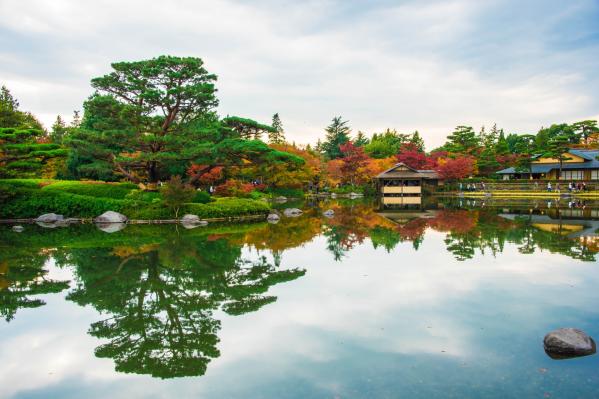
The scenery of Oshino Hakkai changes dramatically with the seasons. In spring, cherry blossoms harmonize with the clarity of the spring water, and on clear days the satoyama landscape with Mount Fuji in the background stands out beautifully. In summer, the greenery becomes lush, and the coolness of the spring water provides a refreshing atmosphere, making it ideal for a leisurely walk that also serves as a cool retreat. In autumn, the leaves turn brilliant colors, and the combination of the water’s surface, the satoyama scenery, and Mount Fuji creates a deeply atmospheric view. In winter, the contrast between the snowy landscape and the blue of the water becomes striking, allowing visitors to experience an even more mystical mood in the quiet.
In this way, Oshino Hakkai is one of Japan’s foremost sacred waterscapes, where the pure spring scenery created by Mount Fuji’s natural environment overlaps with the history of Fuji worship. Walking around the eight ponds, visitors can enjoy the clarity of the water, the legends, the charm of the satoyama landscape, and the spectacular views of Mount Fuji all at once—this is the great appeal unique to Oshino Hakkai.
#Superb view/Scenic spot #Townscape/Bikan Historical Quarter
Yamanashi Tourist Attractions
View List
Arajukuyama Sengen Park
Shin kura yama Sengen Park is a breathtaking spot located in Fujiyoshida City, Yamanashi Prefecture. Situated halfway up Shin kura yama, visitors can enjoy a panoram...

Take-da Shrine
The Takeda Shrine, dedicated to the renowned samurai Takeda Shingen, was established in 1919 at the site of the historic Tsutsujigasaki Castle. This location, which ...

Kiyosato Terrace
Kiyosato Terrace is a café terrace with the concept of "a prime seat at an altitude of 1,900 meters." Located in the summit area of Sun Meadows Kiyosato, it offers s...

Kawaguchiko Music Forest Museum
The Kawaguchiko Music and Forest Museum is located near the beautiful Lake Kawaguchi and boasts the largest collection of music boxes and automatic instruments in th...

Kawaguchiko
Kawaguchiko, one of the Fuji Five Lakes, is registered as a component of the World Heritage Site of Mount Fuji and has the longest shoreline among the lakes. The lak...

Fuji-Q Highland
Fuji-Q Highland is a large amusement park located in Fujiyoshida City, Japan, famous nationwide for its thrilling attractions and haunted houses. Particularly notabl...

Fujimoto Skoryzote
At the Fujikyu Highland Resort in Yamanashi Prefecture, the "Fuji Shibazakura Festival" is held annually from mid-April to late May, featuring 500,000 clusters of sh...