A traditional rural landscape
Traditional Nambu-style L-shaped farmhouses evoke the atmosphere of an older rural way of life.
AI Summary
This is an AI-generated summary. Please check the official information for opening hours, fees, and closed days.
Experience rural life in a peaceful village setting as you wander among traditional L-shaped farmhouses and satoyama countryside.
Tono Furusato Village recreates a nostalgic rural landscape lined with traditional L-shaped farmhouses. Streams, waterwheels and fields create a tranquil countryside scene that changes with the seasons. Hands-on activities and local cuisine offer a taste of Tono’s rural heritage.
Traditional Nambu-style L-shaped farmhouses evoke the atmosphere of an older rural way of life.
Activities such as farm work and traditional crafts are available, with advance reservations required.
Sample Tono food culture with local specialties such as hittsumi dumpling soup and bucket-style jingisukan barbecue.
Explore the farmhouse village first, then take your time experiencing local life through a hands-on activity or a meal.
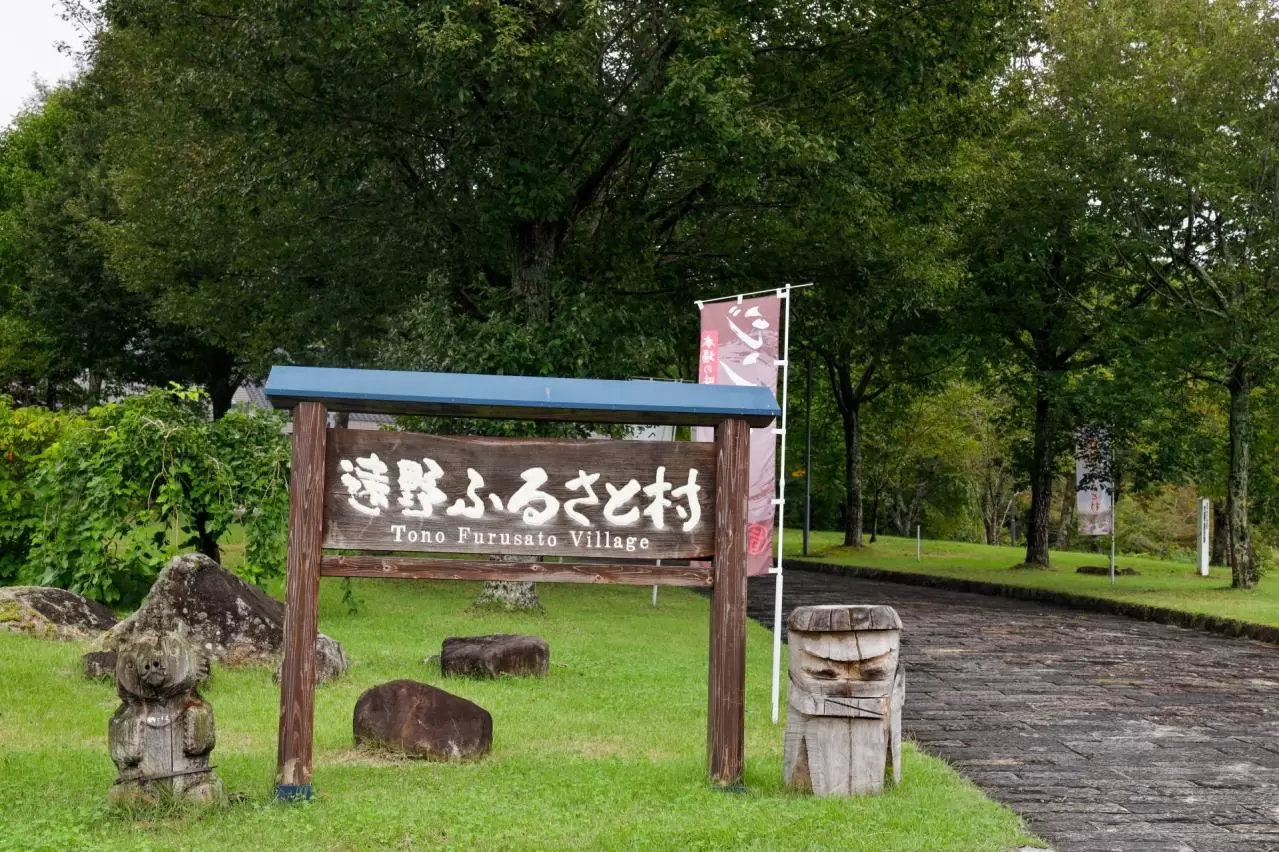
Tono Furusato Village is a tourist facility in Tono City, Iwate Prefecture that recreates a traditional rural settlement from old Japan. Centered around seven farmhouses, including Nanbu curved-roof houses built from the mid-Edo period to the mid-Meiji period, traditional homes have been relocated and preserved, and the area has been developed to evoke the appearance of a rural landscape from the early Showa period. Streams, rice fields, water wheels, and charcoal kilns are also arranged throughout the village, creating a nostalgic satoyama landscape that feels as if time has stopped.
The Appeal of the Buildings and Scenery
Nanbu Curved-Roof House
The Nanbu curved-roof house is a traditional farmhouse in which the main house and stable are integrated in an L-shape, symbolizing Tono’s way of life in which people and horses lived together. Characteristic buildings, such as a village headman’s house and houses that preserve their original form before becoming two-story structures, are scattered throughout the village, allowing visitors to experience the history of rural life firsthand.
Scenery Through the Seasons
Within the village, visitors can enjoy seasonal scenery: spring cherry blossoms, fresh summer greenery, autumn foliage, and snowy winter landscapes. The rural setting harmonized with nature reveals different charms each time you visit. For this reason, the village is also often used as a filming location for dramas and movies, and its historic scenery is widely cherished.
Experience Programs
Maburitto (Guardians)
At Tono Furusato Village, “maburitto,” or guardians, warmly welcome visitors. Maburitto are instructors who teach farm work and traditional culture, and they lead a variety of hands-on programs (advance reservation required; contents vary by season).
Examples of Rural Experiences
Rice cake making
Soba noodle making
Straw rope making
Plant dyeing (dyeing with flowers and plant roots)
Catch yamame trout by hand in the village’s clear streams
Old tales told around an irori hearth
Through these experiences, visitors can enjoyably learn the wisdom and skills of traditional rural life.
Dining and Rest
At the village restaurant, visitors can taste Tono’s local dish “hittsumi” and the specialty “bucket jingisukan.” After a stroll, you can also relax by spreading out a picnic lunch on the veranda or take part in creative activities at the workshop.
Visitor Center and “Mayoiga Forest”
At the visitor center near the entrance, you can buy souvenirs and gather information about Tono’s nature and culture. A library is also available, allowing visitors to learn more deeply about Tono’s history and natural environment.
In addition, the grounds include “Mayoiga Forest.” Inspired by a legend appearing in The Tales of Tono, it is themed around Mayoiga, a mysterious house said to bring good fortune and wealth to those who encounter it in the mountains. In fact, Tale No. 63 of The Tales of Tono recounts an anecdote about finding a splendid house with a black gate deep in a valley.
Tono Furusato Village is a facility that recreates a traditional rural settlement of Tono, centered on Nanbu curved-roof houses from the Edo to Meiji periods. It is filled with a variety of attractions, including rural experiences led by maburitto, beautiful scenery that changes with the seasons, and Mayoiga Forest, colored by The Tales of Tono. Here, visitors can experience the nature, culture, and warmth of the people of Tono, and feel the original landscape of Japan’s hometown with their whole being.
#Traditional culture experience #Cultural assets/historic sites
Ryusendo Cave is one of Japan's three great limestone caves, designated as a national natural monument in 1938 under the name "Iwaizumi Cave and Bats." The cave is e...
Moeji Temple is a unique temple that is designated as both a World Heritage Site and as a special historic site and special scenic spot by the Japanese government, a...
Koiwai Farm Makiba Park is one of Japan’s largest private comprehensive farms, boasting a history of over 130 years since its establishment in 1891. Covering an area...
Morioka Hachimangu Shrine is located in Morioka City, Iwate Prefecture, and was founded in 1680 (the 8th year of the Enpo era) by the 29th lord of the Nanbu clan, Sh...
The Iwate Bank Red Brick Building was established in 1911 as the main branch of Morioka Bank. This beautiful red brick structure was designed by the architectural fi...
Chuson-ji Temple was founded in 850 by the high priest Jikaku Daishi Ennin and had large-scale structures built by Kiyohira, the first ruler of the Oshu Fujiwara cla...
Jodogahama is a beautiful coastline located in Iwate Prefecture, Japan, and serves as the centerpiece of the Sanriku Reconstruction National Park and Sanriku Geopark...
Geibikei is a beautiful gorge selected as one of Japan's top 100 scenery spots, featuring approximately 2 kilometers of cliffs that rise around 100 meters on both si...