Kibitsu Shrine
Kibitsu Shrine Movies


![[吉備津神社参拝ガイド] 桃太郎伝説と美しすぎるご本殿と回廊の吉備津神社を解説。よくわかる吉備津神社](https://i.ytimg.com/vi/hPoq7YweU84/mqdefault.jpg)


Basic Information
- Spot Name
- Kibitsu Shrine
- Location
- 〒701-1341 931 Kibi-tsu, Kita Ward, Okayama City, Okayama Prefecture, Japan
- Access
- 10-minute walk from JR Kibisen Kibitsu Station
About 20 minutes from Okayama IC on the Sanyo Expressway or about 15 minutes from Okayama Soja IC on the Okayama Expressway - Parking
- Parking for 400 standard vehicles and 4 buses.
- Business Hours
- The shrine is open for visitors (offerings office from 9:00 AM to 4:00 PM / prayer acceptance from 9:00 AM to 2:30 PM).
Opening time is 5:00 AM and closing time is 6:00 PM. - Regular Holiday
- None
- Contact Information
- Phone Number:086-287-4111
- Official Website
Map
Detailed Information
Kibitsu Shrine, located in Kita Ward, Okayama City, Okayama Prefecture, is a historic shrine representing the ancient province of Kibi. Known as the ichinomiya, or highest-ranked shrine, of Bitchū Province, it has long been deeply revered by people from the three provinces of Bizen, Bitchū, and Bingo, collectively known as the Sanbi region. It is considered one of the oldest and largest shrines in Okayama Prefecture and is widely known for the legend of Kibitsuhiko-no-Mikoto and Ura, which is said to be the prototype of the Momotaro folktale.
The shrine stands at the northwestern foot of Mount Kibi-no-Nakayama, a mountain revered since ancient times as the “Mountain of the Gods.” Visitors can enjoy a beautiful landscape where the rich natural surroundings harmonize with the shrine’s magnificent architecture.
## The Enshrined Deity and History
The principal deity of Kibitsu Shrine is Ōkibitsuhiko-no-Mikoto, a son of Emperor Kōrei, the seventh emperor of Japan.
According to legend, during the reign of Emperor Sujin, the tenth emperor, Ōkibitsuhiko-no-Mikoto was dispatched to the San’yōdō region as one of the Four Provincial Generals. There, he subdued Ura, a demon-like figure and bandit who had been ravaging the land of Kibi. He is said to have subsequently established peace and order in the region, taught the people agriculture and various industries, and governed with benevolence.
According to the shrine’s traditions, it was founded when Emperor Nintoku visited the province of Kibi. In the Engishiki Jinmyōchō, a record of ancient shrines, it was listed as a Myōjin Taisha, one of the highest-ranking shrines. Later, after being granted the divine rank of “Ippon,” it also came to be known as “Ippon Kibitsu-no-Miya.” Since ancient times, people throughout Japan have worshipped the shrine as a guardian of industry and a protector of longevity.
## The Prototype of the Momotaro Legend and the Defeat of Ura
Kibitsu Shrine preserves the legend of the defeat of Ura, which is said to have inspired the Momotaro folktale.
Ura is said to have been a demon-like figure who oppressed the people of Kibi. Ōkibitsuhiko-no-Mikoto defeated him, and the story is believed to have later been passed down as Momotaro’s battle against the oni.
Numerous places associated with this legend remain within the shrine grounds.
### Yaoki-iwa Rock
A rock where Kibitsuhiko-no-Mikoto is said to have placed his arrows during his battle with Ura.
### Yatate Ritual
A Shinto ritual associated with the defeat of Ura that has been handed down from ancient times to the present day.
### Ushitoramisaki Shrine
A place where Ura-no-Mikoto is enshrined. An oni mask is kept here.
### Okamaden
A building said to stand at the place where Ura’s head was buried. The Narukama Ritual is performed here.
Because these legends remain so strongly preserved, Kibitsu Shrine is widely known throughout Japan as a place associated with Momotaro.
## The Narukama Ritual
One of Kibitsu Shrine’s most famous rituals is the Narukama Ritual.
Held at the Okamaden, this mysterious ritual divines good and bad fortune, as well as blessings and calamities, from the sound produced by a kettle. It is said that one’s fortune is determined by the volume and duration of the kettle’s sound, and the ritual is cherished by many visitors.
The ritual is based on a legend that a kettle continued to ring at the Okamaden, where Ura’s head had been buried. Its miraculous reputation was already known throughout Japan by the Muromachi period, and the ritual became so famous that it appeared in *Ugetsu Monogatari*, a collection of supernatural tales written by Ueda Akinari during the Edo period.
The ritual is still solemnly performed by Shinto priests today, and many visitors listen intently to its mysterious sound.
## The National Treasure Main Hall and Worship Hall: Kibitsu-zukuri
The greatest highlights of Kibitsu Shrine are its main hall and worship hall, both designated as National Treasures.
The present shrine buildings were reconstructed beginning in 1425, during the early Muromachi period, under the orders of Ashikaga Yoshimitsu. More than 30 years were required to complete the project.
The main hall and worship hall employ a unique architectural style known as hiyoku irimoya-zukuri, a paired gabled hip-and-gable roof style found nowhere else in Japan. This distinctive style is called Kibitsu-zukuri and has been designated a National Treasure as a rare form of architecture with no equal.
The magnificent structure, in which the main hall and worship hall are integrated into a single building, is exceptionally beautiful and highly regarded as a representative example of early Muromachi-period shrine architecture.
The following structures have also been designated Important Cultural Properties of Okayama Prefecture:
- Watari-den Corridor
- Tsuriden
- Saimon-den
- Konrō Covered Corridor
- Worship Hall
- Shinsenjo Offering Hall
In addition, the South and North Zuishinmon Gates, the Okamaden, and the wooden lion and komainu guardian statues have been designated Important Cultural Properties of Japan.
## The Beautiful Covered Corridor
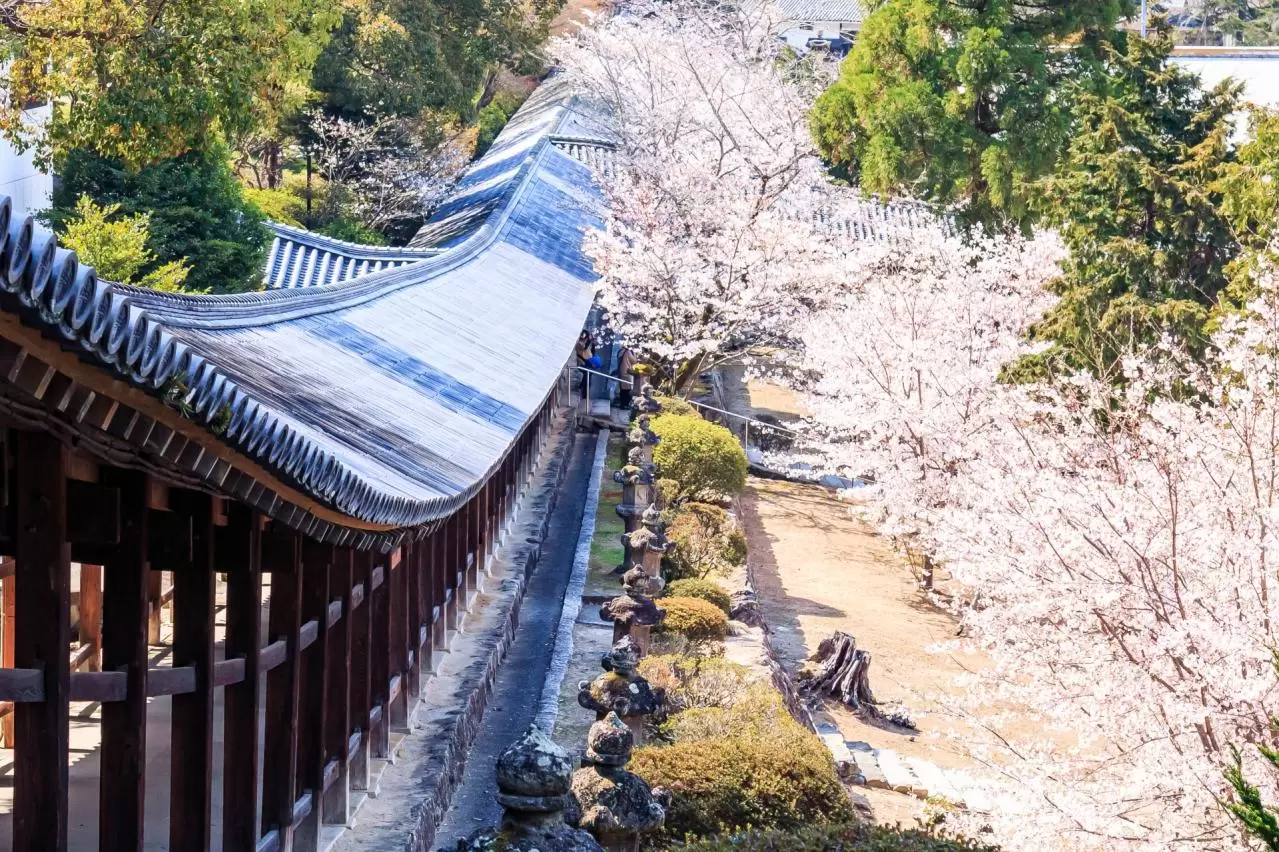
One of the symbols of Kibitsu Shrine is its beautiful covered corridor, which extends approximately 360 to 400 meters from the main hall to the Motomiya Shrine to the south.
Built to follow the natural contours of the land, this long, uninterrupted corridor is truly spectacular and offers visitors a sense of historic architectural beauty. Walking through the quiet surroundings can feel as though one is being guided beyond the bounds of time into a sacred space.
The corridor has also been designated a cultural property by Okayama Prefecture.
## Nature Throughout the Seasons
Kibitsu Shrine is also popular for its seasonal flowers.
The most famous feature is the hydrangea garden along the corridor, containing approximately 1,500 plants. Around the middle of June each year, the flowers bloom in profusion, attracting many worshippers and visitors.
Other seasonal flowers include:
- Peonies
- Satsuki azaleas
- Rhododendrons
- Cherry blossoms
- Plum blossoms
These flowers add color to the shrine grounds throughout the year and soothe the hearts of visitors.
## The Allure of Kibitsu Shrine
Kibitsu Shrine offers a wide variety of attractions, including:
- The legend of Ura’s defeat, said to be the prototype of the Momotaro folktale
- The mysterious Narukama Ritual
- Kibitsu-zukuri, the only National Treasure architectural style of its kind in Japan
- The magnificent covered corridor stretching approximately 400 meters
- Beautiful natural scenery that changes with the seasons
It is a place where long history and mythology, architectural beauty, and nature come together in perfect harmony. As one of Okayama’s most iconic destinations, it is beloved by people from near and far.
Okayama Tourist Attractions
View List
Toy Kingdom
"Toy Kingdom" is a toy and play-themed park located in Tamano City, Okayama Prefecture. It features 18 toy pavilions filled with children's dreams, including Tomica ...

Washuzan Observation Deck
Washu Mountain Observatory is located near the summit of Washu Mountain within Setonaikai National Park and has been designated as a national scenic spot. There are ...

Okayama Castle
Okayama Castle, also known as "Ujo" (Crow Castle), was built in 1597 by Ukita Hideie, a vassal of Toyotomi Hideyoshi. It features a unique three-story, six-floor asy...

Bitchū Matsuyama Castle
Bitchu Matsuyama Castle is the only surviving hilltop castle in Japan with an existing main keep, and it is one of the 12 castles from the Edo period that still stan...

Kurashiki Ivy Square
Kurashiki Ivy Square is a multi-use cultural facility located in the Kurashiki Bikan Historical Quarter. It has been renovated from the original headquarters of the ...

Kurashiki Bikan Historical Quarter
Kurashiki Bikan Historical Quarter features an enchanting townscape with white-walled storehouses, earthen walls, and beautiful rows of willows, creating a perfect h...

Ohara Museum of Art
The Ohara Museum of Art, established in 1930 by Kurashiki businessman Ohara Sozaburo, is Japan's first private Western art museum. It features globally renowned West...

Korakuen Garden
Okayama Korakuen is one of Japan's most representative daimyo gardens from the Edo period, constructed by the Okayama domain lord Ikeda Tsunamasa. The construction b...