Okayama Castle
Okayama Castle Movies


Basic Information
- Spot Name
- Okayama Castle
- Location
- 〒700-0823 2-3-1 Marunouchi, Kita Ward, Okayama City, Okayama Prefecture
- Access
- From JR Okayama Station, take the tram to Higashiyama for about 5 minutes and get off at "Jōka," then walk for about 10 minutes, or take the Okayama Electric Tramway bus to Takaya or Nishida via Higashiyama and get off at "Kenchō-mae," then walk for about 5 minutes. It is about a 20-minute drive from Okayama IC on the Sanyo Expressway.
- Parking
- Please use the nearby paid parking facilities.
- Business Hours
- 9:00 AM to 5:30 PM (Last admission at 5:00 PM)
- Regular Holiday
- Year-end (December 29th to 31st)
- Fees
- Adults (high school students and above) 400 yen, elementary and junior high school students 100 yen ※ Preschool children are free.
- Contact Information
- Phone Number:086-225-2096
- Official Website
Map
Detailed Information
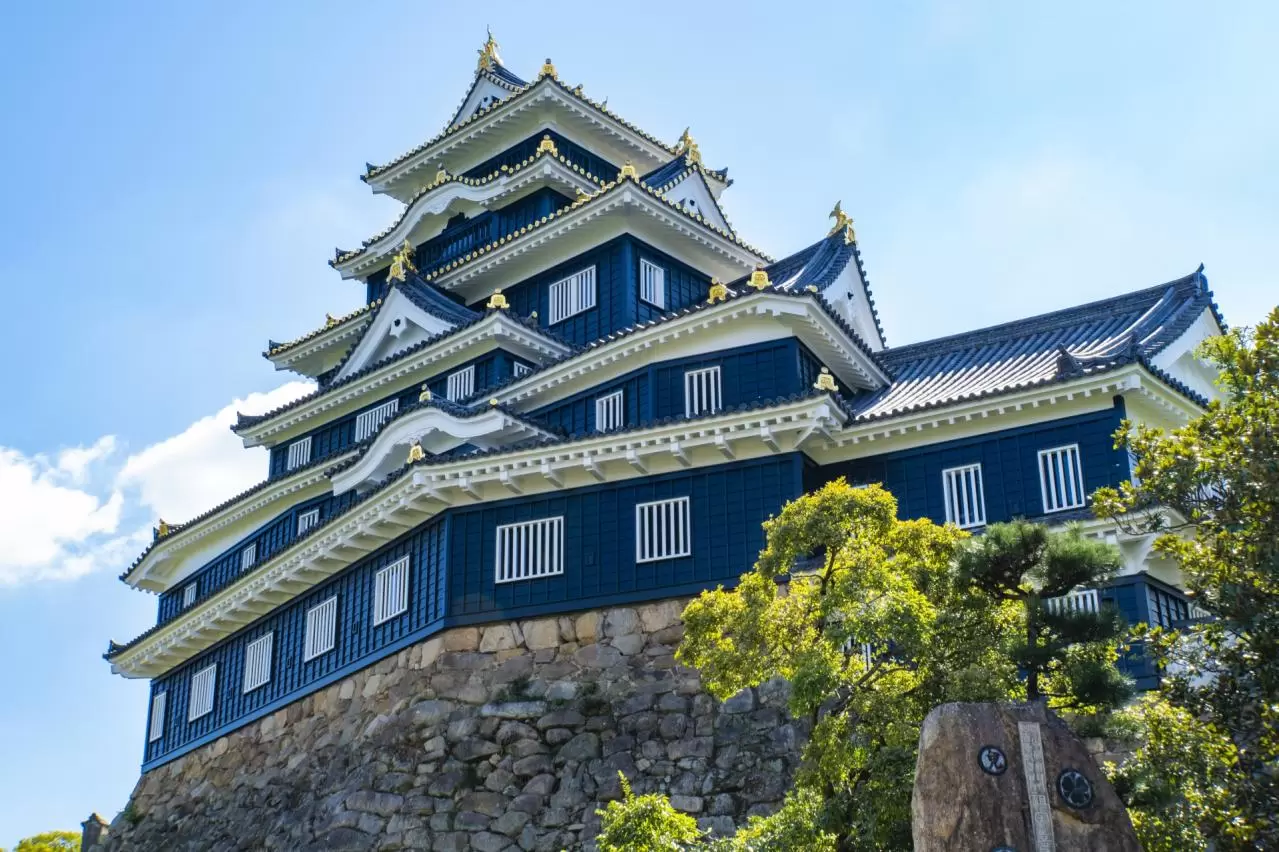
Okayama Castle, located in Okayama City, Okayama Prefecture, is one of Japan’s most renowned early modern castles. Its beautiful black exterior, finished with black lacquered weatherboard siding, has earned it the nickname “Ujō,” or “Crow Castle.” Because gold-leaf roof tiles and golden shachi roof ornaments were also used, it is sometimes called “Kinujō,” or “Golden Crow Castle.” Today, it is a famous castle and a landmark symbolizing Okayama City, attracting many visitors.
## The Construction of Okayama Castle and Hideie Ukita
Okayama Castle was built by Hideie Ukita, one of the Five Elders of the Toyotomi government, and its keep is believed to have been completed in 1597. Hideie’s father, Naoie Ukita, was a Sengoku-period warlord who established his power in Bizen Province and laid the foundations for the castle town of Okayama. Hideie’s talents were recognized by Toyotomi Hideyoshi, who appointed him to important positions and showed him great favor.
During the castle’s construction, the course of the Asahi River was extensively altered. The river was diverted around the northern and eastern sides of the main bailey and used as a natural moat. For its time, this large-scale construction project was a major undertaking that brought together the most advanced civil engineering techniques available. Along with Toyotomi Hideyoshi’s Osaka Castle and Mōri Terumoto’s Hiroshima Castle, Okayama Castle is highly regarded as a pioneer of early modern Japanese castle architecture.
## Features of the Castle Keep
The keep of Okayama Castle is an impressive three-story, six-level structure and is said to have been modeled after the keep of Oda Nobunaga’s Azuchi Castle. One of its most notable features is its unusually shaped, irregular pentagonal keep foundation, which is rare among Japanese castles. Due to the structure of its stone walls, the east–west width is greater than the north–south width, giving the keep a graceful and solid appearance that changes depending on the viewing angle.
The keep is also a valuable example that retains the traditional style of castles from before the Battle of Sekigahara, conveying features of the transitional period from Sengoku-era fortifications to early modern castle architecture.
The contrast between the black lacquered wooden walls, gold-leaf roof tiles, and golden shachi is exceptionally striking. While Himeji Castle, known for its white plaster walls, is called “Shirasagijō,” or “White Heron Castle,” Okayama Castle possesses a distinctive presence as “Ujō,” or “Crow Castle.”
## The Battle of Sekigahara and Changes in Castle Lords
Hideie Ukita fought as one of the leading commanders of the Western Army at the Battle of Sekigahara, but was defeated and exiled to Hachijōjima Island. Okayama Castle was subsequently taken over by Hideaki Kobayakawa. However, Hideaki died of illness just two years after entering the castle.
Afterward, Tadanori Ikeda became lord of Okayama Castle at the age of just five. He was the son of Terumasa Ikeda, who is known for building Himeji Castle, and the maternal grandson of Tokugawa Ieyasu. From that time onward, the Ikeda family served as lords of the Okayama domain throughout the Edo period, bringing significant development to Okayama Castle and its surrounding castle town.
During the Ikeda family’s rule, Tsunamasa Ikeda, lord of the Okayama domain, ordered his retainer Nagatada Tsuda to create the daimyo garden Korakuen on the opposite bank of the Asahi River. Today, Korakuen is widely known as one of the Three Great Gardens of Japan. The view of Okayama Castle and Korakuen standing across the river from each other has become one of Okayama’s most iconic and beautiful landscapes.
## Destruction by War and Reconstruction
Before World War II, the keep of Okayama Castle was designated a National Treasure. However, it was destroyed in the Okayama air raid of 1945.
The present keep is an exterior reconstruction completed in 1966 using reinforced concrete. After its reconstruction, it was used as a museum, displaying materials related to the history of Okayama and the Ukita and Ikeda families.
In November 2022, the castle completed the “Great Reiwa Renovation,” which brought a major renewal of its exhibits. Under the supervision of historian Fumimasa Isoda, the castle now offers accessible introductions to history through videos and interactive displays.
## Highlights of Okayama Castle Today
Today, Okayama Castle offers not only exhibits where visitors can learn about history, but also a variety of facilities and activities for tourists to enjoy.
### Ujō Café
The castle keep houses Ujō Café, where visitors can take a break while enjoying sweets and drinks unique to Okayama.
### Bizen Ware Experience Workshop
There is also a workshop where visitors can experience Bizen ware, one of Okayama’s traditional crafts, and enjoy hands-on pottery making.
### Video Exhibits
Inside the keep, video presentations and exhibits using the latest technology allow visitors to learn about history in a visually engaging way.
### Interactive and Photo Areas
There are also interactive experiences and photo areas themed around the Sengoku and Edo periods. Visitors can tour the castle while enjoying the atmosphere of samurai armor and traditional Japanese clothing.
## Surviving Important Cultural Properties
Okayama Castle is also home to several valuable surviving structures that escaped wartime destruction:
- Tsukimi Yagura Turret
- Nishinomaru Nishite Yagura Turret
These structures have been designated Important Cultural Properties of Japan.
The Tsukimi Yagura is particularly notable. Although it appears to be a two-story turret when viewed from the outside, it has three levels inside. It was a multifunctional structure that served as a defensive facility while also providing a place from which to enjoy viewing the moon.
## Castle Layout and Stone Walls
Okayama Castle has a large-scale layout divided into upper, middle, and lower sections. The highest area, known as the Hon-dan, contained the castle keep and the lord’s palace.
The castle also features numerous highly defensive structures, including sturdy gates such as the Tetsumon Gate and the Fumeimon Gate, long stretches of tamon-yagura corridor buildings, and high stone walls. During wartime, special measures were even taken to prevent the gates from being opened or closed by piling earth and sand in front of them.
Other surviving remains, such as an “ana-gura” underground storage chamber for emergency food supplies and a stone washing basin, offer insight into the daily life and defensive systems of the time.
## Ujō Tōgenkyō
In spring, summer, and autumn, the Ujō Tōgenkyō illumination event is held throughout the Okayama Castle area. The black keep, illuminated in a fantastical manner, is exceptionally beautiful and offers a charm quite different from that of the castle during the day.
Okayama Castle illuminated against the surface of the Asahi River is especially popular and has become one of Okayama’s most celebrated night-view spots.
## The Appeal of Okayama Castle
Okayama Castle is a valuable historic site where visitors can experience the transition from the Sengoku period to the Edo period. Its distinctive and beautiful black-and-gold exterior, rare irregular pentagonal keep foundation, and harmonious setting alongside Korakuen are just some of its many highlights.
With numerous features that appeal not only to history enthusiasts but also to families and general tourists, this magnificent castle reveals a different character by day and by night.
Okayama Tourist Attractions
View List
Washuzan Observation Deck
Washu Mountain Observatory is located near the summit of Washu Mountain within Setonaikai National Park and has been designated as a national scenic spot. There are ...

Ohara Museum of Art
The Ohara Museum of Art, established in 1930 by Kurashiki businessman Ohara Sozaburo, is Japan's first private Western art museum. It features globally renowned West...

Kurashiki Bikan Historical Quarter
Kurashiki Bikan Historical Quarter features an enchanting townscape with white-walled storehouses, earthen walls, and beautiful rows of willows, creating a perfect h...

Toy Kingdom
"Toy Kingdom" is a toy and play-themed park located in Tamano City, Okayama Prefecture. It features 18 toy pavilions filled with children's dreams, including Tomica ...

Korakuen Garden
Okayama Korakuen is one of Japan's most representative daimyo gardens from the Edo period, constructed by the Okayama domain lord Ikeda Tsunamasa. The construction b...

Bitchū Matsuyama Castle
Bitchu Matsuyama Castle is the only surviving hilltop castle in Japan with an existing main keep, and it is one of the 12 castles from the Edo period that still stan...

Kibitsu Shrine
Kibitsu Shrine is known for its legends surrounding Kibitsuhiko no Mikoto and the ogre Ura, which are considered to be the prototypes of the Momotaro legend and asso...

Kurashiki Ivy Square
Kurashiki Ivy Square is a multi-use cultural facility located in the Kurashiki Bikan Historical Quarter. It has been renovated from the original headquarters of the ...