Tokugawa-en
Tokugawa-en Movies




Basic Information
- Spot Name
- Tokugawa-en
- Location
- 〒461-0023 1001 Tokugawa-cho, Higashi-ku, Nagoya-shi, Aichi-ken, Japan
- Access
- A 10-minute walk from JR Chuo Main Line Osone Station.
- Parking
- Parking available
- Business Hours
- 9:30 AM to 5:00 PM (Last admission at 5:30 PM)
- Regular Holiday
- Closed on Mondays (or the following weekday in case of holidays or substitute holidays) and during the New Year's holiday (December 29 to January 1).
- Fees
- [General/High school and university students] 300 yen
[Residents of the city aged 65 and over] 100 yen
[Elementary school students and below] Free - Contact Information
- Phone Number:052-935-8988
- Official Website
Map
Detailed Information
Tokugawaen is a Japanese garden that originated on the site of the former “Ozone O-yashiki,” an estate built in 1695 by Tokugawa Mitsutomo, the second lord of the Owari Domain, as a retirement residence. At the time, the grounds covered an enormous area of about 130,000 tsubo (approximately 44 hectares), and it is said that boats were once floated on the garden pond for sightseeing. After Mitsutomo’s death, the site was used as the residence of senior retainers of the Owari Domain, and from the Meiji period onward it became the residence of the Owari Tokugawa family. In 1931, the mansion and garden were donated to Nagoya City by Tokugawa Yoshichika, the nineteenth head of the family, and were opened to the public the following year as Tokugawaen. However, much of the garden was destroyed in the Nagoya air raid of 1945. It was later used as a public park, and in 2004 it was re-developed as a Japanese garden, recreating the design of a daimyo garden in a modern form to become its present-day appearance.
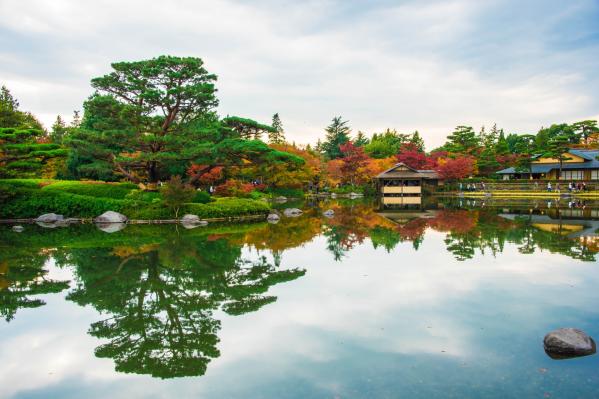
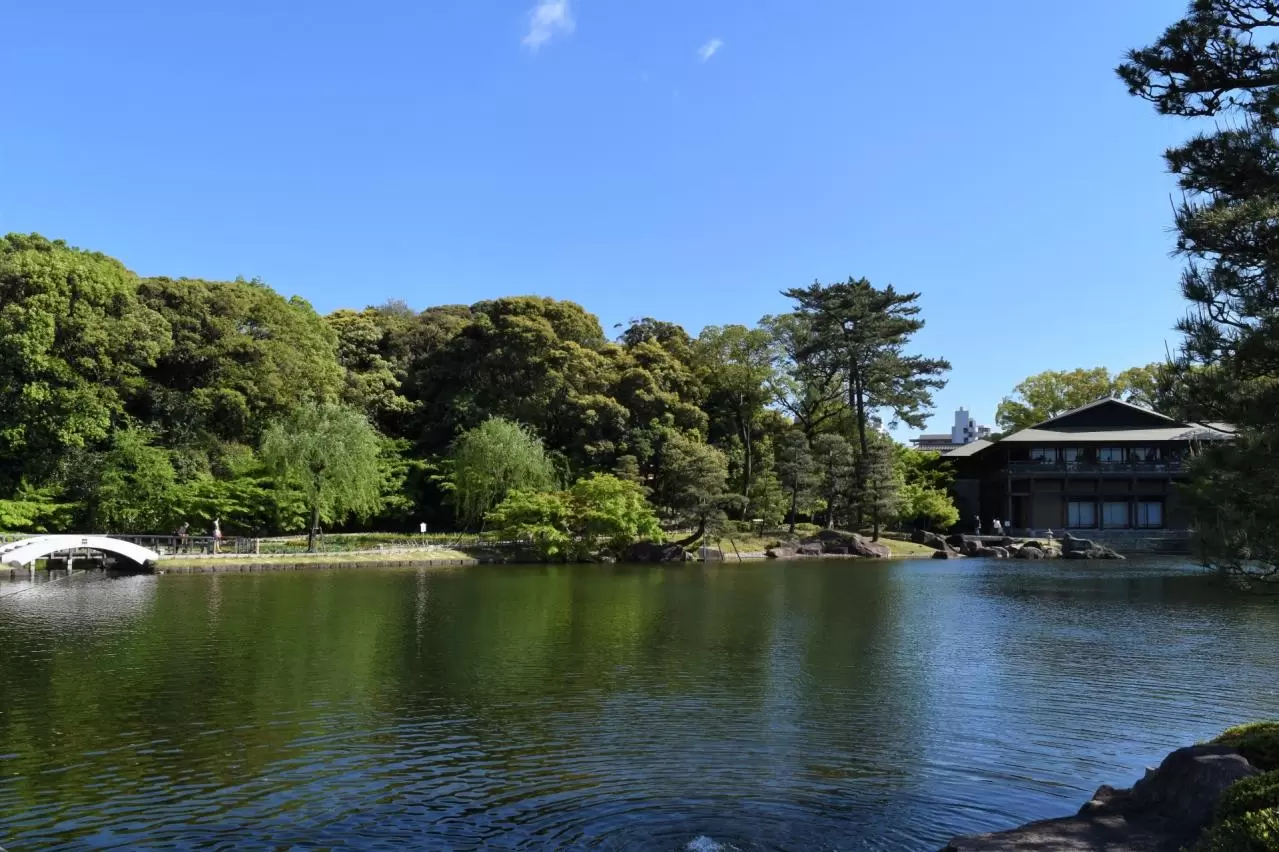
Today, Tokugawaen is a pond-strolling Japanese garden covering a total area of about 2.3 hectares, inheriting a style common to the major daimyo gardens of the Edo period. Within the garden, Japan’s natural scenery is symbolically expressed through a composition in which clear streams descend from a waterfall through a valley and flow into a pond representing the sea. Another major feature is the dynamic three-dimensional arrangement of rock formations and artificial hills, making use of the area’s steep terrain and existing woodland, and using massive stones that evoke the vigor of samurai society.
One of the highlights is the “Dragon Gate Waterfall,” recreated based on a waterfall that once stood at the Owari Tokugawa family’s Edo lower residence, with a display in which the water volume increases every 20 minutes. Another attraction is the “Ozone Waterfall,” which has a three-tiered structure with a total drop of about 6 meters, allowing visitors to enjoy a variety of water expressions through the different rock arrangements on each tier. The view of Ryuosen Lake, with its Chinese-style stone bridge and elegantly swimming nishikigoi carp, is also one of Tokugawaen’s signature landscapes.
The garden is home to a wide variety of plants, including a peony garden and iris beds, as well as lotus, water lilies, and crape myrtle, allowing visitors to enjoy the beauty of each season, from spring peonies and early summer irises to fresh greenery and autumn foliage. In autumn especially, Japanese maples turn the garden vividly red and gold, and nighttime illuminations are also held.
In addition, Tokugawaen features several Registered Tangible Cultural Properties, including the Tokugawaen Black Gate, side longhouse, walls, bucket well, and Sozan-so. The Black Gate preserves the dignity of the former main gate of the Ozone residence, while Sozan-so is known as an excellent example of modern Japanese-style architecture. Combined with a visit to the adjacent Tokugawa Art Museum, visitors can gain a deeper appreciation of the history and culture of the Owari Tokugawa family, as well as the appeal of Japanese gardens.
Aichi Tourist Attractions
View List
National Treasure Inuyama Castle
Inuyama Castle is one of five castles designated as national treasures in Japan, located in Inuyama City, Aichi Prefecture. Built during the Sengoku period by Oda No...

Nagoya City Science Museum
Nagoya City Science Museum is located in Nagoya, Aichi Prefecture, with the concept of "See, Touch, and Verify." It opened in 1962, commemorating the 70th anniversar...

Okazaki Castle
Okazaki Castle is a historic landmark located in Okazaki City, Aichi Prefecture, Japan, and is especially known as the birthplace of Tokugawa Ieyasu. According to le...

Toyokawa Inari Shrine
Toyokawa Inari is one of Japan's three major Inari shrines, attracting about five million visitors from across the country with its blessings for prosperous business...

The Museum Meiji-Mura
Meiji Mura is an outdoor museum where visitors can experience Japan's history and culture centered around the Meiji era. Located in Inuyama City, Aichi Prefecture, i...

Atsuta Shrine
Atsuta Shrine is a prestigious shrine located in Nagoya City, Aichi Prefecture, dedicated to one of the three sacred treasures of Japan, the Kusanagi no Tsurugi (Gra...

Nagoya Castle
Nagoya Castle is an important place in Japan's history and culture, and it is considered a symbol of Nagoya City. Construction of the castle began in 1610 (the 15th ...

Osu Kannon (Hosho-in)
Osu Kannon (Hōshō-in) is one of Japan's three great Kannon temples, located in the heart of Nagoya City. Its formal name is Kitano-san Shinpukuji Hōshō-in, with its ...