Atsuta Shrine
The history of Atsuta Shrine dates back about 1900 years ago. It is said that when Yamato Takeru no Mikoto died in Mie Prefecture, the sacred sword was enshrined in Atsuta. Since then, the shrine has gathered wide-ranging faith as a place for praying for the peace and prosperity of the nation, as well as serving as a "spiritual home" for local residents.
Within the shrine grounds, there is a treasure house that displays many precious national treasures. Additionally, there are numerous other shrines including the main shrine, subsidiary shrines, and smaller shrines, where visitors can pray for various blessings. Particularly during the New Year, it becomes lively with many people visiting for the first prayer of the year, wishing for happiness and success in the new year.
The shrine is easily accessible, being close to Nagoya Station, allowing not only locals but also many visitors from afar to come. Atsuta Shrine is an important center of Japanese history, culture, and faith, and its presence is highly valued by the Japanese people.
Basic Information
- Spot Name
- Atsuta Shrine
- Location
- 〒456-8585 1-1-1 Jingu, Atsuta Ward, Nagoya City, Aichi Prefecture, Japan
- Access
- Take the Meijo Line subway and get off at "Jingu-Nishi Station." It is about a 5-minute walk.
Take the Meijo Line subway and get off at "Denmachō Station." It is about a 6-minute walk.
Take the Meitetsu Nagoya Main Line and get off at "Jingu-Mae Station." It is about a 5-minute walk.
Take the JR Tōkaidō Main Line and get off at "Atsuta Station." It is about a 12-minute walk. - Parking
- Capacity for 400 ordinary cars and 6 buses.
- Business Hours
- The treasure museum is open from 9:00 AM to 4:30 PM (last entry at 4:10 PM).
- Regular Holiday
- The Treasure Museum is closed on the last Wednesday of each month, the following day, and from December 25th to 31st.
- Fees
- 【Jingu】
Free
【Treasure Museum】
Adults: 500 yen, Children: 200 yen
【Sword Treasure House Kusanagi Hall】
Adults: 500 yen, Elementary and Junior High School Students: 200 yen
【Combined Ticket】
Adults: 800 yen, Children: 300 yen - Contact Information
- Phone Number:052-671-4151
- Official Website
Map
Detailed Information
Atsuta Jingu is one of Japan’s oldest and most prestigious shrines, enshrined in Atsuta Ward, Nagoya City, Aichi Prefecture. Its main deity is Atsuta-no-Okami, which refers to Amaterasu Omikami, who is manifested through the Kusanagi no Tsurugi, one of the Three Sacred Treasures of Japan.
In addition, deities closely associated with the Kusanagi no Tsurugi, including Miyasuhime no Mikoto and Takeninadane no Mikoto, are enshrined together there; these are collectively known as the “Five Gods.”
As a shrine of exceptional sanctity second only to the Grand Shrine of Ise, Atsuta Jingu has long been deeply revered. While it has been treated as a shrine for the protection of the nation, it is also affectionately known as “Atsuta-san” or “Miya,” and today it attracts some seven million worshippers annually from both within Aichi and across Japan.
■ Founding and History (Approximately 1,900 Years)
● Origins
The founding of Atsuta Jingu began with the enshrinement of the Kusanagi no Tsurugi in this area.
It is said that Yamato Takeru no Mikoto, on his return from the conquest of eastern Japan, passed away in Nobono, Kameyama City, Mie Prefecture, leaving the Kusanagi no Tsurugi behind on Mount Kaji in Odaka-cho, Midori Ward, Nagoya City.
Later, his consort, Miyasuhime no Mikoto, honored his final wishes and enshrined the sacred sword in the present-day Atsuta area.
This marks the beginning of Atsuta Jingu, which is traditionally said to have been founded in 113 CE, in the 43rd year of Emperor Keiko’s reign, giving it a history of more than 1,900 years.
● Reverence Since Ancient Times
Atsuta Jingu was ranked as a Myojin Taisha in the Engishiki and has also been designated as a Chokusai-sha, a special shrine visited by imperial envoys sent by the Emperor.
It has been deeply revered not only by the imperial court but also by samurai and military clans. In the Warring States period, Oda Nobunaga is known to have prayed there for victory before the Battle of Okehazama. After his victory, the earthen wall he donated in gratitude remains in the grounds today as the “Nobunaga-bei.”
● From the Modern Era Onward
The shrine buildings were destroyed in the air raids of 1945, but were rebuilt in 1955.
Since then, improvements and restoration efforts have continued through projects such as the 1,900th anniversary commemorative program and celebrations for the auspicious Imperial rites of the Reiwa era, allowing its history and faith to be passed down to the present day.
■ Grounds and Shrine Buildings
The precincts of Atsuta Jingu cover approximately 190,000 square meters, and including its detached precinct land, the total area reaches about 290,000 square meters.
● Lush Nature: “Atsuta no Mori”
The grounds are known as Atsuta no Mori, or “Atsuta Forest,” and are home to many trees, including giant camphor trees estimated to be over 1,000 years old.
Although located in the heart of Nagoya, the shrine is enveloped in silence and pure air, and is cherished as an oasis for city residents.
Notable trees include:
- The Great Camphor Tree, said to have been planted by Kobo Daishi
- Naranzu no Ume, a plum tree said to bloom but never bear fruit
- Taroan Tsubaki, a camellia long loved by tea masters
● Shrine Buildings and Number of Shrines
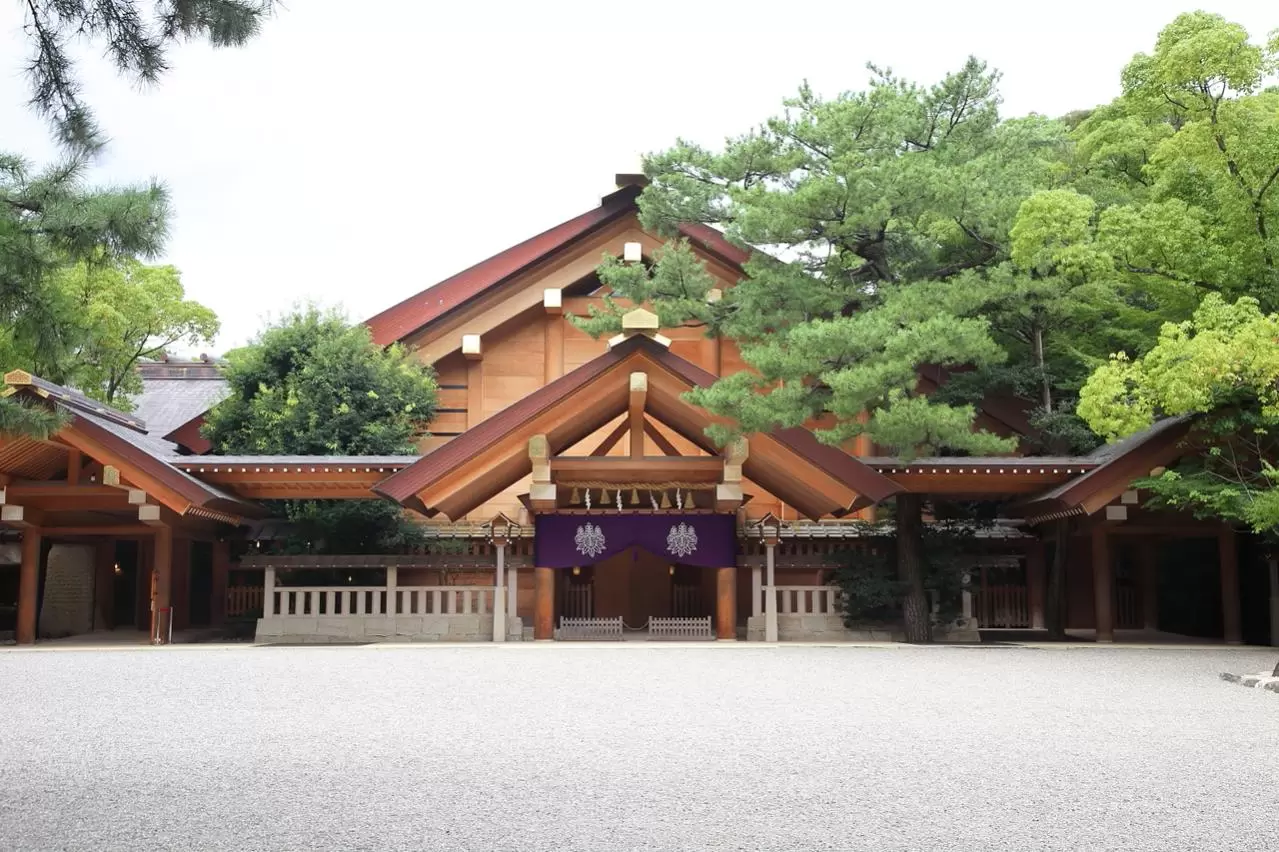
The main shrine buildings were originally in the distinctive Owari style, but were changed to the present Shinmei style in 1893.
Within and outside the grounds, there are 45 shrines in total, including the main shrine, one auxiliary shrine, 12 subordinate shrines, and 31 minor shrines.
● Ichinotamae Shrine
At the deepest part behind the main hall stands Ichinotamae Shrine, which enshrines the ara-mitama, or rough spirit, of Atsuta-no-Okami.
In the past, access for the general public was prohibited, but since 2012 worship has been permitted, and visitors can proceed along the “Kokoro no Komichi” path to pay their respects.
■ Treasures and Cultural Properties
Because of its profound history, Atsuta Jingu has received many offerings over the centuries.
The total number of treasures exceeds 6,000, of which more than 170 are designated cultural properties by the national government and Aichi Prefecture.
Major items in the collection include:
- Swords and blades, including a short sword by Rai Kunitoshi
- Ancient sacred treasures
- Twelve bugaku masks
- A lacquered box with chrysanthemum maki-e
- The Atsuta Bon Nihon Shoki
- The Lotus Sutra: Emergence of the Treasure Tower Chapter
These are displayed in rotation at the Treasure Hall and at Tsurugi no Hokan Kusanagi Museum. At Kusanagi Museum, visitors can experience Japanese sword culture through about 450 famous donated blades.
■ Festivals and Rituals
At Atsuta Jingu, around 60 annual festivals and more than 10 special rituals are preserved today in their ancient forms.
● Major Festivals
- June 5: Annual Grand Festival (Atsuta Festival)
The most important festival, attended by an imperial envoy from His Majesty the Emperor.
- Hatsumode
- Hatsu Ebisu (January 5)
- Hana no Toh (from May 8)
- Shichi-Go-San visits
These festivals are deeply connected to agriculture and the daily lives of the people, and they clearly reflect the shrine’s origins and spirit of faith.
■ Blessings and Faith
Since Atsuta-no-Okami is Amaterasu Omikami, the shrine is believed to bring a wide range of blessings, including household safety, good health, harmonious relationships, and success in life and career.
It is also known for the legend of prayers for victory associated with the Nobunaga-bei, and many worshippers visit to pray for good fortune in battle or competition.
Amulets related to victory are also offered within the grounds, making the shrine beloved by those facing major challenges or life milestones.
■ Access and the Present Day
Atsuta Jingu is easily accessible from Nagoya Station and attracts many worshippers from both inside and outside the city.
While it also serves as a tourist destination, it remains a center of faith and continues to support Japan’s spiritual culture as a “hometown of the heart.”
Atsuta Jingu is:
- One of Japan’s foremost ancient shrines, enshrining the Kusanagi no Tsurugi
- A shrine with a history of about 1,900 years and precious cultural properties
- A vast sacred precinct with abundant nature and many subsidiary shrines
- A national shrine deeply revered by both the imperial court and samurai clans
Through worship and strolling the grounds, visitors can experience the pure atmosphere where history and nature are in harmony, calm both body and mind, and gain new energy.
Atsuta Shrine Movies


Aichi Tourist Attractions
View List
Noritake Garden
"Noritake no Mori" is a cultural complex created in Nagoya City to commemorate the 100th anniversary of the ceramics manufacturer "Noritake." Noritake started in 190...

Nagoya City Science Museum
Nagoya City Science Museum is located in Nagoya, Aichi Prefecture, with the concept of "See, Touch, and Verify." It opened in 1962, commemorating the 70th anniversar...

Flight of Dreams
"Flight of Dreams" is a unique commercial complex located at Chubu Centrair International Airport in Japan. Its main attraction is the first Boeing 787 (ZA001), whic...

LEGOLAND® Japan
"LEGOLAND Japan" is an outdoor theme park that opened in 2017 at Knjyo Point in Nagoya City, targeting children aged 2 to 12 and their families. This park is the eig...

Higashiyama Zoo and Botanical Gardens
Higashiyama Zoo and Botanical Gardens is one of Japan's largest comprehensive zoos and botanical gardens, sprawling over an extensive area of 60 hectares in Nagoya C...

Toyota Commemorative Museum of Industry and Technology
The Toyota Commemorative Museum of Industry and Technology is located in Nishi Ward, Nagoya City, and is considered the birthplace of the Toyota Group. It features n...

Tokugawa Art Museum
The Tokugawa Art Museum is an art museum located in Nagoya City that broadly introduces Japanese history and culture. It opened in 1935 and showcases over 10,000 val...

Osu Shopping Street
Osu Shopping District is located on the south side of the bustling Sakae area in Nagoya city and is a vibrant “melting pot” of diverse industries, cultures, and even...