A symbol of Kawagoe
A landmark that stands out among the city’s traditional warehouse-style buildings.
AI Summary
This is an AI-generated summary. Please check the official information for opening hours, fees, and closed days.
A historic bell tower where you can soak up Kawagoe’s old-town charm in a short visit.
Standing amid Kawagoe’s traditional warehouse-style buildings, the Time Bell Tower is one of the city’s signature landmarks. Its bell rings four times a day, adding to the historic atmosphere. It is free to visit and easy to stop by while exploring the area.
A landmark that stands out among the city’s traditional warehouse-style buildings.
The bell rings four times a day, bringing the atmosphere of old Kawagoe to life.
Free to visit, it makes a convenient stop along a walk through town.
Walk through the traditional warehouse district, stop at the Time Bell Tower, and enjoy the surrounding streets as well.
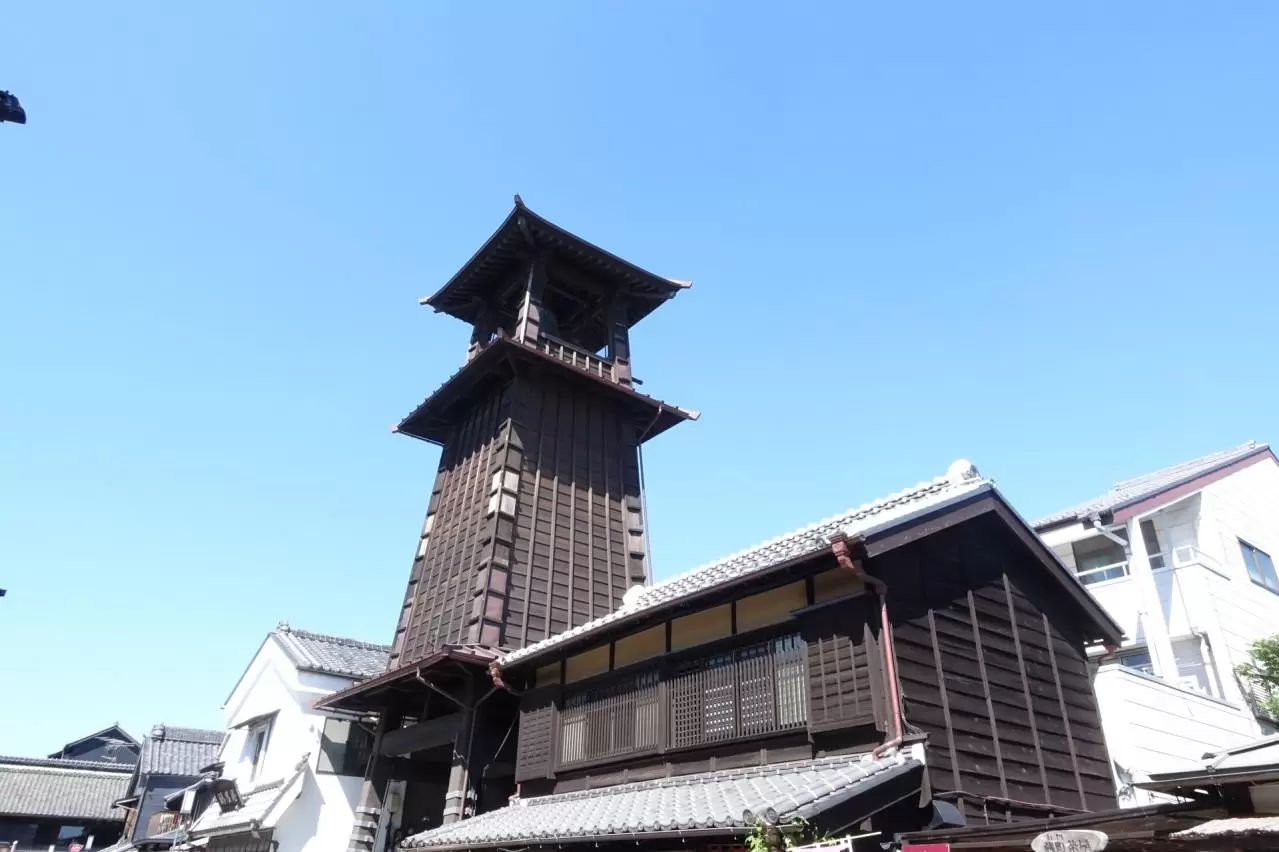
Known as a symbol of Kawagoe, the “Bell of Time” is a historic bell tower rising above the kura-zukuri merchant streets. In the little Edo of Kawagoe, where the atmosphere of the Edo period still lingers strongly, it continues to tell the time four times a day just as it always has, and is deeply loved by both local residents and visitors.
Its chime was selected in 1996 by the Environment Agency, now the Ministry of the Environment, as one of the “100 Soundscapes of Japan to Preserve.” Its evocative tone further enriches the atmosphere of Little Edo.
History and Origins
The Bell of Time dates back about 400 years to the early Edo period, during the Kan’ei era (1627–1634). It is said to have first been built in Takamachi (present-day Saiwai-cho), the castle town, by Kawagoe domain lord Sakai Tadakatsu.
Since then, it has been cherished as an important presence that announced the time for the townspeople. However, throughout the Edo period it was repeatedly struck by fires, and the bell tower and bronze bell were burned down many times. Each time, townspeople and merchants rebuilt it, supporting the life of the town.
The current bell tower is the fourth generation, rebuilt the year after it was destroyed in the Great Kawagoe Fire of 1893. In that fire, about one-third of the town was lost, but it is said that merchants rebuilt the bell before reconstructing their own shops, in order to restore the indispensable “time” of daily life. It was a symbolic reconstruction filled with love for the town.
In 1958, it was designated a Kawagoe City Tangible Cultural Property, and it is still carefully preserved and maintained today.
Structure and Features
The current Bell of Time is a wooden three-tiered yagura-style structure, standing about 16 meters tall. Towering above the kura-zukuri streetscape, it is an impressive landmark from every angle.
A bronze bell hangs at the top. In the past, a person called a “bell keeper” rang it by hand according to the time. Today, an automatic bell-ringing mechanism is installed, and the bell rings mechanically four times a day: at 6:00 a.m., noon, 3:00 p.m., and 6:00 p.m.
Despite being a wooden structure, it is built to be sturdy and has withstood fire, wind, and snow over the years. The entire bell tower has a calm, refined color that evokes the beauty of Japanese tradition, and it blends beautifully with the kura-zukuri townscape.
Tone and Cultural Value
The sound of the Bell of Time is said to be the “sound of Kawagoe’s heart,” conveying scenes from the old castle town to the present day. Its resonance changes throughout the day—from the clear morning air, to the gentle afternoon, to the sound that melts into the sunset sky—each time carrying its own charm.
This gentle bell sound was selected in 1996 as one of the “100 Soundscapes of Japan to Preserve.” This title is given to sounds of especially high value as symbols of local life and culture, and the Bell of Time is widely known nationwide as a true symbol of Little Edo, Kawagoe.
Yakushi Shrine and Nearby Attractions
Directly beneath the Bell of Time stands Yakushi Shrine. Its principal deity is a standing image of Yakushi Nyorai, and it is said to bring healing from illness, especially eye ailments. Many ema votive plaques are dedicated within the grounds, drawing the faith of those praying for health and healing.
The surrounding area is a major tourist center, popular alongside the kura-zukuri streets and Kashiya Yokocho, the candy shop lane. It is so famous that few visitors to Kawagoe sightseeing skip it, and it is also highly popular as a photo spot.
Best Time to Visit
Because the Bell of Time is located in the heart of the tourist area, it gets especially crowded on weekends. It is relatively uncrowded and easier for photography on weekdays until around 10:00 a.m., or in the evening. At dusk, the number of tourists decreases, allowing visitors to enjoy a magical atmosphere where the bell’s sound and the glowing sunset blend together.
For nearly 400 years, from the Edo period to the present day, the Bell of Time has continued to mark the passage of time alongside the town of Kawagoe. Having survived fires and been preserved through the hands of local people, it symbolizes the sophistication and spirit of Kawagoe. The tone that echoes from its three-story wooden bell tower continues to resonate in many hearts as a “bridge of time” connecting the past and the present.
#Townscape/Bikan Historical Quarter #Cultural assets/historic sites
Tokorozawa Aviation Memorial Park is a vast public park, approximately 50 hectares in size, established on the site of Japan's first airport. Inside the park, there ...
Mitsumine Shrine is a famous power spot located at an elevation of approximately 1,100 meters in the奥秩父 (Okuchichibu) area of Saitama Prefecture. Notable features...
Nagatoro is located in the Chichibu district of Saitama Prefecture and is particularly famous for the "Nagatoro Iwadatami," a popular tourist destination. The Iwadat...
The Railway Museum opened on October 14, 2007, in Omiya, Saitama, as the main project commemorating the 20th anniversary of JR East. In 2018, the South Building was ...
The Shibusawa Eiichi Memorial Museum was established on November 11, 1995, to convey the achievements of Shibusawa Eiichi, often referred to as the "Father of Modern...
Seibu-en Yuenchi is a long-established amusement park located in the Sayama Hills of Tokorozawa City, Saitama Prefecture, and has been cherished by many people since...
Kawagoe Hikawa Shrine is a historic shrine that is said to have been founded about 1500 years ago during the Kofun period, in the 2nd year of Emperor Kinmei (541 AD)...