Mitsumine Shrine
Mitsumine Shrine Movies
![[埼玉 秩父vol2] 三峯神社を参拝(2025.1.26撮影)](https://i.ytimg.com/vi/Dym8eCx3Duk/mqdefault.jpg)


Basic Information
- Spot Name
- Mitsumine Shrine
- Location
- 〒369-1902 298-1 Mitsumine, Chichibu City, Saitama Prefecture
- Access
- Get off at Seibu-Chichibu Station on the Seibu Chichibu Line and take the express bus to Mitsumine Shrine. From the Hanazono IC on the Kan-Etsu Expressway, it takes about 150 minutes via National Route 140 and the Minano-Yori bypass.
- Parking
- Parking available
- Business Hours
- 7:00 AM to 5:00 PM (last entry), Mitsumine Museum until 4:00 PM (closing time)
- Regular Holiday
- Open year-round.
- Fees
- Free
- Contact Information
- Phone Number:0494-55-0241
- Official Website
Map
Detailed Information
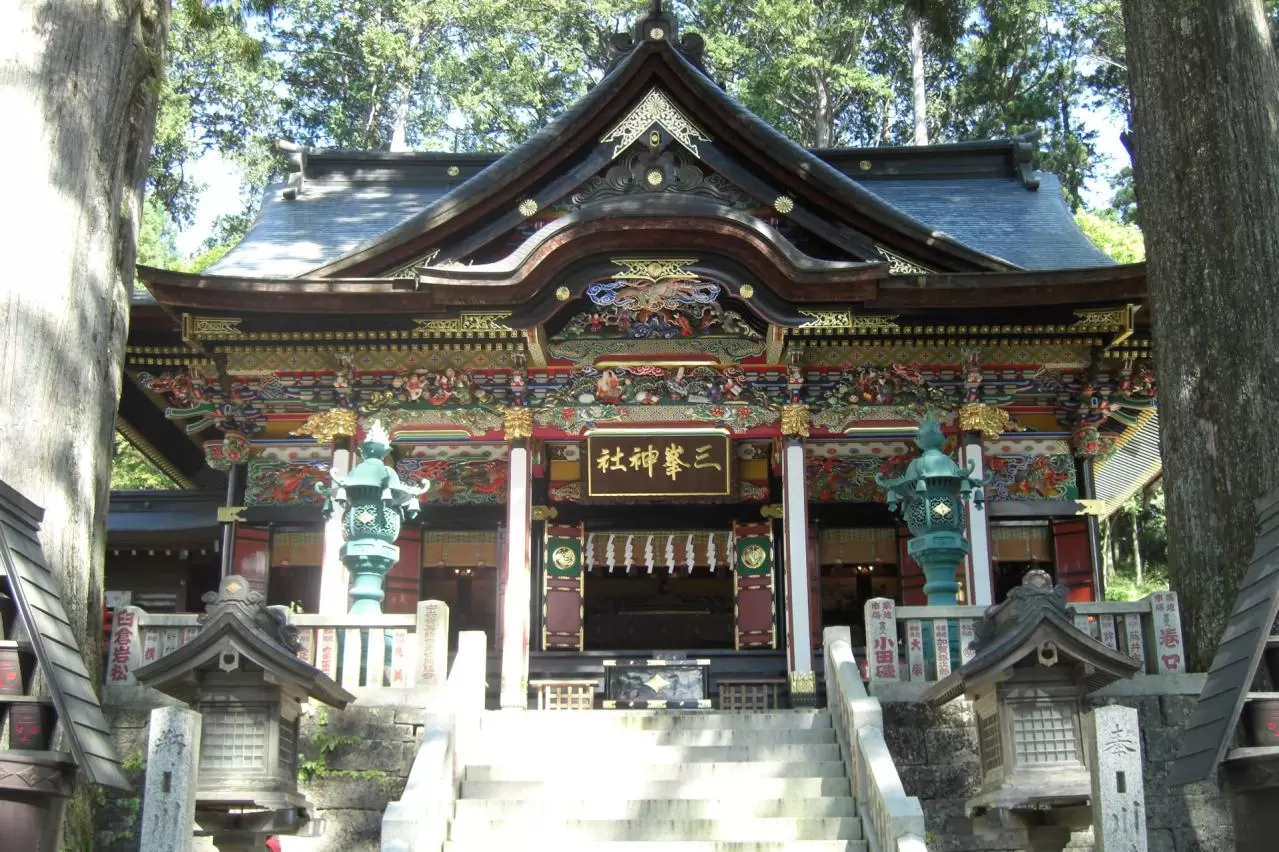
Mitsumine Shrine is a historic shrine located in Mitsumine, Chichibu City, Saitama Prefecture, at an altitude of about 1,100 meters on a mountaintop. Surrounded by the great nature of Okuchichibu, it has long been known as one of the Kanto region’s premier power spots, renowned for its powerful spiritual efficacy. Its sacred tree, estimated to be 800 years old, and the “dragon god” said to appear in the stone-paved area in front of the worship hall are especially famous.
Deities and Origins
The principal deities enshrined here are Izanagi no Mikoto and Izanami no Mikoto, the gods of creation.
The shrine is said to have been founded about 1,900 years ago, when Prince Yamato Takeru visited the area during the pacification of eastern Japan and, deeply impressed by the purity of the mountains and rivers, enshrined the two deities.
It is said that Yamato Takeru was guided by wolves, and for this reason the “Okami-sama” are revered at Mitsumine Shrine as divine messengers. Wolf statues stand in place of komainu guardian dogs within the precincts, making it a uniquely rare shrine in Japan.
Origin of the Name and Geographic Features
The name “Mitsumine” comes from the three peaks of Mount Kumotori, Mount Shiraiwa, and Mount Myoho that extend to the south. These mountains are composed of hard rock such as chert and limestone from the Chichibu Belt, creating their sharply rugged form.
In addition, because of place-name similarities with the Nachi mountain area in Kumano, Mitsumine’s faith is said to be deeply connected with Kumano Shugendo. The geological belt of Chichibu continues as far as Nanki, Shikoku, and Kyushu, telling of ancient links in faith and culture.
History and the Spread of Faith
Mitsumine Shrine developed from ancient times as a sacred site of Shugendo. It is said that during the reign of Emperor Monmu, En no Ozunu, the founder of Shugendo, traveled back and forth from Izu to Mount Mitsumine to train there. During the reign of Emperor Junna, Kobo Daishi (Kukai) is said to have carved a statue of Eleven-Headed Kannon and founded the Honjido Hall.
In the medieval period, it gained deep devotion, especially among eastern Japanese warriors such as Hatakeyama Shigetada. However, it lost its shrine territory during the wars of the Nanboku-cho period and fell into ruin for a time. Later, the ascetic Gekkan Doman lamented this decline and traveled across Japan for 27 years to raise funds for restoration, rebuilding the shrine buildings and halls.
In 1533, the head priest Ryuei visited Shogoin in Kyoto and was granted the title of “Dai Gongen,” after which the shrine flourished as the head temple of Tendai Shugendo in the Kanto region and was called Kannon-in Kounji. Furthermore, since the seventh head priest of Kannon-in was adopted into the Hanayama-in imperial family in Kyoto, subsequent head priests were treated with the status of 100,000 koku. The current shrine crest, the “Ayamebishi,” derives from the Hanayama-in family crest.
During the Edo period, belief in “Okami-sama” spread in 1720 through a monk named Nichiko Ho’in, and as Gokenzoku faith, it spread throughout Japan. As a result, the name Mitsumine Shrine became known nationwide.
Following the Separation of Shinto and Buddhism in the Meiji era, the temple was abolished and the site became the present-day Mitsumine Shrine.
Architectural Highlights
Main Hall
The main hall, built in 1661, is a highly prestigious one-bay Kasuga-style structure with a copper plate roof. During repairs in 1959, older materials from 1655 were discovered. The previous main hall still remains today as the Tosho-gu Upper Hall within the shrine grounds and is the only surviving Muromachi-period structure.
Worship Hall
Rebuilt in 1800, the worship hall is a magnificent building with beautiful vermilion lacquer and black lacquer finishes. Inside, it has a coffered ceiling, and the bracket complexes and kaerumata are decorated with vivid polychrome carvings.
Zuishin-mon Gate
Rebuilt in 1792, the Zuishin-mon is one of the largest eight-pillared gates in the prefecture, adorned with vivid carvings on its karahafu gable. Standing at the entrance to the former main approach, it is a solemn gate that welcomes worshippers.
Kuninotokotachi Shrine
Rebuilt in 1761, this shrine enshrines Kuninotokotachi no Mikoto. It was originally called the goma hall and honjido hall, and housed statues of Eleven-Headed Kannon and Fudo Myoo.
Yamatotakeru Shrine
Rebuilt in 1853, this was formerly the Yakuo-do Hall, which was converted into a shrine. Its rainbow beam and carvings strongly reflect the styles of the time.
Purification Pavilion
Also built in 1853, this pavilion has a gabled roof with karahafu curves on both sides, and is decorated with vivid carvings on all four sides. It occupies an important place within the overall shrine complex.
Chichibu Imperial Visit Memorial Hall
Completed in 1931, this hall was built to commemorate Prince Chichibu Yasuhito’s visit to Mitsumine Shrine. Designed by Chichibu-born architect Yotaro Sekine, it features a unique style that blends shrine architecture with palace architecture.
Faith and Culture at Mitsumine Shrine
Within the grounds stands a sacred tree estimated to be 800 years old, and it is said that touching this tree while praying grants powerful “ki” energy. The “Kimamori” amulets made in connection with the power of this sacred tree are extremely popular, and many visitors come on the days they are distributed.
The “dragon god” appearing in the stone paving in front of the worship hall is said to be visible after rainfall and other conditions, drawing attention as a mysterious phenomenon.
Mitsumine Shrine Today
Today, Mitsumine Shrine continues to be revered as one of the “Chichibu Sansha” — the three major shrines of Chichibu, along with Chichibu Shrine and Hodosan Shrine. Many people visit from all over Japan in search of its reputed spiritual blessings, and it is also popular as a place to enjoy hiking, sea-of-clouds viewing, and nature walks. In the early morning, when the sea of clouds forms, many worshippers come to witness the fantastical scenery.
Mitsumine Shrine is a sacred site that preserves the legend of Yamato Takeru and the history of Shugendo, and it is a precious cultural heritage site that retains strong traces of the fusion of Shinto and Buddhism. Together with its magnificent natural surroundings, it is truly a mountain sanctuary where one can feel the power of faith — a holy mountain where the gods dwell.
Saitama Tourist Attractions
View List
Toki no Kane (Bell of Time)
The symbol of Kawagoe, the "Toki no Kane" (Bell of Time), is a historic bell tower that rises above the town's traditional warehouse-style buildings. It was founded ...

Seibu Enyu Park
Seibu-en Yuenchi is a long-established amusement park located in the Sayama Hills of Tokorozawa City, Saitama Prefecture, and has been cherished by many people since...

Tobe Yanson Akebono Children's Forest Park
The thoughts of the Finnish fairy tale author Tove Jansson are scattered throughout the park. It is an enchanting spot that evokes the world of her representative wo...

Hitsujiyama Park
Hitsujiyama Park is located on the eastern side of Chichibu City and in spring, the "Shibazakura Hill" is covered with a beautiful carpet of flowers, attracting many...

Moomin Valley Park
Moomin Valley Park is a theme park located by Lake Miyazawa in Hannō City, Saitama Prefecture, where visitors can experience the Nordic worldview. It is part of the ...

The Railway Museum
The Railway Museum opened on October 14, 2007, in Omiya, Saitama, as the main project commemorating the 20th anniversary of JR East. In 2018, the South Building was ...

Tokorozawa Aviation Memorial Park
Tokorozawa Aviation Memorial Park is a vast public park, approximately 50 hectares in size, established on the site of Japan's first airport. Inside the park, there ...

Kadokawa Musashino Museum
The "KADOKAWA Musashino Museum" is a landmark of "Tokozaawa Sakura Town," known as one of Japan's largest hubs for pop culture, located in Tokorozawa City, Saitama P...