Hitsujiyama Park
Hitsujiyama Park Movies


Basic Information
- Spot Name
- Hitsujiyama Park
- Location
- 〒368-0023 6360 Omiya, Chichibu City, Saitama Prefecture, Japan
- Access
- Approximately 20 minutes on foot from Chichibu Railway Ohanabatake Station (Shibazakura Station)
Approximately 20 minutes on foot from Seibu Railway Seibu-Chichibu Station
Approximately 20 minutes on foot from Seibu Railway Yokose Station - Parking
- Parking available.
- Business Hours
- Free admission (Shibazakura Hill from mid-April to early May is open from 8:00 AM to 5:00 PM)
- Fees
- During the peak season for shiba-zakura, admission is charged.
Entrance fee: General 300 yen
Early April to mid-April: Cherry blossoms
Mid-April to early May: Shiba-zakura - Contact Information
- Phone Number:0494-25-5209
- Official Website
Map
Detailed Information
Hitsujiyama Park is a lush, nature-filled park located at the foot of Mount Buko, a symbol of Chichibu, on the eastern side of Chichibu City, Saitama Prefecture. It is included in the Buko Prefectural Natural Park and is beloved as a place of relaxation for local residents. The park offers beautiful scenery throughout the four seasons, with shibazakura and cherry blossoms in spring, fresh greenery in summer, autumn foliage in fall, and snowy landscapes in winter, allowing visitors to enjoy nature’s charms all year round.
🌸 Shibazakura Hill
The biggest highlight of Hitsujiyama Park is “Shibazakura Hill.”
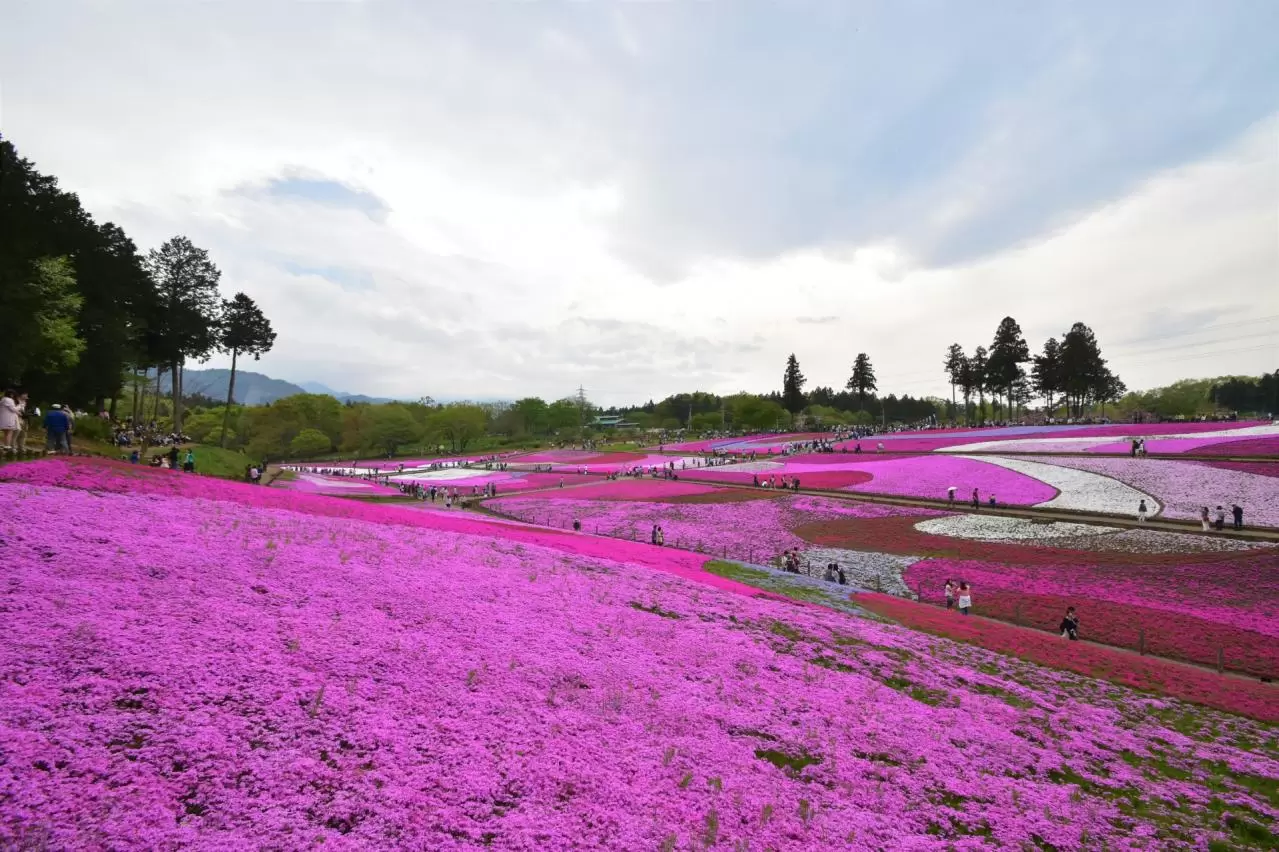
Covering about 17,600 square meters, it is one of the largest of its kind in the Kanto region, with more than 400,000 moss phlox plants of 10 varieties planted there. The flowers bloom in a range of colors such as white, pink, purple, and pale blue, turning the entire hill into a colorful carpet of blossoms. The best viewing season is usually from mid-April to early May, and during the flowering period the “Chichibu Marche” is also held, offering local gourmet foods and specialty products.
The hill is designed to take advantage of the undulating terrain, and from the higher ground visitors can overlook the gradations of shibazakura. In the background rises majestic Mount Buko, creating a beautiful contrast between nature and flowers. This spectacular view is also popular as a photo spot.
🌳 Miharashi Hill and Famous Cherry Blossom Spot
“Miharashi Hill,” located on the north side of the park, has long been known as a famous cherry blossom viewing spot. From here, visitors can enjoy panoramic views of Chichibu’s cityscape and the mountains of Oku-Chichibu. Around 1,000 cherry trees, mainly Somei Yoshino and double-flowered cherry trees, are planted in the park, and in spring it becomes lively with people enjoying hanami under the cherry blossom tunnel. The fireworks of the Chichibu Night Festival can also be seen from Miharashi Hill, making the nighttime scenery equally appealing.
🐏 Fureai Farm and the Origin of “Hitsujiyama”
The name “Hitsujiyama” comes from the fact that there was once a Saitama Prefectural Livestock Breeding Center Chichibu Branch here, where sheep were raised. Carrying on that history, sheep are still kept at the “Fureai Farm,” where visitors can interact with them up close. It is especially popular with families with children. The farm keeps Japanese Corriedale sheep.
🎨 Cultural and Educational Facilities
There are also many cultural facilities within and around the park.
• Yamato Art Museum (located next to the park): Exhibits many works of art, including prints by Munakata Shikō.
• Mount Buko Museum: Introduces the geology, natural environment, and quarrying history of Mount Buko, Chichibu’s symbol.
These facilities allow visitors to learn deeply about Chichibu’s nature, culture, and history.
👧 Wanpaku Square and Lawn Square
In the central part of the park are “Wanpaku Square” and “Lawn Square.” Wanpaku Square is equipped with wooden playground equipment that harmonizes with the natural scenery. Safety inspections are also carried out regularly, making it a space where children can play with peace of mind. At Lawn Square, visitors can often be seen enjoying picnics under the cherry trees in spring.
🧭 History and Design
Hitsujiyama Park was designed by Dr. Seiroku Honda, a University of Tokyo professor known as the “father of Japanese parks.” Dr. Honda was a renowned forestry expert who also worked on the design of Hibiya Park and the forest of Meiji Shrine, and his park designs are characterized by the use of natural topography. In the 1936 “Outline of the Chichibu Park Plan,” the original design, though on a smaller scale than today, envisioned a beautiful park that made the most of the natural terrain.
🗻 Topography and Natural Environment
Hitsujiyama Hill is located on a middle terrace formed by erosion from the Arakawa River, and is believed to have been created about 130,000 years ago. Its geology consists of the Hitsujiyama gravel layer, several meters to 20 meters thick, and the Kanto Loam Layer, making it a geologically valuable area. From the park, visitors can look out over the Odamaki Hills and the mountain ranges of Oku-Chichibu, enjoying a landscape where nature and history are in harmony.
Hitsujiyama Park is not only known as a famous spot for shibazakura and cherry blossoms, but also as a rich, comprehensive park where nature, culture, learning, and history come together. In spring, the ground is covered in a carpet of flowers; in summer, it is lush with greenery; in autumn, it glows with fall colors; and in winter, visitors can gaze at the mountains of Chichibu in crisp, clear air. It is a representative sightseeing destination of Chichibu that can be enjoyed by everyone, from families and couples to photography enthusiasts.
Saitama Tourist Attractions
View List
Saitama Stadium 2002
Saitama Stadium 2002 is the largest soccer-only stadium in Japan, located in Saitama City, Saitama Prefecture. It opened in 2001 and was constructed for the FIFA Wor...

Tobe Yanson Akebono Children's Forest Park
The thoughts of the Finnish fairy tale author Tove Jansson are scattered throughout the park. It is an enchanting spot that evokes the world of her representative wo...

The Railway Museum
The Railway Museum opened on October 14, 2007, in Omiya, Saitama, as the main project commemorating the 20th anniversary of JR East. In 2018, the South Building was ...

Kadokawa Musashino Museum
The "KADOKAWA Musashino Museum" is a landmark of "Tokozaawa Sakura Town," known as one of Japan's largest hubs for pop culture, located in Tokorozawa City, Saitama P...

Toki no Kane (Bell of Time)
The symbol of Kawagoe, the "Toki no Kane" (Bell of Time), is a historic bell tower that rises above the town's traditional warehouse-style buildings. It was founded ...


Tokorozawa Aviation Memorial Park
Tokorozawa Aviation Memorial Park is a vast public park, approximately 50 hectares in size, established on the site of Japan's first airport. Inside the park, there ...

Mitsumine Shrine
Mitsumine Shrine is a famous power spot located at an elevation of approximately 1,100 meters in the奥秩父 (Okuchichibu) area of Saitama Prefecture. Notable features...