Known for prayers for good relationships
A popular place to pray for lasting relationships and marital harmony.
AI Summary
This is an AI-generated summary. Please check the official information for opening hours, fees, and closed days.
A popular shrine where you can experience Kawagoe’s history and pray for good relationships.
Believed to have been founded around 1,500 years ago, this historic shrine is associated with good relationships and marital harmony. Highlights include its large torii gate, ema votive tablet tunnel, and tai-shaped fortune slips. Its summer wind chime decorations are especially popular. It’s easy to visit during a Kawagoe sightseeing trip, though crowds can make a leisurely visit difficult.
A popular place to pray for lasting relationships and marital harmony.
The grounds feature memorable spots, including the large torii gate and ema tunnel.
Summer wind chime decorations create a colorful scene with a distinctly Kawagoe feel.
Stop by the shrine during a walk around Kawagoe, then continue to nearby sights on your way back.
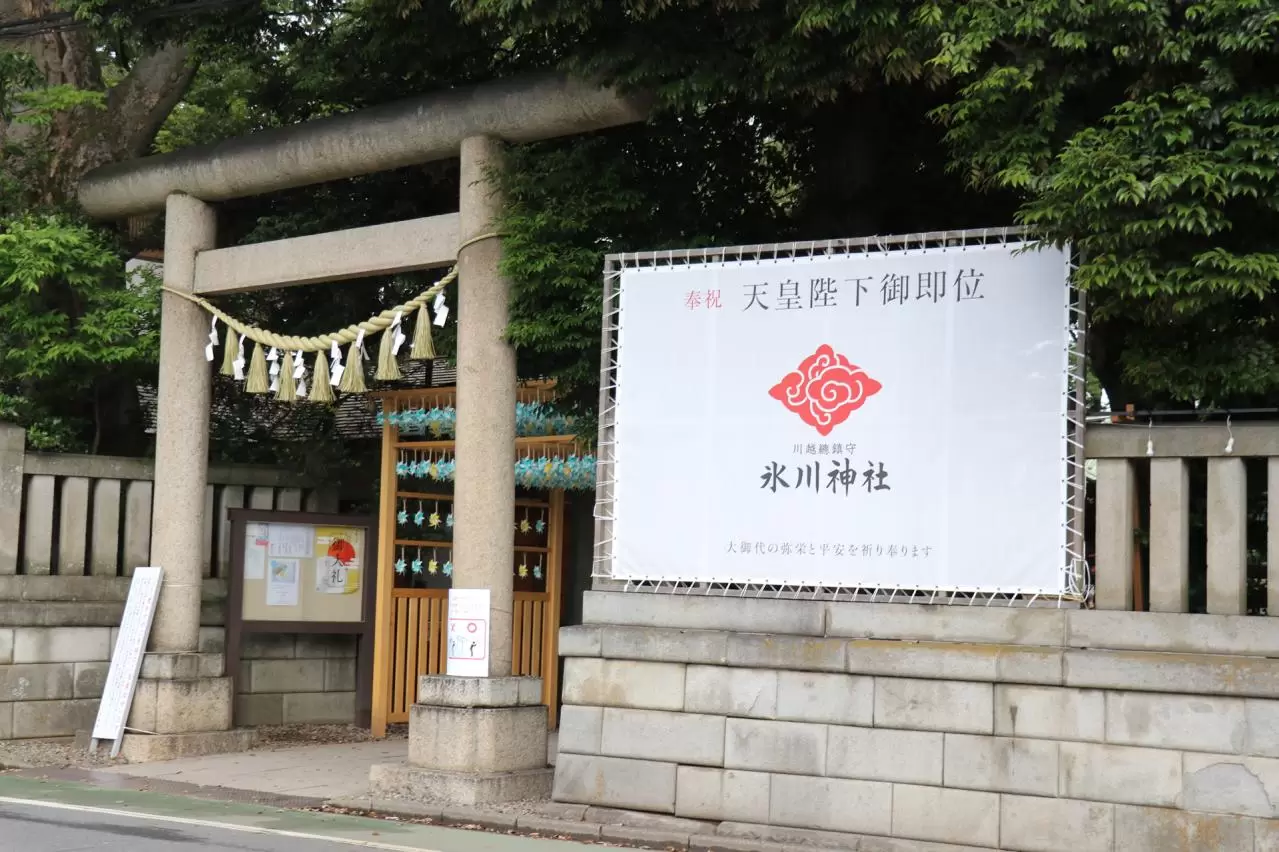
Kawagoe Hikawa Shrine is a historic shrine in Kawagoe City, Saitama Prefecture, said to have been founded in the 2nd year of Emperor Kinmei’s reign (541), during the Kofun period about 1,500 years ago. Long affectionately known as “O-Hikawa-sama,” it is widely worshipped across Japan as a deity of good relationships and family harmony.
🏯 History and Origins
Kawagoe Hikawa Shrine is said to have been founded in 541. According to tradition, its origins lie in an incident in which something shining brightly appeared on the riverbed of the Iruma River, and people came to venerate it as the divine spirit of Hikawa. In 1948, stone swords and earthenware believed to be ancient ritual implements were excavated from the shrine grounds, showing that this area had long served as a place of worship.
In 1457, during the Muromachi period, after the father-and-son team of Ota Dōshin and Dōkan built Kawagoe Castle, the shrine came to be deeply revered as the guardian deity of the castle town and the principal tutelary shrine of the domain. In the Edo period, successive lords of Kawagoe Domain sponsored the construction and donation of shrine buildings, and the shrine flourished as the spiritual center of the domain. The current main hall was built in 1842 by Matsudaira Naritsune, then lord of Kawagoe Domain, together with local parishioners, and features exquisite “Edo carving” decorations.
This main hall was designated a “Saitama Prefecture Tangible Cultural Property (Building)” on March 16, 1965, and is preserved as a structure of great historical and artistic value.
🙏 Deities and Blessings
The principal deity is Susanoo-no-Mikoto, and enshrined together with him are his wife Kushiinadahime-no-Mikoto, their child Ōnamuchi-no-Mikoto, and Kushiinadahime’s parents, Ashinazuchi-no-Mikoto and Tenazuchi-no-Mikoto, making a total of five deities.
Because these five deities are gods of family and include two married couples, Kawagoe Hikawa Shrine is deeply revered as a shrine for “good relationships,” “marital harmony,” and “family harmony.” In particular, Ōnamuchi-no-Mikoto is also known as the “god of matchmaking,” enshrined at Izumo Taisha, and many visitors seeking fulfillment in love come from all over Japan.
🕊 Highlights
1. One of Japan’s largest wooden torii gates, the Great Torii
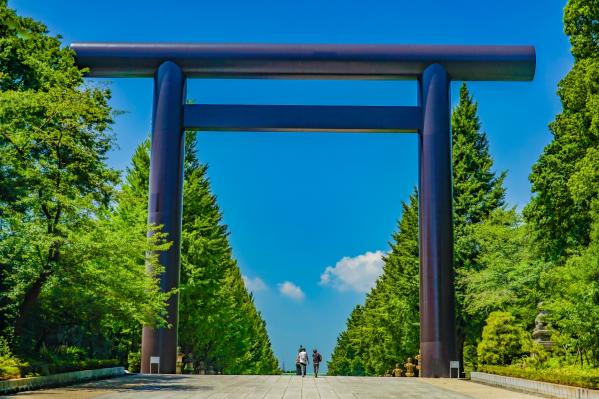
The “Great Torii” standing at the entrance to the grounds is a Myojin-style torii gate about 15 meters high, and is one of the largest wooden torii in Japan. It was erected in 1990, and the shrine name on the plaque at its center was handwritten by Kaishu Katsu, a politician from the end of the Edo period. Its magnificent presence leads visitors into the solemn sacred precincts.
2. The mystical “ema tunnel”
Next to the main hall is the “ema tunnel,” lined with about 30,000 votive plaques. The plaques, on which people have written their wishes and words of gratitude, form a tunnel-like passage, and the sight of sunlight filtering through the trees is magical and highly photogenic. When the wind blows, the plaques sway gently and create a pleasant sound, surrounding visitors with an enchanting atmosphere.
3. The “Enmusubi-dama” that brings good matches
The “Enmusubi-dama” is a special charm made by miko who collect pebbles from the shrine grounds one by one, wrap them in an asanoha hemp net, and pray over them. Only 20 are distributed free of charge each day, making them extremely popular, with numbered tickets handed out from 6:00 a.m. People say that those who receive one will be blessed with a good match. It is recommended to keep the Enmusubi-dama in a wallet or pouch, somewhere out of sight.
4. The “Tai-mikuji” fortune fish
Kawagoe Hikawa Shrine’s famous “Tai-mikuji” is a unique fortune lot that you “catch” using a fishing rod, with a sea bream-shaped omikuji. The red “Ichi-nen An-dai Mikuji” tells your overall fortune, while the pink “Ai-dai Mikuji” tells your love fortune. Special seasonal colors such as white and gold sometimes appear, and it is especially popular among women.
5. Purification through “Hitogata Nagashi”
At the shrine’s “Purification Stream,” visitors can experience “hitogata nagashi,” in which they breathe onto a paper doll (hitogata) to transfer impurity onto it, then release it into the stream. By reciting “Harae tamae, kiyome tamae” as it floats away, one is believed to cleanse away impurities and fatigue accumulated unconsciously in daily life.
🎐 Seasonal Events
Summer: “Enmusubi Wind Chimes”
Held from July to September, “Enmusubi Wind Chimes” is the signature summer event of Kawagoe Hikawa Shrine. About 2,000 colorful Edo-style wind chimes adorn the grounds, and their clear, refreshing sounds resonate through the shrine. Dreamlike features such as the “Wind Chime Corridor” and the nighttime illuminated “Glowing River” brighten the summer nights.
Autumn: “Kawagoe Festival”
Held in mid-October, the “Kawagoe Festival” is a “tsuke-matsuri” held in conjunction with Kawagoe Hikawa Shrine’s annual grand festival. This traditional event has continued since the Edo period, and the splendid parade of ornate floats and festival music enlivens the city streets. In 2016, it was inscribed on UNESCO’s Intangible Cultural Heritage list, and every year it attracts many visitors from across Japan.
Spring: “Randoseru Purification Ceremony”
In spring, a “randoseru purification ceremony” is held to pray for traffic safety and academic success for children entering elementary school. It is also popular as a family New Year’s shrine visit event, and the atmosphere is warm and celebratory, marking a new beginning.
🌳 Grounds and Nature
The shrine grounds are filled with many trees, including a sacred zelkova tree over 500 years old, allowing visitors to enjoy the beauty of nature throughout the seasons. Cherry blossoms bloom in spring, autumn leaves add color in fall, and the sound of wind chimes is pleasant in summer. Surrounded by the breeze through the trees and the murmur of the stream, visitors can spend a peaceful time here.
Kawagoe Hikawa Shrine is a venerable shrine said to have been founded in the Kofun period, and it enshrines five deities associated with marriage, family, and bonds between people. Known nationwide as a power spot for granting good relationships, it also captivates many visitors with seasonal events such as the summer “Enmusubi Wind Chimes” and the autumn “Kawagoe Festival.”
This shrine, where history, culture, nature, and people’s wishes are in harmony, will surely continue to be loved by many worshippers as a true “sacred place for connecting bonds.”
The Railway Museum opened on October 14, 2007, in Omiya, Saitama, as the main project commemorating the 20th anniversary of JR East. In 2018, the South Building was ...
Tokorozawa Aviation Memorial Park is a vast public park, approximately 50 hectares in size, established on the site of Japan's first airport. Inside the park, there ...
The "KADOKAWA Musashino Museum" is a landmark of "Tokozaawa Sakura Town," known as one of Japan's largest hubs for pop culture, located in Tokorozawa City, Saitama P...
Moomin Valley Park is a theme park located by Lake Miyazawa in Hannō City, Saitama Prefecture, where visitors can experience the Nordic worldview. It is part of the ...
Nagatoro is located in the Chichibu district of Saitama Prefecture and is particularly famous for the "Nagatoro Iwadatami," a popular tourist destination. The Iwadat...
The thoughts of the Finnish fairy tale author Tove Jansson are scattered throughout the park. It is an enchanting spot that evokes the world of her representative wo...
Seibu-en Yuenchi is a long-established amusement park located in the Sayama Hills of Tokorozawa City, Saitama Prefecture, and has been cherished by many people since...