Kikuchi Gorge
Kikuchi Gorge Movies


Basic Information
- Spot Name
- Kikuchi Gorge
- Location
- 〒861-1441 Hara, Kikuchi City, Kumamoto Prefecture
- Access
- 30 km by car from Ueki IC on the Kyushu Expressway via National Route 3, Prefectural Route 53, National Route 387, and Prefectural Route 45 towards Kikuchi Valley.
Approximately 1 hour and 20 minutes from downtown Kumamoto.
About 50 minutes from Ueki IC on the Kyushu Expressway. - Parking
- Parking available
- Business Hours
- 8:30 AM - 5:00 PM
- Regular Holiday
- Open every day.
- Fees
- 300 yen for high school students.
- Contact Information
- Phone Number: 0968-27-0210(菊池渓谷料金所)
- Official Website
Map
Detailed Information
Kikuchi Gorge, located in Hara, Kikuchi City, Kumamoto Prefecture, is one of Kumamoto’s most celebrated natural scenic attractions. It spreads across the northwestern part of the Aso Outer Rim, approximately 17 kilometers east of central Kikuchi. The main scenic areas lie at elevations of roughly 500 to 800 meters, while the Kikuchi Gorge Nature Recreation Forest, including the surrounding area, extends across an even broader range of elevations. Covering approximately 1,193 hectares, the nature recreation forest is also located within Aso-Kuju National Park. Known as a relaxing forest where visitors can enjoy walking and forest bathing amid clear streams and abundant woodland, it is beloved by many people.
Kikuchi Gorge lies in the headwaters of the Kikuchi River, which originates in the Aso Outer Rim and flows into the Ariake Sea. Rain that falls on the forest seeps into the ground and enters the gorge as spring water and underground flows. This abundant water winds over rocky surfaces and, over the course of many years, has formed waterfalls, rapids, and pools of various sizes. The combination of crystal-clear water, moss-covered rocks, and deep forest is so beautiful that the gorge has been called the “ultimate expression of gorge scenery.”
Kikuchi Suigen, the source of the Kikuchi River, has been selected as one of the Ministry of the Environment’s “100 Remarkable Sources of Water.” The surrounding forests have also been included among the “100 Best Forests for Forest Bathing in Japan” and the “100 Best Water-Source Forests.” The Forty-Three-Million-Toku Waterfall within the gorge has been selected as one of the “100 Best Waterfalls in Japan,” reflecting the high regard in which the area’s outstanding natural environment and scenery—created by the harmony of water and forest—are held.
Water originating at Kikuchi Suigen is used for municipal water supplies, agriculture, and hydroelectric power generation, helping to support the lives of people in the region. According to materials from the Ministry of the Environment, the temperature of the clear stream remains at approximately 14°C throughout the year. The water stays cold even in summer, and the shade created by the forest keeps the gorge cool, making it a summer retreat often described as a “natural air conditioner.”
The forest surrounding the gorge is home to broad-leaved trees such as zelkova, maple, beech, and oak, as well as conifers such as fir. Planted forests of cedar and cypress can also be found nearby, creating a beautiful harmony between natural broad-leaved woodland and carefully managed artificial forests. The shade provided by the trees helps prevent the stream from warming, while fallen leaves and deadwood support habitats for aquatic organisms, insects, and other creatures. The beauty of Kikuchi Gorge is created not by the water alone, but by a rich ecosystem in which the forest and river influence and sustain one another.
One of the gorge’s most representative attractions is Kakemaku Falls. It has the greatest drop of any waterfall in Kikuchi Gorge, and is said to have received its name from the way the water trickles down like a curtain. The falls are located directly beneath a bridge near the entrance to the gorge and can be viewed from above from the bridge. On sunny days, a rainbow may appear depending on the sunlight and the pattern of the spray.
Reimei Falls is another beautiful waterfall symbolic of Kikuchi Gorge. The falling water breaks into a fine mist, resembling the dawn when the landscape is shrouded in morning haze, which is how it is said to have received the name “Reimei,” meaning “dawn.” Its gleaming white flow, moss-covered rock walls, and water-filled pool form a beautiful harmony. During the seasons of fresh greenery and autumn foliage, the colors of the surrounding trees are reflected on the surface of the water, creating an even more striking scene.
Continuing upstream from Reimei Falls, visitors will come to Tengu Falls and Ryugafuchi Pool. Tengu Falls, with a drop of approximately eight meters, is said to have been a place where mountain ascetics once washed and purified themselves during their training. The forceful cascade and the thunderous sound echoing through the surroundings convey the power of nature.
Adjacent to Tengu Falls, Ryugafuchi is a mysterious pool filled with cobalt-blue water. A legend says that a dragon once lived there, giving the pool an almost mystical atmosphere in addition to its beauty. However, the currents around the waterfalls and pool are fast, and the rocks can be slippery. It is important not to approach the water carelessly and to enjoy the scenery safely from the designated trail.
The Forty-Three-Million-Toku Waterfall is known for its abundant flow and graceful appearance as the water slips over intricately shaped rock surfaces. One theory about the origin of its name is that it received approximately 430,000 votes in a popularity poll of scenic destinations conducted by the Kyushu Nichinichi Shimbun. Another theory holds that the name refers to an average daily water volume of approximately 430,000 koku, equivalent to about 78,000 tons in modern units. Although the exact origin of the name has not been established, the waterfall has been selected as one of the “100 Best Waterfalls in Japan” because of its abundant water despite being located in the headwaters of the Kikuchi River.
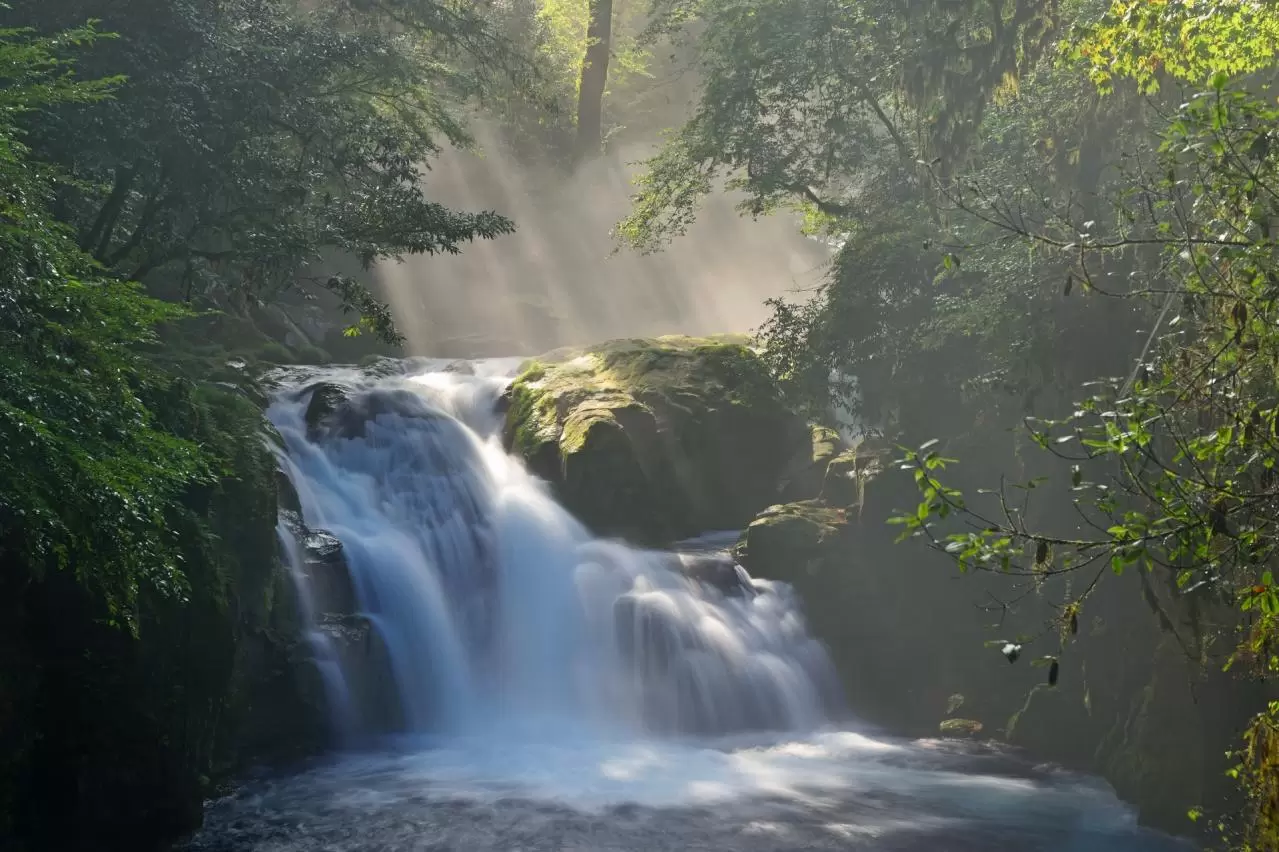
Hirogawara, located deep within the gorge, is one of the best photography spots in Kikuchi Gorge, offering expansive views of the flowing river and surrounding forest. Particularly in the early morning from mid-July through August, when weather and other conditions are favorable, sunlight filtering through the trees may illuminate the spray above the water, creating multiple shafts of light known as “crepuscular rays.” Because this phenomenon appears only when natural conditions are just right, it attracts photography enthusiasts as a fantastical landscape.
Momijigase is, as its name suggests, a beautiful place to view autumn foliage. Maples and zelkovas turn red and yellow, while fallen leaves cover the moss and walking paths. The sight of autumn leaves lying on the riverbed and visible through the clear water is also beautiful. The green of the moss, the blue of the water, and the red and yellow of the foliage create a vivid contrast.
Tsutsumi-iwatsuki is another attraction unique to Kikuchi Gorge. It is a natural formation in which the roots of a zelkova tree appear to embrace a large rock. The rock is thought to have been created by an eruption of Mount Aso and later enveloped by the tree’s roots before being exposed at the surface through erosion. “Tsuki” is another name for the zelkova tree. The sight of tree and rock becoming one conveys both the powerful vitality of plants and the workings of nature shaped over many years.
Kikuchi Gorge changes its appearance dramatically with the seasons. In spring, trees that have endured the cold of winter begin to bud, and the pale green of new leaves envelops the gorge. When purple mountain wisteria blooms, it adds a brilliant splash of color to the forest, evoking the awakening of nature and the breath of new life. Water levels vary depending on the year’s rainfall, and after rain, the waterfalls and rapids may flow with noticeably greater force.
Summer is the season when Kikuchi Gorge is at its most refreshing. The approximately 14°C stream and the shade created by the trees produce cool air quite different from that of the city. Spray rising from the waterfalls and breezes passing over the river offer a pleasant sensation to visitors as they walk. This is also when the foliage is at its deepest green, allowing visitors to enjoy vibrant scenes filled with life, including moss-covered rocks and water surfaces illuminated by sunlight filtering through the trees.
In autumn, maples, zelkovas, and other trees change color, and the forest surrounding the stream is dyed red, yellow, and orange. Reflections of the foliage in the clear water, along with fallen leaves drifting across the surface, create one of the most popular seasonal scenes in Kikuchi Gorge. The timing of the autumn colors varies depending on temperatures each year, but they generally begin to appear in late October and reach their peak around November.
In winter, the shapes of the gorge become more pronounced as the trees shed their leaves. On especially cold days, frost-covered trees may appear, creating a fantastic landscape in which the entire forest seems wrapped in silver-white. In this still winter forest, where the only sound may be the roar of a waterfall, the scenery possesses a solemn beauty unlike that of spring through autumn.
The regular opening period is from April 1 through November 30, with hours from 8:30 a.m. to 5:00 p.m. Visitors may enter the gorge outside this period, but no staff will be present. In winter, there are risks such as snow, icy roads and trails, falling rocks, and fallen trees. Visitors should check current local conditions in advance and proceed carefully with appropriate equipment.
Walking trails have been developed within the gorge, allowing visitors to choose a route according to their fitness level and available time. A short round-trip course of approximately one kilometer mainly explores the area around the entrance, while a roughly two-kilometer round-trip course visits the major waterfalls and pools. Along the way, visitors can enjoy forest bathing while listening to the murmuring stream and the calls of birds.
However, the trails include stairs and slopes, and some areas may become slippery due to spray, rain, or fallen leaves. For safety, visitors should wear familiar, slip-resistant footwear such as sneakers and clothing that leaves both hands free. Sections of the trails may be closed or changed because of disasters, construction, fallen trees, or other conditions, so it is important to check the latest information before setting out.
The clear water may make visitors want to enter the river, but swimming is prohibited at Kikuchi Gorge. The current is fast, and in some places, once a person loses their footing, it can be difficult to stand up again, creating the danger of being swept directly into a plunge pool. Pets, bringing in or collecting plants and animals, smoking, the use of fire, and camping are also prohibited. The use of drones requires permission from the national government. To protect this valuable natural environment, visitors are asked to remain on the designated trails, take their trash home, and act with consideration for the surroundings.
Kikuchi Gorge is more than a tourist destination where visitors simply admire waterfalls and autumn foliage. It is a place where people can experience firsthand the natural cycle in which the forest stores water, the water creates clear streams, and those streams support living creatures and the lives of local communities. Each season and time of day offers a different view, from the fresh greenery of spring and the cool atmosphere of summer to the autumn foliage and frost-covered trees of winter. By listening to the sound of the water and walking amid the scent of the forest and the cool air, visitors can forget the bustle of everyday life and refresh both body and mind.
#Superb view/Scenic spot #Waterfalls, valleys, limestone caves
Kumamoto Tourist Attractions
View List
Kusasenrigahama
Kusasenrigahama is a representative tourist destination of Aso, located at an altitude of approximately 1,100 meters, featuring a vast grassland. To the east, you ca...

Kumamoto Castle
Kumamoto Castle is one of Japan's three famous castles, featuring both the main and small towers side by side. Constructed by Katō Kiyomasa over a period of six to s...


Aso Shrine
Aso Shrine, located in Aso City, Kumamoto Prefecture, is the head shrine of approximately 500 shrines across Japan and has a history of over 2,500 years. The deities...

Nabegataki Park
Nabega Falls is a beautiful waterfall with a height of about 10 meters and a width of approximately 20 meters, formed by a volcanic eruption that created the Aso cal...

Green Land
"Greenland," located in Arao City on the border with Fukuoka Prefecture, is one of the largest amusement parks in Kyushu. The park features over 81 attractions, cate...

Suizenji Jojuen Garden
Suizenji Jojuen is a nationally designated scenic spot and historic site located in Kumamoto City. It is a stroll garden created by the Hosokawa clan during the Edo ...

Shirakawa Suigen
Shirakawa Water Source is a representative spring located in Minamiaso, Kumamoto Prefecture, and is selected as one of the "Top 100 Ruins of Famous Water" by the Min...