Daikanbo
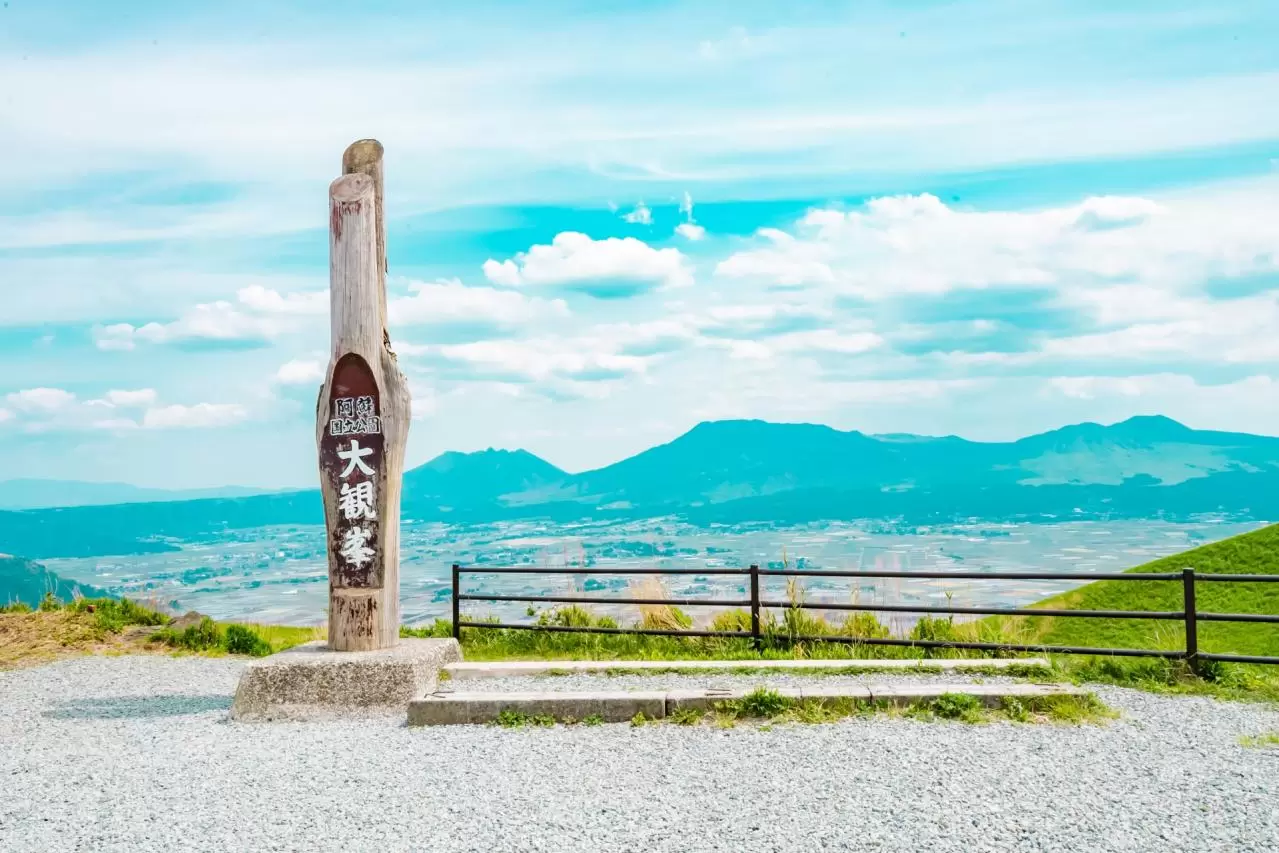
At an elevation of 935 meters, Daikanbo serves as a natural observation deck with a sweeping view of the five peaks of Aso and the Kuju mountain range. The side paths leading to the observation deck are perfect for a scenic walk, allowing visitors to enjoy the refreshing atmosphere. The Aso area is rich in gourmet experiences and power spots, all easily accessible while using Daikanbo as a base for exploration.
Additionally, Daikanbo, located on the southern side, is a hidden gem with few tourists, offering a beautiful rural landscape of rice fields resembling a grid. The typical access route to Daikanbo is by car, and by heading south from the observation plaza, you can enjoy a private view of Aso's scenery. Particularly from early autumn to winter, on days with high humidity and gentle winds, a sea of clouds spreads out, creating a fantastical view. Spring and autumn are recommended seasons to visit, with November being the best time to enjoy the sea of clouds and immerse yourself in Aso's magnificent nature.
Daikanbo Movies





Basic Information
- Spot Name
- Daikanbo
- Location
- 〒869-2313 Yamada, Aso City, Kumamoto Prefecture
- Access
- From JR Hakuhō Line Aso Station, take the Sanko Bus to Tsuchitate for 25 minutes, then get off at Daikanbo Entrance and walk for 15 minutes to the viewpoint.
- Parking
- 150 vehicles
- Business Hours
- Open for visitation.
- Regular Holiday
- Open every day.
- Contact Information
- Phone Number: 0967-34-1600
- Official Website
Map
Detailed Information
Daikanbo is one of the peaks of the northern outer rim of Mount Aso, located in Yamada, Aso City, Kumamoto Prefecture, northeast of Uchinomaki Onsen. Rising approximately 936 meters above sea level, it is known as one of Aso’s most representative scenic viewpoints. The difference in elevation between the summit and the Aso Valley below is approximately 400 meters, allowing visitors to take in the magnificent terrain of Aso from the observation deck. The 360-degree panoramic view encompasses the Aso Five Mountains, the urban area of Aso City, rural fields, and even the distant Kuju Mountains, making it one of the landscapes that symbolizes sightseeing in Aso.
Daikanbo stands along the edge of the outer rim surrounding the northern side of the Aso Caldera. Extending approximately 18 kilometers from east to west and 25 kilometers from north to south, the Aso Caldera is one of the largest calderas in the world. It was formed by four massive pyroclastic-flow eruptions that occurred between approximately 270,000 and 90,000 years ago. Volcanic activity continued inside the caldera afterward, leading to the development of the central volcanic cones, including the present-day Aso Five Mountains.
When looking south from Daikanbo, the urban areas, fields, and farmland of the Aso Valley spread out in the foreground, with the Aso Five Mountains rising beyond them. To the left and right, magnificent caldera walls approximately 300 to 500 meters high continue into the distance. Because the vast topography of the caldera can be observed three-dimensionally from a single location, Daikanbo is also regarded as one of the foremost geosites representing the Aso Caldera.
The Aso Valley visible below is dotted with homes, roads, railways, fields, and farmland. One of Daikanbo’s major attractions is the view of people living and building communities inside a gigantic caldera formed by volcanic activity, while engaging in agriculture and livestock farming. Rather than simply enjoying the scenery of the mountains, visitors can experience Aso’s unique living landscape, where volcanic landforms and human life coexist.
Daikanbo was originally known locally as Tomigahana. The word “hana” refers to a landform that juts out from a mountain or plateau. It is said that Tokutomi Soho, a renowned writer and journalist from Kumamoto, visited the area in 1922 and, deeply moved by its magnificent view, named it “Daikanbo,” meaning “Great View Peak.” Around the present observation area are monuments inscribed with poems and verses associated not only with Tokutomi Soho, but also with the poet Isamu Yoshii and the haiku poet Kyoshi Takahama. Visitors can therefore sense the area’s connection not only to its scenery but also to literature.
The Aso Five Mountains visible directly from Daikanbo are the collective name for Mount Nekodake, Mount Takadake, Mount Nakadake, Mount Eboshidake, and Mount Kishimadake. When the ridgeline formed by these mountains is viewed from the north, in the direction of Daikanbo, it resembles the figure of the Buddha lying on his back. For this reason, it is known as the “Nirvana Image of Aso” or the “Sleeping Buddha.” Generally, Mount Nekodake is seen as the face, while the ridgeline of the mountains as a whole is viewed as a reclining figure extending from the head to the chest, abdomen, and legs.
The changing appearance of the Nirvana Image depending on the season, time of day, and weather is another attraction unique to Daikanbo. On clear days, the contours of the mountains stand out sharply, while in the evening, light entering at an angle can make the ridgeline appear even more striking. Visitors can enjoy the Aso Five Mountains amid the changing scenery of the four seasons, from fresh greenery in spring and deep green foliage in summer to silver grass in autumn and snow-covered landscapes in winter.
Daikanbo is also famous as a viewing spot for seas of clouds. In the early morning under suitable weather conditions, the Aso Valley below may be covered in white clouds, creating a fantastical scene in which the Aso Five Mountains appear to float above the clouds. The possibility of encountering a sea of clouds is relatively high from autumn through winter, when the difference between daytime and nighttime temperatures tends to be greater.
Seas of clouds are said to form more easily when the humidity is high due to rain during the preceding days, the temperature near the ground drops through radiational cooling toward morning, and winds are light. As fog forms and accumulates in the basin inside the caldera, it appears from the higher elevations of the outer rim to spread out like a sea of clouds. However, because this is a natural phenomenon, it cannot be guaranteed even when all the conditions seem favorable.
Temperatures around Daikanbo are low in the early morning, and snow or icy roads may occur in autumn and winter. Those visiting in hopes of seeing a sea of clouds should dress warmly and check the weather forecast and road conditions. Cameras that provide real-time information on sea-of-cloud conditions are also installed in the Aso area, making them useful to check before setting out.
Because there are few tall buildings obstructing the view around Daikanbo, numerous stars shine across the wide sky at night. The area is therefore also popular for astronomical observation and stargazing. On nights with little moonlight and clear air, visitors may be able to see stars that are difficult to observe in urban areas. However, the roads leading to the observation area and the surrounding area become dark at night, so visitors should bring a flashlight and take great care around uneven ground and passing vehicles.
A walking path has been developed from the parking lot to the observation area, allowing visitors to enjoy the scenery while walking through the grasslands. The mountains of Aso and seas of clouds can also be viewed from near the parking lot, but walking to the observation area at the tip of the ridge opens up the view even further and provides an even greater sense of the magnificent landscape. Along the path, visitors can enjoy a leisurely stroll while experiencing the wind and the scent of the grasses.
The grasslands spreading around Daikanbo are another landscape symbolizing Aso. They have not been preserved as completely untouched nature; rather, they have been maintained through people’s long-standing activities, including grazing, grass cutting, and controlled burning. These practices have helped prevent trees from spreading across the grasslands while securing grass resources necessary for agriculture and livestock farming.
In spring, new grass sprouts from the blackened ground in areas that have been burned, and from early summer through summer, the entire landscape is covered in vivid green. In autumn, silver grass sways in the wind, while in winter, the scenery changes into a tranquil landscape covered with withered grasses. The grasslands, preserved through the combined influence of nature and human activity, are also an important landscape that conveys the history and culture of Aso.
Spring through autumn is the easiest time to visit for refreshing views on clear days. Spring is attractive for its fresh greenery, summer for its blue skies and green grasslands, and autumn for its silver grass and crisp air. In winter, visitors may see the Aso Five Mountains covered in snow, but temperatures are low and snow or icy roads may occur. Daikanbo is windier than the surrounding lowlands, and mornings and evenings can feel cool even in summer, so bringing a jacket that can be added or removed as needed is recommended.
Daikanbo is also a popular destination for driving and motorcycle touring. The road running along the northern outer rim around Daikanbo is known as Milk Road. Passing along Kumamoto Prefectural Route 45, the Aso Park Kikuchi Line, and other roads, it forms a scenic driving route offering magnificent grassland landscapes. Because broad pastures and the mountain ranges of Aso can be viewed from the vehicle windows, the area attracts not only tourists but also many visitors traveling by motorcycle or bicycle.
Near the parking lot are rest facilities, shops, and places to eat, where visitors can purchase Aso specialties, souvenirs, and light meals. In addition to providing a place to rest during a drive or walk, the area offers an opportunity to enjoy flavors unique to Aso. However, shop hours may change depending on the season and weather, so visitors should take care when coming in the early morning or at night.
Most visitors travel to Daikanbo by car. Under normal conditions, it takes approximately 30 minutes from the area around JR Aso Station and approximately 60 minutes from Kumamoto Airport. Public transportation may operate only on certain days or have limited services, so those using it should check the latest operating dates and timetables. During the sightseeing season, consecutive holidays, and early mornings when a sea of clouds is expected, the parking lot and surrounding roads may become congested.
Around Daikanbo are several of Aso’s leading tourist destinations, including Uchinomaki Onsen, Aso Shrine, Kusasenri-ga-hama, and the crater of Mount Nakadake. After viewing the overall topography of the caldera at Daikanbo, visiting the towns and hot springs inside the caldera and the area around the Aso Five Mountains can provide a deeper understanding of the relationship between Aso’s terrain and the lives of its people. However, access to the area around the Nakadake crater may be restricted depending on volcanic activity and weather conditions, so it is important to check the latest information before visiting.
Daikanbo is not only a scenic viewpoint overlooking the Aso Five Mountains and the Kuju Mountains; it is also a place where visitors can sense how the caldera was formed by massive eruptions and learn about the history of people who have lived alongside the volcano. From the grand panorama of the daytime and seas of clouds in the early morning to mountain ranges at sunset and star-filled skies at night, the scenery changes depending on the time of day. Daikanbo, where visitors can fully experience the scale and beauty of Aso’s natural environment, is a spectacular destination well worth visiting when traveling to Kumamoto.
#Superb view/Scenic spot #Townscape/Bikan Historical Quarter #mountain/plateau #Climbing/Hiking
Kumamoto Tourist Attractions
View List
Green Land
"Greenland," located in Arao City on the border with Fukuoka Prefecture, is one of the largest amusement parks in Kyushu. The park features over 81 attractions, cate...

Aso Shrine
Aso Shrine, located in Aso City, Kumamoto Prefecture, is the head shrine of approximately 500 shrines across Japan and has a history of over 2,500 years. The deities...

Kumamoto Castle
Kumamoto Castle is one of Japan's three famous castles, featuring both the main and small towers side by side. Constructed by Katō Kiyomasa over a period of six to s...

Kikuchi Gorge
Kikuchi Gorge is a scenic natural forest located in the northwestern part of the Aso Outer Rim Mountains, and it stretches across a vast canyon at an elevation of 50...

Nabegataki Park
Nabega Falls is a beautiful waterfall with a height of about 10 meters and a width of approximately 20 meters, formed by a volcanic eruption that created the Aso cal...

Suizenji Jojuen Garden
Suizenji Jojuen is a nationally designated scenic spot and historic site located in Kumamoto City. It is a stroll garden created by the Hosokawa clan during the Edo ...

Kusasenrigahama
Kusasenrigahama is a representative tourist destination of Aso, located at an altitude of approximately 1,100 meters, featuring a vast grassland. To the east, you ca...

Shirakawa Suigen
Shirakawa Water Source is a representative spring located in Minamiaso, Kumamoto Prefecture, and is selected as one of the "Top 100 Ruins of Famous Water" by the Min...