Aso Shrine
Aso Shrine Movies


Basic Information
- Spot Name
- Aso Shrine
- Location
- 〒869-2612 3083-1 Miyaji, Ichinomiya-machi, Aso-shi, Kumamoto Prefecture
- Access
- Get off at Miyaji Station on the JR Hōhi Line → About a 15-minute walk or about a 5-minute ride on the local bus (From Aso Station, take the local bus "Aso City Circular Line (Counterclockwise)" for about 20 minutes)
Approximately 90 minutes from Kumamoto City / approximately 130 minutes from Fukuoka City / about 30 minutes from Aso Kusasenrigahama and Daikanbo. - Parking
- Available
- Business Hours
- Free access to the grounds
Visiting hours: 6:00 AM to 6:00 PM - Regular Holiday
- Open every day.
- Contact Information
- Phone Number:0967-22-0064
- Official Website
Map
Detailed Information
Aso Shrine, located in Miyaji, Ichinomiya-machi, Aso City, Kumamoto Prefecture, is one of the region’s foremost ancient shrines. Situated at the northern foot of Mount Aso, within the vast Aso Caldera, it is regarded as the head shrine of approximately 500 Aso Shrines throughout Japan. Since ancient times, it has been closely associated with volcanic worship directed toward Mount Aso and has been widely revered as the ichinomiya, or highest-ranking shrine, of Higo Province.
According to shrine records, Aso Shrine was founded in the ninth year of the reign of Emperor Kōrei, corresponding to 282 BCE, and is said to have a history of approximately 2,300 years. However, this foundation date is based solely on the shrine’s traditional accounts. Throughout its long history, the shrine buildings have suffered damage from natural disasters, warfare, and other calamities, but they have been rebuilt each time and passed down as the spiritual center of the Aso region.
The shrine’s principal deity is Takeiwatatsu-no-Mikoto, who is said to have opened up and developed the land of Aso. Regarded as a grandson of Emperor Jimmu, Takeiwatatsu-no-Mikoto is worshipped as a deity who cultivated the land and spread agriculture throughout Aso. Aso Shrine enshrines twelve deities in total, centered on Takeiwatatsu-no-Mikoto and including his consort, Aso-tsu-hime-no-Mikoto, as well as other members of the divine family.
A distinctive feature of Aso Shrine’s faith is the deep connection between volcanic worship, which expresses awe and reverence toward the volcano, and agricultural worship, which seeks protection for farming. The pool of water inside the crater at the summit of Mount Aso has long been called the “Sacred Pond” and revered as the sacred body of the deity of Aso. It is said that unusual changes in the crater were reported through Dazaifu to the imperial court in the capital, demonstrating that Mount Aso was once an object of prayer at the national level.
Atop Mount Aso stands Aso Sanjo Shrine, from which worshippers traditionally offer distant prayers toward the crater. Historically, the mountaintop shrine was called the “Upper Shrine,” while Aso Shrine at the foot of the mountain was known as the “Lower Shrine.” Aso Shrine still holds a ritual called the Kakō Chinsai, or “Crater-Calming Ceremony,” in which sacred streamers are dedicated in prayers for the peaceful volcanic activity of Mount Aso. In this way, Aso Shrine continues to convey the prayers of people who have lived while receiving the blessings of the volcano.
The Aso clan, which inherited the office of chief priest from generation to generation, is known as one of Japan’s oldest lineages. During the medieval period, the Aso clan became a warrior family and grew into one of the leading powerful clans of Higo Province. Their political and religious influence is thought to have contributed to the spread of approximately 500 branch shrines throughout Japan.
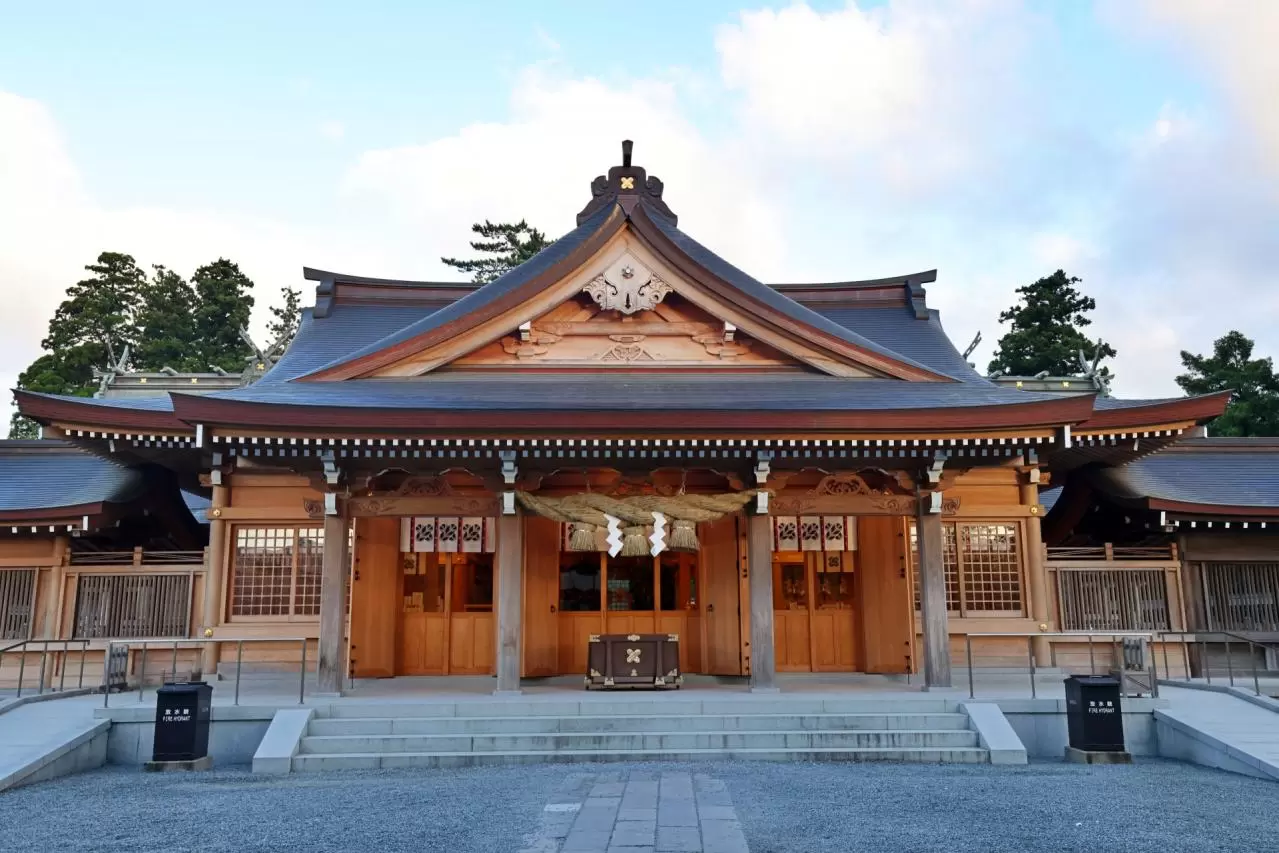
The principal shrine buildings standing today were constructed between 1835, the sixth year of the Tenpō era, and 1850, the third year of the Kaei era, as part of a reconstruction project funded by the Kumamoto domain. The grounds are characterized by a symmetrical layout: a two-story gate stands at the front, with the Jinkō Gate and Kangyo Gate on either side, and the First, Second, and Third Main Shrines arranged behind them.
Six of these buildings—the First Main Shrine, Second Main Shrine, Third Main Shrine, Rōmon Gate, Jinkō Gate, and Kangyo Gate—were designated National Important Cultural Properties on June 18, 2007. All are constructed primarily of zelkova wood. Their roofs were originally shingled with thin wooden boards but have since been converted to copper-sheet roofing. The pillars and brackets feature elaborate carvings, including wave-crest and cloud motifs, vividly conveying the architectural techniques and regional characteristics of the late Edo period.
The First Main Shrine was built in 1840, the Second Main Shrine in 1842, and the Third Main Shrine in 1843. The First and Second Main Shrines are large five-bay structures in the irimoya-zukuri style, with both their length and height exceeding 12 meters. The Third Main Shrine is a three-bay nagare-zukuri structure. The three shrines stand close together, creating a solemn and distinctive landscape unique to Aso Shrine.
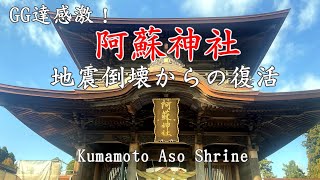
The symbol of Aso Shrine is its approximately 18-meter-high Rōmon Gate. Completed in 1850, it is a two-story gate with three bays and a single entrance, and is the largest gate of its type in Kyushu. It is also commonly regarded as one of the “Three Great Rōmon Gates of Japan.” With its imposing structure and intricate carvings, the gate is a building that should not be missed when visiting Aso Shrine.
On either side of the Rōmon Gate stand the Jinkō Gate and Kangyo Gate, both built in 1849. Each is a four-legged gate and serves a special purpose during the Ontaue Jinkō-shiki, held annually on July 28. The Jinkō Gate is associated with the departure of the mikoshi, or portable shrine, while the Kangyo Gate is associated with its return to the shrine; together, they form part of the route followed during the festival. The Rōmon Gate, the two side gates, and the three main shrines beyond them reveal a grounds layout in which architecture and ritual are closely integrated.
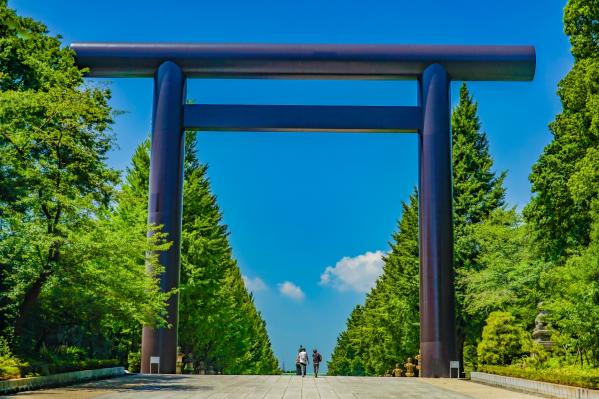
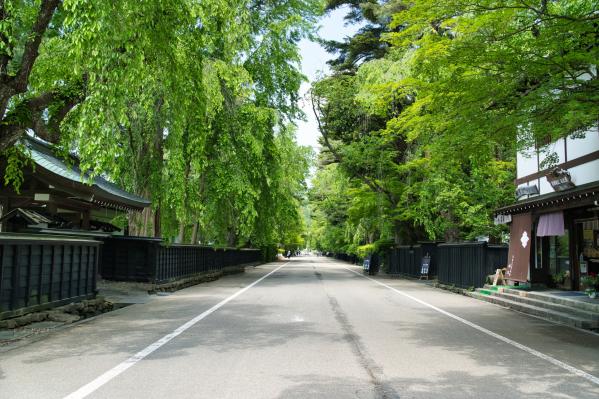
Aso Shrine has a “side approach,” an unusual feature rarely seen at shrines elsewhere in Japan. At most shrines, the approach runs directly from the torii or gate toward the worship hall. At Aso Shrine, however, the shrine buildings face east, while the approach extends north and south, running parallel to the buildings. The Rōmon Gate rises at the center of this side approach, and a traditional shrine-front town spreads around it. This distinctive scenery is another major attraction of Aso Shrine.
The Kumamoto Earthquake, which struck in April 2016, caused enormous damage to Aso Shrine. The Rōmon Gate, a National Important Cultural Property, and the worship hall at the center of worship collapsed. All six Important Cultural Properties—including the Jinkō Gate, Kangyo Gate, and the three main shrines—were also damaged. Images of the shrine’s symbolic structures reduced to rubble conveyed the severity of the earthquake damage to people throughout Japan.
After the disaster, restoration work proceeded with funding from subsidy programs provided by the national government, Kumamoto Prefecture, and Aso City, as well as donations from local residents and people across Japan. Although buildings other than designated cultural properties faced difficulty receiving public assistance, the necessary funds for reconstruction were raised through measures such as a designated donation system that offered tax benefits to donors.
In particular, for the collapsed Rōmon Gate, each recovered component was carefully examined and classified according to whether it could be repaired and reused or needed to be replaced with new material. Ultimately, approximately 70 percent of the original components were reused. While preserving traditional construction methods and the gate’s value as a cultural property, the restoration also improved its earthquake resistance through structural reinforcement. Restoring the enormous gate with as much of its original material as possible was an exceptionally challenging technical undertaking.
The worship hall was rebuilt in 2021, the third year of the Reiwa era, and a completion ceremony was held on July 12 of that year. Approximately 80 percent of the timber used for reconstruction and repairs came from Kumamoto Prefecture. Some of the wood was donated by the school forest of Aso Chuo High School. The new worship hall, with its large shimenawa rope and beautiful timber framework, has become a symbol of recovery from the Kumamoto Earthquake.
Restoration work on the six nationally designated Important Cultural Properties, including the Rōmon Gate, was completed in December 2023. Further work, including the restoration of the transparent lattice fence and the redevelopment of disaster-prevention facilities, continued afterward, with the remaining construction completed in December 2024. In February 2025, Aso Shrine formally announced the completion of its disaster-recovery project following the Kumamoto Earthquake, which had continued for nine fiscal years.
One of the highlights of the shrine grounds is the “Pine of Takasago,” known as a place associated with matchmaking. According to tradition, approximately 1,000 years ago, the shrine’s 26th chief priest, Aso Tomonari, brought pine seeds back from Takasago in Harima Province and planted them on the grounds. Today, the pine is visited by people praying for good relationships and marital harmony.
According to tradition, men should circle the Pine of Takasago twice from the left side, while women should circle it twice from the right side, while making a wish in order to be blessed with a good relationship. However, visitors should follow the latest instructions posted on the shrine grounds regarding the proper method of worship and areas where entry is permitted.
Along the approach directly in front of the Rōmon Gate is a spring known as the “Fountain of the Gods.” The Aso region is rich in groundwater nurtured by its volcanic terrain, and clear spring water also rises around Aso Shrine. The Fountain of the Gods has long been revered as water that grants longevity and has been cherished by many visitors. Anyone wishing to drink the water should check the local instructions beforehand.
The shrine-front town contains numerous drinking fountains called mizuki. Each fountain has been given an evocative name, and “Mizuki Meguri,” a walk through the town visiting the springs, is popular among visitors. The town also has restaurants, confectionery shops, souvenir stores, cafés, and other establishments where visitors can enjoy food and sweets made using Aso’s abundant spring water. Exploring the town together with a visit to the shrine offers an opportunity to experience both the richness of Aso’s water and the culture of its shrine-front community.
The “Agricultural Festivals of Aso” are indispensable to any discussion of Aso Shrine. Centered on Aso Shrine and Kokuzō Shrine, and held at related shrines such as Shimo-miya, this series of festivals follows the progress of rice cultivation, from prayers for a good harvest and the sowing of seeds to rice planting, protection against wind and frost damage, and thanksgiving for the harvest. As a valuable example of the systematic transmission of ancient agricultural rituals, these festivals were designated a National Important Intangible Folk Cultural Property on January 14, 1982.
One of the best-known events is the fire ritual held during the spring Tazukuri Festival. It is a sacred marriage ceremony welcoming the consort of Toshine-no-Ōkami, a deity of agriculture. Participants swing burning bundles of reeds attached to the ends of ropes in order to welcome the divine bride. The sight of countless rings of fire appearing in the darkness is magical and has become a celebrated spring tradition in Aso, expressing prayers for abundant crops.
The Ontaue Jinkō-shiki, held in summer, is commonly known as the Onda Festival. Mikoshi carrying the deities travel around two rice paddies, where prayers are offered for healthy rice growth and a plentiful harvest. A procession of priests and local residents moves through the green rice fields, led by women in white garments called unari, who carry sacred offerings on their heads. During the festival, rice-planting songs are sung and young rice seedlings are thrown up toward the mikoshi.
At the autumn Tami Festival, rice is offered before the deities in gratitude for the harvest, and performances such as sumo wrestling and yabusame horseback archery are dedicated to the shrine. Other traditions that continue today include the Tōka Sechie, when rice-planting songs are first sung at the beginning of the year; the Kazematsuri, which calms winds that could damage the rice crop; the Kararomiru Shinji, which concludes the season of rice-planting songs; and the Hitataki Shinji at Shimo-miya near Aso Shrine, in which prayers are offered to protect the crops from frost damage.
Festivals that consistently encompass prayers for a good harvest through thanksgiving for the harvest across all four seasons are now rare throughout Japan. The Agricultural Festivals of Aso are an important cultural heritage resource for understanding Japanese agricultural life, the traditional reverence for nature, and the bonds that unite local communities.
At Aso Shrine, people visit and offer prayers for a wide variety of blessings, including protection from misfortune, household safety, business prosperity, traffic safety, success in education, abundant harvests, and fulfillment in relationships. These benefits are based on the traditions surrounding the enshrined deities and on centuries of faith. Visitors can gain a deeper understanding by paying attention not only to the act of worship but also to the history of the shrine grounds and the culture of the Aso region.
Aso Shrine is not merely a place to view old shrine buildings. It is a site where many layers of history come together: volcanic worship directed toward Mount Aso, the legend of Takeiwatatsu-no-Mikoto’s development of the land, the history of the Aso clan, late-Edo-period architecture, agricultural festivals passed down through the local community, and recovery from the Kumamoto Earthquake.
By admiring the magnificent Rōmon Gate and the symmetrically arranged shrine buildings, walking along the side approach and through the shrine-front town, and encountering the clear spring water, visitors can sense how the natural environment of Aso and the lives of its people have been connected through faith. Having regained its form after overcoming the Kumamoto Earthquake, Aso Shrine remains an important symbol of regional recovery as well as a vital place for conveying the history and culture of Aso.
Kumamoto Tourist Attractions
View List

Nabegataki Park
Nabega Falls is a beautiful waterfall with a height of about 10 meters and a width of approximately 20 meters, formed by a volcanic eruption that created the Aso cal...

Kusasenrigahama
Kusasenrigahama is a representative tourist destination of Aso, located at an altitude of approximately 1,100 meters, featuring a vast grassland. To the east, you ca...

Shirakawa Suigen
Shirakawa Water Source is a representative spring located in Minamiaso, Kumamoto Prefecture, and is selected as one of the "Top 100 Ruins of Famous Water" by the Min...

Kikuchi Gorge
Kikuchi Gorge is a scenic natural forest located in the northwestern part of the Aso Outer Rim Mountains, and it stretches across a vast canyon at an elevation of 50...

Kumamoto Castle
Kumamoto Castle is one of Japan's three famous castles, featuring both the main and small towers side by side. Constructed by Katō Kiyomasa over a period of six to s...

Suizenji Jojuen Garden
Suizenji Jojuen is a nationally designated scenic spot and historic site located in Kumamoto City. It is a stroll garden created by the Hosokawa clan during the Edo ...

Green Land
"Greenland," located in Arao City on the border with Fukuoka Prefecture, is one of the largest amusement parks in Kyushu. The park features over 81 attractions, cate...