Suizenji Jojuen Garden
Suizenji Jojuen Garden Movies


Basic Information
- Spot Name
- Suizenji Jojuen Garden
- Location
- 〒862-0956 8-1 Suizenji Park, Chuo Ward, Kumamoto City, Kumamoto Prefecture, Japan
- Access
- From JR Kumamoto Station, take the Tram Line A bound for Kengunchō for 30 minutes, get off at Suizenji Park, and walk for 3 minutes.
- Parking
- Please use the nearby paid parking facilities.
- Business Hours
- 7:30 AM - 5:30 PM (Last entry at 6:00 PM); from November to February, 8:30 AM - 4:30 PM (Last entry at 5:00 PM)
- Regular Holiday
- None
- Fees
- Adults (16 years and older) 400 yen, Children (6 to 15 years old) 200 yen
- Contact Information
- Phone Number:096-383-0074
- Official Website
Map
Detailed Information
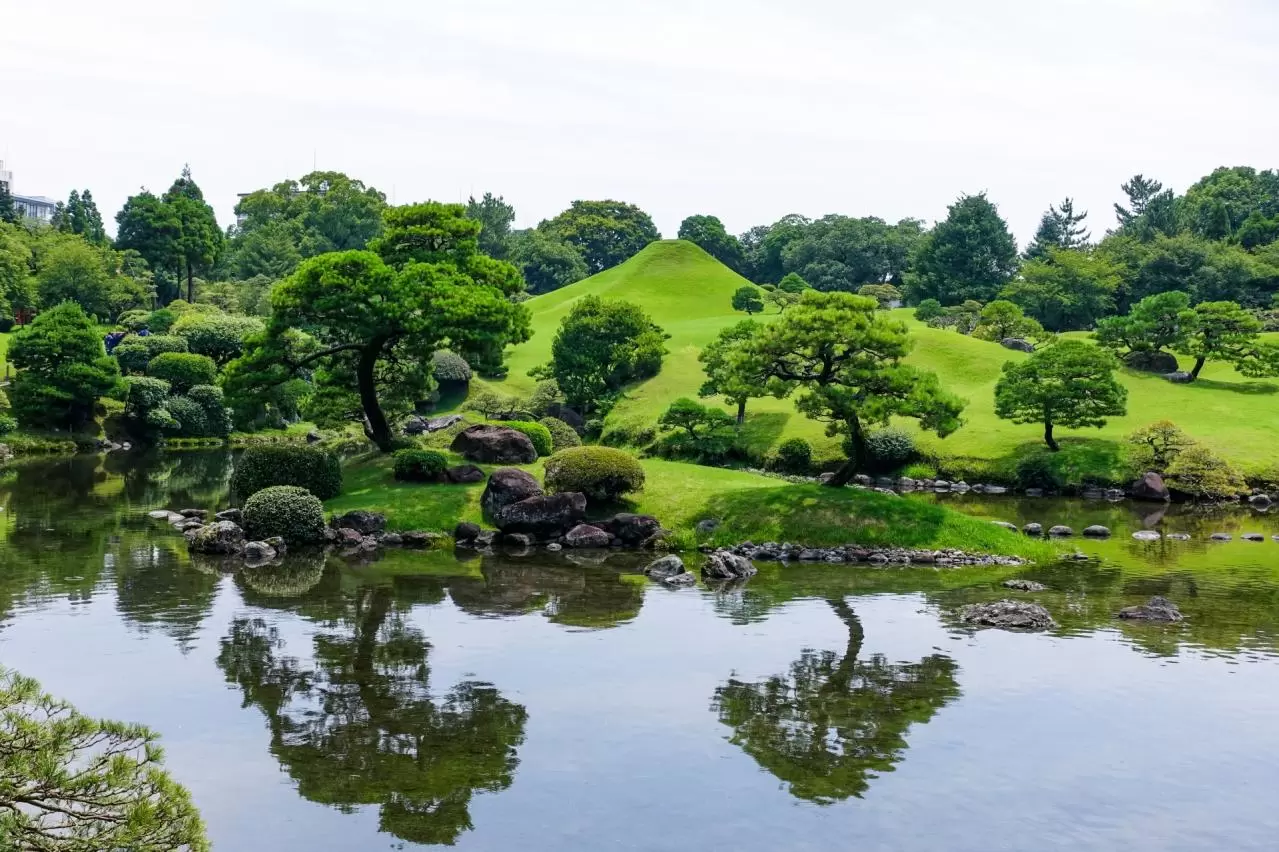
Suizenji Jojuen Garden is a strolling pond garden in Suizenji Park, Chuo Ward, Kumamoto City, with a history dating back to the early Edo period. It is also widely known as “Suizenji Park.” Centered around a pond filled with pure spring water, the garden features elegantly arranged grassy hills, standing stones, pine trees, and other elements, allowing visitors to enjoy constantly changing scenery as they walk through the grounds. Because of its historical and cultural value, it was designated a national Place of Scenic Beauty and Historic Site on December 17, 1929.
The history of Suizenji Jojuen began in 1632, when Hosokawa Tadatoshi arrived in Kumamoto as the first lord of the Kumamoto domain of the Higo Hosokawa family. On this site southeast of Kumamoto Castle, Tadatoshi built a temple for Gentaku, a monk who had come from Buzen, and named it “Suizenji.” Later, Tadatoshi is said to have taken a liking to the area after discovering its abundant clear spring water while hawking, and he built a teahouse there. Known as the “Suizenji Tea House,” it became the starting point of today’s Suizenji Jojuen Garden.
After Tadatoshi, extensive landscaping was carried out during the reigns of the second lord, Hosokawa Mitsunao, and the third lord, Hosokawa Tsunatoshi. In 1671, the strolling garden was completed. It was named “Jojuen,” meaning “Garden of Growing Interest,” after the poem “Kikyorai no Ji” by Tao Yuanming, a poet of China’s Eastern Jin dynasty.
The name is said to come from the line, “The garden, traversed day after day, gradually develops its charm.” It expresses the idea that rather than simply viewing the garden once, one walks through it repeatedly and gradually comes to appreciate its beauty and character more deeply.
During the Genroku era of the Edo period, many garden pavilions were built, and the grounds became such a splendid garden that the “Ten Views of Jojuen” were selected. However, during the reign of the sixth lord, Hosokawa Shigekata, many of the buildings other than the Suigetsutei Pavilion were removed as part of the Hōreki Reforms. The trees were also rearranged into a simpler composition centered mainly on pine trees. The open and tranquil scenery seen today reflects these historical changes.
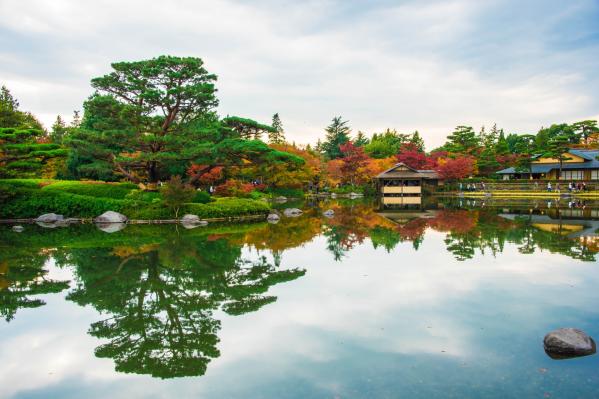
The greatest attraction of Suizenji Jojuen is its expansive pond and the graceful garden landscape created around it. The pond is fed by underground water from the Aso volcanic region, and visitors can observe carp swimming in its exceptionally clear water, as well as reflections of pine trees, the sky, and the garden’s hills on the surface. Small islands, standing stones, and stepping stones are arranged in and around the pond so that different landscapes appear depending on where visitors stand and the direction in which they walk.
The spring-water environment around Suizenji Jojuen, together with the garden itself, was selected in 2008 as one of the “100 Remarkable Waters of the Heisei Era” by Japan’s Ministry of the Environment under the name “Suizenji-Ezuko Spring Water Group.” It was not the pond within the garden alone that was selected; rather, the designation applies to the entire extensive spring-water area, including Suizenji Jojuen, Lake Ezuko, and the Kengun Water Source.
Rain that falls in the Kumamoto region seeps underground, flows through the earth over a long period, and eventually emerges in various places as pure groundwater. Blessed with abundant groundwater, Kumamoto is sometimes called the “City of Water,” and Suizenji Jojuen is one of the places that symbolizes this rich water environment.
The landscape extending across the garden is traditionally said to have been modeled after the Fifty-Three Stations of the Tokaido. The pond represents a sea or lake, while hills, pine trees, stones, and lawns of various sizes symbolically recreate landscapes found along the highway. Among these features, the particularly prominent conical hill is considered a representation of Mount Fuji and has become one of the garden’s signature views.
The hill representing Mount Fuji is not a miniature model that simply reproduces the actual mountain. Instead, the pond, hills, lawns, pine trees, and other elements are combined to symbolically express famous places and roadside landscapes from throughout Japan. Moreover, it has not been clearly established that each individual hill or stone corresponds one-to-one with a specific station along the Fifty-Three Stations of the Tokaido. It is therefore more natural to understand the garden as a whole as an expression of scenery from a journey along the Tokaido.
As visitors walk around the garden and change their viewpoints, the shape of the hills and their relationship to the pond appear to change as well. From one place, the Fuji-shaped hill rises beyond the pond; from another, pine trees and buildings overlap to create a landscape with a strong sense of depth. These changing views are one of the pleasures unique to a strolling garden.
One of the garden’s important structures is the Kokin Denju no Ma. “Kokin denju” refers to a method of teaching waka poetry in which interpretations and secret traditions associated with the Kokin Wakashu anthology were transmitted orally from teacher to disciple. The building is said to be associated with the place where Hosokawa Fujitaka, also known as Yusai, taught the traditions of the Kokin Wakashu to Prince Hachijo-no-miya Toshihito in 1600.
The present Kokin Denju no Ma is a building associated with the Hosokawa family that was said to have stood within the Kyoto Imperial Palace. It was moved to Suizenji Jojuen in November 1912 and reconstructed at its current location. In 1964, it was designated an Important Cultural Property by Kumamoto Prefecture.
The view of the garden from the Kokin Denju no Ma is considered particularly beautiful. Visitors can enjoy a harmonious composition of the pond, the hill symbolizing Mount Fuji, pine trees, and lawns. At the adjoining teahouse, visitors may also be able to enjoy matcha tea and sweets while looking out over the garden, depending on its operating schedule. It is a place where visitors can relax while experiencing the waka-poetry and tea cultures passed down through the Hosokawa family.
On the northern side of the grounds stands Izumi Shrine, which enshrines figures associated with the Higo Hosokawa family. After Kumamoto suffered extensive damage during the Satsuma Rebellion of 1877, former retainers of the Kumamoto domain planned to establish a shrine to honor the virtues of successive domain lords and to pray for the spiritual peace of the people and the recovery of Kumamoto. On October 7, 1878, the shrine buildings were established, with Suizenji Jojuen serving as the shrine precincts.
Izumi Shrine primarily enshrines four deities: Hosokawa Fujitaka, Hosokawa Tadaoki, Hosokawa Tadatoshi, and Hosokawa Shigekata. Together with successive domain lords and figures connected to the Hosokawa family, including Tadaoki’s wife, Gracia, a total of fifteen deities are enshrined there. Visitors come to pray for lasting success in battle, the safety of their families, and other blessings. Today, the shrine is cherished as a place of worship integrated with Suizenji Jojuen. The garden is currently owned and managed by Izumi Shrine.
Within the grounds of Izumi Shrine is a spring known as “Shinsui, the Water of Longevity.” It is fed by underground water from the Aso volcanic region and emerges from a stone basin said to have been named “Kesa” and treasured by Hosokawa Tadaoki. Long regarded as water that brings longevity, it is one of the garden’s representative springs.
The garden also has a Noh theater equipped with a full-scale Noh stage. The Hosokawa family was known for its longstanding appreciation of Noh, and Hosokawa Fujitaka is said to have been both a cultured man and a skilled taiko drummer. The original Noh theater, built at the same time as Izumi Shrine, was destroyed by fire in 1965. The present theater was moved here in 1986 from the former Matsui family, the lords of Yatsushiro Castle.
At Izumi Shrine’s spring and autumn grand festivals, Noh performances and Takeda-style yabusame horseback archery are dedicated. In yabusame, archers dressed as warriors fire arrows at targets from horseback while riding at full speed. A 150-meter yabusame course has been prepared within the garden, allowing visitors to see this powerful traditional martial art at close range. Because the dates and programs of these events may vary from year to year, visitors wishing to attend should check the official information in advance.
Suizenji Jojuen displays different scenery in each season. In spring, cherry blossoms and fresh greenery add color to the grounds, with the cherry blossoms usually reaching their peak from late March to early April. However, the flowering period may vary depending on temperatures and weather conditions that year. In early summer, vivid lawns and green trees are reflected on the surface of the water, creating a refreshing landscape. In autumn, the trees take on vibrant colors, while in winter the garden’s essential sculptural beauty, centered on its pine trees and hills, becomes especially prominent.
The grounds also include an area introducing the “Six Higo Flowers”: Higo camellias, Higo peonies, Higo irises, Higo morning glories, Higo chrysanthemums, and Higo sasanqua camellias. Since the Edo period, these flowers have been cultivated and uniquely developed in Kumamoto, representing the region’s distinctive horticultural culture.
The Six Higo Flowers bloom in different seasons, so they do not all flower at the same time. Depending on the season of a visit, guests can enjoy different flowers—including irises, morning glories, chrysanthemums, and sasanqua camellias—while experiencing the horticultural culture nurtured in Kumamoto.
Natsume Soseki, who stayed in Kumamoto, is also said to have frequently visited Suizenji Jojuen. A monument inscribed with one of his haiku poems stands in the garden. Verses such as “Spring water, bubbling forth and flowing onward” evoke the garden’s clear springs and Noh theater, highlighting the connection between the garden and literature.
The plant known as suizenjinori takes its name from Suizenji. It is a type of cyanobacterium that grows in clean freshwater. It was scientifically described based on a specimen collected from the pond at Suizenji Jojuen in 1872, and was named after the place where it was found.
Suizenjinori was once highly valued as a food and used in kaiseki and Buddhist vegetarian cuisine. However, it requires limited and specific conditions—including clean spring water, stable water temperatures, and suitable water quality—and is vulnerable to changes in its growing environment. As a result, it has become extremely rare. Although it is not commonly seen in the garden today, it remains an important reminder of the rich spring-water environment of the Suizenji area.
Suizenji Jojuen is also attractive because it is easy to reach by public transportation from central Kumamoto. It is approximately a four-minute walk from the Suizenji-Koen tram stop on the Kumamoto City Tram system and about a ten-minute walk from Shin-Suizenji Station on the JR Hohi Main Line. The garden is easy to visit together with Kumamoto Castle, allowing travelers to experience Kumamoto’s samurai and garden cultures in a single day.
Suizenji Jojuen is not merely a garden in which to admire beautiful scenery. The site embodies layers of Kumamoto’s history and culture, from the construction of Tadatoshi Hosokawa’s teahouse and the landscaping carried out by successive domain lords to the establishment of Izumi Shrine, the relocation and reconstruction of the Kokin Denju no Ma, and the continuation of Noh theater and yabusame traditions.
Walking through the grounds while gazing at the clear pond created by underground water from the Aso volcanic region allows visitors to experience both the culture of Edo-period feudal lords and Kumamoto’s rich water environment. New views appear with every step, and the garden reveals a different character in each season. Suizenji Jojuen is a magnificent garden that visitors to Kumamoto should make a point of visiting.
Kumamoto Tourist Attractions
View List
Kusasenrigahama
Kusasenrigahama is a representative tourist destination of Aso, located at an altitude of approximately 1,100 meters, featuring a vast grassland. To the east, you ca...

Kikuchi Gorge
Kikuchi Gorge is a scenic natural forest located in the northwestern part of the Aso Outer Rim Mountains, and it stretches across a vast canyon at an elevation of 50...

Kumamoto Castle
Kumamoto Castle is one of Japan's three famous castles, featuring both the main and small towers side by side. Constructed by Katō Kiyomasa over a period of six to s...

Shirakawa Suigen
Shirakawa Water Source is a representative spring located in Minamiaso, Kumamoto Prefecture, and is selected as one of the "Top 100 Ruins of Famous Water" by the Min...


Aso Shrine
Aso Shrine, located in Aso City, Kumamoto Prefecture, is the head shrine of approximately 500 shrines across Japan and has a history of over 2,500 years. The deities...

Green Land
"Greenland," located in Arao City on the border with Fukuoka Prefecture, is one of the largest amusement parks in Kyushu. The park features over 81 attractions, cate...

Nabegataki Park
Nabega Falls is a beautiful waterfall with a height of about 10 meters and a width of approximately 20 meters, formed by a volcanic eruption that created the Aso cal...