Kitano Tenmangu Shrine
It is particularly known as a place for examination success, and during the plum blossom season from winter to spring, it attracts many worshippers. The plum garden is home to about 1,500 plum trees of 50 different varieties, showcasing their beautiful blossoms. Additionally, the Umehana Festival is held on February 25, featuring outdoor tea ceremonies performed by maiko.
Kitano Tenmangu offers different charms with each season; in early summer, the vibrant green of the fresh leaves beautifully contrasts with the vermilion of Usubashi Bridge, while in autumn, 350 maple trees turn brilliant shades. The exquisite combination of natural beauty, historic architecture, and sacred atmosphere makes it a site worth visiting throughout the year.
Moreover, the shrine houses national treasures and a wealth of cultural properties, providing plenty of attractions for those interested in history and culture.
Kitano Tenmangu Shrine Movies


![[京都観光]京都一の梅の名所「北野天満宮」に行ってきました2023年2月下旬](https://i.ytimg.com/vi/0pysWxdFbZ0/mqdefault.jpg)
Basic Information
- Spot Name
- Kitano Tenmangu Shrine
- Location
- 〒602-8386 Bakucho, Kamigyo-ku, Kyoto City, Kyoto Prefecture, Japan
- Access
- A short walk from the Kitano Tenmangu-mae bus stop on the city bus. Approximately a 5-minute walk from Kitano Hakubai-cho Station on the Keifuku Electric Railroad Kitano Line.
- Parking
- Parking available
- Business Hours
- Opening hours: 6:30 AM to 5:00 PM.
- Regular Holiday
- Open every day.
- Fees
- [Sanctuary] Free, [Treasure Hall] General admission 1,000 yen, Junior and Senior High School students 500 yen, Children 250 yen, Preschoolers Free
*Ume Garden (usually open from early February to late March): Adults 1,000 yen, Children 500 yen
*Maple Garden (usually open from late October to early December): Adults 1,000 yen, Children 500 yen - Contact Information
- Phone Number: 075-461-0005
- Official Website
Map
Detailed Information
Kitano Tenmangu is a Shinto shrine located in Kamigyo Ward, Kyoto City, and is the head shrine of approximately 12,000 Tenmangu and Tenjin shrines nationwide. Dedicated to Sugawara no Michizane, known as the deity of learning, it has been widely worshipped since its founding in 947 as a place to pray for success in entrance examinations and academic achievement.
Origins and History
Kitano Tenmangu was founded in 947, in the mid-Heian period, based on a divine oracle to appease the spirit of Sugawara no Michizane. Michizane was an outstanding scholar and statesman who rose to the rank of Minister of the Right, but due to a Fujiwara conspiracy he was demoted to Dazaifu in Kyushu, where he died in despair in 903.
Afterward, disasters and epidemics continued to strike the capital, so a shrine was built in Kitano, northwest of Heian-kyo—the direction of the heavenly gate—to calm Michizane’s angry spirit. In 987, an imperial envoy was dispatched by Emperor Ichijo, and the shrine became established as an imperial institution for praying for national peace and security. Since then, it has been deeply revered by the imperial family, warriors, and common people alike, and “Tenjin-san” shrines spread throughout Japan as the origin of Tenjin worship.
Enshrined Deity: Sugawara no Michizane
Michizane was gifted academically from childhood and was also a cultured figure versed in waka poetry and Chinese verse. He served in the government as Minister of the Right, but died after experiencing a troubled and unhappy final period. His character and scholarship were praised as “the great founder of literature and learning, and the true master of poetry,” and in later generations he came to be worshipped as the “god of learning” and the guardian deity of culture and the arts.
Architecture and Cultural Properties
Main Hall (National Treasure)
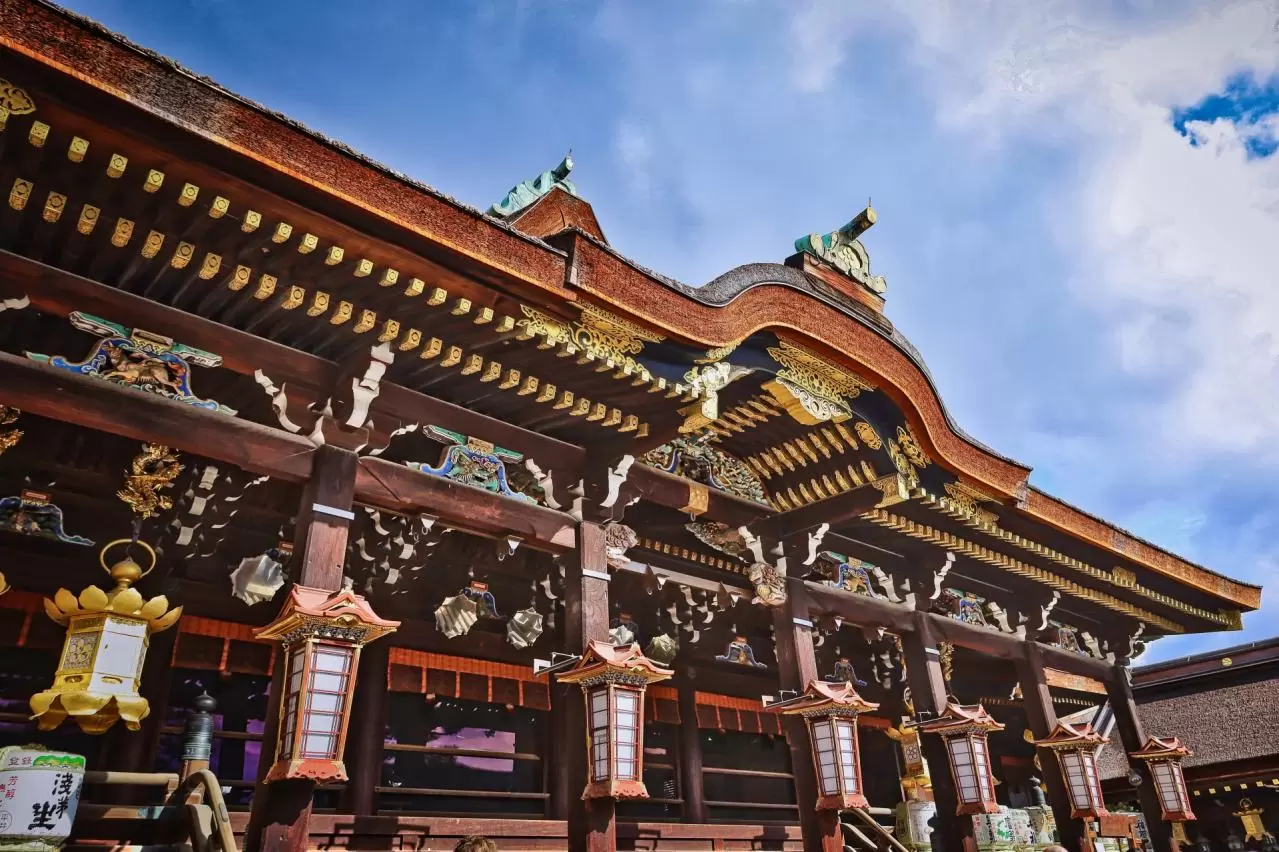
The present main hall was built in 1607 by Toyotomi Hideyori and is a representative example of the Momoyama period’s “yatsumune-zukuri” style. Its structure, in which the worship hall and main sanctuary are connected by an intermediate room, with music rooms attached on both sides, became the prototype for the later gongen-zukuri style.
Paper-based, polychrome Kitano Tenjin Engi Emaki, Jokyu Version (National Treasure)
A masterpiece depicting the life of Michizane and the origins of Kitano Tenmangu, it is specially exhibited in the Treasure Hall (on the 25th of each month and on other occasions).
Kien Hyojin Stone
A stone pillar about 1 meter high engraved with “the one who asks” and “the one who tells.” It stands in the garden of the tea room Shokoken and is usually not open to the public.
Komainu
At the entrance to the approach road stand some of the largest guardian lion-dogs in Kyoto Prefecture, measuring about 5 meters in total length, and there are 12 pairs throughout the shrine grounds. Their design was conceived by the painter Takeuchi Seihō in 1934.
Sacred Cattle as Divine Messengers
Throughout the shrine grounds are statues of the sacred cow, the messenger of Tenjin-sama. Especially famous is the reclining ox statue at Ushi Shrine (Ushi-sama of the Northwest). It is said that stroking the ox’s head grants wisdom, making it popular among students preparing for exams.
Seasonal Nature and Annual Events
Season | Highlights | Main Events
Early spring (February) | The Plum Garden, fragrant with about 1,500 plum trees of 50 varieties | February 25: Baika-sai (Plum Blossom Festival), famous for outdoor tea ceremonies hosted by geiko and maiko
Early summer (May–June) | The vivid green maple leaves contrasted with the vermilion Uguisu Bridge | —
Midsummer (July–August) | Shinko-sai and chinowa kuguri (passing through a sacred grass ring) | July 25: Tenjin Festival (Kitano Festival)
Autumn (November) | About 350 maple trees turn brilliant colors, with nighttime illumination | Early to late November: Momiji-en open to the public
Year-round | Tenjin-san Day on the 25th of every month (market day) | Stalls, special exhibition of the Treasure Hall, and illumination of stone lanterns
Representative Rituals
Ake no Matsuri
A festival commemorating the clearing of the false accusation against Michizane in 903.
Choyo Shinji
Held on September 9, this ritual recreates the Choyo banquet of the imperial court, featuring the dedication of waka poetry and Chinese verse. Priests and attendants decorate their crowns with small chrysanthemums.
Kyokusui no En
A Heian-period courtly event in which cups are floated down a stream, and participants compose waka or Chinese verse before the cup passes by, preserving the cultural legacy associated with Michizane.
With over a thousand years of history, Kitano Tenmangu continues to draw worshippers as the head shrine of learning and the arts. It is not only a place to pray for success in exams and academic pursuits, but also a site where visitors can experience the depth of Japanese culture through seasonal beauty such as plum blossoms and autumn leaves, as well as national treasure shrines, sacred treasures, and elegant rituals. When visiting Kyoto, be sure to stop by and spend a rich and memorable time surrounded by history and nature, under the protection of Tenjin-sama.
Kyoto Tourist Attractions
View List
Kyoto Railway Museum
The Kyoto Railway Museum, opened in 2016, is one of the largest railway museums in Japan, designed to be a fun and educational facility with the theme of "see, touch...

Heian Shrine
Heian Shrine was established in 1895 to commemorate the 1100th anniversary of the relocation of the capital to Heian-kyo, with Emperor Kanmu as its deity. Located in...

Tofuku-ji Temple
Tōfuku-ji is the head temple of the Rinzai sect of Zen Buddhism, founded in 1236 by Kujō Tadayoshi, with its main hall completed in 1255. It is counted among the fiv...

Yasaka Shrine
Yasaka Shrine, commonly known as "Gion-san," is widely cherished. This shrine is particularly significant as the head shrine of the approximately 2,300 Yasaka Shrine...

To-ji Temple
Toji Temple (official name: Kyo-o Gokokuj), is the only existing structure from the Heian-kyo period and is registered as a UNESCO World Heritage Site. Founded two y...

Kenninji Temple
Kennin-ji Temple, founded in 1202 by the Zen master Eisai, is the oldest Zen temple in Kyoto and serves as the head temple of the Kennin-ji branch of the Rinzai sect...

Nijo Castle
Nijo Castle, originally built as a retreat for the Shogun, can be described as a place condensed with Japan’s history and culture. Constructed in 1603 by the first S...