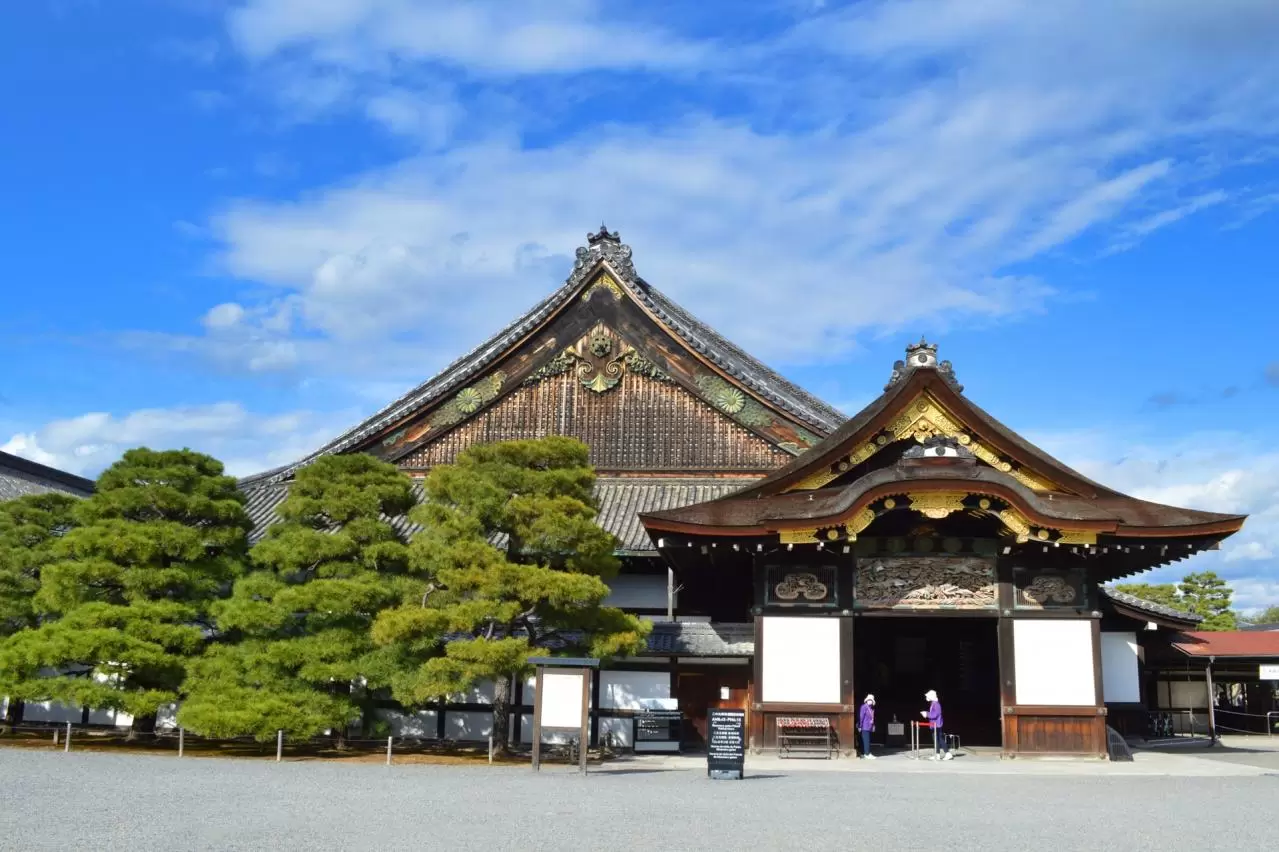
Nijo Castle
The Ninomaru Palace of Nijo Castle underwent major renovations by the third Shogun, Tokugawa Iemitsu, in preparation for the Emperor Go-Mizuno's visit, and many of the screen paintings created by Kano Tanyu remain to this day. These magnificent artworks showcased the high cultural standards and power of the Edo Shogunate.
During the late Edo period, the 15th Shogun Tokugawa Yoshinobu declared the "Taisei Hokan" (the return of governance) here, marking a historic moment when the Shogunate returned power to the Imperial court. Nijo Castle has been involved in many significant events in Japanese history, from the beginning to the end of the Shogunate era.
Designated as a UNESCO World Heritage Site in 1994, this castle is an important cultural asset that conveys around 400 years of history to the present day. Particularly in spring, about 300 cherry blossom trees of 50 varieties bloom beautifully, and during the Nijo Castle Cherry Blossom Festival, they are spectacularly illuminated.
Located in the heart of Kyoto, Nijo Castle is easily accessible. This place, where one can enjoy history, culture, and the beauty of nature all at once, is an unmissable tourist destination for anyone visiting Japan. Official guided tours are also available, providing opportunities for a deeper understanding of this historic site.
Nijo Castle Movies


Basic Information
- Spot Name
- Nijo Castle
- Location
- 〒604-8301 541 Nijojo-cho, Nakagyo-ku, Kyoto City, Kyoto Prefecture, Japan
- Access
- A short walk from Nijojo-mae Station on the Tozai Subway Line.
A short walk from the Nijojo-mae bus stop on the city bus. - Parking
- Parking available
- Business Hours
- 8:45 AM to 4:00 PM (Last entry at 5:00 PM)
- Regular Holiday
- From December 29 to December 31, the Ninomaru Palace is closed on Tuesdays in January, July, August, and December, as well as from January 1 to January 3 and from December 26 to December 28. (Please note that if these days fall on holidays, the Ninomaru Palace can be visited, but it will be closed for viewing the following day.)
- Fees
- 【Admission Fee / Ninomaru Palace Viewing Fee】 General: 1,030 yen, Junior High and High School Students: 350 yen, Elementary School Students: 200 yen, *Free for children under elementary school age.
【Exhibition and Storage Museum Viewing Fee】 100 yen
【Admission Fee Only】 General: 620 yen - Contact Information
- Phone Number:075-841-0096
- Official Website
Map
Detailed Information
Nijo Castle, formerly the Imperial Villa, is a historic castle located in Nakagyo Ward, Kyoto. It was built by Tokugawa Ieyasu in 1603, the eighth year of the Keicho era. It was constructed to serve as lodging for the shogun during visits to Kyoto, to protect the Kyoto Imperial Palace, and to stand as a base for demonstrating the shogunate’s authority close to the Emperor. Nijo Castle is a place that symbolizes the beginning and end of the Edo shogunate, and it is an important cultural property deeply connected to Japanese politics and culture.
In 1994, it was registered as part of the UNESCO World Cultural Heritage site “Historic Monuments of Ancient Kyoto.” Within the castle grounds, visitors can enjoy seasonal natural beauty throughout the year, including spring cherry blossoms and autumn foliage, as well as many highlights such as buildings designated as National Treasures and Important Cultural Properties, and superb Japanese gardens.
Historical Background
In addition to serving as lodging for Tokugawa shoguns during their stays in Kyoto, Nijo Castle was also built to display the authority of the shogunate near the Emperor. Most notably, in 1867, the 15th shogun, Tokugawa Yoshinobu, declared the “return of political authority to the Emperor” here. This historic event marked the return of governing power from the Edo shogunate to the Imperial Court and became a major turning point in Japan’s transition toward a modern nation.
Ninomaru Palace (National Treasure)
Ninomaru Palace is a group of buildings that represents early Edo-period shoin-style architecture. It consists of six buildings, with 33 rooms and a total of about 800 tatami mats. Inside, splendid sliding-door paintings by artists of the Kano school are displayed throughout, and the transom carvings and decorative metal fittings are also extremely intricate. These features vividly convey the cultural richness and dignity of the Edo shogunate.
The palace corridors also feature a device known as “uguisubari” or “nightingale floors,” which produce a chirping sound like birds singing when walked upon. This was a security measure intended to detect intruders and demonstrates the high level of architectural technology of the time.
Karamon Gate (Important Cultural Property)
The Karamon Gate, which serves as the front gate of Ninomaru Palace, is a highly prestigious gate in the four-legged gate style, with karahafu gables on both the front and back. The entire gate is covered with carvings symbolizing longevity and good fortune, such as dragons, tigers, cranes, turtles, and pine, bamboo, and plum, while its brilliant polychrome decoration overwhelms viewers.
Ninomaru Garden (Special Place of Scenic Beauty)
The “Ninomaru Garden” adjacent to Ninomaru Palace is said to have been renovated in 1626, the third year of the Kan’ei era, by Kobori Enshu, the chief construction magistrate, in preparation for Emperor Go-Mizunoo’s visit. This garden takes the form of a shoin-style garden and is characterized by stone arrangements shaped like Mount Horai, the legendary home of immortal sages. The pond is designed so that it can be admired from three directions, creating a landscape that is both powerful and graceful.
Honmaru Palace (Important Cultural Property)
The current Honmaru Palace was relocated in the Meiji period from the main section of the Katsura-no-miya residence, which had originally stood north of the Kyoto Imperial Palace. It consists of four buildings: the entrance, the study room, the main living quarters, and the kitchen and Gannoma room. Among them, the main living quarters feature a mezzanine structure, making the exterior appear as though it is a three-story building.
This Honmaru Palace is scheduled to reopen to the public in September 2024 for the first time in 18 years, offering a rare opportunity to view this precious cultural heritage up close.
Other Structures
Ninomaru Palace Oseisho (Important Cultural Property): A building that was called the “Koryori-no-ma” in the Edo period, equipped with a hearth and a well (not open to the public).
Ninomaru Earthen Storehouses (Rice Storehouses, Important Cultural Properties): Three earthen storehouses still remain within the castle grounds, a very rare example among castles throughout Japan (not open to the public).
Honmaru Yaguramon Gate (Important Cultural Property): Among the buildings in the Honmaru compound built during the Kan’ei period, this is the only remaining structure that survived the great fire of 1788, in the eighth year of the Tenmei era.
Annual Events and the Fusion of Contemporary Art
Every autumn, the “Nijo Castle Festival” is held, featuring a variety of events that blend historic architecture with contemporary art. At night, visitors are captivated by beautiful scenes where tradition and modernity harmonize, such as the flower-themed projection mapping “NAKED FLOWERS” and the fantastical underwater art exhibition “Art Aquarium Castle,” where goldfish and koi appear to swim through illuminated spaces.
Seasonal Natural Beauty
Within the castle grounds, plum blossoms, cherry blossoms, satsuki azaleas, camellias, and autumn leaves delight visitors throughout the year. In spring, especially, about 300 cherry trees bloom in full splendor, and the “Nijo Castle Cherry Blossom Festival” also features magical nighttime illumination, allowing visitors to enjoy the cherry blossoms after dark.
From its construction by Tokugawa Ieyasu to Tokugawa Yoshinobu’s declaration of the return of political authority to the Emperor, Nijo Castle has witnessed major turning points in Japanese history. Its solemn architecture, refined gardens, and abundant natural beauty make it a precious place that conveys the essence of Japanese culture to the present day. When you visit Kyoto, be sure to stop by and experience the depth of Japan’s history and beauty.
Kyoto Tourist Attractions
View List
The National Museum of Modern Art, Kyoto
The National Museum of Modern Art, Kyoto, was opened in 1963 in Okazaki Park, Kyoto. This museum covers a wide range of art genres, including Japanese painting, oil ...

Ginkaku-ji (Silver Pavilion)
Ginkaku-ji, officially known as Jishō-ji, is located in the Sakyo Ward of Kyoto City and is affiliated with the Rinzai school of the Shokoku-ji sect. Originally buil...

Fushimi Inari Taisha Shrine
Fushimi Inari Taisha is the head shrine of approximately 30,000 Inari shrines located in Kyoto. It is believed that the deity Inari was enshrined here in the 4th yea...

Sanjusangen-do Temple
Sanjusangendo, officially known as Rengeoin, is a Tendai Buddhist temple located in Kyoto. Rebuilt during the Kamakura period, this temple boasts a main hall that is...

Amanohashidate
Amanohashidate is a special scenic spot located in Miyazu Bay, facing the Sea of Japan in the northern part of Kyoto Prefecture. It is one of the "Three Views of Jap...

Kyoto National Museum
The Kyoto National Museum was opened in 1897 as the Imperial Kyoto Museum. Located in Kyoto, this museum houses approximately 14,600 artworks and cultural properties...

Kyoto Aquarium
Kyoto Aquarium is a large inland aquarium located in Umekoji Park in the Shimogyo Ward of Kyoto City. It is conveniently accessible, being about a 15-minute walk fro...

Tofuku-ji Temple
Tōfuku-ji is the head temple of the Rinzai sect of Zen Buddhism, founded in 1236 by Kujō Tadayoshi, with its main hall completed in 1255. It is counted among the fiv...