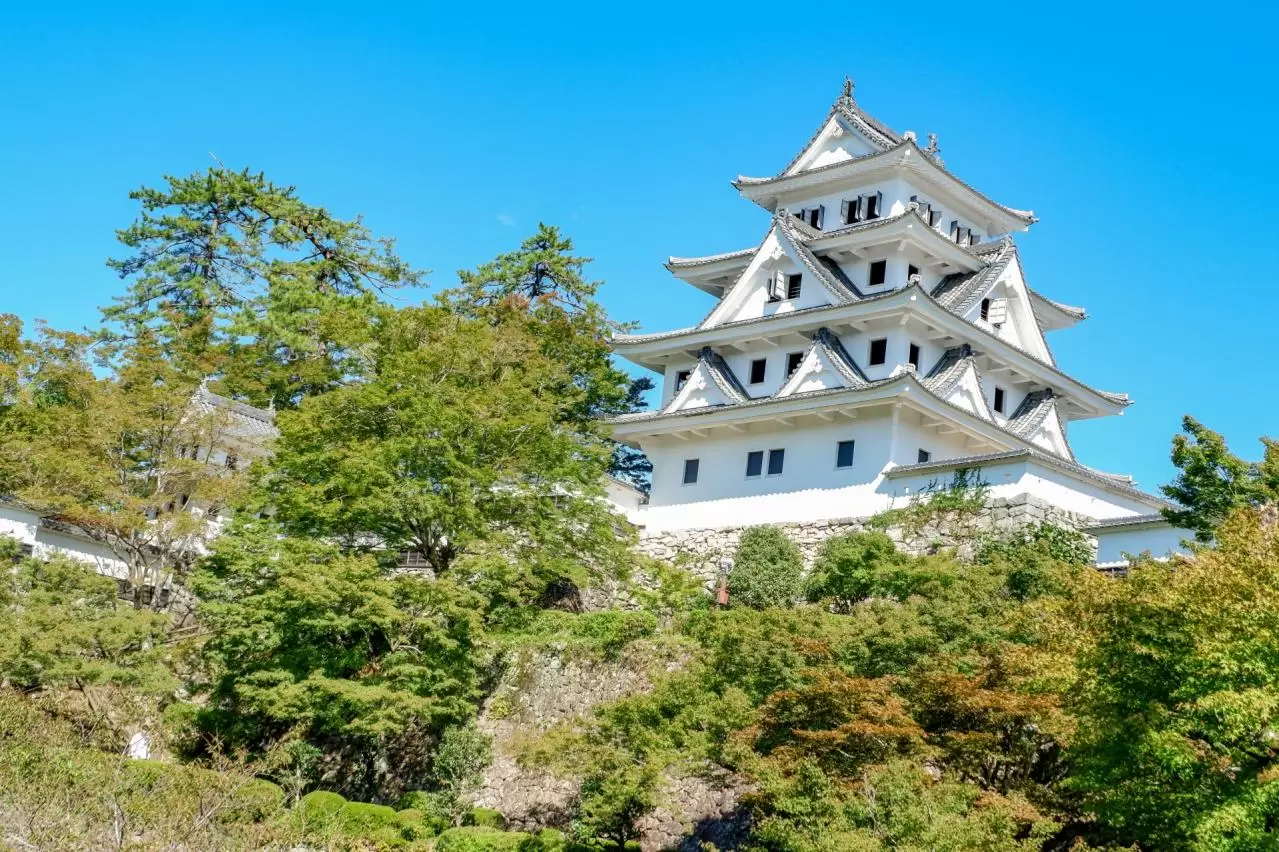
Gujo Hachiman Castle
Gujo Hachiman Castle Movies


Basic Information
- Spot Name
- Gujo Hachiman Castle
- Location
- 〒501-4214 659 Ichinohei, Yanagimachi, Hachiman, Gujo City, Gifu Prefecture, Japan
- Access
- From Gujo Hachiman Station: Take the Mame Bus Red Route and get off at "Jokamachi Plaza," then walk for 20 minutes.
From Gujo Hachiman IC: About a 12-minute drive. - Parking
- Available
- Business Hours
- From March to May and September to October: 9:00 AM to 5:00 PM
From June to August: 8:00 AM to 6:00 PM
From November to February: 9:00 AM to 4:30 PM
*Last admission is until 15 minutes before closing. - Regular Holiday
- From December 20th to January 10th.
- Fees
- Adults (High school students and above) 320 yen
Children (Elementary and middle school students) 150 yen
Preschoolers Free - Contact Information
- Phone Number:0575-67-1819
- Official Website
Map
Detailed Information
Gujo Hachiman Castle is a castle located in Hachiman-cho, Gujo City, Gifu Prefecture, and is a flatland castle with a mountain-castle-like setting. Known as the oldest wooden reconstructed castle in Japan, it was built atop Hachiman Mountain (formerly Ushikubeyama), at an elevation of about 359 meters. Overlooking the castle town of Gujo Hachiman, it remains a beloved local symbol and is cherished by many people today. Also known as “Sekisui Castle,” it is highly regarded as one of Japan’s most beautiful and distinguished castles, surrounded by nature that changes with the seasons.
Origins and the History of Construction
The origins of Gujo Hachiman Castle date back to 1559, in the late Sengoku period. This area had originally been ruled by the Toh clan since the Kamakura period, but after moving their residence to Akeyama Castle in 1541, they were destroyed in 1559 after coming under attack by Endo Morikazu.
During the assault on Akeyama Castle, Endo Morikazu set up his camp on Ushikube Mountain on the opposite bank of the Yoshida River, which is considered the beginning of Gujo Hachiman Castle. Later, Morikazu’s eldest son, Endo Yoshitaka, built a full-scale castle atop Ushikubeyama in 1566. The site was considered to conform to the geomantic “Four Auspicious Symbols” configuration based on Onmyodo, making it an excellent location both for defense and for the formation of a castle town.
Development into a Castle of the Early Modern Period and the Battle of Sekigahara
Endo Yoshitaka served Oda Nobunaga and later Hashiba Hideyoshi, taking part in battles across the country, but left Gujo in 1588. After that, Sada Michi Inaba, the son of Inaba Ittetsu—known as one of the “Three Leaders of Western Mino”—became lord of Gujo Hachiman Castle.
Sadamichi Inaba carried out major improvements to the castle, including building the stone base for the keep, constructing high stone walls, adding walls, turrets, armories and storehouses, digging wells, and expanding the Ninomaru enclosure, laying the foundation for the early modern castle that remains today.
When the Battle of Sekigahara broke out in 1600, Sadamichi Inaba sided with the Western Army led by Ishida Mitsunari. Meanwhile, Endo Yoshitaka, who had once been driven from the castle, supported Tokugawa Ieyasu’s Eastern Army and, with reinforcements from Kanamori Kazushige of Hida, recaptured Gujo Hachiman Castle. This conflict is known as the “Battle of Gujo Hachiman Castle” and is regarded as one of the prelude battles to Sekigahara.
After the war, Endo Yoshitaka received a letter of confirmation for Gujo from Tokugawa Ieyasu and became the first lord of the Gujo domain.
Completion of the Castle and Changes in Lords
Endo Yoshitaka carried out extensive renovations and completed the keep, stone walls, and turrets between 1601 and 1603. Later, in 1667, further renovations were made by the third lord, Endo Tsunetomo, and Gujo Hachiman Castle was officially recognized by the shogunate as a legitimate castle.
A total of 17 lords from five families—five generations of the Endo clan, two of the Inoue clan, two of the Kanamori clan, and seven of the Aoyama clan—served at Gujo Hachiman Castle, which played an important role as the center of domain administration.
The Horeki Disturbance (Gujo Uprising)
In 1755, during the rule of Kanamori Yorinori, a large-scale peasant uprising broke out among farmers suffering under heavy taxation. This event is known as the Horeki Disturbance, or the Gujo Uprising. The peasants repeatedly petitioned the shogunate directly, and the incident ultimately ended in the extraordinary removal of the domain lord. This event is known as one of the most significant social upheavals of the Edo period and had a major impact on shogunal politics.
The Aoyama Clan, the Late Edo Period, and the Ryosotai
From 1758 onward, the Aoyama clan became lords of the domain and governed Gujo for about 100 years until the Meiji Restoration. In the late Edo period, some samurai from the Gujo domain formed the “Ryosotai” and took part in the Aizu War during the Boshin War. Their loyalty and tragic fate have been passed down through generations, and today the castle grounds still feature a monument honoring the Ryosotai and the “Forest of Ryosho.”
Abandonment and Reconstruction
After the Meiji Restoration, the castle was gradually dismantled in the early Meiji period, and all of the buildings were torn down, leaving only the stone walls.
The present keep was reconstructed in wood in 1933 as one of the pioneers of castle restoration in Japan. It is a mock keep of a four-story, five-level independent tower style, modeled after Ogaki Castle at the time, and is considered the oldest wooden reconstructed castle in Japan. The keep is designated as a tangible cultural property of Gujo City, and the stone walls throughout the castle ruins are designated as a Gifu Prefectural Historic Site.
Highlights and Scenic Beauty
From the keep, visitors can enjoy sweeping views of the castle town of Gujo Hachiman and the mountains of Oku-Mino. In autumn, the castle surrounded by colorful foliage is especially beautiful, and nighttime illumination is held from early to mid-November. On autumn mornings, visitors can also witness its fantastical appearance enveloped in mist, earning it the nickname “Castle in the Sky.”
Another major attraction is the way it shows different faces throughout the seasons: cherry blossoms in spring, deep greenery in summer, autumn leaves in fall, and light powder snow in winter. The literary giant Shintaro Ishihara also praised the beauty of Gujo Hachiman Castle in his work Kaido o Yuku.
Current Recognition
In 2017, it was selected as one of the “Continued Top 100 Japanese Castles.” It has also been introduced as one of the castles selected for TripAdvisor’s “Top 20 Castles in Japan.” In addition, it is well known as a filming location for many historical productions, including NHK taiga dramas.
Conclusion
Gujo Hachiman Castle is one of Japan’s representative castles, conveying a rich history from the Sengoku period through the modern era. Its present form reflects the overlapping layers of warfare, changes in domain administration, the history of the common people, and the passion behind its reconstruction. Blending beautiful nature with deep history, Gujo Hachiman Castle offers visitors a quiet sense of awe and conveys the profound depth of Japanese castle culture.
Gifu Tourist Attractions
View List

Yoro Falls
Yoro Falls, known for centuries as the "Waterfall of Filial Piety," is a renowned waterfall selected as one of Japan's Top 100 Waterfalls. With a height of approxima...

Shin-Hotaka Ropeway
The Shin-Hotaka Ropeway, the first two-story gondola in Japan, spans a total length of 3,200 meters and takes you to a world above the clouds at an elevation of 2,15...

Gero Onsen
Gero Onsen is a hot spring resort located in the basin of the Hida River, known as one of Japan's three famous hot springs, along with Arima Onsen in Hyogo Prefectur...

Gifu Castle
Gifu Castle is a historic castle located in Gifu City, Japan, formerly known as Inabayama Castle. During the Warring States period, it served as the residence of Sai...

Takayama Shrine
Takayama Jinya is a location where the governors and officials of the Edo period conducted their administration, and the term "Jinya" refers collectively to the offi...

Magome-juku
Magome-juku is a historic town that prospered as a post town on the Nakasendo route. It retains the charm of the Edo period, with its cobblestone paths and tradition...

Shirakawa-go Historic Village
Shirakawa-go Gassho-zukuri village is located in Gifu Prefecture, Japan, where a unique architectural style known as Gassho-zukuri has been preserved for hundreds of...