One of Tokyo’s historic shrines
Traditionally said to have been founded in 730, the shrine has a long history to discover.
AI Summary
This is an AI-generated summary. Please check the official information for opening hours, fees, and closed days.
A historic Tokyo shrine where the city’s past and present meet, offering an easy stop for worship and a neighborhood stroll.
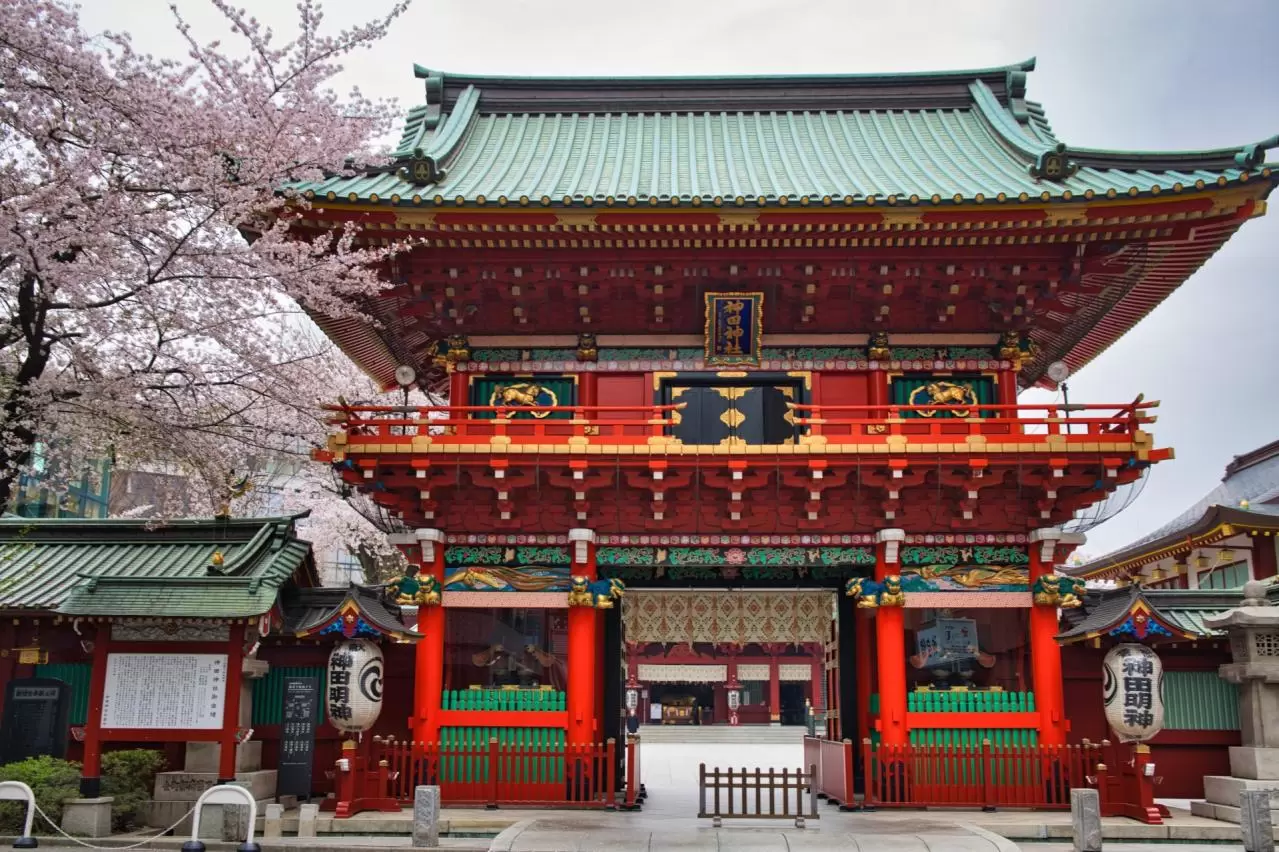
One of Tokyo’s oldest shrines, Kanda Shrine is revered as the guardian shrine of the Kanda, Nihonbashi, and Akihabara areas. Visitors come to pray for business success, good relationships, and protection from misfortune. Its vermilion buildings and lively festivals are highlights, and it is easy to combine a visit with a walk around Akihabara.
Traditionally said to have been founded in 730, the shrine has a long history to discover.
It is easy to continue on to the electronics district or explore the surrounding area after your visit.
The Kanda Festival and charms for protection in the IT age reflect both tradition and contemporary Tokyo.
Visit from Ochanomizu or Akihabara, then continue with a relaxed walk or some shopping in the surrounding area.
Kanda Shrine (commonly known as Kanda Myojin) is a historic and prestigious shrine located in Sotokanda, Chiyoda City, Tokyo, and is one of the most representative shrines of the capital. It is said to have been founded in the 2nd year of the Tenpyo era of the Nara period (730), giving it a history of nearly 1,300 years. For centuries, it has been deeply revered as the tutelary shrine of 108 neighborhoods, including Kanda, Nihonbashi, Akihabara, Otemachi, Marunouchi, Toyosu Market, and the former Kanda Market. Affectionately known as “Myojin-sama,” it attracts many worshippers throughout the year seeking blessings for prosperous business, good matches in love, and protection from misfortune and calamity.
Deities and Their Blessings
Kanda Shrine enshrines the following three deities:
Ōnamuchi no Mikoto — Daikoku-sama
Commonly known as “Daikoku-sama,” this deity is often identified with Ōkuninushi no Mikoto and is also famous as the enshrined deity of Izumo Taisha. Widely worshipped as a god of nation-building, medicine, industry, marital harmony, and matchmaking, this deity is also seen as a guardian of the otherworld, or the realm of ancestral spirits, and is deeply connected to people’s everyday lives and peace of mind.
Sukunahikona no Mikoto — God of commerce and health
Sukunahikona no Mikoto is known for blessings such as business prosperity, medical well-being, good health, and good fortune. This deity is said to be the child deity of Takamimusubi no Kami and to have helped build the nation together with Ōnamuchi no Mikoto. Though small in stature, Sukunahikona is endowed with great wisdom and is sometimes syncretized with Ebisu-sama, making him widely revered by merchants as a god of business.
Taira no Masakado no Mikoto — Masakado-sama
Taira no Masakado was a military leader of the mid-Heian period who sought independence for the Kanto region during the Jōhei and Tengyō Rebellions and aimed to carry out political reforms for the common people. He was enshrined at Kanda Shrine in 1309, after which he came to be revered as a deity who wards off disasters and misfortune. His remains are still enshrined today at the “Masakado Mound” in Otemachi, Chiyoda City.
History
Kanda Shrine is said to have been founded in 730, when a member of an Izumo-line clan, Makanda no Omī, established it in Shibasaki Village in Toshima District, Musashi Province (around present-day Otemachi, Chiyoda City, near the Masakado Mound). During the Kamakura period, Taira no Masakado was enshrined in hopes of calming natural disasters and upheavals, and over time the shrine’s role as a center of worship deepened.
In 1600, at the beginning of the Edo period, Tokugawa Ieyasu prayed for victory at Kanda Shrine in advance of the Battle of Sekigahara. When victory was achieved on the day of the Kanda Festival, the shrine came to be deeply revered by the Tokugawa shogunate as the “Great Guardian Shrine of Edo.” In 1616, it was relocated to its current site in Sotokanda, guarding the northeast direction, considered the upper demon gate of Edo Castle, and the shrine buildings were improved by the shogunate.
With the arrival of the Meiji era, the shrine’s official name was fixed as “Kanda Shrine,” and it was classified as a “Tokyo Prefectural Shrine” and a “Quasi-Chokusaisha” shrine. Emperor Meiji also paid a personal visit in 1874, and the shrine came to be supported by the Imperial Household as well. The name “Kanda Myojin” remains widely used as its familiar common name to this day.
During the Great Kanto Earthquake of 1923, the shrine buildings were destroyed by fire, but in 1934 they were rebuilt as a steel-framed reinforced concrete shrine in vivid vermilion. Miraculously, these buildings survived even the Tokyo air raids, and together with the recovery of the Showa and Heisei eras, the shrine became a symbol of hope for the local community.
After the war, facilities such as the Zuishin Gate, Myojin Kaikan, and the cultural exchange complex “EDOCCO” were developed, and the shrine has continued to grow as a place where tradition and modernity coexist in harmony.
The Kanda Festival and Kanda Shrine Today
The most famous event at Kanda Shrine is the “Kanda Festival.” This festival, which has been held since the Edo period, is counted as one of the Three Great Festivals of Edo, alongside the Sanno Festival and the Fukagawa Hachiman Festival. During the Edo period, it was held in alternating years with the Sanno Festival. Today, it is held on a grand scale in May of odd-numbered years, and the sight of portable shrines parading through central Tokyo is spectacular, filling the entire city with a festive atmosphere.
Taking advantage of its location near Akihabara, the shrine also offers prayers for safety and security for IT companies and engineers, and modern charms such as “IT amulets” have become popular. In addition, events featuring collaborations with anime and games are also held, and interest from young people and international tourists continues to grow each year.
For nearly 1,300 years, Kanda Shrine has watched over the heart of Tokyo as its true “great guardian shrine.” While preserving traditional beliefs, it continues to respond flexibly to the needs of contemporary culture and society, making it a deeply appealing place for many people.
The Kanda Matsuri is one of the three great festivals of Edo, held at Kanda Myojin Shrine, and is a grand celebration that conveys the traditions of Tokyo to the pre...
The National Art Center, Tokyo is located in Roppongi, known as the art hub of Japan's capital city, Tokyo. This museum opened in 2007, and its architectural design ...
The Tokyo Metropolitan Art Museum opened in 1926 as Japan's first public art museum. Throughout the year, it hosts numerous exhibitions, including special exhibition...
Sunshine Aquarium is an aquarium located on the rooftop of a building in Ikebukuro, Tokyo, themed as a "sky oasis." The outdoor area, brimming with a resort-like atm...
Ryogoku Kokugikan is the "home of sumo," where the Grand Sumo Tournament is held three times a year. This multipurpose hall, which can accommodate up to 10,000 peopl...
Meiji Shrine is an important Shinto shrine located in Shibuya, Tokyo, dedicated to Emperor Meiji and Empress Shoken. Built in 1920, it boasts the highest number of v...
Takeshita Street is a 350-meter long street located just outside Harajuku Station in Shibuya, Tokyo. It is popular as the center of Harajuku's "Kawaii culture," line...
Yomiuriland offers a variety of attractions, including the thrilling roller coaster "Bandit," a large Ferris wheel, and the new Ferris Wheel "SKY-GO-LAND." In the su...


![[4K]🇯🇵 神田明神 アニソン盆踊り おジャ魔女カーニバル!! 2025 / Bon dance at Ojamajo Carnival!! in Kanda Myojin Shrine.](https://i.ytimg.com/vi/udzVht-ykLs/mqdefault.jpg)