Star-shaped fort
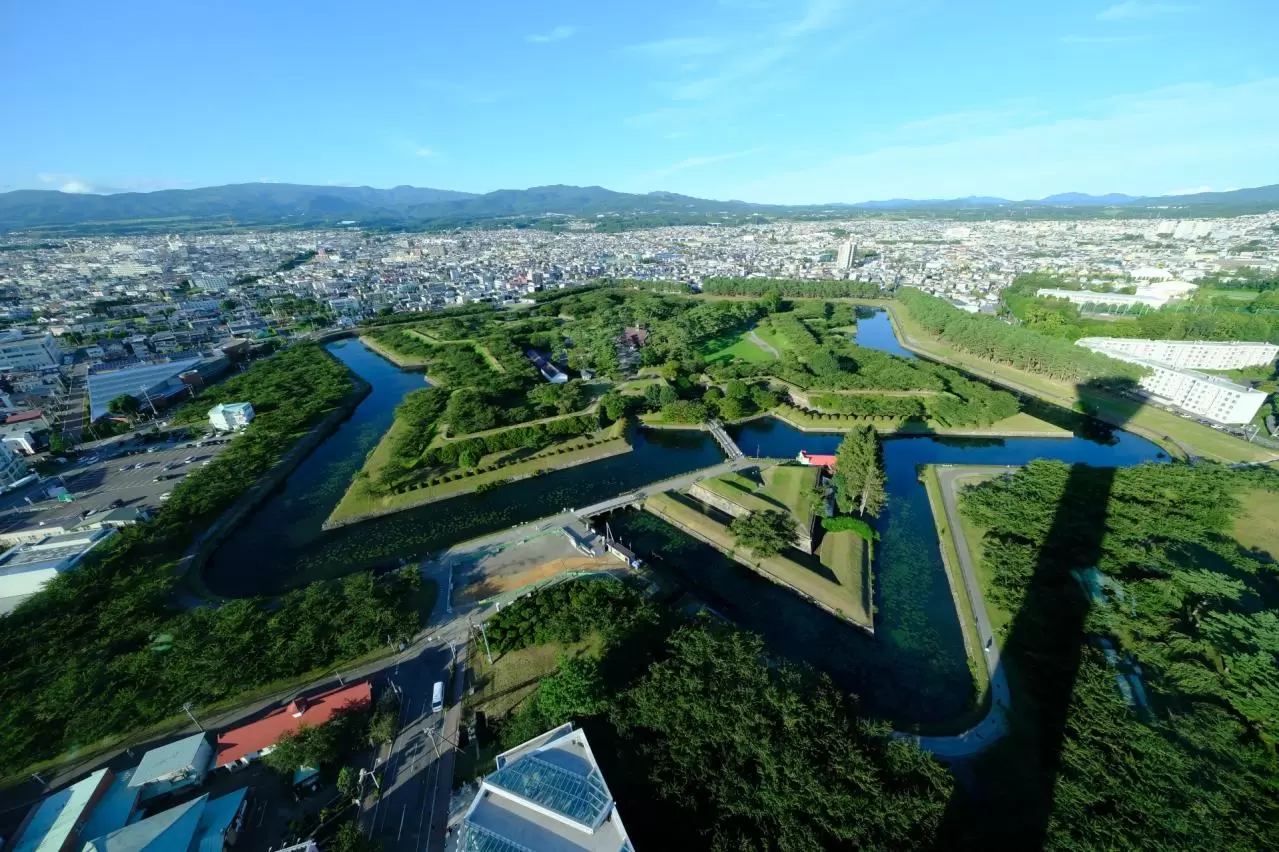
This distinctive Western-style fortress is best appreciated from above and offers a uniquely Hakodate view.
AI Summary
This is an AI-generated summary. Please check the official information for opening hours, fees, and closed days.
Enjoy Hakodate’s distinctive star-shaped scenery alongside a fascinating chapter of Japan’s late-19th-century history.
A Special Historic Site of Japan, Goryokaku Park is known as the site where the Boshin War came to an end. Highlights include its star-shaped fort and the reconstructed Hakodate Magistrate’s Office. Around 1,500 cherry trees bloom in spring, while winter brings illuminations—making it a rewarding stop for both history and seasonal scenery.
This distinctive Western-style fortress is best appreciated from above and offers a uniquely Hakodate view.
Explore the reconstructed building to learn about the late Edo period and Goryokaku’s role in history.
The park takes on a different character with spring blossoms and winter illuminations.
Take in the full view from Goryokaku Tower, walk through the park, then visit the Hakodate Magistrate’s Office to deepen your understanding of the site.
Goryokaku Park, located in Hakodate, Hokkaido, is a nationally designated Special Historic Site and is also widely known as the stage where the Boshin War of the late Edo period came to an end. Centered around the beautiful star-shaped Western-style fortress “Goryokaku,” this park is one of Hakodate’s most representative sightseeing destinations, where history, culture, and nature come together.
History and Features of Goryokaku
Goryokaku was planned by the Edo shogunate as a defensive stronghold against foreign powers while governing Ezo (present-day Hokkaido), and it was completed in 1864 after seven years of construction. Designed by the Dutch-learning scholar Takeda Ayasaburo, it is characterized by its five-pointed star-shaped structure with five projecting bastions called ryobo. It is regarded as Japan’s first full-scale Western-style fortress, modeled after French fortification techniques.
After its completion, it served as the political and military center of Hakodate. Following the return of governing authority to the emperor in 1867, it was handed over to the new government. However, in 1868, former shogunate forces led by Enomoto Takeaki and Hijikata Toshizo occupied the site, triggering the Hakodate War. Fierce battles were fought here against the forces of the new Meiji government, making it the final site of the Boshin War.
After the war, the buildings including the Hakodate Magistrate’s Office were dismantled in 1871, and Goryokaku’s original role came to an end. It was then placed under the management of the Army Ministry, and from 1914 it was opened to the public as “Goryokaku Park.” In 1952, it was designated a National Special Historic Site as the “Goryokaku Ruins,” a status it holds to this day.
Highlights in the Park
Hakodate Bugyosho
Located in the center of the park, the Hakodate Magistrate’s Office was restored in 2010 based on the original location, design, construction methods, and scale of the time. Inside, visitors can see reconstructed meeting rooms and offices, as well as historical materials and video exhibits, allowing them to learn about the politics of the late Edo period and the role of Goryokaku. It is a must-see spot for history enthusiasts.
Goryokaku Tower
From Goryokaku Tower next to the park, visitors can enjoy a panoramic view of the star-shaped fort from an observation deck about 90 meters above ground. The sweeping views of Hakodate city and even the Tsugaru Strait are truly breathtaking. It is recommended to go up the tower first to get an overall view before strolling through the park, as this makes the experience even more meaningful. The tower also houses restaurants and souvenir shops, making it a perfect place to take a break during sightseeing.
Cherry Blossoms and Seasonal Scenery
Goryokaku Park is known as one of Hokkaido’s premier cherry blossom spots. About 1,500 Somei Yoshino cherry trees are planted in the park, and the best viewing season is from late April to early May. Since this coincides with Golden Week, the park is crowded with many hanami visitors every year.
In spring, visitors can enjoy viewing the cherry blossoms while circling the moat in a rowboat, and at night, the illuminated yozakura creates a fantastical scene throughout the park. As the blossoms fall, petals floating on the surface of the moat form “hanaikada” or flower rafts, enchanting visitors with their graceful beauty.
Beyond the cherry blossoms of spring, the park also offers seasonal beauty throughout the year: wisteria, azaleas, and water lilies in early summer; autumn foliage of maples and azaleas; and in winter, a tranquil landscape covered in snow and ice.
Winter Illumination Fantasy: “Goryokaku Star Dream Illumination”
Held every year from December through the end of February, the “Hoshi no Yume” Illumination is one of Hakodate’s signature winter attractions. About 2,000 lights are installed around the moat, and the star shape of Goryokaku beautifully emerges against the night sky. The view from the tower is truly magical and captivates many tourists.
Experience History at the Hakodate Goryokaku Festival
Every year in late May, the Hakodate Goryokaku Festival is held. A parade featuring citizens dressed in costumes of the Shinsengumi and former shogunate forces winds its way through the city, drawing many visitors as an event that brings the history of the Boshin War to life. It is a rare opportunity to experience the romance of the late Edo period.
Goryokaku Park is an important heritage site that conveys the history of the late Edo period to the present day, while also serving as a place of relaxation surrounded by seasonal natural beauty. The space created by the moat surrounding the star-shaped fortress, the natural scenery, and the historic buildings leaves a profound impression on all who visit. When you come to Hakodate, be sure to take your time and stroll through it at a leisurely pace. In this place where history and nature blend together, a timeless experience awaits.
"The Shirogane Blue Pond" is a representative tourist spot of Biei, possessing a beauty that feels like another world. This pond is an artificial lake created during...
Shiretoko Goko consists of five enchanting lakes surrounded by primeval forests, captivating the hearts of visitors with its tranquility and abundant nature. The lak...
Otaru Canal was created to assist the logistics of Otaru Port, which was an important gateway for the development of Hokkaido. Completed in 1923, this canal is speci...
Noboribetsu Onsen is well-known for its abundant hot water and diverse mineral springs, making it extremely popular in Japan. It is particularly referred to as the "...
Otaru Sakaimachi Street is the main street for sightseeing in Otaru, located just a 5-minute walk from Otaru Canal. Lined with historical buildings constructed from ...
The Sapporo Clock Tower is a historic building that was constructed in 1878 as a drill hall for the former Sapporo Agricultural College. In 1881, a tower clock manuf...
Kushiro Wetland is Japan's largest wetland, spreading over 28,788 hectares in eastern Hokkaido, with 7,863 hectares designated as a Ramsar site. It is home to endang...