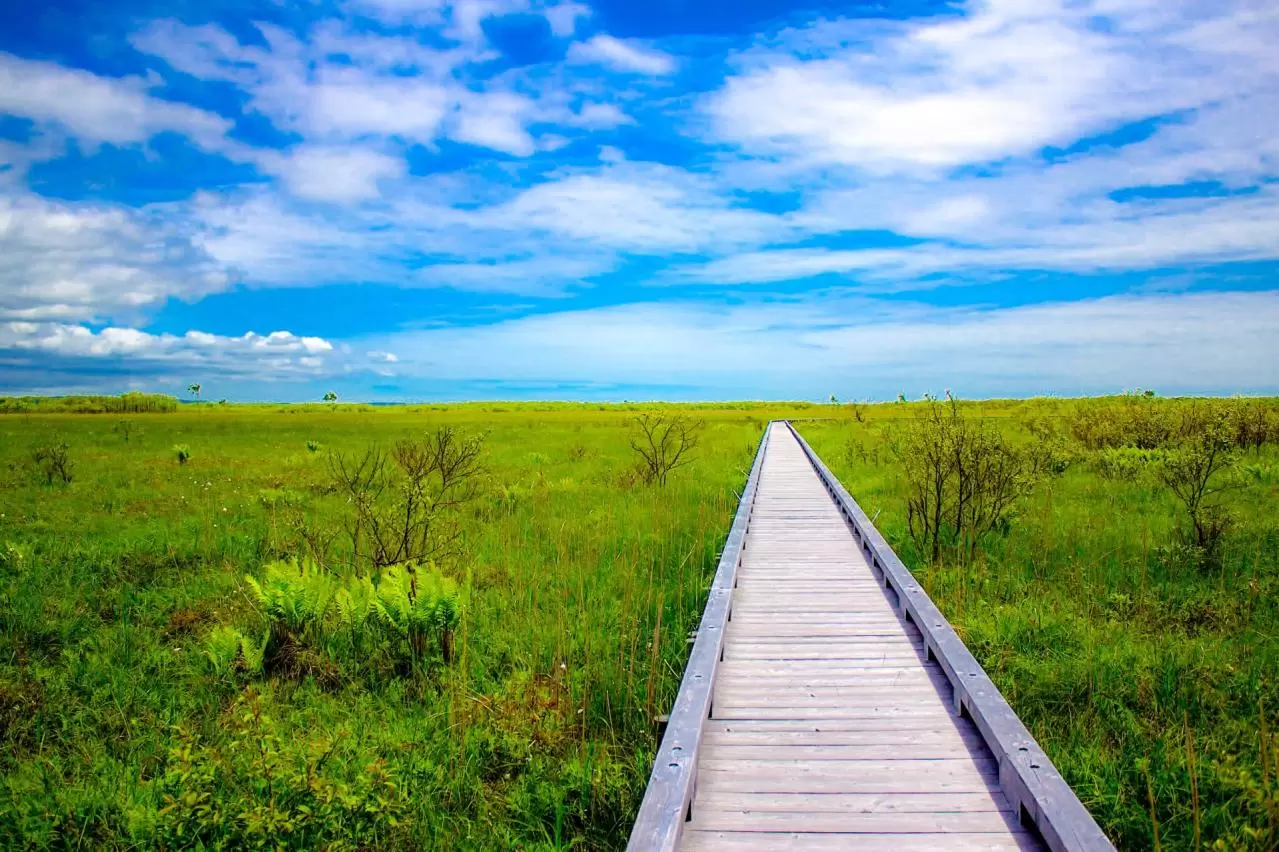
Vast wetland scenery
Take in Hokkaido’s wide-open landscapes, with expansive skies and grasslands stretching into the distance.
AI Summary
This is an AI-generated summary. Please check the official information for opening hours, fees, and closed days.
Japan’s largest wetland offers several ways to explore its landscapes, from observation decks and boardwalks to train rides and canoeing.
Located in eastern Hokkaido, Kushiro Wetland is Japan’s largest wetland. Its expansive grasslands and wildlife, including red-crowned cranes, are among its main attractions, and you can take in the scenery from observation decks and boardwalks. Train rides and canoe experiences offer other ways to enjoy the area, making it a good choice for a peaceful nature outing.
Take in Hokkaido’s wide-open landscapes, with expansive skies and grasslands stretching into the distance.
Look out for rare wildlife, including red-crowned cranes and white-tailed eagles.
Choose from observation decks, boardwalks, scenic train rides, and canoeing.
Start at an observation deck for a sweeping view, then use a boardwalk or scenic train ride to get a closer feel for the wetland.
Kushiro Wetland is the largest marshland in Japan, spanning eastern Hokkaido, with a total area of 28,788 hectares. Of this, 7,863 hectares are registered under the Ramsar Convention, which protects wetlands of international importance, and its natural environment is highly valued worldwide. In 1987, it was designated as Kushiro Shitsugen National Park, Japan’s first national park centered on a wetland.
This wetland was once regarded as “useless land,” but as natural environments were being lost through postwar agricultural development and urban expansion driven by food shortages, its rich ecosystem came to be re-evaluated and conservation efforts began in earnest. As a result, it is now recognized as one of Japan’s leading natural tourist destinations.
Origin and Features
Kushiro Wetland was once part of the sea until about 4,000 to 6,000 years ago. After the seawater retreated, peat and sediment accumulated over a long period, forming the vast wetland. Around 3,000 years ago, the present landscape took shape, leaving behind relict lakes on the eastern side of the marsh, such as Lake Toro, Lake Shirarutoro, and Lake Takkobu.
The wetland is classified into three types: “reed-sedge marsh,” “sphagnum bog,” and “intermediate marsh,” with most of the area covered by the reed-sedge marsh dominated by reeds and sedges. These plants create a magnificent landscape that evokes the original scenery of Japan.
Ecosystem and Wildlife
Kushiro Wetland is home to about 700 plant species and about 1,300 animal species. One of its most iconic animals is the red-crowned crane, a Special Natural Monument of Japan and listed as Vulnerable (VU) on the Ministry of the Environment’s Red List. Other endangered and valuable species, such as the white-tailed eagle, the Hokkaido salamander, and the taimen, Japan’s largest freshwater fish, have also been confirmed here.
In addition, the wetland supports a diverse range of mammals and birds, including Ezo deer, red foxes, Ural owls, and grey herons. About 200 bird species, 1,100 insect species, and 39 mammal species have been recorded, making Kushiro Wetland one of Japan’s richest areas in terms of biodiversity.
Observation Decks and Walking Trails
To fully experience the charm of Kushiro Wetland, visiting its observation decks and walking trails is highly recommended. From six major observation decks, you can enjoy sweeping views of the vast marshland and its wildlife, with changing expressions across the seasons and throughout the day.
Major Observation Decks
Kushiro City Wetland Observatory: Opened in 1984, this observatory is known for its castle-like European appearance. Inside, there are exhibits about the wetland, and a 2.5-km barrier-free wooden boardwalk is also available.
Hosooka Observation Deck (Kushiro Town): A spectacular viewpoint offering a panoramic view of the meandering Kushiro River and the entire wetland, especially famous for its beautiful sunsets. The adjacent visitor lounge offers light refreshments and photo exhibits.
Yumegaoka Observation Deck: Located in the Takkobu area of Kushiro Town, this deck offers a 270-degree panoramic view. Along the way, visitors can observe wetland plants and “yachibozu” peat hummocks.
Kottaro Wetland Observation Deck: Situated in an area designated as a Special Protection Zone of the national park, it offers scenery reminiscent of the age of dinosaurs, with plants such as kitayoshi and midorigusa. It is also an excellent place for birdwatching.
Sarubo Observation Deck / Sarurun Observation Deck: These provide views of Lake Toro, the surrounding lake and marsh system, and mountain ranges such as Mt. Akan and Mt. Shari. They are also popular spots for photographing the sightseeing trains “Kushiro Shitsugen Norokko Train” and “SL Winter Wetland Train.”
Walking Trails
Several walking trails are maintained around the wetland, allowing visitors to experience close contact with nature. In particular, the Onnenai Boardwalk is a route of about one hour starting from the Onnenai Visitor Center, where you can enjoy seasonal vegetation and wild birds, including alder forests and cotton grass colonies. Firefly viewing is possible in July and August, and snowshoe walking is available in winter.
Nature Experiences and Sightseeing Trains
Kushiro Shitsugen Norokko Train
The seasonal sightseeing train “Kushiro Shitsugen Norokko Train,” operated by JR Hokkaido, runs between Kushiro Station and Toro Station from late April through October. The journey takes about 50 minutes and is a popular way to enjoy panoramic views of Kushiro Wetland. If wildlife is spotted, the train may slow down or stop for observation.
Canoe Tours
On the Kushiro River, visitors can take a canoe and view the wetland from the quiet water surface. Spending time in nature while watching Ezo deer and red-crowned cranes will surely leave a lasting impression on visitors.
Kushiro Wetland is one of Hokkaido’s leading natural tourist destinations, where majestic nature, beautiful original landscapes, and rare plants and animals coexist. Once considered a barren land, it has been protected through the efforts of many people, and its value has now been recognized both in Japan and abroad.
With observation decks, walking trails, sightseeing trains, canoe tours, and more, visitors can enjoy the many attractions of Kushiro Wetland in a variety of ways. Here, you can experience the changing seasons and rich ecosystem throughout the year. If you are visiting Hokkaido, be sure to immerse yourself in this abundant natural environment.
#Superb view/Scenic spot #flowers/plants #park #Sightseeing boat/vehicle #Climbing/Hiking
Nijo Market in Sapporo boasts a history of over 125 years, beginning in the early Meiji era when fishermen from Ishikari Bay started selling fresh fish. Serving as t...
Kanemori Red Brick Warehouses are an iconic tourist destination in Hakodate, established in 1887 by the first owner, Kumashiro Watanabe. This historic warehouse was ...
Otaru Sakaimachi Street is the main street for sightseeing in Otaru, located just a 5-minute walk from Otaru Canal. Lined with historical buildings constructed from ...
Farm Tomita is known for its breathtaking expanse of lavender that captivates visitors with its vibrant colors. The vast grounds feature various flower fields, allow...
"Shiroi Koibito Park" is located in Sapporo and is a chocolate entertainment facility that can be enjoyed by both adults and children. Visitors can observe the produ...
Cape Kamui is a beautiful tourist spot located in the northwest part of the Shakotan Peninsula in Hokkaido, offering a breathtaking view of the Sea of Japan from a h...
"The Shirogane Blue Pond" is a representative tourist spot of Biei, possessing a beauty that feels like another world. This pond is an artificial lake created during...
The Sapporo Clock Tower is a historic building that was constructed in 1878 as a drill hall for the former Sapporo Agricultural College. In 1881, a tower clock manuf...