Hiroshima Peace Memorial (Genbaku Dome)
Hiroshima Peace Memorial (Genbaku Dome) Movies


![【女ひとり旅】広島観光1日目|駅周辺|お好み焼き|原爆ドーム|広島城|縮景園|G7]](https://i.ytimg.com/vi/pSEp0IERwvM/mqdefault.jpg)


Basic Information
- Spot Name
- Hiroshima Peace Memorial (Genbaku Dome)
- Location
- 〒730-0051 1-10, Otemachi, Naka-ku, Hiroshima-shi, Hiroshima Prefecture, Inside Peace Memorial Park
- Access
- Take the Hiroshima Electric Railway from JR Hiroshima Station to Miyajima-guchi for 16 minutes, and get off at Genbaku Dome-mae station, which is just a short walk away.
- Parking
- Please use the nearby paid parking facilities.
- Business Hours
- Viewing available (exterior only)
- Regular Holiday
- Open year-round.
- Contact Information
- Phone Number:082-242-7831
- Official Website
Map
Detailed Information
The Atomic Bomb Dome is a World Heritage Site located in Naka Ward, Hiroshima City, Hiroshima Prefecture. It is a building that was exposed to the atomic bomb—the first nuclear weapon used in warfare in human history. It has survived to the present day with its appearance at the time of the bombing preserved as faithfully as possible. It is known throughout the world as a symbol conveying the devastation of war, the horror of nuclear weapons, and the importance of peace. In 1996, it was registered as a UNESCO World Cultural Heritage Site, and it remains a peace memorial visited by many people today.
## The Origins of the Atomic Bomb Dome
The Atomic Bomb Dome was originally called the “Hiroshima Prefectural Industrial Promotion Hall.” Designed by the Czech architect Jan Letzel, it was completed on April 5, 1915.
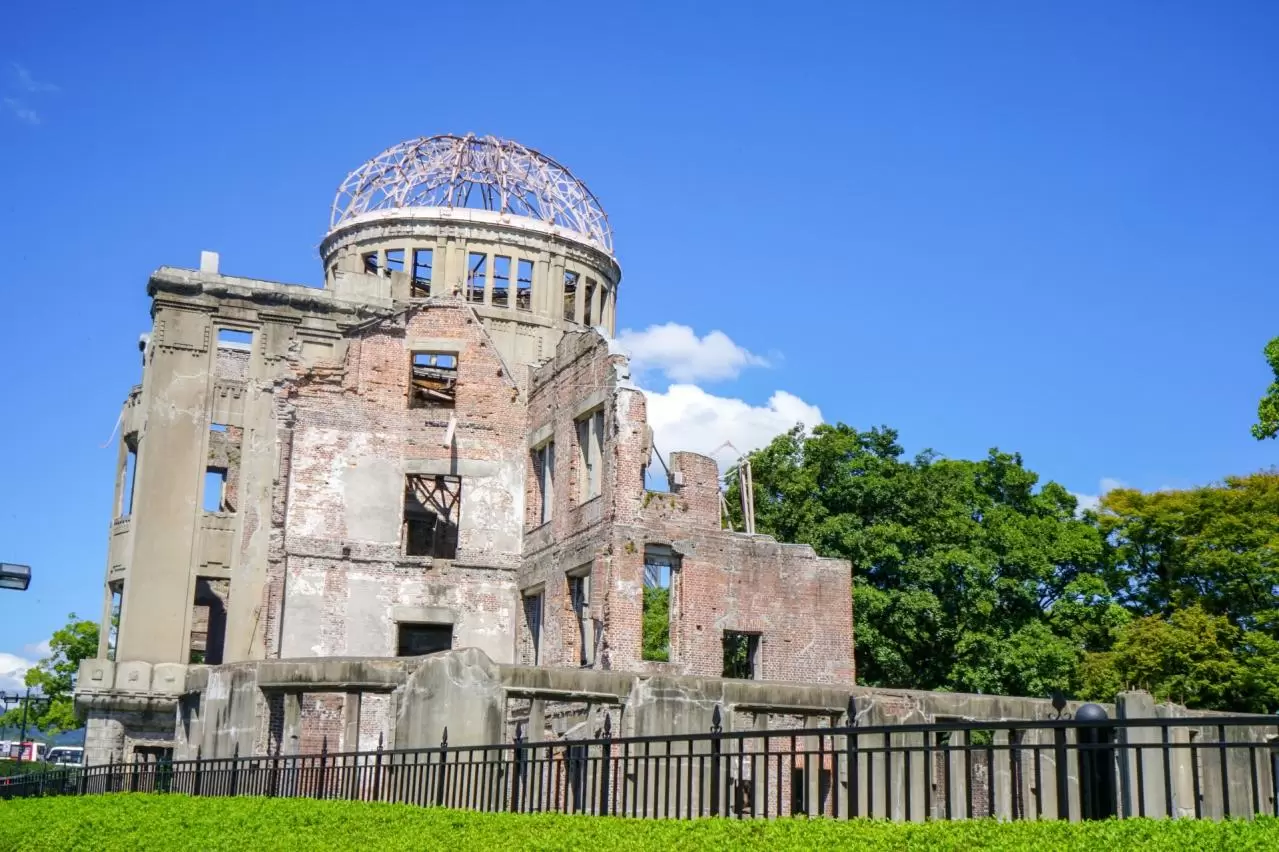
The building was a three-story brick structure with a five-story stairwell in the center, topped by an elliptical copper dome. The dome was approximately 11 meters along its major axis, 8 meters along its minor axis, and 4 meters high. At the time, it was an exceptionally modern and bold European-style building.
In those days, most buildings in Hiroshima were two-story wooden structures, so beautiful Western-style architecture was extremely rare. As a result, the building became one of Hiroshima’s popular landmarks. Its modern appearance along the river attracted people’s attention, and it was also used as a venue for cultural events such as art exhibitions and trade fairs.
The building’s name subsequently changed as follows:
- Hiroshima Prefectural Industrial Promotion Hall
- Hiroshima Prefectural Products Exhibition Hall
- Hiroshima Prefectural Industrial Promotion Hall
Toward the end of the war, it was used as offices for the Chugoku-Shikoku Civil Engineering Office of the Ministry of Home Affairs and a lumber company, among others.
## The Atomic Bombing
At 8:15 a.m. on August 6, 1945, an American B-29 bomber dropped the first atomic bomb used in human history on Hiroshima.
The atomic bomb exploded approximately 160 meters southeast of the Hiroshima Prefectural Industrial Promotion Hall, at an altitude of about 600 meters. The intense blast and heat generated by the explosion reduced central Hiroshima to ruins in an instant, killing many people.
The pressure of the blast is said to have reached approximately 35 tons per square meter, with wind speeds of about 440 meters per second. The Industrial Promotion Hall was also struck by the tremendous blast and heat, and its interior was completely burned out. Many of the staff members inside the building at the time are believed to have perished.
The walls of the second and third floors collapsed, and the interior was severely damaged. However, because the explosion occurred almost directly above the building, the horizontal impact was relatively limited, allowing part of the central framework and exterior walls to miraculously remain.
After the war, the ruins of the building came to be known by local residents as the “Atomic Bomb Dome,” reflecting the shape of the iron dome framework that remained at the top.
## Efforts to Preserve the Building
For some time after the war, there were calls for the Atomic Bomb Dome to be demolished as a dangerous ruin. However, many people also believed that the fact of the atomic bombing should be preserved for future generations, and a preservation movement led mainly by local residents gradually spread.
In 1953, the building was transferred from Hiroshima Prefecture to the city of Hiroshima. In 1966, the Hiroshima City Council officially resolved to preserve it.
As the building continued to deteriorate and weather, extensive preservation work was carried out using donations collected both in Japan and abroad. Regular repairs and surveys are still conducted today in an ongoing effort to maintain the building’s appearance as closely as possible to its condition at the time of the bombing.
## Registration as a World Heritage Site
The Atomic Bomb Dome was highly regarded as a historic structure conveying the devastation caused by nuclear weapons and was designated a national historic site in 1995.
Then, in December 1996, the 20th session of the UNESCO World Heritage Committee decided to register it as a World Cultural Heritage Site.
In its World Heritage designation, the Atomic Bomb Dome was highly recognized as a valuable remnant conveying the first nuclear attack in human history and as a symbol calling for the abolition of nuclear weapons and lasting world peace.
The designated area surrounding the Atomic Bomb Dome covers approximately 0.39 hectares.
## The Atomic Bomb Dome Today
Today, the Atomic Bomb Dome stands adjacent to Hiroshima Peace Memorial Park and is visited by many tourists and school groups from around the world.
Only the exterior of the Atomic Bomb Dome can be viewed; visitors are not permitted to enter the building. However, the exposed iron framework and collapsed walls convey the appearance of the building at the time of the bombing and strongly impress upon visitors the horror of the atomic bomb.
The building is also illuminated at night, allowing visitors to see its quiet and mysterious appearance, which differs from its daytime view.
The surrounding area includes the following facilities dedicated to the hope for peace:
- Hiroshima Peace Memorial Museum
- Children’s Peace Monument
- Peace Bell
- Memorial Cenotaph
- Flame of Peace
The Atomic Bomb Dome can also be viewed from the rooftop of the nearby Orizuru Tower and from sightseeing boats.
## What the Atomic Bomb Dome Communicates
The Atomic Bomb Dome is more than just a historic building. By preserving its appearance from the time of the bombing, it continues to convey to the present the devastation of war and the horror of nuclear weapons.
Together with the words “No More Hiroshimas,” it has become a symbol appealing to people around the world for the abolition of nuclear weapons and the importance of lasting world peace.
The Atomic Bomb Dome is an important peace memorial that helps ensure that this tragic history is not forgotten. It is a shared heritage of humanity that carries the wish for peace into the future.
Hiroshima Tourist Attractions
View List
Kaijouji Eitaikurashiryoukan (Tetsu no Kujirakan)
Kure Maritime Museum (commonly known as the "Museum of Iron Whale") is the only museum in Japan where you can enter an actual submarine. Here, the submarine "Akishio...


Hiroshima Peace Memorial Museum
The Hiroshima Peace Memorial Museum was opened in 1955 with the aim of conveying the realities of the damage caused by the atomic bomb in Hiroshima to the world, and...

Miyajima Aquarium
Miyajima Aquarium is one of the leading aquariums in the Chugoku region, featuring about 350 species and over 13,000 specimens primarily from the Seto Inland Sea. It...

Shukkei-en Garden
Shukkeien Garden is a daimyo garden built in 1620 as a retreat for the Hiroshima feudal lord, Asano Nagamasa, by his tea-master retainer, Ueda Soko. It is known to h...

Hiroshima Castle
Hiroshima Castle, known for its beautiful main keep built by Mori Terumoto in 1589, is also referred to as "Rijou" (Carp Castle). After the Battle of Sekigahara, the...

Yamato Museum (Kure Maritime Museum)
The Yamato Museum (Kure Maritime History and Science Museum) is a museum that introduces the history of Kure City, which thrived as a military port where the battles...

Itsukushima Shrine
Itsukushima Shrine is a sacred place deeply rooted in Japan's history and culture. Constructed in the year 593, the year of Emperor Suiko's ascension, it is known as...