Heijo Palace Ruins
Heijo Palace Ruins Movies


Basic Information
- Spot Name
- Heijo Palace Ruins
- Location
- 〒630-8577 Saki-cho, Nara City, Nara Prefecture
- Access
- 15-minute walk from Kintetsu Nara Line Yamato-Saidaiji Station.
- Parking
- Parking available.
- Business Hours
- Open for visits; visiting hours are from 9:00 AM to 4:00 PM (last entry at 4:30 PM).
- Regular Holiday
- Monday (the following weekday if Monday is a holiday) and New Year's holidays.
- Fees
- Free
- Contact Information
- Phone Number:0742-30-6753
- Official Website
Map
Detailed Information
Heijō Palace Site is the remains of the palace located at the center of Heijō-kyō, to which the capital was moved from Fujiwara-kyō in 710 (the third year of the Wadō era). It is known as the political and cultural center of the Nara period and as an important place where Japan’s ritsuryō state was formed. Owing to its great historical and scholarly value, it was designated a Special Historic Site in 1952, and in 1998 it was inscribed as one of the “Cultural Properties of Ancient Nara” on the World Heritage List.
Today, the Heijō Palace Site covers a vast area of about 1.3 km east to west and 1 km north to south, and has been developed as Heijō Palace Site Historical Park. In Nara Prefecture, development has been carried out with the aim of creating “a space where the Nara period can still be felt today,” and on March 24, 2018, the national park area and the prefectural park area were unified and opened as Heijō Palace Site Historical Park.
Among its highlights is Suzakumon Plaza. Here, facilities such as the Heijō Palace Izanai-kan, Tenpyō Miharashi-kan, Tenpyō Umashi-kan, and Tenpyō Mitsuki-kan are gathered together, making it one of Nara Prefecture’s important tourist hubs with extensive visitor information, exhibitions, dining, and shopping. At the Heijō Palace Izanai-kan, visitors can learn about the history of Heijō Palace in a comprehensive way, with guidance that is easy to understand even for first-time visitors.
Within the Heijō Palace Site, many reconstructed buildings and archaeological remains are scattered throughout the grounds. Among them, the First Daigokuden Hall is the largest building in Heijō Palace and was the venue for important state ceremonies such as the emperor’s enthronement and receptions for foreign envoys. The current structure was reconstructed in 2010, stands about 27 meters high, and inside is a reproduction of the Takamikura, the emperor’s throne. Around this hall, reconstruction of features such as the earthen-walled cloister and the east and west pavilions of the First Daigokuden compound is still underway.
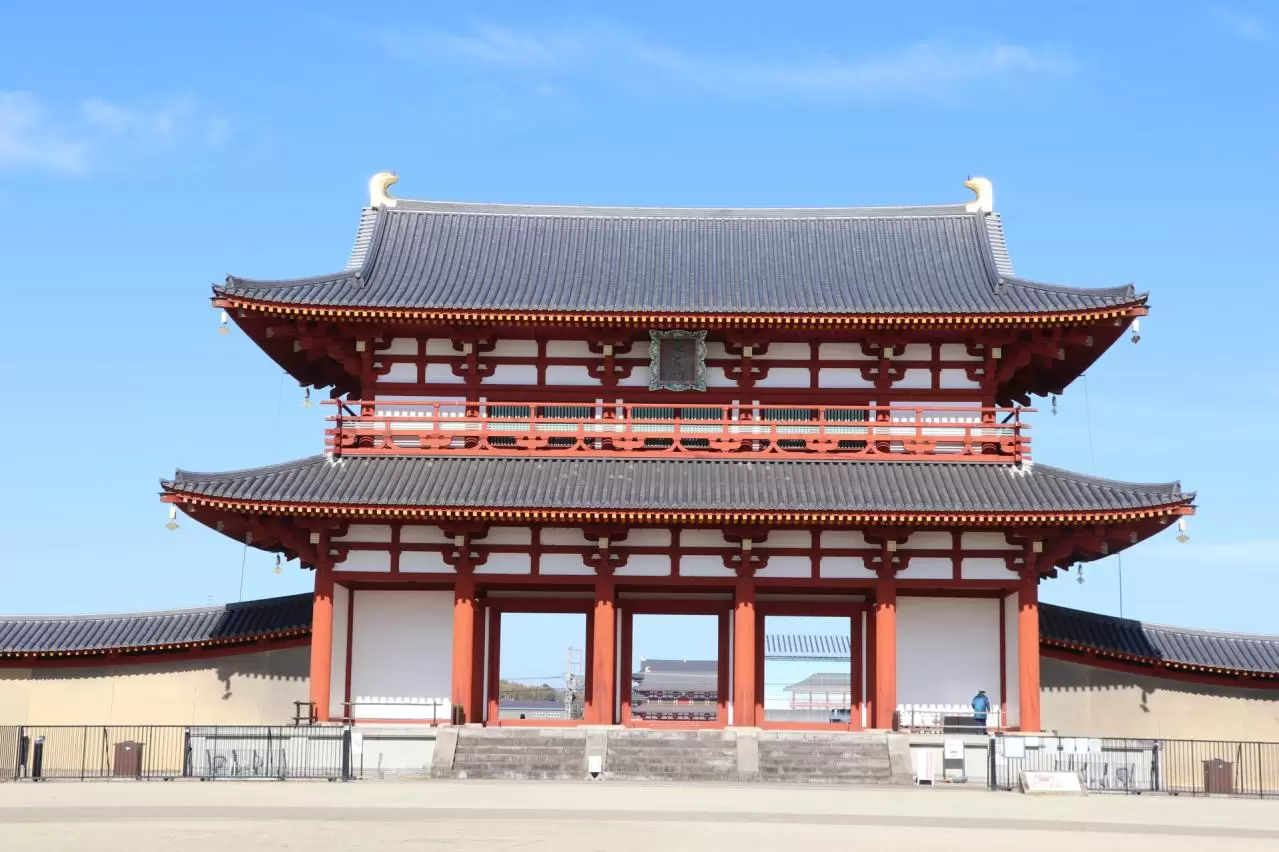
Another must-see is Suzakumon Gate, the main gate of Heijō Palace. Reconstructed in 1998, this magnificent gate measures about 25 meters in width and about 20 meters in height. In the past, Suzaku Avenue extended in a straight line from here to Rajōmon, the entrance to the capital. Ceremonies and events were held around the gate, allowing visitors to feel the bustle of the ancient capital.
The Tōin Garden is an elegant garden located on the eastern side of Heijō Palace and is believed to have been used as a reception facility where members of the imperial family held banquets and ceremonies. The remains were discovered in 1967, and the garden was reconstructed in 1998 based on research. In 2010, it was designated a Special Place of Scenic Beauty as an especially valuable ancient garden.
The exhibition facilities are also well developed. At the Heijō Palace Site Museum, based on the results of many years of excavation by the Nara National Research Institute for Cultural Properties, visitors can learn in detail about the palace, government offices, and the lives of the people of the time through excavated artifacts and models. The Archaeological Site Exhibition Hall preserves and displays excavated remains as they are, allowing visitors to observe wells and building foundations up close. In addition, the Reconstruction Project Information Center introduces the reconstruction process and related techniques.
In this way, at the Heijō Palace Site, visitors can learn about the culture and lifestyle of the Nara period from multiple perspectives, not only by viewing historic structures but also through exhibits and hands-on experiences. Within the spacious grounds, you can also enjoy bicycle rentals and a VR theater, while the changing seasons and year-round events add to its appeal.
Excavation and development work are still ongoing, and new discoveries continue to be made, so it is a place where visitors can encounter fresh attractions even on repeated visits. As a precious cultural heritage site where Japan’s ancient history can truly be experienced, the Heijō Palace Site is beloved by many people.
Nara Tourist Attractions
View List

Todai-ji Temple
Todai-ji is one of Japan's most renowned temples, founded during the Nara period in the capital of that era, Heijo-kyo, as a kokubunji (provincial temple). The most ...

Kasukadai Shrine
Kasuga-taisha Shrine was established in the second year of Jingo-Keiun (768) and the current shrine buildings were completed in the early Heian period in 794. It flo...

Horyu-ji Temple
Hōryū-ji is a temple founded by Prince Shōtoku in the 14th year of Suiko (606 AD), and it is currently registered as a UNESCO World Heritage Site. Established as Oka...


Tōshōdaiji
Tōshōdai-ji is a temple founded by the Tang dynasty monk Jianzhen in the Nara period, established in 759 (the 3rd year of Tenpyō Hōji) at the former residence of Pri...

Isuien Neiraku Art Museum
Isui-en is a representative Japanese garden in Nara, designated as a national scenic spot. It features two distinct gardens: the "前園" (Maezono) created during the ...

Nara National Museum
The Nara National Museum is a historic museum located within Nara Park, adjacent to world heritage sites such as Todai-ji Temple and Kofuku-ji Temple. Established in...