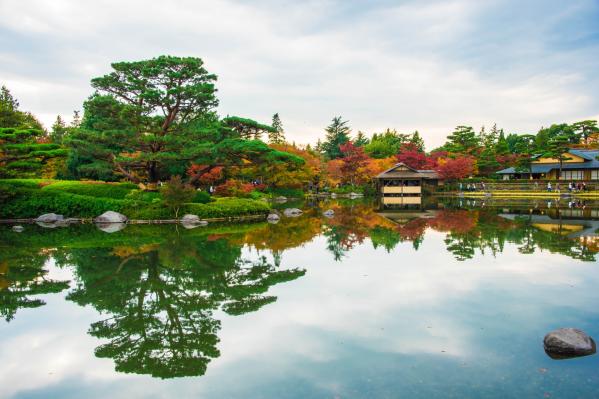
Kenrokuen Garden
Kenrokuen Garden Movies


Basic Information
- Spot Name
- Kenrokuen Garden
- Location
- 〒920-0937 1-1 Marunouchi, Kanazawa City, Ishikawa Prefecture
- Access
- Public Transportation:
Approximately a 5-minute walk from the "Kenrokuen-shita / Kanazawa Castle" bus stop served by the Kanazawa Loop Bus, Hokuriku Railway line bus, and West Japan JR Bus.
Approximately a 5-minute walk from the "Kenrokuen-shita" bus stop on the Kanazawa Furatto Bus Zaimoku Route.
By Car: About 15 minutes from Kanazawa East IC and Kanazawa Morimoto IC, and about 20 minutes from Kanazawa West IC. - Parking
- Please use the nearby paid parking lots.
- Business Hours
- From March 1 to October 15: 7:00 AM to 6:00 PM (closing time)
From October 16 to the end of February: 8:00 AM to 5:00 PM (closing time)
* Rigid Turrets, Irokan Nagaya, Hashizume Gate Turret, and Hashizume Gate: 9:00 AM to 4:30 PM (last admission at 4:00 PM)
* Kahoku Gate and Nezumi Kado (free): 9:00 AM to 4:30 PM (last admission at 4:00 PM)
* Gyokusen-an: 9:00 AM to 4:30 PM (last admission at 4:00 PM), closed from December 29 to January 3. - Regular Holiday
- Open year-round
- Fees
- Admission fee: Free
* Entry fee (Hiriyagura, Gojukken Nagaya, Hashizume Gate Suzakura, Hashizume Gate): Adults 320 yen, Children (ages 6 to under 18) 100 yen, Free for those under 6 and over 65 (proof required) - Contact Information
- Phone Number: 076-234-3800
- Official Website
Map
Detailed Information
Kanazawa Castle Park is a historic park developed on the former site of the residence of the Maeda clan, the lords of Kaga Province, known for their immense wealth of one million koku. Located in central Kanazawa City, Ishikawa Prefecture, it borders Kenrokuen Garden, one of Japan’s three most famous gardens, and the two are connected by Ishikawa Bridge. As one of Kanazawa’s signature sightseeing destinations, it is a popular spot visited by many tourists.
The appeal of Kanazawa Castle Park lies not only in the many historically valuable structures that remain, but also in its restored and magnificent castle architecture, beautiful stone walls, and rich natural surroundings. The park is spacious and well maintained, making it a valuable place where visitors can enjoy both history and nature while strolling through the grounds.
History of Kanazawa Castle
The history of Kanazawa Castle dates back to the Sengoku period. It is said to have begun when the Honganji Temple, which had gained control during the Kaga Ikko-ikki uprising, built Kanazawa Mido (Oyama Gobo) in 1546.
Later, in 1580, Sasa Narimasa began construction of the castle, and in 1583, Maeda Toshiie, the first lord of the Kaga Domain, entered the castle from Noto. With Toshiie’s arrival, full-scale castle building began, and Kanazawa Castle came to play an important role as the center of the Kaga Domain.
However, in 1602, the main keep was destroyed by fire after being struck by lightning. It was never rebuilt, partly out of consideration for the Tokugawa shogunate. From then on, the castle was maintained with a three-story turret in the main enclosure and a palace in the second enclosure.
Then, after the great fire of 1631, the castle’s structure changed significantly, and samurai residences within the grounds were moved outside the castle. The inner moat was improved and the baileys were reorganized, gradually shaping the castle into its present form.
In the fire of 1759, most of the castle was destroyed, but reconstruction afterward focused on practicality, with development centered around the second enclosure.
From the Meiji period onward, Kanazawa Castle was used as an army base, and after the war it served as the campus of Kanazawa University. After being used as a university facility until 1995, it was developed as a park and opened to the public in 2001 as Kanazawa Castle Park.
Important Cultural Properties and Restored Structures
Kanazawa Castle Park contains many historically significant buildings. Among the most notable are the following structures, designated as Important Cultural Properties of Japan:
- Ishikawa Gate
- Sanjikken Nagaya
- Tsurumaru Warehouse
Ishikawa Gate, rebuilt in 1788, remains a symbolic presence in Kanazawa Castle Park today. Its dignified gate structure is exceptionally beautiful and is also a popular photo spot.
Also open to the public as the park’s main paid-access facilities are the following restored structures, rebuilt in 2001:
- Hishi Yagura
- Gojikken Nagaya
- Hashizume-mon Tsuzuki Yagura
These buildings were originally reconstructed after the second enclosure fire of 1808, then destroyed in the fire of 1881, and later restored based on historical materials. In addition to their powerful exterior appearance, the interiors were also recreated using the construction methods of the time, making them a valuable place to experience the high level of Kanazawa Castle’s architectural techniques.
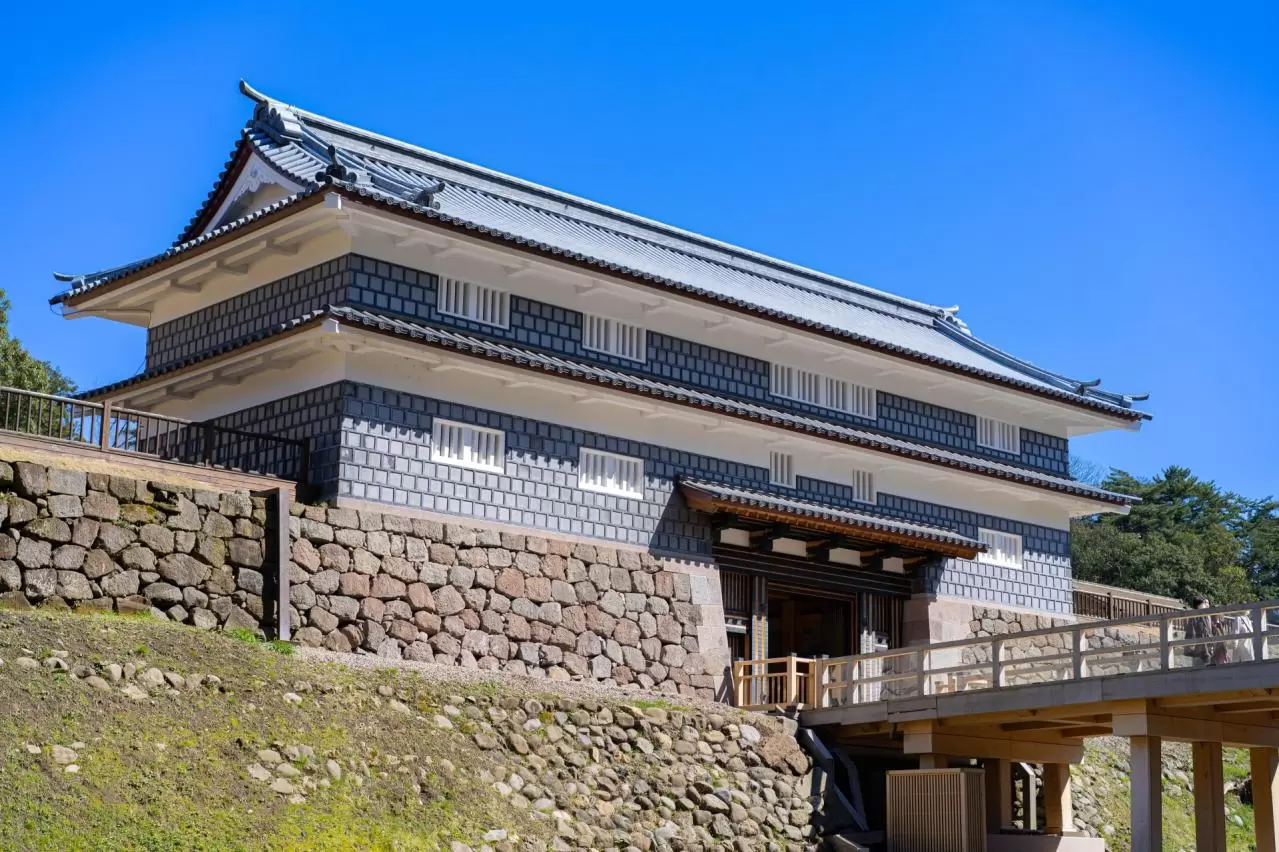
In 2010, Kahoku Gate, one of the three gates of Kanazawa Castle, was rebuilt and is also open to the public. Along with Ishikawa Gate, it is one of the park’s main highlights.
The Appeal of the Stone Walls and the Landscape
At Kanazawa Castle Park, visitors can enjoy a wide variety of stone walls, which are an essential element supporting the castle’s appeal. The shapes and stacking methods of the stone walls differ depending on the location, allowing visitors to observe changes over time and differences in techniques, which is a major feature of the park.
As you stroll through the grounds, the color and shape of the stone walls vary from place to place, so there is always something new to see. Kanazawa Castle Park is so impressive that it is often called a “museum of stone walls,” and it is popular not only among castle enthusiasts but also among general tourists.
Gyokuseninmaru Garden and Gyokusenan
The park also includes Gyokuseninmaru Garden, where visitors can enjoy a unique landscape created by ponds and stone walls. It is a space where the history of the castle and the beauty of a Japanese garden come together, offering a peaceful atmosphere for leisurely walks.
At Gyokusenan within the garden, matcha and Japanese sweets are served, allowing visitors to relax with seasonal fresh confections. It is a highly recommended place to take a break during a historical walk.
Abundant Nature and Wildlife
The appeal of Kanazawa Castle Park is not limited to its historic buildings. Many plants are grown throughout the grounds, allowing visitors to enjoy nature in every season. The area where the keep once stood is now a lush green space filled with trees, offering a sense of tranquility unique to a castle ruin and the richness of nature.
Animals may also be seen at times, adding to its appeal not only as a historic site but also as a natural park.
Night Illumination
Kanazawa Castle Park is also illuminated at night, offering a fantastical night view usually from sunset until around 9:00 p.m. The Ishikawa Gate and castle structures lit up by the lights have a beauty different from that of the daytime, making the park perfect for an evening stroll. In particular, the shadows and contours of the stone walls and gates are accentuated, enhancing the grandeur of the historic architecture.
Kanazawa Castle Park is a historic park developed on the former site of the Maeda family’s castle, and together with Kenrokuen Garden, it creates one of Ishikawa Prefecture’s most iconic landscapes. From Important Cultural Properties such as Ishikawa Gate, Sanjikken Nagaya, and Tsurumaru Warehouse to the restored Hishi Yagura, Gojikken Nagaya, and Hashizume-mon Tsuzuki Yagura, as well as the rebuilt Kahoku Gate, there is no shortage of highlights.
In addition, the diverse stone walls, Gyokuseninmaru Garden, and Gyokusenan, where visitors can enjoy matcha, allow you to experience history, culture, and nature all at once simply by walking through the park. It is attractive both by day and at night, with lighting creating a different atmosphere depending on the time of visit.
When visiting Kanazawa, be sure to spend a relaxing time at Kanazawa Castle Park while feeling the history of the million-koku Kaga Domain.
Ishikawa Tourist Attractions
View List
Oumi Town Market
Omicho Market is a traditional market in Kanazawa that has been in operation since 1721, and for about 300 years, it has been cherished as the kitchen of the local c...

Kanazawa 21st Century Museum of Contemporary Art
The 21st Century Museum of Contemporary Art, Kanazawa is a museum of contemporary art with the concept of being "a museum like an open park to the city." The buildin...

The Nomura Family Samurai House
The "Nomura Family Samurai Residence," the only publicly accessible samurai house at the Nagamachi Samurai District, is an attraction featuring an esteemed samurai r...

Shiroyone Senmaida (Thousand Rice Terraces)
Shiroe Senmaida is a beautiful terraced rice field located in Shiramine Town, Wajima City, Ishikawa Prefecture. Facing the Sea of Japan, this slope features 1004 sma...

Kenrokuen Garden
Kenrokuen is one of Japan's three famous gardens, alongside Kairakuen in Mito and Korakuen in Okayama. It is a special scenic spot that reflects the rich culture and...

Chirihama Nagisa Driveway
The Chirihama Nagisa Driveway is the only beach in Japan where you can drive along the shoreline. This approximately 8 km stretch of sandy beach is drivable due to t...

Higashi Chaya District
Higashi Chaya District in Kanazawa is an enchanting area with beautiful lattice houses and stone pavements showcasing its historic streets. It has been designated as...

Notojima Aquarium
Surrounded by nature on Noto Island, the "Notojima Aquarium" is an interactive aquarium where you can get close to marine life. The "Noto Marine Corridor" offers an ...