Katori Jingu
Katori Jingu Movies


Basic Information
- Spot Name
- Katori Jingu
- Location
- 〒287-0017 1697-1 Katori, Katori City, Chiba Prefecture
- Access
- About 13 minutes by Katori City Loop Bus from Sawara Station on the JR Narita Line, and approximately a 30-minute walk from Katori Station on the JR Narita Line.
- Parking
- Parking available
- Business Hours
- The regular hours for the issuance and receipt of goshuin are from 8:30 AM to 5:00 PM, with prayer requests accepted until 4:30 PM and treasures reception until 4:00 PM.
- Contact Information
- Phone Number:0478-57-3211
- Official Website
Map
Detailed Information
Katori Jingu is the ichinomiya of Shimousa Province, located in Katori City, Chiba Prefecture, and the head shrine of approximately 400 Katori shrines nationwide. Its founding is traditionally dated to the 18th year of Emperor Jimmu’s reign (643 BCE), making it one of the oldest shrines in Japan. Before the Meiji era, only three shrines—Ise, Kashima, and Katori—were permitted to bear the title “Jingu,” and Katori has long been regarded as being of exceptional prestige. The precincts are protected as “Katori no Mori,” a Chiba Prefecture designated natural monument, where sacred trees over 1,000 years old and the deep stillness of ancient nature envelop visitors.
⚔️ Enshrined Deity: Futsunushi-no-Okami
Futsunushi-no-Okami is a warrior deity who, in the Japanese myth of the “Transfer of the Land,” was sent by Amaterasu-Omikami together with Takemikazuchi-no-Okami of Kashima Jingu to Izumo, where they pacified the land under Okuninushi-no-Kami. From this myth, Katori Jingu has long been revered as a deity of:
- national protection
- the patron deity of martial arts and budo
- victory and protection from misfortune
In martial arts dojos, hanging scrolls of “Kashima Daimyojin” and “Katori Daimyojin” are often displayed together, symbolizing that these two deities are the primordial gods of Japanese martial power. The shrine also attracts broad devotion as the center of the Katori shrines nationwide, with prayers for household safety, prosperity in industry, protection at sea, safe childbirth, matchmaking, and fulfillment of wishes.
🏛 Prestige and Historical Role
Katori Jingu has enjoyed deep imperial reverence since ancient times, and in the Heian-period Engishiki it is ranked as a Myojin Taisha, the highest class of shrine. In the medieval period, it served as the guardian deity of the region as the ichinomiya of Shimousa Province. After the Meiji Restoration, it became a Kanpei Taisha, and in 1942 it was designated a Chokusai-sha, receiving an imperial envoy in place of the Emperor. It is a distinguished shrine deeply connected to Japan’s history in both spiritual and political culture.
🏺 Abundant Cultural Properties and Treasures (Over 200 Items)
Katori Jingu is outstanding in both the quality and quantity of its treasures, with more than 200 items designated as cultural properties at the prefectural level or above.
■ National Treasure: “Kaisju-Budo Mirror”
Designated a National Treasure in 1953, this finely crafted circular mirror of white copper is counted among Japan’s three great mirrors and features engravings of lions, qilin, phoenixes, and other motifs. It is the only National Treasure craft object in Chiba Prefecture.
■ Important Cultural Property: “Old Seto Komainu”
A Kamakura-period Seto ware pair of guardian dogs, famed enough to have been used as a design on a 250-yen postage stamp.
■ Main Hall (Important Cultural Property)
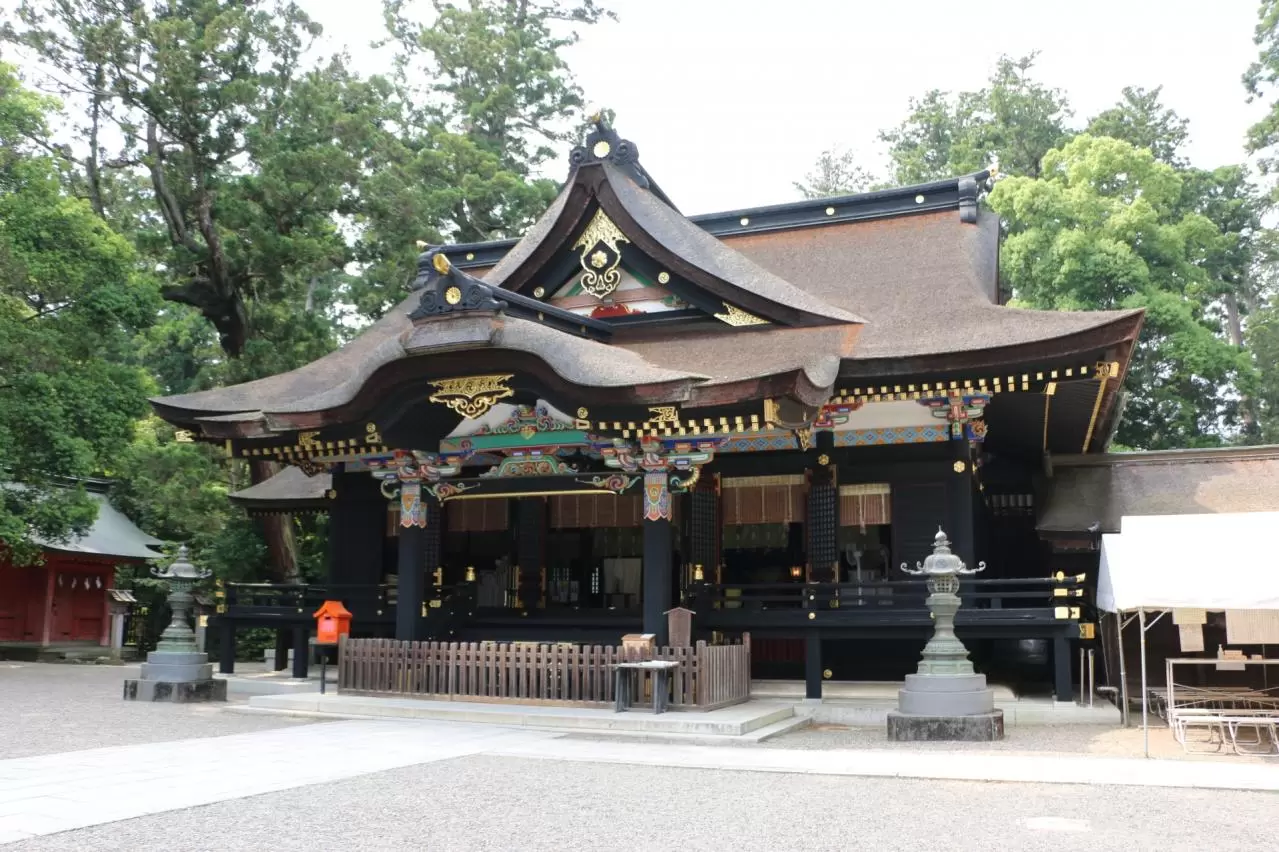
Rebuilt in 1700 by the Tokugawa shogunate, this cypress-bark-roofed nagare-zukuri shrine hall combines the beauty of unpainted wood with the elegance of the Genroku era, and stands as a representative example of shrine architecture in Japan.
■ Rōmon Gate (Important Cultural Property)
Also built in 1700, this vividly vermilion-lacquered, purely Japanese-style gate houses a shrine plaque painted by Admiral Togo Heihachiro and statues of attendant guardians (Takenouchi no Sukune and Fujiwara no Kamatari).
🌲 A Sacred Realm Where Nature and Faith Merge
Within the grounds spreads “Katori no Mori,” preserved since ancient times, creating a spiritual area where tranquility and sanctity coexist.
● Three-Cedared Tree
According to tradition, this tree split into three branches through the prayers of Minamoto no Yoriyoshi, and it is popular as a symbol of wish fulfillment.
● Kaname-ishi
A sacred stone said to pin down the tail of the great namazu that causes earthquakes, corresponding to the Kaname-ishi at Kashima Jingu, which is said to pin down the head of the same creature.
🎎 Festivals of Katori Jingu
■ Shinko-sai Festival (Every year on April 15)
A traditional event continuing for over 800 years, this graceful festival features a procession of about 200 local parishioners dressed in Heian-period attire.
■ Shikinen Shinko-sai Festival (Once every 12 years, in the Horse year)
The largest grand festival in Chiba Prefecture.
- a procession of several thousand parishioners
- a boat procession from Torii Riverside aboard the sacred boat along the Tone River
- a stay at the otabisho in Sawara
As a waterborne ritual, it boasts a splendor rarely seen anywhere in Japan.
💫 The Spread of Faith in Katori-Okami
The worship of Katori-Okami has also spread to shrines such as Kasuga Taisha in Nara and Shiogama Jinja in Miyagi, and is revered across Japan as a warrior and guardian deity. In modern times, it is supported by a wide range of people—from martial artists and fishermen to merchants, business owners, and families—as a deity of victory, safety, and guidance.
✨ Summary: A Special Shrine at the Center of Japan’s History, Martial Spirit, and Faith
Katori Jingu is a shrine of exceptional prestige and history in Japan, combining:
- a founding tradition rooted in Japanese mythology
- deep imperial reverence
- a symbol of martial virtue and national protection
- a treasure trove of national treasures and important cultural properties
- a sacred grove preserving ancient nature
- traditional festivals that have continued for more than a thousand years
It remains beloved by many as a special place where deep history and sanctity quietly resonate in the heart each time one visits.
Chiba Tourist Attractions
View List
Naritasan Shinshoji Temple
Naritasan Shinshoji Temple is located in Narita City, Chiba Prefecture, and is one of Japan's most prominent temples with a history of over 1,080 years. This temple ...

Nokogiriyama
Mount Nokogiri is a mountain rising approximately 330 meters high on the Boso Peninsula in Chiba Prefecture. Known since the Edo period through to the Showa era as a...

Mother Farm
Mother Farm is a tourist farm located in Kannon Mountain on the Boso Peninsula, offering stunning views of Tokyo Bay and Mount Fuji. The expansive grounds are home t...

Kamogawa Sea World
Kamogawa Sea World is an aquarium themed "Encounter with the World of the Sea," located on the Boso Peninsula. Inside the facility, 11,000 specimens of 800 species o...

Tokyo Disneyland
Tokyo Disneyland is a theme park based on Walt Disney's vision of "a place to bring happiness to people," where visitors of all ages can enjoy themselves. Opened in ...

Umihotaru Parking Area
Umihotaru Parking Area is located on the Tokyo Bay Aqua-Line, which connects Kawasaki City in Kanagawa Prefecture with Kisarazu City in Chiba Prefecture. It is built...

Shimizu Park
Shimizu Park is a nature-rich park located in Noda City, Chiba Prefecture. With the catchphrase "Friends with Nature," visitors can enjoy beautiful scenery throughou...

Tokyo German Village
Tokyo German Village is a nature-themed park located in Sodegaura City, Chiba Prefecture, covering a vast area of 270,000 tsubo. Since its opening in 2001, the beaut...