At the heart of Hakata Gion Yamakasa
Known as a key setting for the festival, the shrine offers a sense of Hakata’s lively spirit.
AI Summary
This is an AI-generated summary. Please check the official information for opening hours, fees, and closed days.
A beloved guardian shrine of Hakata, where you can experience the excitement of the Yamakasa festival and explore local history.
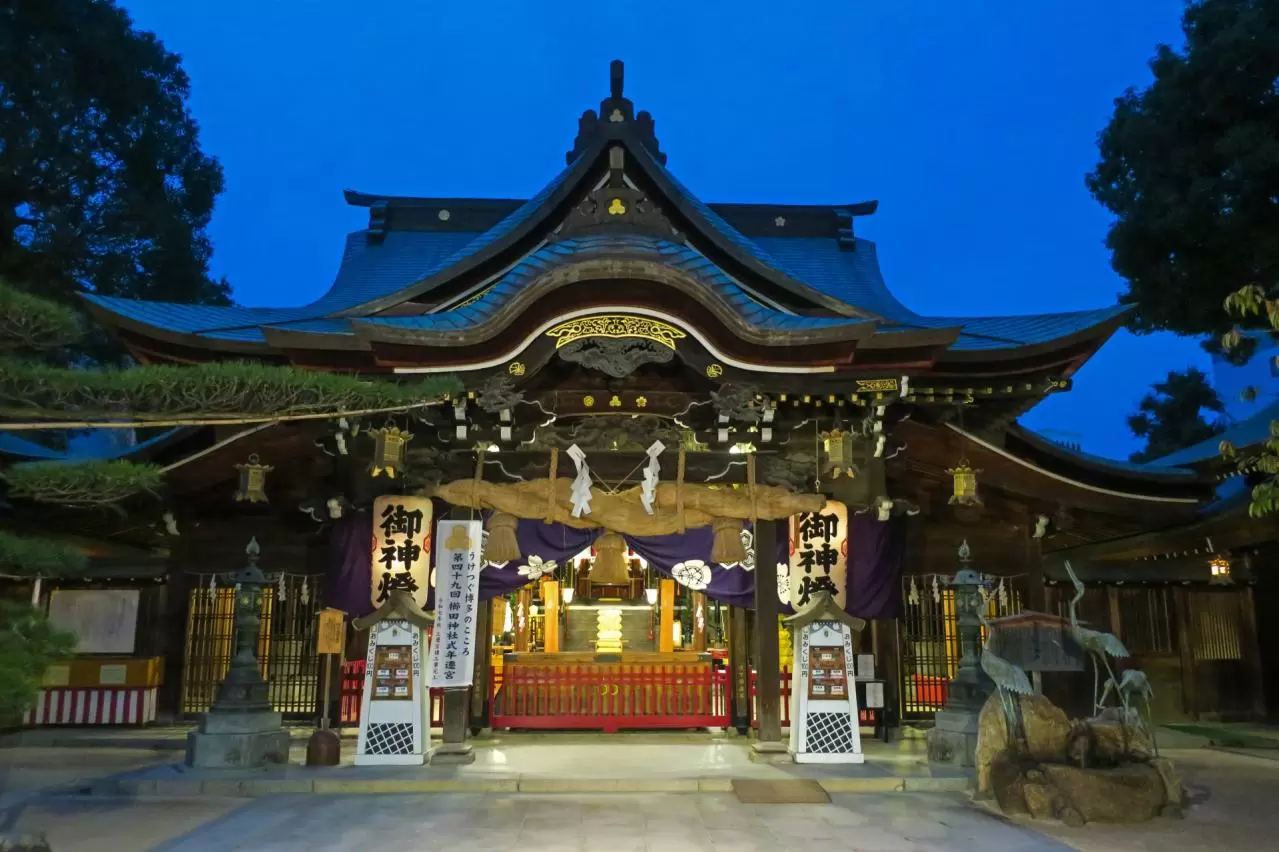
Known affectionately as “Okushida-san,” this shrine sits in the heart of Hakata. It is closely associated with the Hakata Gion Yamakasa festival, and highlights include the decorative festival float, a sacred ginkgo tree, and the Hakata Machiya Folk Museum. It’s a convenient stop for anyone hoping to experience Hakata’s culture in a short visit, as well as for worshippers.
Known as a key setting for the festival, the shrine offers a sense of Hakata’s lively spirit.
A richly detailed Yamakasa float is displayed on the grounds and makes a striking photo subject.
Discover quieter sights too, including the sacred ginkgo tree and traditional Hakata walls.
After paying your respects, see the decorative float, then visit the Hakata Machiya Folk Museum and explore the surrounding area if you have time.
Kushida Shrine is located in Kamikawabata-machi, Hakata Ward, Fukuoka City, Fukuoka Prefecture. As the chief guardian shrine of Hakata, it has been deeply revered for centuries. Affectionately known by locals as “Okushida-san,” it has long been cherished as a spiritual home for the people of Hakata. Closely connected with Hakata’s history, culture, and festivals, the shrine is now one of Fukuoka’s foremost attractions, drawing many worshippers and tourists from Japan and abroad.
According to shrine records, Kushida Shrine was founded in 757, during the reign of Emperor Koken, and is believed to have been established by inviting the deity from Kushida Shrine in Matsusaka, Ise Province. It has an exceptionally long history as Hakata’s chief guardian shrine, although it was repeatedly devastated by fires caused by warfare during the medieval period. Later, in 1587, Toyotomi Hideyoshi carried out the “Taiko Machiwari,” a project to reconstruct the war-damaged town of Hakata. It is said that he built and donated the shrine buildings that form the basis of the present-day shrine.
The deities enshrined here are Ohatanushi no Okami and Oto-wakago no Mikoto in Kushida-gu, the central sanctuary; Amaterasu Omikami in Daijingu, the left sanctuary; and Susanoo no Okami in Gion-gu, the right sanctuary. They are said to have originally been enshrined at separate shrines, and even today, three bells stand side by side in the worship hall. Since ancient times, the shrine has been deeply revered as a place of worship for prosperous business and longevity, and has been carefully protected by Hakata’s merchants and local residents.
Kushida Shrine is nationally known as the shrine where Hakata’s signature traditional event, the Hakata Gion Yamakasa Festival, is dedicated. Said to have originated in 1241, Hakata Gion Yamakasa is a historic festival designated as an Important Intangible Folk Cultural Property of Japan. In 2016, it was also registered as a UNESCO Intangible Cultural Heritage event as part of the “山・鉾・屋台行事” (Yama, Hoko, and Yatai float festivals).
Hakata Gion Yamakasa takes place every year from July 1 to 15. During Oiyamanarashi, the festival’s climax, held early in the morning on July 15, the kaki-yama floats carried by the various participating groups enter the grounds of Kushida Shrine at full speed. In an event known as the Kushida-iri, they race around the Seido flags before speeding onward. The powerful sight of men carrying the heavy floats and running at full strength is truly thrilling, and large crowds gather along the streets and around the shrine grounds to witness it.
A huge and lavishly decorated kazari-yama float is also permanently displayed on the shrine grounds outside the festival season. Adorned with colorful figures and intricate decorations, the float offers visitors a close look at Hakata’s traditional culture and the craftsmanship of its artisans. A new float is created each year, but it may not be available for viewing around June, when preparations are underway for its replacement and construction. Since visitors can experience the magnificence of the yamakasa floats even outside the festival period, it is one of Kushida Shrine’s most popular photography spots.
The shrine grounds contain many sites of historical and cultural interest. Among the most notable is the sacred tree known as the “Ginnan of Kushida,” a ginkgo tree designated as a natural monument by Fukuoka Prefecture and said to be around 1,000 years old. Its exact age is unknown, but it has been revered as the sacred tree of Kushida Shrine for many centuries. Considered a symbol of longevity and prolonged life, it is mentioned in Hakata’s celebratory song “Iwai Medeta,” which includes the line, “What a magnificent Kushida ginkgo.” In autumn, its leaves turn golden, beautifully coloring the shrine grounds.
The “Meoto Ginnan,” or “husband-and-wife ginkgo,” is another notable tree on the grounds. Of its three massive trunks, one is a female tree that bears fruit in autumn. Because of its appearance, it is revered as a sacred tree associated with marital harmony, finding a good match, and the prosperity of descendants. Together with the ancient Kushida ginkgo, it is one of the shrine’s most distinctive natural attractions.
Hanging from the ceiling of the tower gate is an astrological direction board called the Eto Eho Ban, which indicates the year’s favorable direction. The board depicts the twelve zodiac signs, and an arrow in the center points toward the auspicious direction for that year. Every New Year’s Eve, the arrow is moved to indicate the favorable direction for the coming year. Visitors should look up to check it when passing through the tower gate, as it is a unique feature of Kushida Shrine.
Wooden carvings of the gods of wind and thunder are displayed on the gable of the worship hall. The Wind God appears to be making the playful “akkanbe” gesture—a gesture in which one pulls down the lower eyelid toward the Thunder God. This humorous carving is said to express the cheerful and playful character of the people of Hakata. Such a friendly touch amid the solemn shrine buildings is another of Kushida Shrine’s charms.
The Reissen Tsuru no Ido, or “Sacred Crane Well,” on the shrine grounds has long been revered as a miraculous spring associated with longevity. In the past, it was said that drinking its water would ensure a long life, but it is no longer available for drinking. It remains one of Kushida Shrine’s best-known attractions.
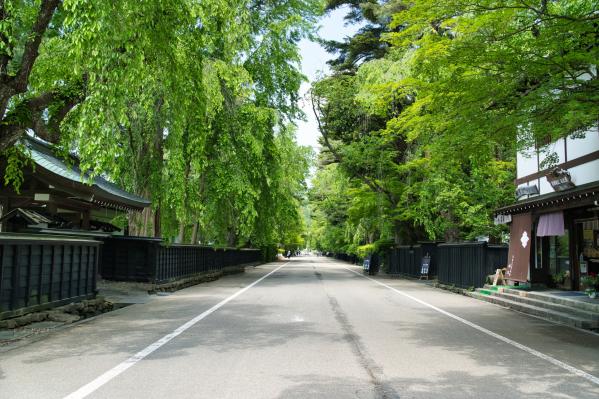
The shrine grounds are also home to a section of Hakata-bei, earthen walls that convey the appearance of the town after its reconstruction by Toyotomi Hideyoshi. Hakata-bei were built by embedding stones and roof tiles burned during warfare into clay. The section preserved at Kushida Shrine is said to have been relocated and reconstructed from a Hakata-bei wall that once stood at the residence of Shimai Soshitsu, a wealthy Hakata merchant. It continues to tell the story of Hakata’s revival as the town transitioned from the Warring States period into the early modern era.
The grounds also feature chikara-ishi, or “strength stones,” which reflect the shrine’s history of hosting sumo wrestling. A number of stones are displayed that famous wrestlers from past generations lifted and dedicated as proof of their strength. New strength stones have also been dedicated by sumo wrestlers in recent years. Near the base of the sacred tree are two Mongol anchor stones, which are associated with the Mongol invasions of Japan. They have been designated archaeological materials by Fukuoka Prefecture.
The Hakata Historical Museum on the shrine grounds houses and displays valuable materials passed down by Kushida Shrine. Visitors can learn more about Hakata’s history and culture through historically and folklorically significant items, including a vermilion-seal letter issued by Toyotomi Hideyoshi, old masks associated with the Hakata Matsubayashi festival, and ancient documents. Kushida Shrine also has a history of establishing the Kushida Bunko library in 1818, and it has long maintained a close connection with local culture and scholarship. Since exhibits and opening days may change, visitors are advised to check the latest information before visiting.
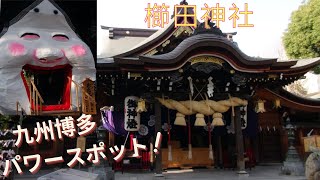
In addition to Hakata Gion Yamakasa, Kushida Shrine hosts a variety of festivals and events throughout the year. During the Setsubun Grand Festival held every February, a huge otahuku mask is installed at one of the shrine gates. Worshippers pass through the mask’s widely open mouth while praying for good health and good fortune. Bean-throwing ceremonies featuring celebrities and other guests are also held, making this one of Hakata’s most popular winter traditions and attracting many visitors.
The Hakata Okunchi festival takes place in late October. It is an autumn festival held to express gratitude for a bountiful harvest. Depending on the year, a mikoshi portable shrine pulled by an ox-drawn cart and a procession of children in ceremonial dress may travel through the streets of Hakata. The colorful procession moving through the town is a beloved traditional event that adds vibrancy to Hakata’s autumn.
After visiting the shrine, it is also recommended to stop by Kushida Chaya near the shrine’s south gate. Its signature treat, Kushida no Yakimochi, is made by wrapping sweet bean paste in mochi dough and grilling it until fragrant and lightly browned. Visitors can enjoy its freshly baked aroma and soft texture, making it a quintessential Hakata delicacy and a perfect snack during a stroll or a memorable treat after worshipping at the shrine.
The area surrounding Kushida Shrine is home to many attractions where visitors can enjoy Hakata’s history, culture, and shopping, including the Hakata Machiya Furusatokan Museum, Canal City Hakata, and Kawabata Shopping Arcade. The shrine is also close to Kushida Shrine Station on the Fukuoka City Subway Nanakuma Line, making it easily accessible from Hakata Station and the Tenjin area. Exploring the surrounding neighborhood together with a visit to the shrine allows visitors to experience both Hakata’s traditional streetscapes and the appeal of its modern city.
Kushida Shrine is a special place that preserves the history and culture of Hakata, its festivals, its development as a town of merchants, and the daily lives of its people. With its historic shrine buildings, magnificent kazari-yama float, Kushida ginkgo, Hakata-bei walls, and Hakata Historical Museum, the shrine offers an abundance of things to see. Taking time to explore the grounds provides a deeper understanding of the town of Hakata. More than simply the setting for the Hakata Gion Yamakasa Festival, it is one of the essential destinations to visit in Fukuoka for anyone wishing to experience the spirit of Hakata throughout the year.
Nokonoshima is a small, eggplant-shaped island just 10 minutes by ferry from Meihama Ferry Terminal in Fukuoka City. It is rich in nature, offering activities such a...
The Kyushu National Museum is the fourth national museum in Japan, following those in Tokyo, Kyoto, and Nara. It opened in 2005 in Dazaifu City, Fukuoka Prefecture. ...
Fukuoka Tower reopened entirely on February 1, 2019, and stands at an impressive height of 234 meters, making it the tallest seaside tower in Japan. It serves as a s...
The Senbutsu Cave is a magnificent cave located in Hiraodai, Kitakyushu, and it has been designated as a national natural monument. This cave was formed by the erosi...
In July 2020, "BOSS E・ZO FUKUOKA" opened next to the Fukuoka PayPay Dome. This seven-story facility is known for its breathtaking attractions and state-of-the-art e...
Moji Port Retro is an attractive district in Kitakyushu City. This port town, which flourished from the Meiji era to the early Showa period, was once counted among J...
Canal City Hakata opened in 1996 with the concept of "Theater of the City" and has become Japan's first full-scale commercial complex that creates a new flow of peop...
Dazaifu Tenmangu is a shrine dedicated to Sugawara no Michizane, the god of learning, and is known as the head shrine among approximately 12,000 Tenmangu shrines nat...